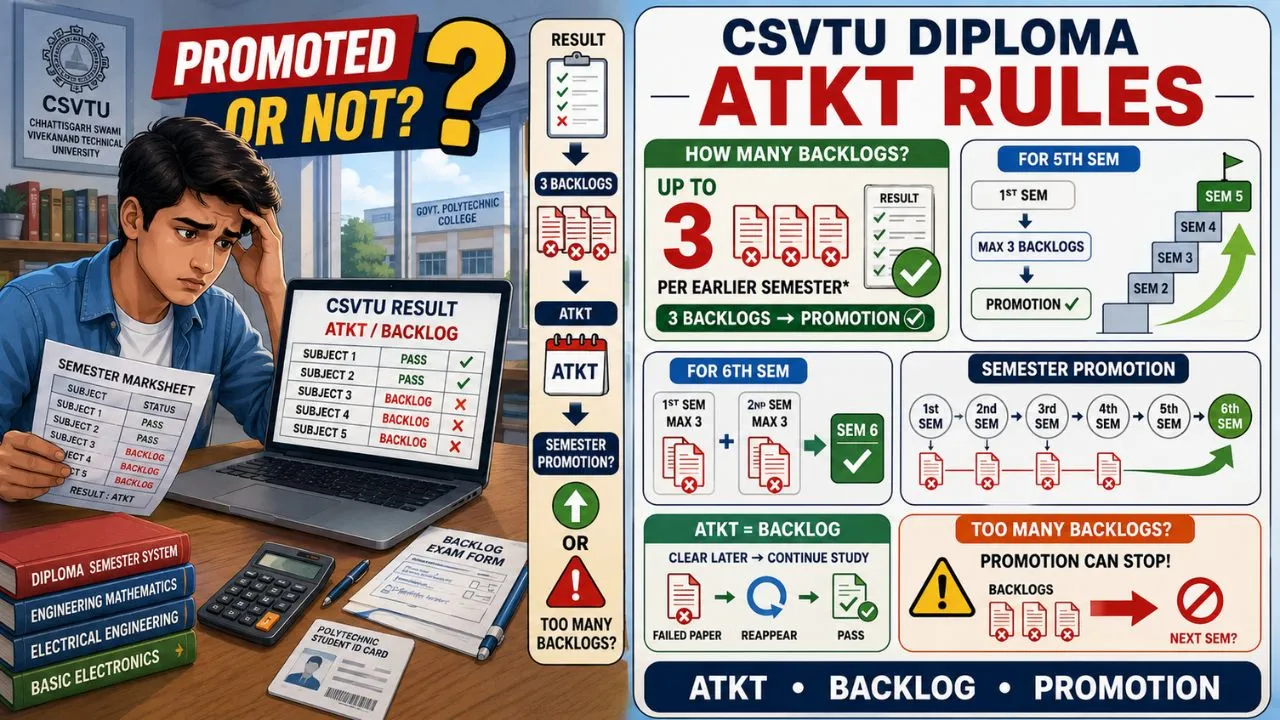
Getting a backlog in a diploma semester does not always mean repeating the entire year. Under the CSVTU diploma system, students can continue their studies in certain situations through ATKT, commonly understood as Allowed to Keep Terms.
The confusion usually starts when a student has failed one or more subjects and wants to know whether admission to the next semester will still be allowed. Questions become even more important before entering the fifth semester because promotion rules can depend on whether earlier semester requirements have been cleared.
CSVTU Diploma ATKT rules are linked with the applicable diploma scheme, credits, examination regulations and promotion conditions. Students studying under different schemes should therefore check the regulations applicable to their batch rather than relying on an old senior’s result.
Table of Contents
What Is ATKT in CSVTU Diploma?
ATKT allows an eligible student to continue to the next semester even when some subjects from an earlier semester remain uncleared. Suppose a student passes most subjects in Semester 2 but receives a backlog in one paper. If the applicable promotion rules permit that carryover, the student does not necessarily have to repeat the whole semester. The failed paper can be attempted again through a subsequent examination.
This failed subject remains a backlog until the student satisfies its passing requirements. ATKT should not be confused with passing the semester. A student promoted with ATKT still has to clear the pending subjects before completing the diploma. The exact promotion decision depends on the curriculum scheme and academic regulations applicable to that admission batch.
How the Credit-Based Diploma System Affects ATKT
CSVTU diploma programmes follow prescribed curriculum structures in which subjects carry defined credits and assessment components. This means promotion cannot always be understood simply by counting the number of failed subjects.
Two students with the same number of backlogs may not necessarily have identical academic status if their applicable scheme, semester requirements or credits are different. This is one reason students should be careful with statements such as “three backlogs are always allowed” or “four subjects automatically cause a year back.” The correct answer has to come from the promotion provisions of the scheme under which the student is registered.
NITTTR-based curriculum structures used for diploma education also divide learning into theory, practical, laboratory, project and other components. Each component can have its own assessment and passing requirements.
How Many Backlogs Are Allowed for Semester Promotion?
This is the question most CSVTU diploma students want answered, but treating it as one universal number can be misleading. Semester-to-semester continuation and promotion to a higher year are not necessarily decided by a simple fixed backlog count applicable to every batch.
A student may be permitted to study in the next semester while carrying pending papers, provided the conditions prescribed under the applicable CSVTU scheme are satisfied. The critical stage is progression into the final year. Before entering Semester 5, students need to pay particular attention to pending subjects from the first year, meaning Semester 1 and Semester 2.
Depending on the applicable regulation, earlier semester deficiencies can affect eligibility for further progression even when the student has been attending subsequent semesters normally.
Therefore, if you currently have first-year backlogs, do not wait until the fourth semester result to investigate your status. Check the scheme applicable to your enrollment year and confirm the current promotion requirement through your institute’s examination section.
Understanding the Year Back Rule
A Year Back, commonly shown or discussed as YB, is more serious than an ordinary ATKT. ATKT means the student is allowed to continue while carrying eligible pending academic requirements. A year back means the student does not satisfy the conditions required for progression to the relevant higher stage.
The first-year-to-final-year transition is particularly important. For example, imagine a student reaches the end of Semester 4 but still has uncleared subjects from Semester 1 or Semester 2.
Whether that student can enter Semester 5 depends on the promotion regulations applicable to the student’s scheme and batch. This is why first-year backlogs should receive priority.
A recent Semester 4 backlog may appear more worrying, but an old Semester 1 or Semester 2 carryover can create a bigger progression problem if the rules require earlier academic requirements to be cleared before final-year admission.
Students should plan backlog attempts according to progression importance, not merely according to which subject was failed most recently.
Internal Assessment and ESE Backlogs Are Different
A diploma subject is not always evaluated through one examination alone. Depending on the subject and scheme, assessment can include Class Tests (CT), Teacher’s Assessment (TA), practical work and End Semester Examination (ESE). The passing conditions attached to these components matter.
If a student performs poorly in an internal component, simply scoring well in the university examination may not always resolve the deficiency if separate minimum requirements apply. Similarly, good internal marks cannot automatically compensate for failure in an ESE where the scheme requires a separate passing standard.
This distinction becomes important when checking a result. Do not look only at the overall marks and conclude that the subject is cleared. Check which component has been marked unsuccessful.
What Happens If You Fail the End Semester Examination?
An ESE backlog generally means the student needs another eligible attempt in that examination component. The subject remains pending until its prescribed passing conditions are satisfied.
Students should watch the examination schedule and backlog examination form notifications carefully. Missing an available attempt can unnecessarily extend the period for which the subject remains pending.
This becomes especially risky when an old backlog approaches an important promotion stage. For example, a student with a first-year ESE backlog should use available attempts seriously instead of assuming it can be cleared at any point before graduation.
The academic consequences can arrive earlier through promotion rules.
What If CT or Teacher’s Assessment Is Not Cleared?
Internal assessment deficiencies need to be handled differently from a normal university theory back paper. CT and TA are connected with internal academic evaluation by the institution. Practical, sessional and other internal components can also have separate requirements.
If your marksheet shows a deficiency in an internal component, contact the department or examination section first.
Do not assume that filling a standard ESE backlog form will automatically clear an internal deficiency. The procedure can depend on the nature of the component, applicable curriculum and instructions issued by the institute or university.
Students should identify exactly what is pending before paying any examination fee.
Revaluation After a Diploma Backlog
A student who receives unexpectedly low marks in a theory examination may consider the post-result options made available by CSVTU.
The terminology and facility offered can depend on the examination notification. Students should therefore read the current notice for revaluation, rechecking or other permitted result-review processes.
Revaluation should not be treated as a guaranteed method of converting a fail into a pass.
Apply when there is a genuine reason to believe the evaluated marks may not reflect the attempted paper.
More importantly, do not ignore the next backlog examination while waiting for a favourable result unless university instructions clearly resolve the situation.
A safer academic plan is to prepare for the next available attempt until the revised result officially shows the subject as passed.
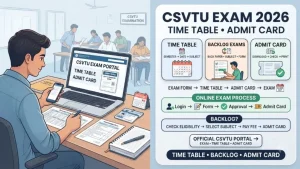
How to Fill the CSVTU Backlog Examination Form
CSVTU examination-related services are increasingly handled through its designated online systems, while colleges also play a role in verification and submission.
The exact interface can change, so students should follow the examination notice issued for their session.
The usual process begins by checking the current examination notification and identifying the subjects shown as pending.
Log in through the portal specified by CSVTU or your institution for that examination cycle.
Select the applicable examination form and carefully verify the backlog subjects.
Check subject codes instead of relying only on subject names. Curriculum revisions can make similar-looking subjects confusing across different schemes.
Complete the required details, pay the prescribed examination fee and save the acknowledgement or payment receipt.
After submission, check whether institute-level verification is required.
Finally, download the admit card when released and confirm that every intended backlog paper appears correctly.
Any mismatch should be reported to the college examination section before the examination.
A Practical Backlog Clearing Strategy
The worst approach is to collect old backlogs while concentrating only on the current semester. Instead, separate pending papers according to their academic importance. Start with Semester 1 and Semester 2 subjects because older deficiencies can become relevant when approaching Semester 5.
Next, identify subjects that are prerequisites or particularly difficult to clear without regular practice. Prepare them alongside the current semester rather than starting a few days before the back examination. For numerical branches such as Mechanical, Civil and Electrical Engineering, repeated problem-solving is usually more useful than reading solutions repeatedly.
For theory-heavy papers, prepare answers according to syllabus units and previous examination patterns. Keep one written record containing the subject name, code, semester, failed component and next examination attempt. This simple habit prevents confusion when multiple carryovers exist.
Can You Complete the Diploma With Backlogs?
A student can progress through parts of the programme with permitted carryovers, but pending academic requirements cannot simply be ignored at the end. To receive the final diploma, the candidate ultimately has to satisfy the passing and credit requirements prescribed for the programme. Reaching Semester 6 is therefore not the same as completing the diploma.
An uncleared paper can delay final completion even after regular classes have ended. This can create practical problems when applying for jobs, apprenticeships or lateral-entry admission because employers and institutions may ask for proof of diploma completion. Clearing backlogs as early as possible is therefore much better than planning to handle everything after the final semester.
Do Not Depend on Old ATKT Rules
CSVTU students frequently obtain ATKT information from seniors, WhatsApp groups, YouTube videos or old notices. These can provide an initial idea, but they should not be treated as the final authority. A senior may have studied under a different curriculum scheme. Promotion rules, examination systems and terminology can also change between batches.
Before deciding whether you are eligible for Semester 5 or whether a particular backlog will cause YB, identify your admission batch and applicable scheme. Then confirm the rule through the current CSVTU examination regulations or your college examination section. This is especially important when the decision affects semester admission.
Final Words
The CSVTU Diploma ATKT system gives eligible students an opportunity to continue their studies while clearing permitted pending subjects, but ATKT should never be treated as permission to leave backlogs until the end. Semester 1 and Semester 2 carryovers deserve special attention as students move towards Semester 5. The exact promotion status depends on the academic scheme, credits and regulations applicable to the student’s batch rather than an assumed universal backlog number.
Students should also distinguish between CT, TA, practical and ESE deficiencies because the method of clearing each component may differ. After receiving a backlog, check the result carefully, consider the available revaluation process when justified, fill the next eligible examination form on time and prepare for the paper without waiting for the final year.