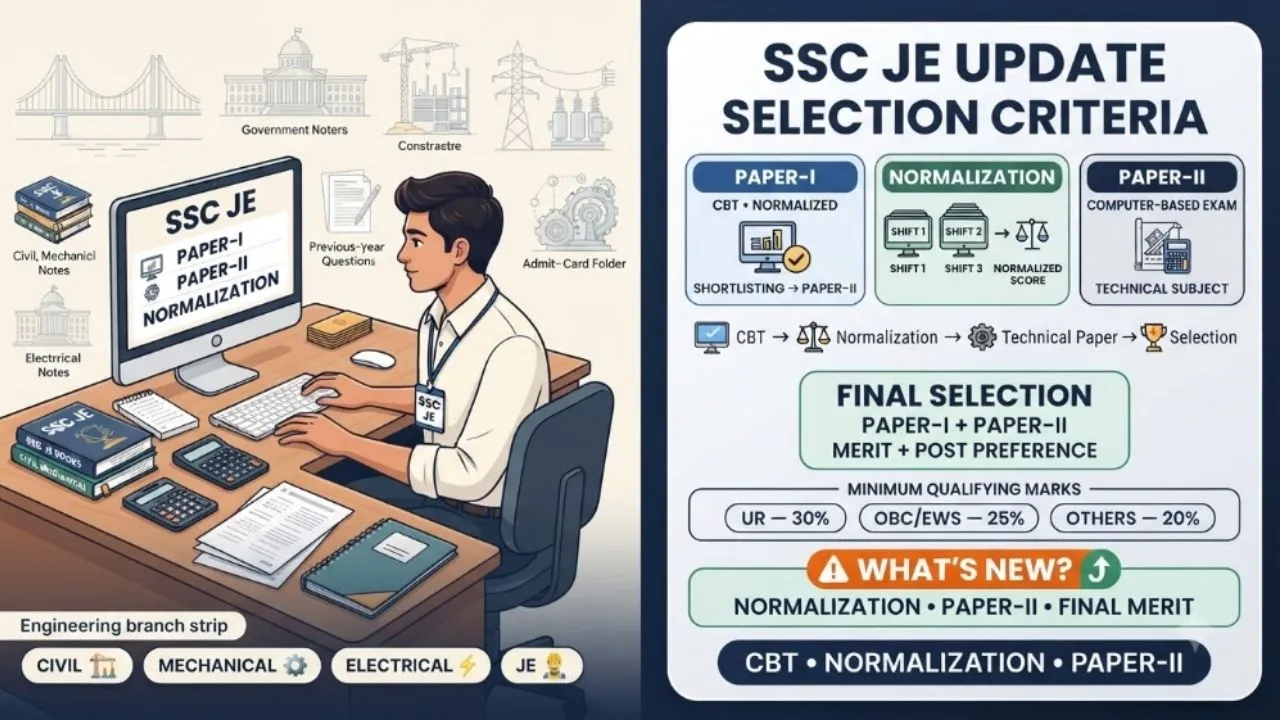
The SSC Junior Engineer examination has changed significantly in recent years, especially in the structure of Paper-II and the way marks are used for selection. For diploma and engineering graduates preparing for SSC JE 2026, understanding the selection criteria is just as important as completing the syllabus.
One important clarification comes first: SSC JE officially refers to the two stages as Paper-I and Paper-II, rather than Tier-I and Tier-II. Many students still use the term “Tier-2” for Paper-II, so both terms are commonly seen in preparation material.
The selection process currently revolves around a Computer-Based Paper-I followed by a technical Paper-II. Normalization becomes relevant when an examination is conducted in multiple shifts.
Table of Contents
SSC JE Selection Process 2026
The SSC JE selection process has two computer-based examination stages. Paper-I is the first screening stage. It tests General Intelligence and Reasoning, General Awareness and General Engineering from the candidate’s selected discipline.
Candidates who meet the required qualifying standard and the applicable cutoff are shortlisted for Paper-II. Paper-II focuses entirely on technical knowledge. Candidates appear in the engineering discipline selected during the application process.
The final selection is then made according to the rules specified in the applicable examination notice, along with category, vacancies and post preferences. This makes Paper-II particularly important for candidates aiming for a strong final position.
Is CBT-1 Weightage Changing in SSC JE?
The phrase “CBT-1 weightage” can create confusion because SSC JE does not use the same Tier-I and Tier-II terminology found in examinations such as SSC CGL. Paper-I carries 200 marks, while Paper-II carries 300 marks under the recent SSC JE examination structure.
Therefore, when both papers contribute to final merit, Paper-II naturally has a larger numerical share of the total marks. The combined maximum becomes 500 marks, with Paper-I contributing 200 marks and Paper-II contributing 300 marks.
In percentage terms, Paper-I represents 40% of the combined maximum, while Paper-II represents 60%. However, candidates should not treat this simply as a fixed “40% versus 60% formula” unless the 2026 notification confirms the same final-merit arrangement.
SSC can modify examination rules through a new notice. The safest approach is to follow the latest SSC JE notification issued for the relevant recruitment cycle.
SSC JE Paper-I Pattern
Paper-I is conducted through a computer-based examination. The recent pattern contains three sections. General Intelligence and Reasoning carries 50 questions for 50 marks.
General Awareness carries another 50 questions for 50 marks. General Engineering carries 100 questions for 100 marks. This brings Paper-I to 200 questions and 200 marks.
Candidates answer the General Engineering section according to their discipline, such as Civil and Structural Engineering, Electrical Engineering or Mechanical Engineering. The examination duration is generally two hours, subject to applicable provisions for candidates eligible for additional time.
Paper-I also has negative marking. Under the recent pattern, 0.25 marks are deducted for every incorrect response. That makes accuracy important, particularly when attempting questions where the answer is uncertain.
What Happens After Paper-I?
Paper-I is not simply a practice test for Paper-II. Candidates first need to cross the applicable minimum qualifying standard and the examination cutoff used for shortlisting. The minimum qualifying percentages specified in recent SSC JE rules have been:
30% for UR candidates, 25% for OBC/EWS candidates and 20% for other categories.
These are minimum qualifying standards, not guaranteed selection marks. The actual cutoff can be considerably higher because it depends on vacancies, candidate performance, discipline, category and competition. For example, the SSC JE 2025 Paper-I result showed different category-wise cutoffs for Civil, Electrical and Mechanical candidates.
This demonstrates why merely scoring above the minimum qualifying percentage is not enough. Candidates should prepare for a competitive cutoff rather than targeting only the qualifying percentage.
SSC JE Normalization Rules Explained
Normalization becomes important when candidates take a computer-based examination in multiple shifts. Different shifts can have slightly different levels of difficulty. One shift might contain comparatively easier questions, while another could include more difficult questions.
Comparing raw marks directly in such a situation may not provide a completely fair basis for ranking candidates. SSC therefore uses its prescribed normalization procedure for examinations conducted in multiple shifts.
The normalized score can be used for determining cutoffs and shortlisting, according to the rules applicable to the examination. This means your raw score and the final score used by SSC may not always be identical.
A candidate should therefore avoid calculating a final rank solely from the number of correct and incorrect answers. The official result and marks released by SSC remain the final reference.
Why Normalization Matters for SSC JE Aspirants
Normalization can have a noticeable effect when candidates are separated by only a few marks. Suppose two candidates have similar raw scores but appeared in different shifts. Their final normalized scores may differ after SSC applies its prescribed statistical process.
This is why shift-wise comparisons seen on social media should be treated cautiously. Coaching institutes may publish expected cutoffs after the examination, but those figures are estimates. The actual cutoff is determined by SSC after processing the examination data. Candidates should focus on maximizing their own score instead of trying to predict how a particular shift will be treated.
SSC JE Paper-II Pattern Changes
Paper-II has undergone one of the most important changes in the SSC JE examination structure. Earlier SSC JE cycles used a descriptive Paper-II format. The newer structure introduced a Computer-Based Test for Paper-II, making the second stage objective in nature.
Under the recent pattern, Paper-II contains 100 technical questions carrying a total of 300 marks. Each question carries three marks. The paper is based entirely on the candidate’s selected engineering discipline. Civil candidates attempt Civil and Structural Engineering.
Electrical candidates attempt Electrical Engineering. Mechanical candidates attempt Mechanical Engineering. There is no separate General Awareness or Reasoning section in Paper-II. The focus is on deeper technical understanding.
Paper-II Negative Marking
The negative marking in Paper-II is more significant than in Paper-I. Under the recent pattern, one mark is deducted for each incorrect response. Since every correct answer carries three marks, candidates need to balance speed and accuracy carefully.
Random guessing can become expensive in this paper. A candidate who attempts fewer questions with strong accuracy can sometimes perform better than someone who attempts almost everything without sufficient confidence. Technical preparation should therefore focus on concepts, numerical practice and repeated revision.
Why Paper-II Matters More for Technical Candidates
Paper-I contains General Intelligence, General Awareness and basic technical questions. Paper-II goes much deeper into the selected engineering discipline. For Civil Engineering candidates, preparation covers areas such as structural concepts, soil mechanics, surveying, hydraulics, transportation and construction-related subjects.
Mechanical candidates need strong command over subjects such as strength of materials, theory of machines, thermodynamics, fluid mechanics, production and industrial engineering. Electrical candidates need to prepare areas including electrical circuits, machines, measurements, power systems and related engineering concepts. This technical depth makes Paper-II a major differentiator during the selection process.
Paper-I vs Paper-II: How Preparation Should Change
Many candidates spend too much time trying to maximize Paper-I while leaving technical preparation for later. That approach can create problems.
Paper-I is essential because candidates cannot reach the next stage without qualifying and clearing the relevant cutoff. At the same time, Paper-II requires deeper preparation because it carries more marks under the recent examination pattern.
A balanced strategy works better. During the early preparation stage, candidates can build technical fundamentals while gradually covering reasoning and general awareness. Closer to Paper-I, speed-based practice becomes more important. After Paper-I, preparation should become heavily focused on the technical subjects required for Paper-II.
Does Paper-I Score Affect Final Selection?
This is one of the most important points candidates need to verify in the latest SSC JE notification. Under the recent SSC JE structure, the Commission has used performance in Paper-I to shortlist candidates for Paper-II, while final selection has been governed by the applicable rules concerning both papers.
Therefore, candidates should not rely on social-media claims that Paper-I has suddenly become completely irrelevant or that only Paper-II determines selection. The exact wording of the current recruitment notice takes priority. For SSC JE 2026, candidates should check the final notification before making assumptions about final merit, normalization and paper-wise contribution.
What Candidates Should Do Differently for SSC JE 2026
The first priority should be understanding the latest notification rather than following an old preparation strategy. Candidates should download the current syllabus and examination scheme once SSC releases the applicable notice.
The second priority is technical preparation. Choose one discipline and develop strong command over its core subjects. The third priority is mock-test practice. Paper-I requires speed because 200 questions have to be handled within a limited time. Paper-II requires technical accuracy because the questions carry higher marks and incorrect answers attract a larger penalty. Previous-year papers are particularly useful because they show the level and style of questions asked in the examination.
Final Words
The SSC JE selection process has become more technically focused with the introduction of an objective Computer-Based Paper-II. Paper-I remains an important screening stage, while Paper-II carries greater marks under the recent examination structure.
Normalization also plays an important role when an examination is conducted in multiple shifts, so raw marks should not be treated as the final score. Candidates preparing for SSC JE 2026 should also remember that SSC officially calls the stages Paper-I and Paper-II, even though many aspirants refer to them as CBT-1 and Tier-2.
The most reliable strategy is simple: prepare Paper-I seriously enough to clear the cutoff comfortably, then build the technical depth needed to perform strongly in Paper-II. Above all, follow the latest SSC notification for the final selection criteria, paper-wise weightage and normalization rules because these conditions can be revised from one recruitment cycle to another.