For diploma holders, the Merchant Navy offers a different career path from conventional engineering jobs. Technical work on ships can provide international exposure, structured training and the opportunity to build a career at sea.
However, entering the Merchant Navy is not simply a matter of completing a diploma and joining a ship. Candidates have to meet maritime education requirements, medical standards, safety-training requirements and, for some routes, company sponsorship or selection conditions.
For students from diploma backgrounds, the two routes that often create confusion are GP Rating and Diploma in Marine Engineering, commonly referred to as DME.
The right route depends mainly on the diploma discipline, academic performance, career objective and whether the candidate wants to work in the deck department or engine department.
Table of Contents
Merchant Navy Roles for Diploma Holders
Merchant ships have two major operational sides: the deck department and the engine department.
The deck department deals with navigation, cargo operations, ship handling, safety and related activities. The engine department manages propulsion machinery, electrical and mechanical equipment, maintenance and engine-room operations.
A diploma holder interested in technical machinery generally looks towards the engine department.
Candidates without the specific engineering background required for officer-level marine engineering routes may consider rating-level courses such as GP Rating, subject to the current eligibility rules.
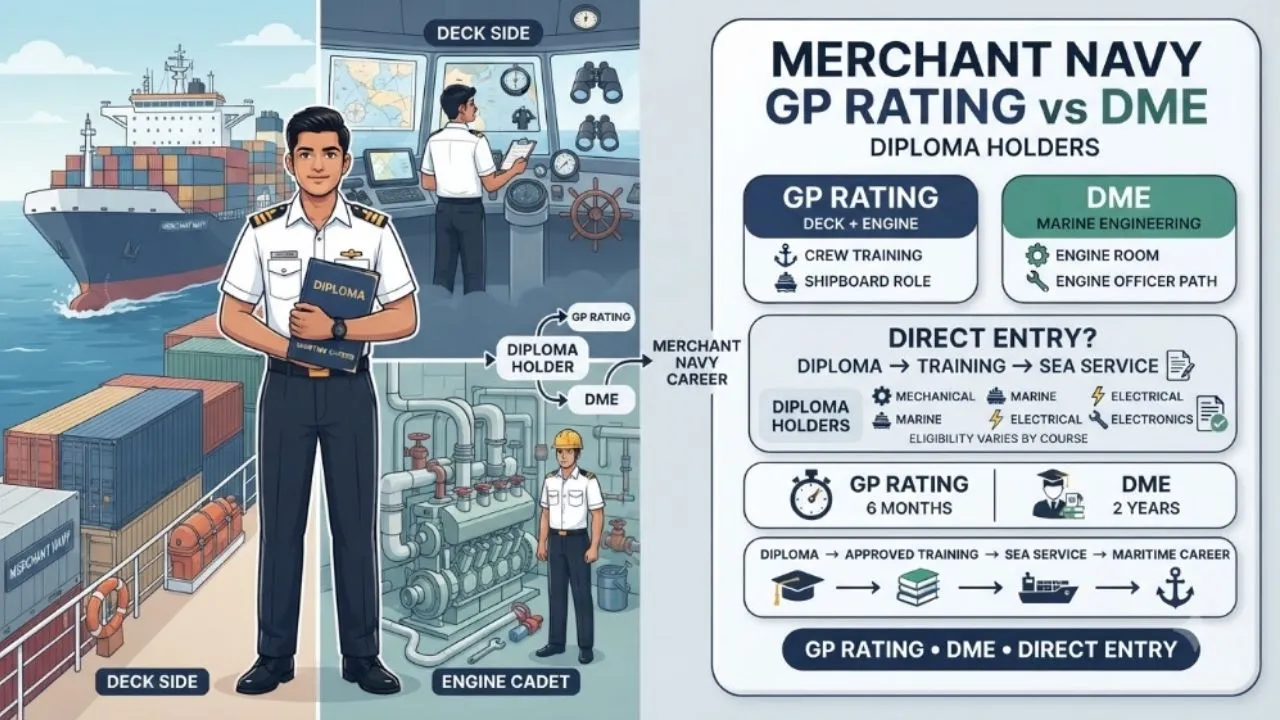
The Directorate General of Shipping, or DG Shipping, recognises both the six-month GP Rating course and the two-year Marine Engineering course for diploma holders as approved pre-sea training categories.
This distinction is important because GP Rating and DME do not lead to the same professional position.
What Is GP Rating?
GP Rating stands for General Purpose Rating.
It is a pre-sea training route designed for candidates seeking rating-level work onboard merchant ships.
The course generally covers basic deck and engine-room duties, seamanship, safety procedures, maintenance activities and other practical maritime skills.
A GP Rating trainee does not enter the ship as a marine engineer officer.
The role is closer to operational and technical support within the ship’s crew structure.
For candidates interested in hands-on work and an earlier entry into seafaring, GP Rating can be a possible route.
Recent DG Shipping policy changes have also placed greater emphasis on candidates with relevant technical qualifications for GP Rating training. From April 1, 2026, revised provisions included additional qualification categories for some GP Rating seats, including certain diploma and ITI backgrounds.
Because maritime rules can change, candidates should check the latest DG Shipping eligibility requirements before selecting an institute.
What Is DME for Diploma Holders?
DME refers to the two-year Marine Engineering course for diploma holders.
This route is more specialised than GP Rating because it is designed around marine engineering and the eventual progression towards engineering officer certification.
DG Shipping lists the two-year DME course as a pre-sea course for diploma holders.
The eligibility requirements are specific and should be checked carefully before admission.
A diploma in Mechanical Engineering is particularly relevant to marine engineering pathways. Other engineering diploma disciplines may be considered only where the current DG Shipping rules specifically permit them.
This is one reason students should not rely on advertisements that simply state “any diploma can join Merchant Navy.”
The exact diploma branch, marks, English qualification, age, medical fitness and other conditions can affect eligibility.
DME vs GP Rating: Which Route Is Better?
The answer depends on the type of career a candidate wants.
GP Rating is a shorter pre-sea course and leads towards rating-level responsibilities.
DME is a longer specialised marine engineering pathway for eligible diploma holders who want to progress in the engine department.
A candidate targeting a technical officer career should examine DME and other approved engineering pathways rather than choosing GP Rating simply because it is shorter.
A candidate who wants an entry-level seafaring role and meets the relevant rating requirements may find GP Rating more suitable.
The two courses should therefore not be compared only on duration.
Career progression, certification, training requirements, responsibilities and long-term goals matter more.
Can Diploma Holders Enter Marine Engineering Directly?
Diploma holders can have routes into marine engineering education, but “direct entry” needs to be understood correctly.
A three-year diploma does not normally mean immediate appointment as a Marine Engineer Officer.
The candidate has to complete the approved training pathway and meet the competency requirements prescribed for seafarers.
DG Shipping has recognised diploma-based pathways into marine engineering education, including routes where eligible diploma holders can enter a marine engineering degree programme at an advanced stage. The eligibility includes specific engineering diploma disciplines and minimum marks.
The DME route is another approved pathway specifically designed for diploma holders.
Therefore, students should distinguish between direct admission to a maritime training course and direct employment as an officer.
The former may be possible when eligibility requirements are satisfied. The latter requires the necessary sea service, examinations, competency certification and other regulatory conditions.
DG Shipping Approved Medical Standards
Medical fitness is one of the most important requirements for anyone planning a Merchant Navy career.
Candidates should complete their medical examination through a doctor or medical facility authorised under the applicable DG Shipping system.
Medical fitness is not simply a routine college admission requirement.
Seafarers need to be physically and medically capable of performing duties in an environment where emergency situations can occur far from shore.
Vision, hearing, general physical fitness and other medical parameters can be assessed.
The applicable standards can differ according to the nature of the role and current regulatory requirements.
Candidates should complete the required medical assessment before spending substantial money on maritime training.
This is particularly important because admission to a maritime institute does not remove the requirement to satisfy the prescribed medical standards.
A candidate who is medically unsuitable may face serious problems later in the training or employment process.
STCW Safety Courses Are Mandatory
STCW stands for the International Convention on Standards of Training, Certification and Watchkeeping for Seafarers.
Safety training forms a fundamental part of becoming a qualified seafarer.
Candidates entering maritime careers have to complete the applicable approved safety courses as required for their training and certification pathway.
Basic STCW training covers areas such as personal survival techniques, fire prevention and firefighting, elementary first aid and personal safety and social responsibilities.
The exact course combination depends on the candidate’s route and current regulatory requirements.
DG Shipping has also tightened the framework around basic STCW courses and clarified that standalone safety courses should not be treated as a shortcut to obtaining a Continuous Discharge Certificate.
This is why candidates should choose a properly approved maritime training institute and follow the complete training pathway.
Why Sponsorship Matters
Sponsorship is another major topic for Merchant Navy aspirants.
Some shipping companies conduct sponsorship examinations or selection processes before candidates enter maritime training.
A sponsored candidate may have a clearer pathway towards sea training with the sponsoring company, subject to the terms of the programme and successful completion of required training.
Sponsorship should not be confused with guaranteed employment under every circumstance.
Candidates still have to satisfy medical, academic, training and regulatory requirements.
Sponsorship examinations can include questions from subjects such as Mathematics, Physics, Chemistry and English, depending on the company and programme.
Some companies may also conduct aptitude tests, interviews or other selection stages.
The examination pattern is not identical across all shipping companies.
Candidates should therefore prepare from the official notification issued by the company conducting the sponsorship examination.
How to Prepare for Sponsorship Exams
Diploma holders should revise their Class 10 and Class 12 mathematics and science fundamentals where applicable.
Mechanical diploma students should also strengthen engineering fundamentals related to machines, thermodynamics, workshop practices and basic electrical concepts.
English deserves attention because maritime communication requires candidates to understand instructions and communicate clearly.
Aptitude and reasoning practice can also help where these sections form part of the examination.
Do not depend entirely on coaching material.
First understand the syllabus and selection process announced by the sponsoring company.
Then prepare according to the actual examination pattern.
A strong academic foundation is useful, but candidates should also prepare for interviews because shipping companies may assess communication, discipline, motivation and understanding of life at sea.
Starting Salary After GP Rating or DME
Salary is one of the biggest attractions of Merchant Navy careers, but advertised figures should be treated carefully.
There is no single starting salary for all diploma holders entering the Merchant Navy.
Pay depends on the rank, company, vessel type, contract, nationality of the vessel, experience and certification level.
A trainee or rating-level candidate generally starts at a different pay level from a certified engineering officer.
DME candidates also spend time completing the required training and sea-service pathway before reaching officer-level positions.
This means a salary advertised for a Marine Engineer Officer should not be presented as the starting salary for a fresh diploma holder.
For a realistic estimate, candidates should compare the actual stipend or trainee pay mentioned in a company’s current sponsorship or employment terms.
Once a candidate progresses through the required competency stages, earnings can increase substantially.
However, no salary should be treated as guaranteed across all shipping companies.
Documents and Preparation Before Admission
Before joining a maritime training programme, candidates should keep their academic and identity documents organised.
Typical requirements can include educational certificates, photographs, identity proof, medical fitness documentation and other documents specified by the training institute or company.
Candidates should also verify whether the institute is currently approved for the exact course they intend to join.
DG Shipping specifically advises candidates to verify approved maritime training institutes before enrolling.
This check can prevent one of the most common mistakes made by new applicants: paying a large fee to an institute without confirming its current approval status.
The approval should be checked for the specific course, not merely for the institute’s general maritime activities.
Career Growth After Entering the Engine Department
For candidates who complete the appropriate marine engineering pathway, the engine department can offer a structured progression.
The career can develop from trainee-level responsibilities towards higher engineering ranks after completing required sea service, examinations and competency certifications.
The long-term objective for many candidates is progression through the marine engineering officer hierarchy.
Each promotion requires meeting the applicable regulatory and competency requirements.
This makes Merchant Navy engineering different from a normal diploma job where experience alone may lead to promotion.
Certification, sea time, examinations and approved training all play important roles.
Is Merchant Navy Suitable for Every Diploma Holder?
The Merchant Navy can offer attractive career opportunities, but life at sea is demanding.
Candidates may spend several months away from home and work according to shipboard schedules.
The work environment can involve strict discipline, safety procedures, confined spaces, machinery noise and physically demanding tasks.
Students should understand these realities before choosing the profession.
Someone interested in engineering but unwilling to spend extended periods at sea may prefer a shore-based technical career.
For candidates comfortable with shipboard life, technical work and a disciplined environment, the Merchant Navy can be an interesting career option.
Final Verdict
For diploma holders, GP Rating and DME provide two different entry routes into the Merchant Navy.
GP Rating is a shorter rating-level pathway, while DME is a specialised two-year marine engineering route for eligible diploma holders.
Students targeting an engineering officer career should study DME eligibility and other approved marine engineering pathways carefully.
Medical fitness, STCW safety training and the correct DG Shipping-approved institute are essential parts of the process.
Sponsorship examinations can also provide an important route into maritime training, particularly for candidates seeking a structured connection with a shipping company.
Starting salaries vary by rank, company and training stage, so candidates should not make a decision based solely on promotional salary figures.
The safest approach is to verify current DG Shipping rules, complete the required medical assessment, check institute approval and understand the sponsorship or admission terms before paying any training fee.
For a diploma holder who is genuinely interested in shipboard engineering, the Merchant Navy can offer a specialised career with international exposure and structured professional progression.