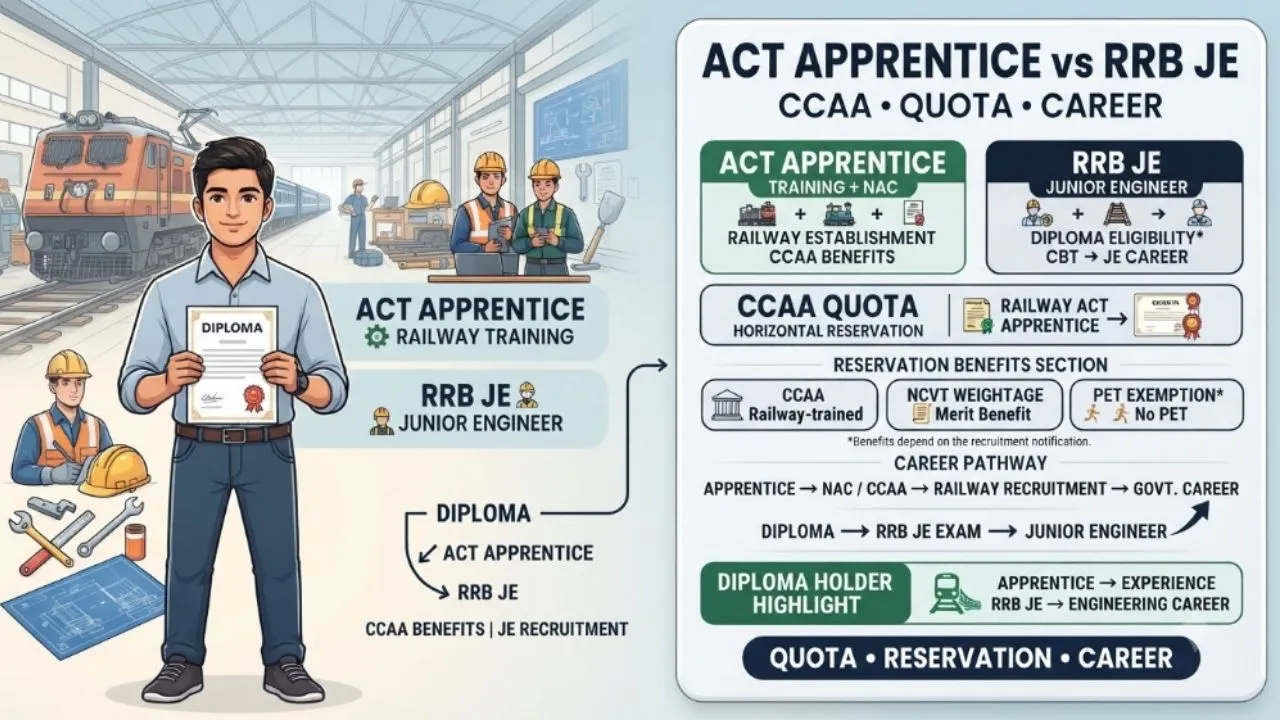
For diploma holders, Indian Railways offers two very different career routes that are often confused with each other: Act Apprenticeship and RRB Junior Engineer recruitment.
Both involve technical work, but they are not equivalent qualifications or job positions. An apprentice joins Railways for structured training, while a Junior Engineer is recruited against a regular railway post with greater technical responsibility.
The difference becomes especially important for diploma holders deciding whether to take an apprenticeship, prepare for RRB JE, or continue with higher education.
There is also considerable confusion around the 20% CCAA quota. This benefit is often described as a railway apprentice quota for RRB recruitment, but it does not apply to RRB JE vacancies.
Understanding that distinction can prevent a costly career decision.
Table of Contents
What Is a Railway Act Apprenticeship?
A Railway Act Apprentice is a trainee engaged under the Apprentices Act for practical training in a designated trade.
Railway Recruitment Cells periodically issue apprenticeship notifications for workshops, sheds, production units and other railway establishments.
Common trades include Fitter, Electrician, Welder, Carpenter, Machinist, Painter and other designated trades.
The training generally focuses on hands-on work rather than the responsibilities of a regular railway employee.
For example, an apprentice may receive practical exposure to workshop equipment, maintenance procedures, electrical systems or railway-related manufacturing activities.
The exact trades, training locations, number of seats and eligibility requirements depend on the particular notification.
A railway apprenticeship can therefore be useful for gaining workplace experience, but it should not be treated as a direct appointment to Indian Railways.
What Is an RRB Junior Engineer?
RRB JE is a regular technical recruitment route conducted through the Railway Recruitment Boards.
Junior Engineers work in technical departments such as Civil Engineering, Mechanical Engineering, Electrical Engineering, Signal and Telecommunication and other notified areas.
The role involves considerably more responsibility than an apprenticeship.
Depending on the department, a Junior Engineer may handle inspection, maintenance, technical supervision, measurements, documentation and coordination with other railway staff.
Diploma holders in relevant engineering disciplines can be eligible for several RRB JE posts, subject to the qualification requirements mentioned in the recruitment notification.
The recruitment process normally involves competitive examinations and subsequent stages such as document verification and medical examination, depending on the post.
The important point is simple: RRB JE is a regular recruitment examination, while Act Apprenticeship is a training programme.
Railway Apprentice vs RRB JE: The Biggest Difference
The biggest difference is the status of the candidate.
An apprentice is undergoing training.
A Junior Engineer is a regular railway employee appointed against a sanctioned post.
An apprenticeship provides practical exposure and a stipend. It does not automatically convert into permanent employment.
Railway apprenticeship notifications specifically state that completion of training does not create an automatic right to absorption in Railways.
This distinction is important for students who believe that completing an apprenticeship guarantees a railway job.
It does not.
A candidate may complete the apprenticeship, obtain the relevant certificate and later apply for recruitment wherever eligible.
The apprenticeship can strengthen practical knowledge, but regular recruitment remains subject to the applicable selection process.
What Is the 20% CCAA Quota?
The 20% CCAA preference is one of the most misunderstood benefits associated with railway apprenticeships.
CCAA means Course Completed Act Apprentice.
Under the railway recruitment policy, preference is given to eligible CCAAs trained in Railway establishments for up to 20% of vacancies in direct recruitment to Level-1 posts.
This policy was introduced following amendments to the Apprentices Act and Railway Board instructions concerning recruitment of apprentices.
It is important to understand what this does and does not mean.
The 20% provision is not a 20% reservation in RRB JE recruitment.
It applies to the specified Level-1 recruitment framework for eligible Course Completed Act Apprentices trained in Railway establishments.
Therefore, a diploma holder should not join a railway apprenticeship simply because someone claims it provides a 20% quota in RRB JE.
That interpretation is incorrect.
Who Can Claim CCAA Benefits?
Completing any apprenticeship is not enough to claim the CCAA benefit.
The candidate generally needs to qualify as a Course Completed Act Apprentice trained in a Railway establishment and satisfy the certificate requirements specified in the relevant recruitment notification.
The National Apprenticeship Certificate, or NAC, can be particularly important for claiming the applicable preference.
The exact conditions are controlled by the recruitment notification issued for the particular examination.
Candidates should therefore read the CCAA provisions in the relevant RRB or RRC notification instead of relying on information from coaching centres or social media.
Another important point is that the 20% preference does not mean automatic selection.
Candidates still have to satisfy the prescribed eligibility and recruitment requirements.
Unfilled CCAA positions can also be handled according to the rules specified in the applicable recruitment process.
Does the CCAA Quota Apply to RRB JE?
This is where many diploma holders make a mistake.
The 20% CCAA preference should not be treated as an RRB JE quota.
The established railway provision concerns direct recruitment to Level-1 posts.
RRB JE is a separate technical recruitment category with its own eligibility criteria, examination and selection process.
A diploma holder who wants to become a Junior Engineer should prepare for the RRB JE examination rather than depending on an Act Apprenticeship for a supposed JE quota.
An apprenticeship may provide useful industrial exposure, but it does not replace the RRB JE recruitment process.
This distinction should be kept in mind when comparing the two pathways.
Railway Apprentice Stipend for Diploma Holders
Apprentices do not receive the salary of regular railway employees.
They receive a stipend during the training period.
The amount depends on the type of apprenticeship and the applicable rules.
For diploma holders entering technician apprenticeship under the National Apprenticeship Training Scheme, the prescribed minimum stipend has been revised over time.
Under the revised apprenticeship rules notified in 2025, the minimum stipend for a technician apprentice or diploma holder in the specified apprenticeship categories is ₹10,900 per month.
The actual amount offered by an establishment can be higher than the prescribed minimum.
Railway Act Apprentices recruited under specific Railway Recruitment Cell notifications may have stipend conditions determined by the particular apprenticeship notification.
Therefore, candidates should check the stipend mentioned in the current Railway apprenticeship advertisement rather than applying a single amount to every railway apprenticeship.
This is different from the salary and allowances received by a regular Junior Engineer.
RRB JE Salary and Career Position
RRB JE is a regular technical position under the railway pay structure.
The post carries a substantially different career structure from apprenticeship training.
A Junior Engineer works with greater responsibility and has opportunities for progression through the railway hierarchy according to the applicable service rules.
The starting salary is therefore not comparable with an apprentice stipend.
A candidate choosing between the two should not compare only the first monthly payment.
The more important comparison is between temporary training and a regular technical career.
For a diploma holder who wants a long-term railway career, RRB JE generally represents the stronger target.
The main challenge is competition because the recruitment process is open and selection depends on merit and the notified criteria.
Is Railway Apprenticeship Useful for Diploma Holders?
Yes, but its value depends on the candidate’s objective.
For someone looking for practical exposure, an apprenticeship can be valuable.
It allows a candidate to experience an industrial workplace and understand how technical systems operate outside college laboratories.
It can also provide an opportunity to develop discipline, safety awareness and practical skills.
However, diploma holders need to examine the eligibility conditions carefully.
Some railway apprenticeship notifications are designed specifically for ITI and trade certificate candidates, while diploma holders may be covered under separate apprenticeship categories.
For example, a Railway Act Apprentice notification can explicitly exclude engineering diploma and degree holders because they are governed by another apprenticeship scheme.
This means a diploma holder should never assume that every Act Apprentice notification is open to them.
Should You Skip Higher Education for Railway Apprenticeship?
This depends on the career goal.
If a diploma holder receives an apprenticeship opportunity and wants immediate practical exposure, accepting it can be reasonable.
But skipping higher education solely because an apprenticeship is available requires more thought.
An apprenticeship is training, not a replacement for an engineering degree.
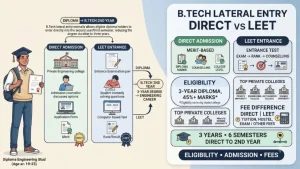
A diploma holder who wants broader technical opportunities can consider lateral entry into B.Tech or B.E. programmes where eligible.
Higher education can also help candidates qualify for positions that specifically require a degree.
For someone targeting RRB JE, the diploma itself may provide the required technical qualification for relevant posts, subject to the notification.
In that situation, preparing for RRB JE while developing practical experience can be a sensible strategy.
The decision should therefore depend on whether the immediate priority is practical exposure, competitive recruitment or long-term academic progression.
Career Path After Railway Apprenticeship
Completing a railway apprenticeship does not limit a candidate to one career route.
After training, candidates can explore private-sector technical jobs, government recruitment, railway recruitment and further education.
A candidate with a technical trade background may find opportunities in manufacturing, maintenance, electrical work, fabrication, workshops and other industrial areas.
Those with diploma qualifications have additional options depending on their branch.
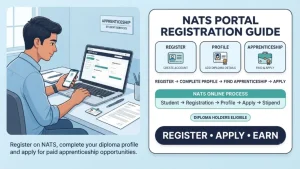
They can prepare for technical recruitment examinations, explore apprenticeship opportunities under NATS or pursue lateral-entry engineering programmes.
The apprenticeship certificate can demonstrate practical exposure, but employers still consider the candidate’s educational qualification, skills and experience.
Which Path Is Better for a Diploma Holder?
For a diploma holder, the answer depends on the intended career.
If the immediate objective is practical experience, an apprenticeship can be useful.
If the target is a regular railway technical position, RRB JE deserves focused preparation.
If the goal is broader engineering education and long-term academic progression, lateral-entry B.Tech can be considered.
The three routes are not mutually exclusive.
A student can gain practical experience and continue preparing for competitive examinations or higher education.
What should be avoided is choosing an apprenticeship because of the misconception that it guarantees a railway job or provides a 20% quota in RRB JE.
Final Verdict
Railway Act Apprenticeship and RRB JE are two different career pathways.
An Act Apprentice receives practical training and a stipend, while an RRB Junior Engineer is recruited to a regular technical position through the prescribed selection process.
The 20% CCAA preference is associated with eligible Course Completed Act Apprentices trained in Railway establishments for specified Level-1 direct recruitment, not with RRB JE recruitment.
For diploma holders, an apprenticeship can be worthwhile when the main objective is gaining industrial experience.
It becomes less attractive if the candidate is treating it as a guaranteed route to a permanent railway job.
Students who want a stronger technical career should compare apprenticeship, RRB JE preparation and higher education based on their actual goals.
A railway apprenticeship can be a useful stepping stone, but it should not automatically replace higher education or competitive-exam preparation.