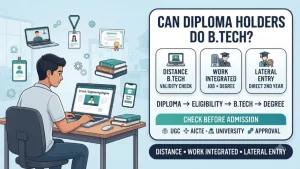
For diploma holders, B.Tech lateral entry offers a practical way to move from a three-year diploma to an engineering degree without starting B.Tech from the first semester.
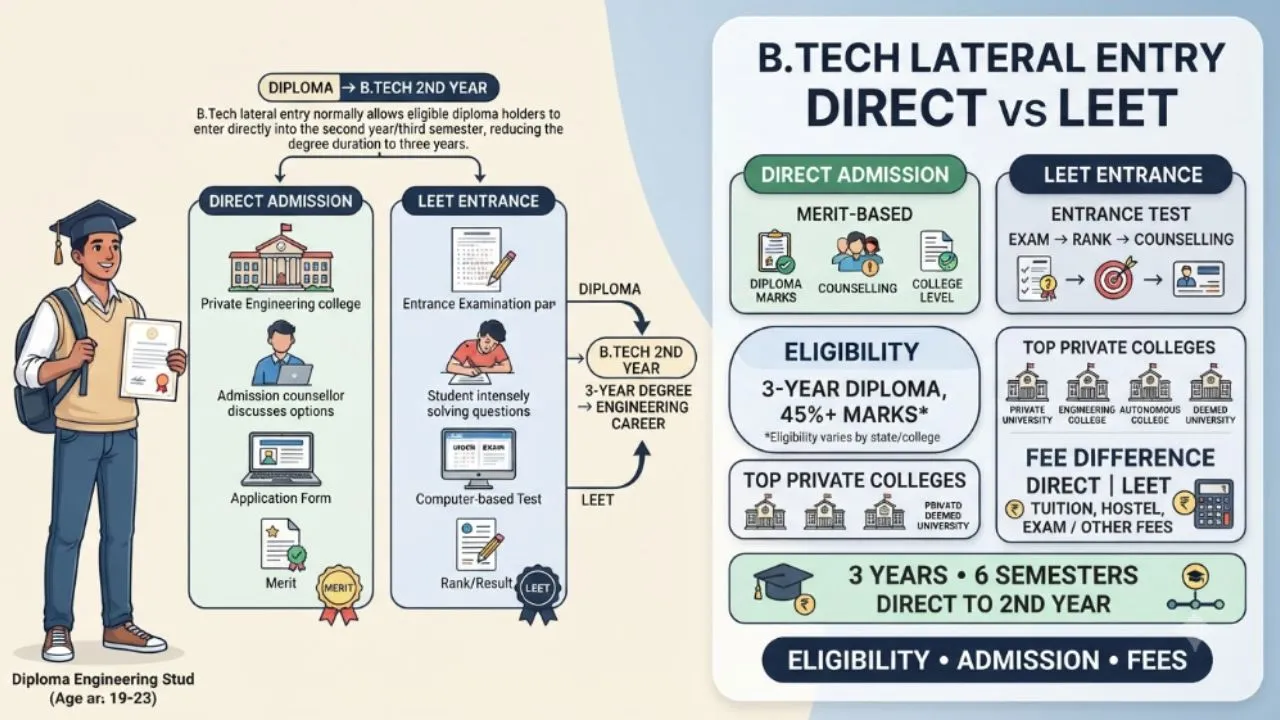
Eligible candidates can normally enter directly into the second year, or third semester, of a B.Tech programme. The route saves one year compared with completing a fresh four-year degree after Class 12.
The main question is how to secure that seat. Some colleges admit diploma holders through a state-level lateral entry entrance examination, while several private universities offer admission through their own merit-based or direct admission process. The difference matters because eligibility, fees, seat availability, admission tests and documentation can vary significantly.
Table of Contents
What Is B.Tech Lateral Entry?
B.Tech lateral entry is designed for candidates who have already completed an eligible diploma in engineering or technology. Instead of entering Semester I, the candidate joins Semester III after meeting the applicable academic and admission requirements.
The course normally takes three years from lateral entry to graduation. AICTE’s Approval Process Handbook permits lateral entry to the second year of undergraduate degree courses. The provision allows lateral-entry seats up to 10% of the approved intake, in addition to unfilled first-year seats as permitted under the applicable rules.
This AICTE framework does not mean that every college automatically offers direct admission. The university, affiliating body and state admission authority can prescribe additional conditions. That is why diploma holders should check the admission rules of the particular institution before paying an application or admission fee.
Who Is Eligible for Direct Second-Year B.Tech Admission?
The basic eligibility normally starts with a recognised diploma in engineering or technology. Many institutions ask for a three-year diploma after Class 10, although the exact qualification can differ.
The required percentage also varies. Some government or state-controlled routes may accept candidates with around 45% marks, particularly where state rules provide such eligibility. Other universities set a higher requirement of 50%, 55% or 60%.
For example, Galgotias University currently lists 60% in the relevant engineering or technology diploma for its B.Tech lateral-entry programmes. Amity University also requires candidates applying through its lateral-entry route to have completed a recognised three-year diploma with at least 60% aggregate marks. Its B.Tech Computer Science Engineering and Artificial Intelligence programmes have a higher 70% diploma requirement under the listed lateral-entry rules. Therefore, having 60% or more is useful when considering private universities, but it does not create automatic eligibility everywhere.
Direct Admission vs LEET Entrance
The biggest difference is the method used to select candidates. In a LEET or state-level entrance route, the candidate first registers for the prescribed examination. After the examination, a rank or merit position is prepared, followed by counselling and seat allocation.
The exact examination name differs between states. For example, Haryana conducts B.Tech lateral-entry admissions through its LEET-related admission system. Kerala uses a B.Tech Lateral Entry examination process for eligible diploma and other candidates.
Other states and universities follow their own procedures. Direct admission at a private university is different. The institution may assess diploma marks and other eligibility requirements without requiring the candidate to appear in a separate state-level lateral-entry examination.
Some universities may still conduct an internal entrance test, interview or eligibility assessment. Therefore, “direct admission” should not automatically be interpreted as “no selection process.” The university’s current admission policy is the deciding factor.
Why Diploma Holders Consider Direct Admission
Direct admission is attractive mainly because it reduces the uncertainty associated with entrance examinations. A candidate with a good diploma aggregate may be able to apply directly to an eligible private university and secure a seat if the programme has vacancies.
This can be useful for students who do not want to wait for a state counselling process. It can also help candidates who have missed an entrance examination deadline.
However, direct admission can cost more than a government counselling route. A private university may charge its standard lateral-entry tuition fee, while a government or aided college may have considerably lower regulated fees.
The decision should therefore be based on the complete cost, not simply the convenience of admission.
How LEET Entrance Admission Works
The entrance-based route usually follows a more structured process. First, the candidate checks the eligibility conditions and registers for the examination.
The application generally requires academic details from the diploma course and personal information. After submitting the application, the candidate appears for the examination if one is prescribed.
A rank or merit list is then prepared. Qualified candidates participate in counselling, where they select available colleges and branches according to the applicable rules.
Seats are allotted according to rank, category, choices and availability. The candidate then completes document verification and pays the prescribed admission fee.
This route can provide access to government and participating private colleges at regulated or comparatively lower fees. The disadvantage is that admission depends on the entrance process and available seats.
Which Route Is Better for a 60%+ Diploma Holder?
A diploma aggregate of 60% or above gives students more choices at several private institutions. It can make merit-based direct admission attractive, particularly for students who want a specific college or branch.
However, candidates should compare this option against entrance-based admission before making a decision. Suppose a student has 68% in a Mechanical Engineering diploma.
A private university may offer direct lateral admission based on the diploma result. Another college may require a LEET examination but charge a much lower annual fee after admission. The first option may save time and reduce admission uncertainty.
The second option could be financially better over three years. The right choice depends on the balance between college preference, total fees, location, entrance rank and career plans.
Private Universities Accepting 60% or More
Several private universities currently list 60% diploma eligibility for lateral-entry engineering programmes.
Galgotias University
Galgotias University in Greater Noida lists B.Tech lateral-entry eligibility of at least 60% in a relevant engineering or technology diploma.
Its lateral-entry offerings cover areas including Computer Science and Engineering, Artificial Intelligence, Data Science and related technology programmes.
The university also lists an annual tuition fee of ₹1.64 lakh for several B.Tech programmes, with additional examination and other charges.
The exact fee for a lateral-entry student should be confirmed for the particular programme and admission year.
Amity University
Amity University’s lateral-entry admission rules require a recognised three-year diploma with at least 60% aggregate for eligible B.Tech programmes.
For B.Tech Computer Science Engineering and B.Tech Artificial Intelligence, the listed requirement is higher at 70%.
Amity’s published 2026 information also shows separate fees depending on programme and campus.
This makes it important to compare the complete three-year cost rather than relying on the fee of one B.Tech branch.
Other Private Universities
Private universities across Uttar Pradesh, Uttarakhand, Haryana and other states offer lateral-entry B.Tech programmes.
The eligibility threshold is not uniform.
Some institutions accept 45% or 50%, while others prefer or require 60% or higher.
For example, Integral University’s listed B.Tech Civil Engineering lateral-entry programme currently accepts a recognised three-year diploma with 55% marks.
Haridwar University lists lateral-entry B.Tech programmes for eligible diploma holders in areas such as Computer Science, AI and Machine Learning, and Electronics and Communication Engineering.
This shows why a 60% diploma aggregate should be viewed as a useful benchmark rather than a nationwide mandatory rule.
Fee Difference: Direct Admission vs Entrance Merit
Fees can differ substantially depending on the institution.
Government and state-affiliated colleges usually offer lower tuition than private universities.
Entrance-based admission can therefore be financially attractive when it leads to a government or aided institution.
Private direct admission normally involves the university’s regular lateral-entry tuition structure.
Some private colleges also have separate charges for registration, examinations, hostel, transportation, development activities and other facilities.
For instance, ABES Institute of Technology lists ₹80,000 annual tuition for lateral-entry students, along with additional annual charges for registration, student activities, training and other services.
This illustrates why comparing only tuition can give an incomplete picture.
Management or direct admission can also involve higher fees in some institutions, but the term “management quota” should not be treated as a universal fee category.
Each college follows its own approved fee structure and admission rules.
Always ask the institution for a written fee breakup before making payment.
Documents Required for B.Tech Lateral Entry
Documentation is one of the most important parts of lateral-entry admission.
A candidate should normally keep the following documents ready:
- Diploma marksheets for all completed semesters
- Diploma certificate or provisional certificate
- Class 10 marksheet and certificate
- Class 12 certificate, where required
- Transfer Certificate
- Migration Certificate, where applicable
- Character Certificate
- Aadhaar or another accepted identity document
- Recent passport-size photographs
- Category certificate, if applicable
- Domicile certificate, where required
- Gap certificate or affidavit, if applicable
- Entrance examination rank card, where applicable
- Counselling allotment letter, where applicable
The exact list depends on the college and admission route.
For example, institutions conducting UPTAC or another counselling process may require an allotment letter in addition to academic documents.
Candidates should carry original documents for verification along with the required photocopies.
Branch Eligibility Also Matters
A 60% diploma does not mean that every B.Tech branch is automatically available. Universities can specify a relevant diploma discipline for lateral entry.
A Diploma in Mechanical Engineering may be accepted for Mechanical Engineering and allied programmes, but not necessarily for Computer Science or every specialised branch. Some universities publish branch-wise mapping rules.
Candidates planning to move into CSE, AI, Data Science or another specialised programme should check whether their diploma discipline is accepted. This is particularly important for students trying to switch fields after completing their diploma.
Which Option Should You Choose?
Choose the entrance-based route if your priority is lower fees, government colleges or access to institutions where lateral admission is controlled through counselling. Direct admission can make more sense if you have a strong diploma percentage, prefer a particular private university and want a simpler admission process.
Neither route is automatically better. The quality of the college, accreditation and affiliation status, total cost, branch, placement record, location and curriculum matter more than the admission method alone.
A cheaper college with strong technical training can be a better decision than an expensive private university simply because direct admission is easier.
Final Words
B.Tech lateral entry gives diploma holders a valuable opportunity to move directly into the second year of an engineering degree. AICTE’s framework provides for lateral entry within approved intake limits, but the actual eligibility and admission process is controlled by the relevant university, state authority and applicable regulations.
For students with 60% or more in their diploma, several private universities offer lateral-entry opportunities without relying exclusively on a state-level LEET examination. At the same time, entrance-based counselling can provide access to lower-cost government and participating institutions.
Before choosing direct admission, compare the complete three-year fee, branch eligibility, placement record, accreditation, hostel costs and documentation requirements. Most importantly, verify the current 2026 admission notification before paying any fee. Eligibility percentages, seat availability, fees and admission procedures can change from one academic session to another.