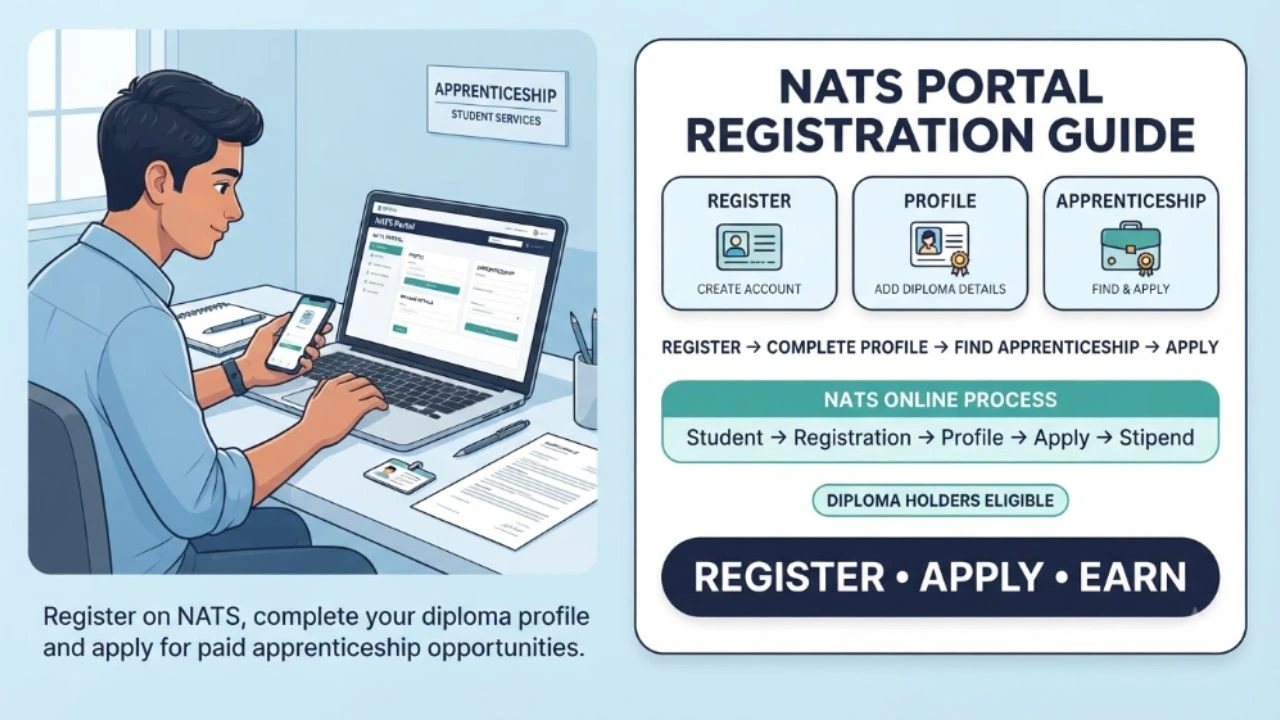
For diploma holders, an apprenticeship can be a practical way to gain industry experience soon after completing technical education. The National Apprenticeship Training Scheme, commonly known as NATS, helps eligible diploma and graduate candidates find structured apprenticeship opportunities with organisations across India.
Unlike a regular job, an apprenticeship is primarily designed around workplace training. Candidates work in a professional environment, learn practical processes and receive a stipend during the training period.
For diploma holders who are struggling to get their first technical job, NATS can provide an important bridge between college and employment.
The registration process is online, but completing the profile correctly matters. A missing qualification detail, incorrect personal information or incomplete registration can affect applications to available apprenticeship positions.
Table of Contents
What Is the NATS Portal?
NATS is a government-supported apprenticeship training system for eligible students and graduates. It connects candidates with organisations offering apprenticeship training in different technical fields.
Diploma holders from engineering and other approved technical disciplines can use the portal to create their profile and apply for suitable opportunities.
The portal is particularly useful for fresh diploma holders because many employers look for candidates who have completed their technical education but do not yet have significant work experience.
An apprenticeship gives them an opportunity to work in an actual organisation while learning under workplace conditions.
The training period and stipend depend on the apprenticeship opportunity and applicable rules. Candidates should check the details mentioned in each individual opportunity before applying.
Who Can Register for NATS?
Eligibility depends on the apprenticeship category and the rules applicable to the particular training opportunity.
Generally, diploma holders who have completed an approved technical diploma can register for relevant technician apprenticeship opportunities.
Candidates should also check whether their diploma discipline matches the requirement of the organisation offering the apprenticeship.
For example, a company recruiting Electrical Engineering diploma holders may not accept candidates from every engineering branch.
Other conditions can relate to the year of passing, age, previous apprenticeship experience and employment status.
The safest approach is to read the eligibility conditions attached to each apprenticeship vacancy rather than assuming that registration itself guarantees eligibility.
Why Diploma Holders Should Consider NATS
A diploma provides technical knowledge, but employers often expect candidates to understand workplace practices as well.
This is where apprenticeship experience can become useful.
During training, candidates may get exposure to industrial equipment, maintenance procedures, production systems, safety practices, documentation and teamwork.
The experience can also help candidates understand how technical departments operate.
For someone with no previous work experience, an apprenticeship can make the transition from college to employment easier.
It also provides an opportunity to understand whether a particular industry suits the candidate’s interests before pursuing a long-term career in that field.
An apprenticeship does not guarantee permanent employment, but the practical experience can strengthen a candidate’s profile for future opportunities.
Documents and Details Needed for Registration
Before starting registration, keep the necessary academic and personal information available.
Diploma holders should generally have details related to their diploma qualification, including the institution, branch, passing year and marks.
Personal information such as name, date of birth, mobile number and email address should match the candidate’s official documents.
Bank account details may also be required for apprenticeship-related payments.
Candidates should enter their information carefully because inconsistencies between documents and the online profile can create problems during verification.
It is also useful to keep scanned copies of certificates and other documents ready if the portal or a particular employer asks for them during the application process.
How to Register on the NATS Portal
The first step is to access the official NATS portal and select the registration option applicable to your qualification.
Choose the category meant for diploma or technician apprenticeship candidates if that is the relevant route for your qualification.
Enter your personal information exactly as it appears on your educational and identity documents.
You may need to provide your name, date of birth, contact details and other basic information during the initial registration.
Next, enter your educational qualification.
Select the appropriate diploma qualification, engineering branch, institution and year of passing.
Pay close attention to the branch name because apprenticeship opportunities are often discipline-specific.
After entering your educational information, provide other required details, including communication information and bank-related details where applicable.
The portal may also require candidates to upload or provide information from their educational documents.
Review the complete profile before submitting it.
A small mistake in your name, qualification, passing year or contact details can create unnecessary problems later.
Once registration is completed, save your login credentials securely.
Completing Your NATS Profile
Registration alone is not enough.
Candidates should complete their profile as accurately as possible so that suitable apprenticeship opportunities can be identified.
Make sure your diploma details are complete and correctly entered.
If the portal provides options for skills, qualifications or other relevant information, add details that genuinely apply to you.
Do not enter skills simply because they appear attractive to employers.
For example, a Mechanical Engineering diploma holder who has practical knowledge of AutoCAD or CNC machining can mention those skills if they have actually learned them.
Similarly, an Electrical Engineering diploma holder can mention relevant electrical maintenance, testing or industrial training experience.
A complete and accurate profile gives employers a better understanding of the candidate’s background.
How to Search for Apprenticeship Opportunities
After completing registration, candidates can look for available apprenticeship opportunities through the portal.
Search according to your diploma branch, preferred location and other available filters.
A Civil Engineering diploma holder, for instance, can search for opportunities related to Civil Engineering rather than applying randomly to every vacancy.
Location is another important factor.
Some apprenticeships may be available near your home, while others may require relocation to another district or state.
Read the training location before applying.
Also check the organisation, training duration, discipline, eligibility requirements and stipend mentioned in the opportunity.
Do not judge an apprenticeship only by the organisation’s name.
The actual training role and technical exposure are equally important.
How to Apply for an Apprenticeship
Once you find a suitable opportunity, read the complete vacancy details before submitting your application.
Check whether your diploma branch is accepted.
Confirm the passing-year, age and other conditions where applicable.
If you meet the requirements, use the application option available through the portal.
Some opportunities may involve additional selection procedures conducted by the organisation.
The employer may shortlist candidates based on academic performance, qualification, screening tests, interviews or other criteria mentioned in the notification.
Therefore, registering on NATS does not mean that every candidate will automatically receive an apprenticeship.
Selection remains dependent on the employer’s requirements and available positions.
How Much Stipend Can Diploma Apprentices Receive?
One of the major attractions of apprenticeship training is the stipend.
However, there is no single fixed amount that every diploma holder receives.
The stipend depends on the apprenticeship category, organisation, applicable government rules and the specific training opportunity.
Candidates should therefore check the stipend mentioned in the current apprenticeship notification.
A paid apprenticeship should not be confused with a regular salary.
An apprentice is undergoing structured training while receiving a stipend according to the applicable terms.
The amount may also differ between organisations and categories.
This distinction is important when comparing apprenticeship opportunities with permanent technical jobs.
NATS Apprenticeship vs Regular Job
An apprenticeship and a permanent job serve different purposes.
A regular technical job generally comes with an employment relationship and salary based on the employer’s terms.
An apprenticeship focuses on practical training and workplace exposure.
For a fresh diploma holder, the second option can be useful when finding a permanent job immediately after college becomes difficult.
The experience gained during an apprenticeship can later be mentioned on a resume and discussed during interviews.
It can also help candidates understand industrial expectations.
However, completing an apprenticeship does not automatically result in permanent employment with the same organisation.
Any future recruitment requires a separate selection process unless the employer specifically states otherwise.
How Apprenticeship Experience Helps Diploma Holders
The biggest benefit of apprenticeship training is practical exposure.
A student who has only worked on college laboratory projects may have limited understanding of industrial procedures.
An apprentice gets the opportunity to see how technical work is organised in a professional environment.
This can include equipment operation, maintenance, inspection, production processes, quality procedures, safety systems and technical documentation.
Communication also improves naturally when candidates work alongside technicians, engineers and supervisors.
Such experience can be particularly useful during private-sector interviews because candidates can discuss actual workplace situations instead of relying only on textbook knowledge.
Common Mistakes to Avoid During NATS Registration
Several simple mistakes can create problems during the application process.
Do not enter incorrect academic details simply to complete registration quickly.
Avoid using an email address or mobile number that you rarely check.
Do not apply for opportunities without reading the branch and eligibility requirements.
Do not assume that every apprenticeship provides the same stipend or training experience.
Candidates should also avoid relying on unofficial individuals who promise guaranteed selection in exchange for money.
Apprenticeship recruitment should be completed through the official process specified by the organisation and the relevant portal.
Keep copies of submitted applications and important communication for future reference.
Tips for Getting Selected
A complete NATS profile is only the starting point.
Diploma holders should work on the technical skills expected in their branch.
Mechanical candidates can strengthen knowledge of manufacturing, maintenance, CAD and workshop practices.
Electrical candidates can revise electrical machines, measurements, power systems and industrial safety.
Civil candidates can improve their knowledge of surveying, construction materials, estimation and CAD.
Computer-related diploma holders can build programming, networking, database and software skills.
Industrial training and college projects should also be presented clearly during applications and interviews.
Communication skills matter as well.
An employer may want to know what you actually learned during your diploma and practical training.
Being able to explain your project, technical skills and apprenticeship interests clearly can improve your performance during selection.
What to Do After Completing NATS Apprenticeship
The end of an apprenticeship can lead to several possible career directions.
Some candidates apply for private technical jobs using their newly gained experience.
Others prepare for government recruitment that accepts their diploma qualification.
Some continue their education through lateral entry into an engineering degree, subject to applicable admission rules.
The choice depends on the candidate’s career objective.
A Mining Engineering diploma holder may look for opportunities in mining companies, while an Electrical diploma holder may target power, manufacturing or maintenance roles.
Similarly, Computer Engineering candidates can explore technical support, networking, software or other technology-related positions depending on their skills.
The apprenticeship should therefore be viewed as a foundation rather than the final destination.
Final Words
NATS registration can be a useful step for diploma holders looking for paid apprenticeship training after completing technical education. The portal provides access to opportunities across different organisations and technical disciplines, but selection depends on eligibility, vacancies and employer requirements.
Before applying, complete your profile carefully, enter accurate diploma details and read every apprenticeship notification properly. Choose opportunities that match your branch and provide meaningful technical exposure instead of applying only because a company has a familiar name.
For a fresh diploma holder, the combination of technical education and real workplace experience can make the transition into the professional world much easier. An apprenticeship may not guarantee a permanent job, but it can provide the practical knowledge, workplace discipline and experience needed to compete for future employment.