CG PPT counselling is the stage where a candidate’s entrance exam rank is converted into an actual polytechnic seat. After appearing for the Chhattisgarh Pre Polytechnic Test, getting a good rank is only the first step. The next decisions, including college preference, branch selection, document verification and seat acceptance, can directly affect admission.
For candidates targeting Government Polytechnic colleges in Chhattisgarh, counselling requires careful planning. A student with a decent rank can still miss a preferred branch by filling choices poorly or failing to complete an important counselling step on time.
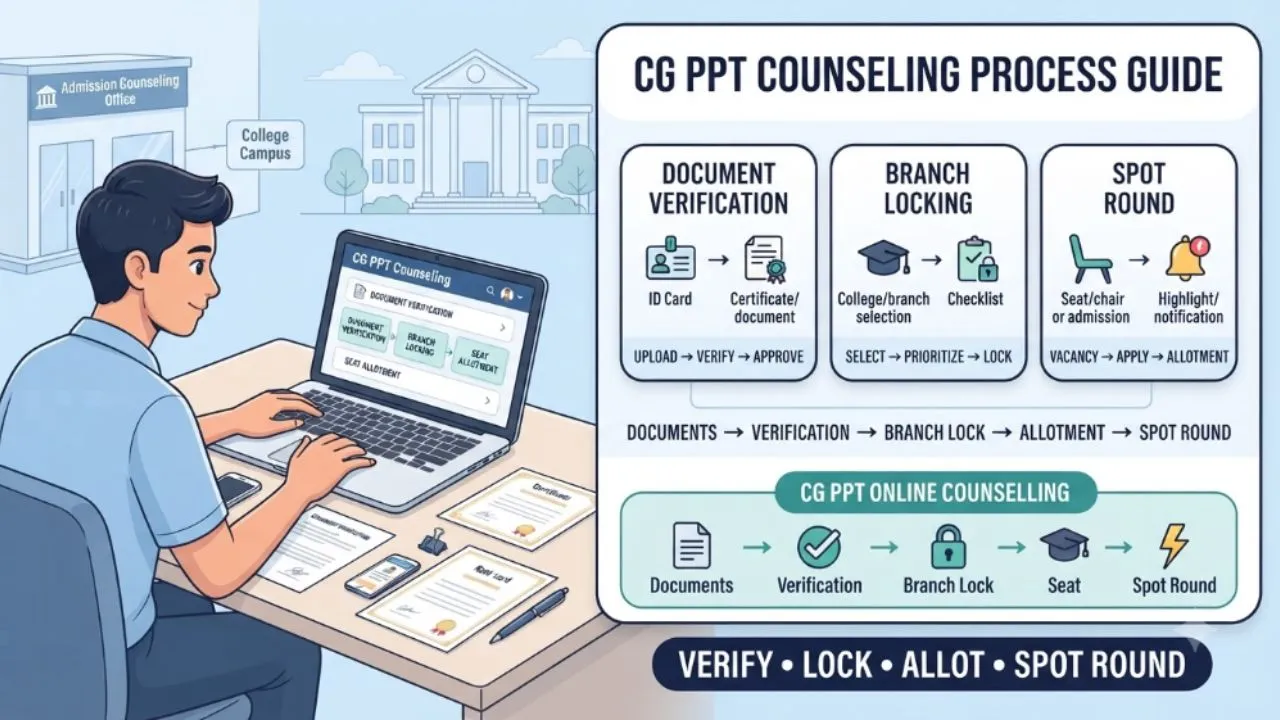
The process generally includes registration, choice filling, seat allotment, document verification, admission confirmation and subsequent rounds. Candidates who do not receive their preferred seat can also benefit from later rounds or spot counselling when vacant seats remain.
Table of Contents
What Is CG PPT Counselling?
CG PPT counselling is the online admission process used for allotting polytechnic seats to eligible candidates based on their entrance rank, category, preferences and available seats. After the CG PPT result is declared, the relevant admission authority announces counselling schedules and instructions. Candidates have to register within the specified period and provide their preferred colleges and diploma branches.
The allotment is not based on rank alone. The choices entered by the candidate also matter. For example, a candidate with a good rank may not receive a particular branch if that branch was not included in the preference list or if seats were already filled by higher-ranked candidates.
This makes choice filling one of the most important parts of the entire process.
CG PPT Counselling Process Step by Step
The counselling procedure can vary slightly from one admission year to another, but the main stages generally remain similar.
1. Check the Counselling Notification
Once CG PPT results are available, check the official counselling schedule carefully.
The notification normally contains information about registration dates, choice filling, seat allotment, document verification, admission deadlines and later counselling rounds.
Do not rely only on previous-year dates because the schedule can change each year.
2. Register for Counselling
Eligible candidates need to register on the designated counselling portal.
The registration process generally requires details such as the CG PPT roll number, rank, personal information and contact details.
Enter information exactly as provided in your examination records. Errors in basic information can create problems during verification.
Keep your login details safe because the same account may be required for choice filling, allotment and downloading admission-related documents.
3. Fill College and Branch Choices
Choice filling is where candidates need to think carefully.
Do not select colleges randomly just because they are familiar names. Consider the branch, location, fees, hostel availability, previous admission trends and your actual career preference.
A practical preference list can include three categories:
High-preference choices: Colleges and branches you strongly want.
Realistic choices: Options that match your rank and previous admission trends.
Backup choices: Colleges and branches that you would genuinely accept if higher preferences are unavailable.
This approach reduces the risk of ending the counselling process without a suitable seat.
Branch Locking: Why It Matters
After entering preferences, candidates may have to save and lock their choices within the prescribed deadline. Branch locking means confirming the final preference list submitted for seat allotment.
Once choices are locked, changes may not be possible during that particular round. The exact rules depend on the counselling authority. Before locking the list, review every college and branch carefully.
Check whether Civil Engineering, Mechanical Engineering, Electrical Engineering, Computer-related branches or another specialisation matches your career plans. Do not put a branch at a higher position simply because you have heard that it has a better salary. A branch that matches your interests and strengths can be more useful over the long term.
How to Prepare Your Choice List
One common mistake is filling only a few choices. Suppose a candidate wants Computer Science but has listed only two colleges offering that branch. If both options close before the candidate’s rank is considered, the system may not have another preferred option to allot.
A broader list can provide more opportunities. However, never add a college or branch that you would refuse after allotment.
If you receive a seat that you genuinely do not want and accept it without understanding the rules, changing the decision later may become difficult.
The preference order should therefore reflect what you actually want, not what other candidates recommend.
Document Verification During CG PPT Counselling
Document verification confirms that the information provided during the application and counselling process is supported by valid documents.
The exact list can vary according to the candidate’s category and admission route, but applicants should generally keep their educational and identity documents ready.
These may include the CG PPT admit card or rank-related document, Class 10 marksheet and certificate, domicile or residence documents where applicable, caste certificate for eligible reserved-category candidates, transfer certificate, character certificate and passport-size photographs.
Additional documents may be required for specific categories or claims. Keep both original documents and photocopies where instructed.
If a certificate has expired, contains incorrect information or does not meet the prescribed format, verification can become difficult. Candidates should also ensure that names and dates of birth are consistent across their records.
What Happens After Seat Allotment?
After each counselling round, candidates can check whether they have received a seat. The response depends on the rules of that particular counselling round.
A candidate may receive a preferred seat, a lower preference or no seat at all. If a seat is allotted, read the instructions regarding acceptance, fee payment, reporting and further-round participation.
Do not assume that simply viewing the allotment result confirms admission. Admission usually requires completing the prescribed steps within the deadline.
Missing the payment or reporting deadline can result in cancellation of the allotted seat.
Government Polytechnic Seats and Competition
Government Polytechnic colleges generally attract significant demand because of their relatively affordable fees and established reputation. Popular branches such as Computer Science, Computer Engineering, Electrical Engineering, Mechanical Engineering and Civil Engineering can have different levels of competition.
The closing rank for a branch can change according to the number of applicants, available seats, category, college preference and counselling round. Previous-year closing ranks are useful for understanding competition, but they should not be treated as guaranteed CG PPT cutoff ranks for the current year.
A candidate’s strategy should therefore include both preferred options and realistic alternatives.
What If You Do Not Get a Seat?
Not receiving a seat in the first round does not necessarily end the admission opportunity. Further counselling rounds may be conducted depending on the number of vacant seats and the admission schedule.
Candidates should check whether they are eligible to participate in the next round and whether fresh choice filling is required. Some students make the mistake of abandoning counselling immediately after the first unsuccessful round.
Vacancies can arise when candidates do not accept allotted seats, withdraw from admission or move to another institution. This is one reason later rounds can be important for candidates with lower ranks.
CG PPT Spot Round: How It Works
A spot round is generally conducted to fill seats that remain vacant after the regular counselling process. The rules for spot admissions can differ from the main counselling rounds. The authority may announce a separate registration process, eligibility condition, reporting procedure or college-level admission process.
Candidates should never assume that every vacant seat will be available to every applicant. The available branches can also be limited.
For this reason, spot counselling requires flexibility. A student targeting only one highly demanded branch may still have limited options, while a candidate willing to consider related branches may find a suitable seat.
Spot Round Strategy for Low-Rank Candidates
Candidates with lower ranks should approach the spot round realistically. Start by identifying government colleges where seats are more likely to remain vacant.
Look at branches beyond the most competitive options. For example, if Computer-related branches are unavailable, a candidate interested in technical careers can consider Electrical, Electronics, Mechanical or Civil Engineering depending on personal interests and future plans.
Location can also influence availability. Colleges in less preferred locations may have vacant seats after candidates choose institutions closer to their homes.
Do not reject an option solely because it was not your first preference. Consider the complete cost, branch relevance, travel requirements and future study opportunities before making the final decision.
Common Mistakes to Avoid During Counselling
Several counselling mistakes are avoidable. The first is waiting until the last day to complete registration or choice filling. Technical problems or payment issues can become difficult to resolve close to a deadline.
The second is entering choices without checking the branch offered at each college. Another common mistake is ignoring document requirements until verification begins.
Candidates should also avoid relying on unofficial claims about guaranteed seats or fixed cutoffs. Do not pay anyone who promises a government polytechnic seat in exchange for an unofficial payment. Admission should follow the process announced by the competent authority.
How to Improve Your Chances of Getting a Government Polytechnic Seat
A strong counselling strategy begins with realistic expectations. First, understand your CG PPT rank and category.
Next, research previous admission trends for colleges and branches you are considering. Then create a long preference list covering ambitious, realistic and backup choices.
Keep government colleges high on the list when they are your genuine preference. At the same time, do not fill choices simply to increase the number of options. The best preference list is one that balances rank, branch interest, location and affordability.
Candidates should also monitor every counselling notice after registration. Admission does not end when the first choice list is submitted.
Final Words
CG PPT counselling can determine where and in which branch a candidate begins their diploma education. The process becomes easier when each stage is handled carefully instead of being treated as a formality. Registration, choice filling, branch locking and document verification all deserve attention. Candidates who do not receive their preferred government seat in an early round should continue checking subsequent counselling opportunities. The spot round can be particularly useful for candidates with lower ranks, but available choices may be limited.
A sensible strategy is to keep several genuine college and branch preferences, understand previous cutoff trends without treating them as guarantees, and remain flexible during later rounds. The final goal should not simply be getting any seat. It should be securing a diploma branch and college that fit your academic interests, budget and longer-term career plans.