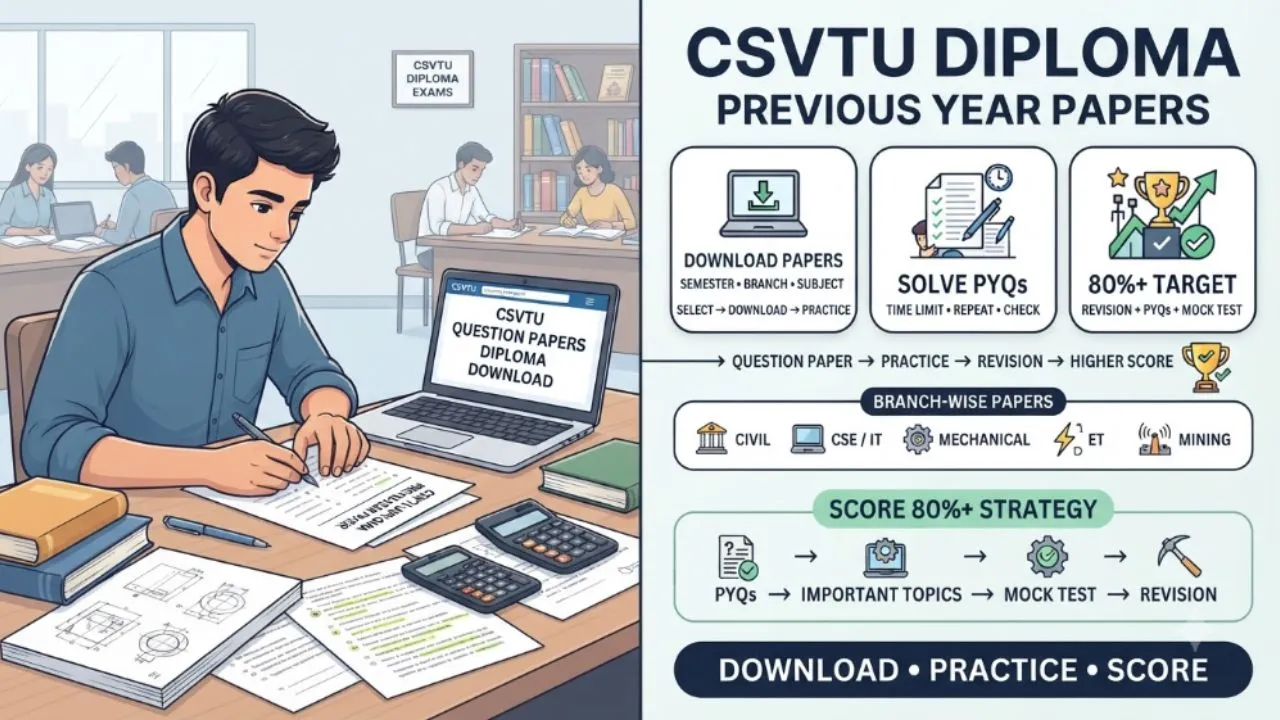
Previous year question papers can make CSVTU diploma semester preparation much more focused. Instead of studying every chapter with equal attention, papers help identify repeated topics, important units and common question patterns. For diploma students preparing for the End Semester Examination (ESE), this becomes especially useful when several subjects have lengthy syllabi and limited preparation time.
Previous papers are not a shortcut to avoid studying the syllabus. They are a practical way to understand how questions are framed and where more preparation is needed. With a combination of syllabus analysis, repeated-question practice, proper revision and timed mock tests, students can prepare more efficiently and aim for 80% or higher.
Table of Contents
Why CSVTU Diploma Previous Year Papers Matter
Chhattisgarh Swami Vivekanand Technical University (CSVTU) conducts diploma examinations for affiliated institutions across the state. Each semester contains several subjects, and every subject has its own syllabus and examination requirements.
Reading only textbooks can make preparation lengthy because it does not always show which concepts are repeatedly tested in examinations. Previous year papers provide that missing examination perspective.
By reviewing several papers, you can identify questions that have appeared more than once, chapters that receive regular attention and topics that require numerical or descriptive practice. They also help you understand the expected answer length and the way technical questions are presented.
A student who solves five years of papers carefully can often recognise patterns that are difficult to notice while studying individual chapters.
How to Find Official CSVTU Previous Year Question Papers
The safest approach is to begin with official university resources rather than relying on random PDF websites. Start by checking the CSVTU website and look for sections related to examinations, diploma programmes, question papers, academic resources or downloads.
The exact location of previous papers can change when the university updates its website. If a particular paper is not available online, contact your college examination section or department office.
College libraries can also be useful because many institutions maintain collections of previous semester papers. Ask specifically for papers belonging to your diploma branch, semester, subject code and examination scheme.
This is important because the same subject name can sometimes appear under different schemes or syllabus structures. Before downloading a paper, verify the following details:
- Diploma branch
- Semester
- Subject name
- Subject code
- Examination year
- Scheme or syllabus applicable to your batch
Avoid preparing from a paper that belongs to an outdated syllabus without checking whether the topics are still included in your course.
Step-by-Step Method to Download the Right Papers
Finding a PDF is only the first part of the process. First, identify your current semester and list every theory subject.
Next, note the subject codes from your syllabus or college timetable. Search the official university examination resources using the subject name or code.
If the university provides separate folders for different years, select papers from the latest relevant examination scheme first. Download several papers rather than relying on only one.
Five or more papers are much more useful for pattern analysis because a single paper can contain an unusual combination of questions. Keep the files organised subject-wise on your phone or computer.
You can also print the most important papers if you prefer solving questions on paper.
How to Analyse Chapter-Wise Weightage
Do not start solving previous papers randomly. The more useful approach is to create a chapter-wise question record.
Take five previous papers for one subject and divide the questions according to the chapters in your current syllabus.
Suppose a subject has six units. Mark every question against the relevant unit. After analysing the papers, you may notice that some units appear more frequently than others.
That does not mean the remaining chapters can be ignored. Instead, it tells you where repeated preparation deserves more time.
For numerical subjects, record the type of problem rather than only the chapter name. For theory subjects, note recurring definitions, explanations, diagrams, comparisons and long-answer topics.
This creates a simple priority system:
High priority: Frequently repeated questions and important concepts.
Medium priority: Topics appearing occasionally or carrying moderate marks.
Basic priority: Less frequently asked areas that still need at least one complete revision.
The actual marks distribution can vary between subjects and examination papers, so use previous papers as a preparation guide rather than treating them as a fixed blueprint.
Focus on Repeating 10-Mark Questions
Long-answer questions deserve special attention because they can contribute significantly to the total score.
If a particular 10-mark topic appears repeatedly across previous papers, prepare it thoroughly.
Do not memorise only the first few lines of an answer.
Understand the concept, important points, diagrams, formulas and practical applications connected with the topic.
For a technical answer, a strong structure can include:
- Definition or introduction
- Main principle
- Construction or components, where applicable
- Working or process
- Diagram
- Advantages or applications
- Relevant formula or example
The exact structure depends on the question.
Repeated 10-mark questions are useful because they show which concepts examiners have considered important in previous papers.
However, repetition does not guarantee that the same question will appear again.
Prepare the underlying topic rather than gambling on an exact question.
How to Prepare for 80%+ in CSVTU Diploma Exams
Scoring above 80% requires more than collecting question papers.
Start preparation with the current syllabus.
Divide each subject into manageable chapters and identify the topics that require conceptual understanding.
Then compare those topics with previous papers.
Use the papers to decide which questions deserve intensive practice.
A practical preparation cycle can look like this:
First round: Complete the syllabus and understand the important concepts.
Second round: Solve repeated questions chapter-wise.
Third round: Attempt complete previous papers without checking notes.
Final round: Revise formulas, diagrams, definitions and frequently repeated long-answer topics.
This approach prevents previous papers from becoming a replacement for actual learning.
Use a Three-Level Question Strategy
While analysing papers, divide questions into three groups.
Level 1: Repeated Questions
These are questions or concepts that appear several times.
Prepare them thoroughly and practise writing complete answers.
Level 2: Important Variations
Sometimes the same concept appears in different wording.
For example, one paper may ask about the working principle while another asks about construction and working.
Treat these as related questions rather than separate topics.
Level 3: New or Less Frequent Questions
These should not be ignored.
Read the relevant chapter and understand the basic concept so that an unfamiliar question does not become a complete surprise in the examination.
This method gives more attention to high-value topics without creating gaps in the syllabus.
Practise Writing Answers, Not Just Reading Them
Many diploma students spend hours reading solved papers but struggle when they have to write answers independently.
That problem becomes noticeable during the ESE because time is limited.
Take a previous paper and solve it without opening your notes.
Write diagrams wherever they are relevant.
Show every step in numerical problems.
Use headings for long theoretical answers.
Underline important technical terms when appropriate.
Once the paper is complete, compare your answer with your textbook, class notes or reliable study material.
Look for missing concepts rather than simply counting mistakes.
Writing practice also helps you estimate how much content you can comfortably complete within the examination time.
Create a Repeated-Question Notebook
A small notebook dedicated to previous year questions can make final revision much easier.
Create separate sections for each subject.
Write down recurring questions, formulas, diagrams and difficult numerical problems.
Do not copy entire answers unnecessarily.
Instead, record the structure and key points that help you reconstruct the answer during revision.
For example, for a machine-related question, note the definition, major components, working principle, diagram and applications.
Before the examination, this notebook can become a compact revision resource.
How to Manage Numerical Subjects
Previous papers are particularly useful for Mathematics, Electrical Engineering, Mechanical Engineering and other subjects containing numerical problems.
Identify repeated problem types.
Then practise them without looking at the solution.
For each numerical question, focus on four things:
- Given data
- Required value
- Formula
- Step-by-step calculation
Always include units where required.
Do not memorise only the final answer from a previous paper.
The numbers can change in the examination while the underlying method remains similar.
Once you understand the method, you can handle different versions of the same problem.
How to Improve Theory Answers
Technical theory answers should be structured rather than written as one large paragraph.
Start with a direct definition when the question asks for one.
Use headings for construction, working, advantages, disadvantages, applications or other relevant parts.
Draw a labelled diagram when the topic requires one.
Keep the explanation technically accurate and avoid unnecessary filler.
For a 10-mark answer, a detailed and well-organised response is generally more effective than several short sentences with no structure.
Your answer should also match the question.
If the examiner asks for working, spend more space explaining the working instead of writing a long introduction.
A Practical 30-Day Preparation Strategy
Students with around one month before the ESE can divide preparation into four phases.
During the first week, complete or revise the syllabus and identify difficult chapters.
In the second week, solve chapter-wise previous questions and prepare frequently repeated topics.
The third week should focus on full-length papers under examination conditions.
Use the final week for revision, error correction, formulas, diagrams and repeated long-answer questions.
Do not spend the entire final week learning completely new material.
The last few days are better used to strengthen topics already studied and correct recurring mistakes.
Common Mistakes While Using Previous Year Papers
One common mistake is preparing only repeated questions.
A paper may contain new questions, even when the syllabus remains unchanged.
Another mistake is downloading papers from unverified websites without checking the subject code or syllabus.
Some students also read previous papers without actually solving them.
That does not provide the same benefit as writing answers under time pressure.
Avoid postponing syllabus completion because a few questions appear repeatedly.
Previous papers should guide preparation, not replace it.
Final Strategy for Scoring 80%+
The most effective approach is simple: understand the syllabus, analyse several previous papers, identify recurring topics and practise writing complete answers. Give special attention to repeated 10-mark questions, but prepare their underlying concepts instead of memorising predictions.
Use chapter-wise analysis to decide where your revision time should go. Solve full papers under timed conditions during the final stages of preparation. Keep a separate record of mistakes and revise it regularly. For numerical subjects, practise problem-solving repeatedly. For theory subjects, focus on answer structure, diagrams and technical keywords. Most importantly, do not depend on a predicted question paper. For CSVTU diploma students, previous year question papers can turn semester preparation from an unfocused reading exercise into a much more organised process.