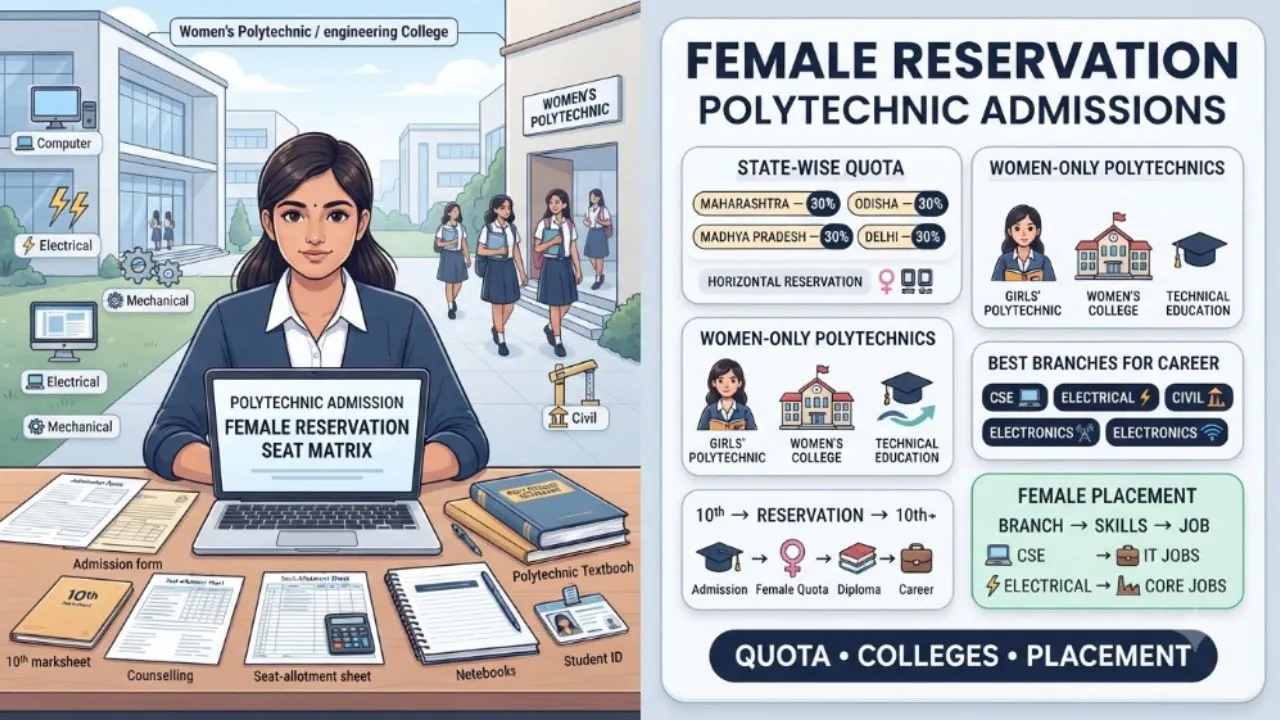
For girls planning a technical career after Class 10, a government polytechnic can offer a practical route into engineering without the cost of a full B.Tech degree. Women-only government polytechnic colleges add another advantage. These institutes are designed specifically for female students and often provide technical courses, hostels, scholarships and campus facilities suited to their needs.
There is no single official national ranking of women’s polytechnic colleges in India. The five institutes discussed below are notable government or government-supported women’s polytechnic options in different regions, based on their institutional status, course range and relevance for diploma education. The admission rules also differ from one state to another. In some states, female candidates receive horizontal reservation in co-educational institutes, while women-only colleges provide an institution-level environment exclusively for female students.
Table of Contents
Top Women’s Government Polytechnic Colleges in India
1. Government Polytechnic for Women, Chandigarh
Government Polytechnic for Women in Sector 10, Chandigarh, is one of the established government institutions dedicated to women’s technical education. The institute offers diploma-level programmes in areas including Electronics and Communication Engineering, Pharmacy, Library and Information Science, Interior Decoration and Modern Office Practice.
For girls interested in technical fields, Electronics and Communication Engineering is among the more directly engineering-oriented choices available at the institute. The college is located in Chandigarh, which also gives students access to a developed urban and industrial environment.
The choice of branch matters more than the institute name alone. A student interested in electronics, communication systems or technical support should examine the curriculum and practical facilities before applying.
2. Government Polytechnic for Girls, Ahmedabad
Government Polytechnic for Girls, Ahmedabad, is another established women-focused technical institute in Gujarat. Its current course offerings include Computer Engineering, Information Technology, Biomedical Engineering, Civil Engineering and Information and Communication Technology.
The availability of Computer Engineering and IT makes the institute particularly relevant for girls interested in software, networking and digital technology. Biomedical Engineering is another interesting option for students who want to combine engineering with healthcare technology.
Civil Engineering remains relevant for students interested in construction, infrastructure, surveying and government technical work. The institute is therefore broader than a traditional girls’ polytechnic focused only on conventional technical trades.
3. Government Polytechnic for Women, Palamaner
Government Polytechnic for Women, Palamaner, in Andhra Pradesh, was established in the mid-1980s and continues to provide diploma education exclusively for female students.
The institute offers Civil Engineering, Electronics and Communication Engineering, Electrical and Electronics Engineering, and Commercial and Computer Practice.
Each engineering programme has a substantial sanctioned intake, making it a useful option for girls looking for a government diploma institution in the region.
Admission is linked with the Andhra Pradesh POLYCET process, with selection based on entrance merit and applicable reservation rules.
The institute also has hostel facilities, which can be important for students travelling from nearby districts.
For girls considering technical education after Class 10, the combination of government status, engineering branches and residential facilities makes this college worth considering.
4. Government Residential Women’s Polytechnic, Latur
Government Residential Women’s Polytechnic in Latur is an important option for female students in Maharashtra.
Its residential character can be particularly useful for students who need accommodation while pursuing a diploma.
Maharashtra has a substantial network of government and aided diploma institutes, and admissions are handled through the state’s technical education system.
Female reservation is also an important feature of Maharashtra’s diploma admission framework. Government rules provide reservation for female candidates in the applicable admission process, with the exact implementation governed by the current admission rules.
Students should check the latest Maharashtra State CAP information before relying on a previous year’s seat distribution.
The institute can appeal to girls who want a government technical education along with a residential campus environment.
5. Government Girls’ Polytechnic, Raipur
Government Girls’ Polytechnic in Raipur is one of the women’s polytechnic institutions listed within Chhattisgarh’s technical education network.
Its location in the state capital is useful for students who want access to a larger urban environment while pursuing diploma education.
Chhattisgarh also has a growing industrial base involving mining, power, metals, manufacturing and infrastructure.
That makes technical branches such as Computer-related courses, Electronics, Electrical and other engineering disciplines relevant to the state’s employment market.
The exact branches and intake can change with the academic session, so applicants should check the current admission brochure before selecting the institute.
For girls from Chhattisgarh, a government women’s polytechnic can provide an affordable alternative to private diploma colleges.
Are Girls Given 30% Reservation in Polytechnic Admissions?
This is one of the most misunderstood parts of diploma admissions.
There is no single 30% women’s reservation rule applicable to every polytechnic college in India.
Reservation is determined by the state government, admission authority and applicable technical education rules.
For example, Maharashtra provides 30% reservation for female candidates in its diploma admission framework. Uttarakhand also lists 30% reservation for women in its government polytechnic admission rules.
The way this reservation works can also differ.
A horizontal reservation is applied across relevant social or category groups rather than creating a completely separate category outside the normal reservation structure.
This distinction matters during counselling.
A female candidate belonging to SC, ST, OBC, EWS or another applicable category may receive the benefit according to the state’s reservation framework.
The exact seat matrix should always be checked for the particular admission year.
State-Wise Women’s Reservation Rules
Reservation policies vary significantly across India.
In Maharashtra, female candidates are eligible for the 30% reservation provided under the applicable technical education admission rules.
Uttarakhand government polytechnic admissions also list a 30% women reservation.
Delhi follows a different framework for diploma admissions. The Directorate of Training and Technical Education has separate government institutes exclusively for girls, while its reservation structure and eligibility rules should be checked through the current admission notification.
Andhra Pradesh follows its own POLYCET-based admission and reservation system. Government Polytechnic for Women, Palamaner specifically states that admissions follow POLYCET merit and government reservation rules.
This means a student should never assume that a reservation percentage from one state will apply in another.
For 2026 admissions, the latest prospectus and seat matrix are more reliable than previous-year information circulating online.
Best Polytechnic Branches for Girls
There is no engineering branch that is exclusively suitable for girls.
Career outcomes depend more on skills, internships, college facilities, location and employer requirements than gender.
That said, some branches have become increasingly attractive because of expanding employment opportunities.
Computer Engineering
Computer Engineering is one of the strongest choices for students interested in programming and technology.
Diploma holders can build skills in programming, databases, networking, web development and technical support.
With additional certifications and projects, the branch can also provide a foundation for further studies in computer science and related fields.
Information Technology
IT is closely connected with software, networking, databases and digital systems.
Girls who prefer computer-based work may find this branch suitable.
However, the college’s laboratory facilities and practical curriculum should be checked before choosing the programme.
Electronics and Communication Engineering
Electronics and Communication Engineering covers circuits, communication systems, digital electronics and embedded technologies.
The branch can lead toward electronics manufacturing, telecom, testing, maintenance and embedded systems.
It can be particularly useful for students interested in hardware rather than purely software-oriented careers.
Electrical Engineering
Electrical Engineering remains relevant across power, manufacturing, infrastructure and industrial maintenance.
Diploma holders can explore technical roles in private companies and prepare for eligible government recruitment.
The branch also provides a foundation for further engineering education.
Civil Engineering
Civil Engineering remains useful in construction, infrastructure, surveying and public works.
Girls interested in site work, design, surveying or government infrastructure projects can consider this branch.
The nature of the job can involve fieldwork, so students should understand the working environment before selecting it.
Which Branch Has the Highest Placement Rate for Girls?
There is no reliable national database that publishes comparable female-only placement rates by polytechnic branch across government colleges.
Claims such as “Computer Engineering has the highest female placement rate” should therefore be treated cautiously unless the institute publishes verified branch-wise placement data.
In many colleges, Computer Engineering and IT attract strong recruiter interest because of demand for digital skills.
Electronics and Electrical Engineering can also provide opportunities across technical industries.
Civil and Mechanical Engineering have their own employment markets, although the type of work can involve more site-based or industrial environments.
The better approach is to check the college’s recent placement record, recruiter list, number of students placed and branch-wise outcomes where those figures are publicly available.
A high overall placement percentage does not automatically mean the same result for every branch.
Government Polytechnic vs Private Polytechnic for Girls
Government polytechnics are generally considered when affordability is a major concern.
Tuition and institutional charges are usually lower than those at many private colleges, although the actual fee depends on the state and institution.
Government institutes can also provide access to scholarships and fee assistance under applicable schemes.
Private colleges may offer different infrastructure, industry partnerships or placement arrangements.
Neither category guarantees better employment.
A student should compare laboratory facilities, faculty, hostel availability, internship opportunities, placement records and total expenses before choosing.
For girls travelling from another district, hostel and transportation costs can significantly affect the actual cost of education.
Scholarships and Financial Support for Female Students
Girls pursuing technical education can also explore scholarship schemes.
The AICTE Pragati Scholarship is specifically designed for girls studying approved technical diploma and degree programmes, subject to the scheme’s eligibility conditions.
State governments may also provide scholarships based on income, category, domicile or academic performance.
Students should check whether their selected institute and course meet the eligibility conditions before applying.
Scholarship applications often require income certificates, bank details, educational documents and other supporting records.
Missing a document can delay the process, so it is better to prepare the paperwork early.
How to Choose a Women’s Polytechnic College
The fact that an institute is women-only should not be the only reason for choosing it.
Start with the branch.
If the goal is software or digital work, Computer Engineering or IT may make more sense.
For power and industrial careers, Electrical Engineering can be a stronger fit.
Students interested in construction and infrastructure can consider Civil Engineering.
Electronics and Communication can suit those interested in circuits, communication systems and embedded technology.
After selecting the branch, compare the college’s admission route, fees, hostel facilities, laboratories, internships and placement record.
Also check the distance from home.
A government college with low tuition may become more expensive if daily travel is difficult or hostel accommodation is unavailable.
Final Words
Women’s government polytechnic colleges provide girls with an affordable route into technical education after Class 10. Institutes such as Government Polytechnic for Women, Chandigarh, Government Polytechnic for Girls, Ahmedabad, Government Polytechnic for Women, Palamaner, Government Residential Women’s Polytechnic, Latur and Government Girls’ Polytechnic, Raipur represent different regional options.
Reservation can make admissions more accessible, but there is no uniform national 30% quota for women across all polytechnic admissions. The applicable percentage and method depend on the state and admission authority. For 2026 admissions, candidates should rely on the latest official prospectus and seat matrix. As for branches, Computer Engineering, IT, Electronics, Electrical and Civil Engineering can all lead to worthwhile careers when supported by practical skills and further learning.