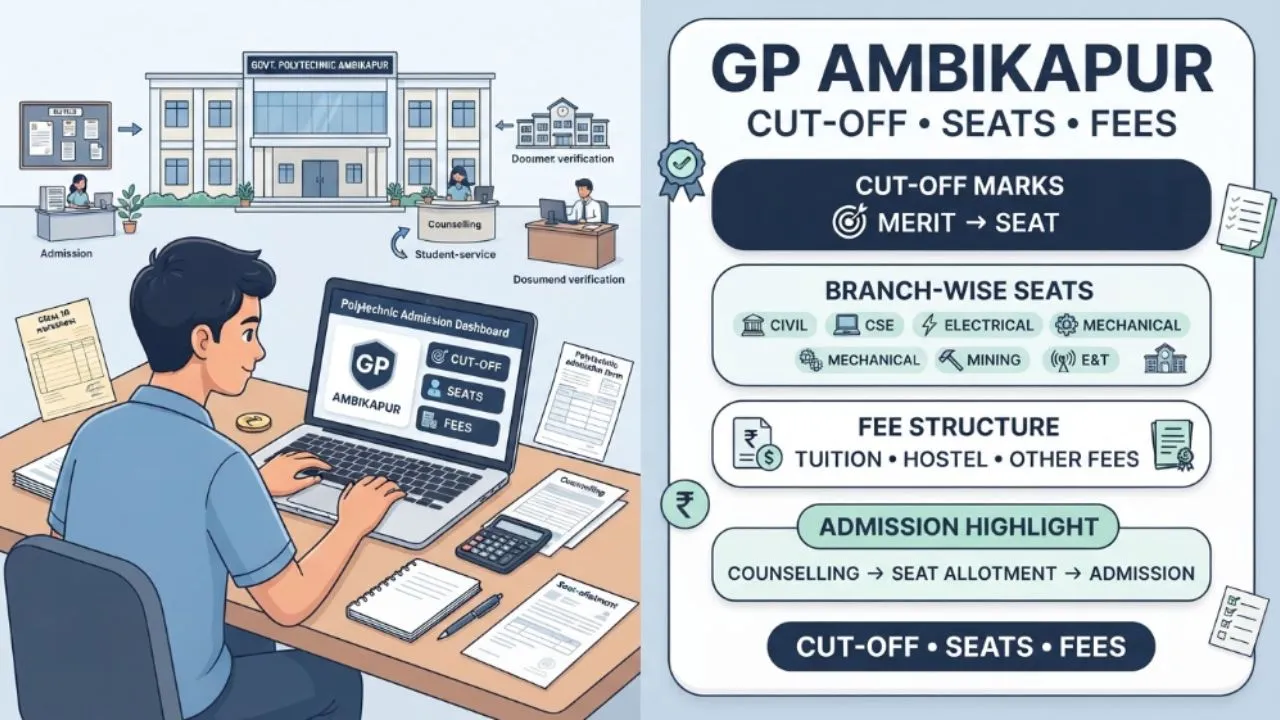
Government Polytechnic Ambikapur is one of the established government diploma institutes in Chhattisgarh, offering technical courses after Class 10. Located in Namnakala, Ambikapur, the institute provides diploma programmes in Civil Engineering, Computer Science Engineering, Electrical Engineering, Electronics and Telecommunication, Mechanical Engineering and Mining Engineering.
Admission to the regular diploma programmes is conducted through the centralized counselling process of the Chhattisgarh Directorate of Technical Education. Candidates can enter through the CG PPT route, while eligible candidates may also apply through lateral entry. For students planning admission in 2026, three things matter most: the available seats in each branch, previous CG PPT admission trends and the total cost of studying at the institute.
Table of Contents
Government Polytechnic Ambikapur Branches and Seat Intake
The institute currently lists 40 regular seats for the first-year intake in each of its major engineering branches. Several departments also mention two TFW seats in addition to the regular intake and four lateral-entry seats.
This means the main branches have a similar sanctioned intake, although the final seat matrix used during counselling can change because of category distribution, reservation, TFW seats and admission rules.
Mining Engineering
Mining Engineering has an intake of 40 seats through the 10th/PPT route, along with two TFW seats and four lateral-entry seats.
The department was established in 1988 and has dedicated facilities for mining machinery, surveying, geology, gas testing and mining models.
For students from Surguja and surrounding districts, Mining Engineering has particular regional relevance because of the area’s connection with coal and other mineral resources.
Computer Science Engineering
The Computer Science Engineering diploma has 40 regular seats, two TFW seats and four lateral-entry seats.
The department focuses on programming, databases, computer fundamentals, networking and related technical subjects.
Its laboratories include facilities for C/C++, Python, Java, DBMS and networking, giving students opportunities to practise skills alongside classroom study.
Civil Engineering
Civil Engineering also offers 40 regular seats, with two TFW seats and four lateral-entry seats listed by the institute.
The branch covers areas connected with construction, surveying, materials, structural work, estimation and infrastructure development.
Civil Engineering can suit students interested in construction projects, government infrastructure departments and technical site work.
Mechanical Engineering
Mechanical Engineering has an intake of 40 regular seats, along with the additional TFW and lateral-entry seats listed by the institute.
The course focuses on machines, manufacturing, workshop practices, production, maintenance and mechanical systems.
It remains a broad diploma branch because mechanical skills are used across manufacturing, automobile, maintenance and industrial sectors.
Electrical Engineering
Electrical Engineering offers 40 regular seats, two TFW seats and four lateral-entry seats according to the department’s current intake information.
The branch covers electrical machines, power systems, measurements, electrical installations and related industrial applications.
Diploma holders can later explore opportunities in power distribution, industrial maintenance, electrical contracting and technical recruitment.
Electronics and Telecommunication Engineering
Electronics and Telecommunication Engineering also has 40 regular seats, two TFW seats and four lateral-entry seats.
The department has laboratories covering digital electronics, microprocessors and microcontrollers, communication, PLC and SCADA, network analysis and other electronics-related subjects.
This branch can be considered by students interested in electronics, communication systems, automation and embedded technologies.
CG PPT Cut-Off for Government Polytechnic Ambikapur
The CG PPT cutoff is not a fixed number that remains unchanged from one admission year to another. It depends on the number of candidates, marks obtained, branch preference, category, available seats and counselling round.
Another important point is that CG PPT admission data can be presented as marks or merit positions depending on the counselling document. For Government Polytechnic Ambikapur, candidates should not confuse the general CG PPT qualifying score with the actual closing score or rank for a particular branch. The qualifying requirement only determines whether a candidate can participate in the admission process. The college and branch cutoff is determined during counselling.
What the Recent Cut-Off Trend Shows
The available previous-year counselling data shows that Government Polytechnic Ambikapur has accepted candidates across different categories and merit positions, particularly as counselling progresses into later rounds.
For example, an official 2025 institute-wise spot-round merit list included Ambikapur candidates with PPT scores ranging from the high 30s to above 60, across UR and reserved categories.
This illustrates an important point: the final admission opportunity can remain different from the first-round competition. Popular branches generally attract stronger competition, while seats that remain vacant in later rounds can become available at lower scores.
Because the 2026 counselling process is still subject to the official seat matrix and allotment results, a fixed 2026 branch-wise closing rank should not be presented as final before the relevant round is completed.
General and Reserved Category Cut-Off Expectations
For a candidate targeting Government Polytechnic Ambikapur, previous counselling data is more useful as a planning reference than as a guaranteed admission figure. UR candidates competing for popular branches should aim for a strong CG PPT score and avoid depending on later-round vacancies.
OBC, SC and ST candidates benefit from the applicable reservation rules, but their actual closing position can still vary considerably between branches and counselling rounds. A reserved-category candidate should therefore compare the previous closing position for the relevant branch rather than relying on a single college-wide cutoff.
The same principle applies to female candidates, TFW seats and other special seat categories. If a candidate’s score is lower than the expected first-round range, later counselling rounds can still be worth considering. However, there is no guarantee that a preferred branch will remain vacant.
Which Branch Usually Faces More Competition?
Competition changes every year, but student preference tends to influence the demand for individual branches. Computer Science Engineering often attracts candidates interested in software, programming and technology careers.
Electrical and Mechanical Engineering have broader industrial applications and can also attract substantial demand. Civil Engineering remains relevant because of construction and infrastructure work.
Mining Engineering has a more specialised career direction but benefits from the industrial environment of Chhattisgarh. Electronics and Telecommunication offers a different technical route involving electronics, communication, automation and embedded systems.
Instead of selecting a branch only because its cutoff is higher or lower, compare the subjects, practical work and career direction associated with each course.
Government Polytechnic Ambikapur Fee Structure
Government Polytechnic Ambikapur is a government institute, making its diploma education considerably more affordable than many private polytechnic colleges. The exact amount payable by a student can include admission-related charges, tuition, examination fees, laboratory charges, student activities and other institutional expenses.
The final amount can also differ according to the applicable category, scholarship provisions and fee regulations for the academic session. Students should therefore check the latest fee notice issued for the 2026-27 admission cycle before making payment. Do not rely on an old fee figure found on a third-party website.
For families comparing government and private polytechnic colleges, the overall cost should include hostel, food, travel, books, uniform and other personal expenses. A college with lower tuition may still involve higher living costs if the student has to relocate.
Eligibility for Government Polytechnic Ambikapur
The institute’s admission information states that candidates applying for a regular engineering diploma should have passed Class 10 under the 10+2 system from a recognised board. Mathematics and Science should be among the main subjects, and candidates must have passed these subjects separately.
For the UR category, the institute specifies a minimum of 35% marks. Chhattisgarh SC, ST, OBC and PwD candidates are subject to the applicable passing-mark requirement mentioned in the admission rules.
Admission is conducted through centralized counselling by the Chhattisgarh Directorate of Technical Education. Candidates applying through the CG PPT route need to follow the examination and counselling process applicable to that admission year.
Documents Required for Physical Reporting
After receiving a seat allotment, the next important stage is physical reporting at the allotted institute. Keep the original documents arranged before visiting the Ambikapur campus.
Step 1: Carry Academic Documents
- Class 10 marksheet
- Class 10 passing certificate
- CG PPT admit card, where applicable
- CG PPT result or merit/rank document
- Recent counselling allotment letter
- Migration certificate, if applicable
The name, date of birth and other details should match across the documents wherever possible.
Step 2: Carry Category and Domicile Documents
- Caste certificate, if claiming reservation
- Chhattisgarh domicile or residence document, where required
- Income certificate, if required for a particular benefit
- TFW-related documents, if admission is through a TFW seat
- PwD certificate, where applicable
Certificates should be valid and issued by the competent authority. An outdated or incorrect certificate can create problems during verification.
Step 3: Carry Identity and Photographs
- Aadhaar card or another accepted identity document
- Recent passport-size photographs
- Photocopies of important documents
- Parent or guardian identity document, if required
Keeping several photocopies can save time during reporting. It is also useful to keep scanned copies on a phone or secure cloud storage for personal reference.
Step 4: Complete the Admission Formalities
Once documents are verified, follow the instructions given by the institute’s admission team. Pay the applicable admission or institutional fee through the permitted method. Collect the payment receipt and admission confirmation.
If hostel accommodation is required, ask about the separate application process and available seats. Do not leave the campus without confirming whether any additional document or fee submission is pending.
What If Your CG PPT Rank Is Low?
A lower rank does not automatically mean that Government Polytechnic Ambikapur is impossible. The result depends on the branch you select and the counselling round. During choice filling, include several realistic branch-college combinations rather than selecting only one highly preferred option.
Candidates with modest scores can also watch subsequent counselling rounds for vacancies. Spot or later rounds can sometimes provide opportunities that were unavailable during the first allotment. Still, candidates should keep alternative government and private polytechnic options in their choice list. The objective is to secure a suitable technical course rather than losing an admission opportunity while waiting for one particular branch.
How to Improve Your Chances During Counselling
Choice filling deserves careful attention. Put the preferred branch first, followed by other acceptable options.
For example, a candidate interested in computers can place Computer Science Engineering at the top and then consider other branches according to personal preference. Do not select a branch only because its cutoff appears lower.
Once the seat is allotted, the candidate may have to continue with that branch for three years unless the counselling rules provide an upgrade or other option. Also monitor every counselling notice. A candidate who misses a choice-filling, reporting or fee-payment deadline can lose an otherwise available seat.
Final Words
Government Polytechnic Ambikapur offers six major diploma engineering branches, with the institute currently listing 40 regular first-year seats in Mining, Computer Science, Civil, Mechanical, Electrical and Electronics and Telecommunication Engineering. The CG PPT cutoff changes according to branch, category, competition and counselling round. Previous-year figures can help with planning, but they should not be treated as guaranteed 2026 closing marks.
For the 2026-27 session, candidates should rely on the official DTE counselling seat matrix and allotment results when checking actual vacancies and closing positions. A strong CG PPT score improves the chances of getting a preferred branch in an earlier round, while later rounds can provide additional opportunities for candidates with lower ranks. Before physical reporting, arrange every original certificate, category document, identity proof, counselling document and required photocopy. With the right branch choice, careful counselling and proper document preparation, Government Polytechnic Ambikapur can be a practical route into diploma-level technical education after Class 10.