Choosing a government polytechnic after Class 10 can be a practical way to enter technical education without taking on the cost of a private engineering college. The better institutes offer recognised diploma programmes, experienced faculty, practical training and access to recruiters from core engineering and technology sectors.
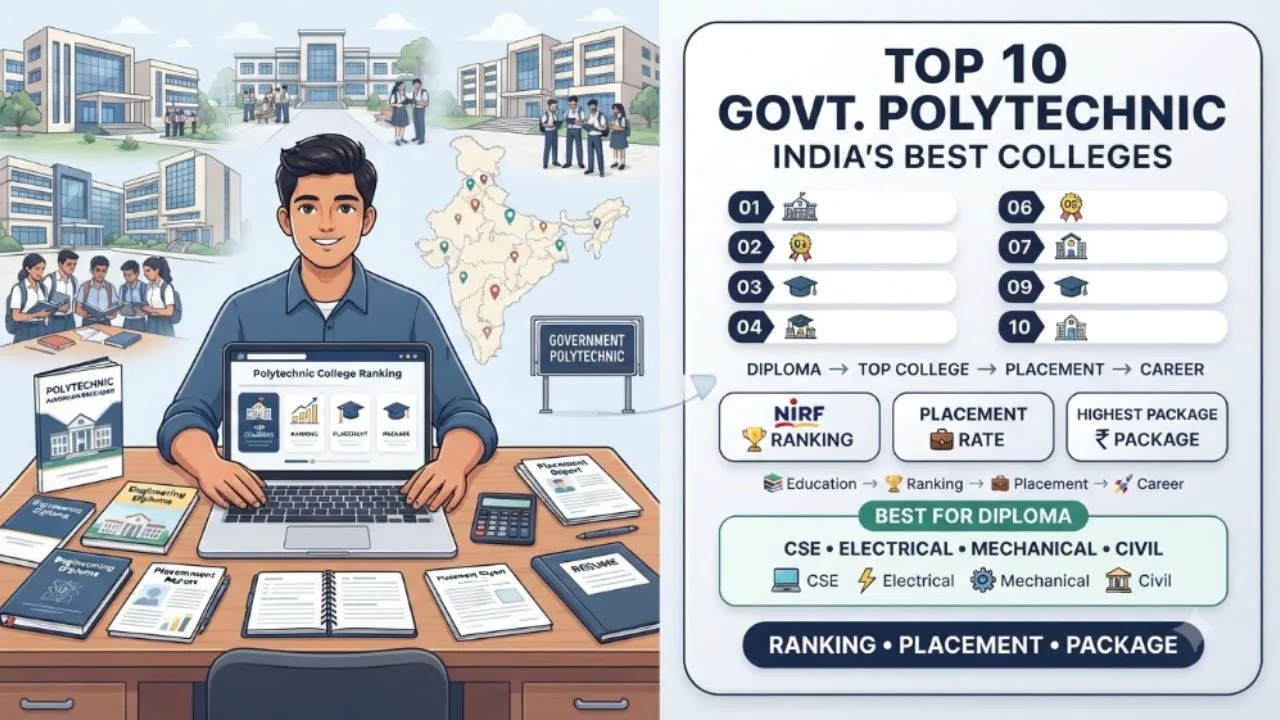
One point needs clarification before looking at rankings. NIRF does not publish a separate national ranking category for standalone polytechnic colleges. Its India Rankings cover categories such as Engineering, Colleges, Universities and other higher-education institutions, but diploma-only government polytechnics are not ranked through a dedicated NIRF list.
Therefore, a list titled “Top 10 Government Polytechnic Colleges in India” should not be presented as an official NIRF ranking. The colleges below are better viewed as a practical shortlist based on institutional reputation, government status, academic profile, industry exposure, infrastructure and placement activity.
Table of Contents
Top 10 Government Polytechnic Colleges in India
1. Government Polytechnic Mumbai, Maharashtra
Government Polytechnic Mumbai is one of the country’s long-established government diploma institutes. Established in 1960, the institute is academically autonomous and offers diploma programmes across several technical disciplines.
Its programmes include Civil, Mechanical, Computer, Electrical, Electronics, Information Technology, Instrumentation and Artificial Intelligence and Machine Learning.
Its location in Mumbai is another advantage because the city has a large base of manufacturing, engineering, infrastructure, technology and service companies.
The institute has reported recruiters including Tata Power, Larsen & Toubro, Tata Consultancy Engineers, Voltas, Bajaj Auto, Shapoorji Pallonji and other companies.
2. Government Polytechnic Pune, Maharashtra
Government Polytechnic Pune was established in 1957 and operates as an autonomous institute under the Government of Maharashtra.
It offers diploma programmes in Mechanical, Computer, Civil, Electrical, Electronics and Telecommunication, Metallurgy and other disciplines.
The institute has a substantial campus and a dedicated training and placement system.
Recent placement activity has included companies such as Alfa Laval, Triumph Motorcycles, NMTronics and other engineering employers.
Older placement records also show recruitment by Tata Motors, L&T, Cummins, Thermax and Bajaj Auto.
Because the institute is located in Pune, students are close to a major automobile, manufacturing, engineering and technology hub.
3. Pusa Institute of Technology, Delhi
Pusa Institute of Technology, formerly known as Pusa Polytechnic, is one of Delhi’s oldest government technical institutes.
The institute was established in 1962 and operates under Delhi’s Directorate of Training and Technical Education.
Diploma programmes have included Automobile Engineering, Civil Engineering, Construction Technology, Electrical Engineering, Electronics and Communication Engineering, Mechanical Engineering and Printing Technology.
Its location provides students access to Delhi’s large industrial, construction, automobile and service-sector employment market.
For students looking at government diploma education in Delhi, Pusa remains an important institute to consider.
4. Government Polytechnic Ahmedabad, Gujarat
Government Polytechnic Ahmedabad is another established government technical institute serving diploma students in Gujarat.
The institute offers technical education across engineering disciplines and provides an affordable alternative to many private diploma colleges.
Its location in Ahmedabad is useful for students interested in manufacturing, engineering, electrical equipment, construction and automobile-related industries.
Students should check the current admission notification for branch availability, intake, eligibility and fee details because these can change between academic sessions.
5. Government Polytechnic Lucknow, Uttar Pradesh
Government Polytechnic Lucknow is a recognised government diploma institute in Uttar Pradesh.
It is particularly relevant for students looking for technical education in the state capital and nearby districts.
Popular diploma areas include Civil Engineering, Mechanical Engineering, Electrical Engineering and other technical disciplines, depending on the current academic offering.
The institute’s location provides access to government departments, construction companies, infrastructure projects and technical employers operating across Lucknow and surrounding areas.
Admission generally follows the rules prescribed by the Uttar Pradesh technical education admission system.
6. Government Polytechnic Nagpur, Maharashtra
Government Polytechnic Nagpur is another established option for students seeking government-funded diploma education in Maharashtra.
Nagpur’s position as a major transport, industrial and logistics centre creates opportunities across mechanical, electrical, civil and related engineering sectors.
Students can consider the institute for diploma education where the available branch matches their career plans.
As with other Maharashtra government polytechnics, applicants should check the current Directorate of Technical Education admission process before applying.
7. Government Polytechnic Bengaluru, Karnataka
Government Polytechnic Bengaluru is an established technical education institute serving diploma-level students in Karnataka.
Its location in Bengaluru gives students access to one of India’s largest technology and engineering employment markets.
Computer-related branches can benefit from the city’s technology ecosystem, while Mechanical, Civil, Electrical and Electronics students can explore opportunities across manufacturing, infrastructure and engineering services.
The presence of a large industrial and technology ecosystem does not guarantee campus placement, but it can provide useful opportunities for internships and employment searches.
8. Government Polytechnic Gandhinagar, Gujarat
Government Polytechnic Gandhinagar is another government institution worth considering when comparing diploma colleges in Gujarat.
The institute provides technical education across engineering and technology disciplines, with practical learning forming an important part of diploma education.
Gandhinagar and nearby Ahmedabad have a wide industrial base covering engineering, manufacturing, construction, electrical and technology-related businesses.
Students can therefore benefit from the broader employment ecosystem surrounding the institute.
9. Government Polytechnic Aurangabad, Maharashtra
Government Polytechnic Aurangabad is a prominent government diploma institute in the Marathwada region.
The institute serves students interested in engineering and technical education without the higher fee burden associated with many private colleges.
Aurangabad’s industrial environment includes automobile, manufacturing and engineering companies, creating a relevant setting for Mechanical, Electrical, Civil and related diploma branches.
Students comparing colleges should look at current placement records rather than relying only on the reputation of the institute.
10. Government Polytechnic Chennai, Tamil Nadu
Government Polytechnic Chennai is another option for students interested in government technical education in Tamil Nadu.
Chennai has a strong industrial base covering automobiles, electronics, manufacturing, engineering services and infrastructure.
This makes the city particularly relevant for diploma students looking for industrial exposure.
The suitability of the institute depends on the branch, admission eligibility, fees and current placement activity.
Government Polytechnic Fees and State Subsidies
Government polytechnic colleges are generally more affordable because they receive substantial public funding and operate under state technical education systems.
However, there is no single fee structure for all government polytechnics in India.
| College | Admission Route | Typical Fee Position | Main Advantage |
| Government Polytechnic Mumbai | Maharashtra DTE/CAP | Low government fee; concessions available for eligible categories | Industry exposure and Mumbai location |
| Government Polytechnic Pune | Maharashtra DTE/CAP | Subsidised government fee | Strong engineering ecosystem |
| Pusa Institute of Technology | Delhi diploma admission system | Government-subsidised | Delhi location |
| Government Polytechnic Ahmedabad | Gujarat admission system | Government-subsidised | Affordable technical education |
| Government Polytechnic Lucknow | UP admission system | Government fee structure | Access to Lucknow region |
| Government Polytechnic Nagpur | Maharashtra DTE/CAP | Subsidised | Industrial and logistics hub |
| Government Polytechnic Bengaluru | Karnataka admission system | Government fee structure | Bengaluru employment ecosystem |
| Government Polytechnic Gandhinagar | Gujarat admission system | Subsidised | Industrial region |
| Government Polytechnic Aurangabad | Maharashtra DTE/CAP | Subsidised | Manufacturing exposure |
| Government Polytechnic Chennai | Tamil Nadu admission system | Government fee structure | Strong industrial base |
The exact amount can vary according to the state, branch, category and applicable financial assistance.
For example, Government Polytechnic Mumbai lists a substantially lower fee for eligible categories under its applicable concessions.
Students should compare the total payable amount rather than assuming that every government institute charges the same annual fee.
Eligibility for Government Polytechnic Admission
Most three-year engineering diploma programmes admit students after Class 10.
Mathematics and Science requirements are common for engineering branches, although exact eligibility varies between states and programmes.
Admission may be based on a state entrance examination, Class 10 merit, counselling or another process notified by the respective technical education authority.
For Maharashtra colleges such as Government Polytechnic Mumbai and Government Polytechnic Pune, admissions are handled through the state’s centralised admission process.
Applicants from other states should follow the rules of their respective admission authority.
Placement Rates and Highest Packages
Placement data needs careful interpretation when comparing polytechnic colleges.
Unlike engineering colleges, diploma institutes do not always publish a standardised placement percentage using the same calculation.
Some colleges report the number of students selected, while others publish the number of companies visiting campus.
A college may also have different placement outcomes across branches.
Computer Engineering students can face a very different recruitment market from Civil or Mechanical students.
Government Polytechnic Mumbai, for example, reports recruitment by several engineering and industrial companies and publishes programme-wise placement information.
Government Polytechnic Pune also maintains placement records showing recruitment across Mechanical, Electrical, Civil and other disciplines.
Instead of focusing only on the “highest package,” look at the number of students placed, recruiter quality, branch-wise hiring and the type of jobs offered.
A very high individual package does not necessarily represent the experience of most diploma graduates.
Top Recruiters for Government Polytechnic Students
Recruiters vary by college and academic year.
Companies that have appeared in placement records of leading government polytechnics include Tata Motors, Tata Power, Larsen & Toubro, Cummins, Bajaj Auto, Voltas, Thermax, Alfa Laval and other engineering organisations.
The presence of a major company on a recruiter list does not mean every branch receives the same opportunity.
Recruitment can depend on technical skills, academic performance, location, vacancy requirements and the company’s hiring policy.
Students should therefore check the latest branch-wise placement information before choosing an institute.
Can Diploma Students Enter Tier-1 B.Tech Colleges Directly?
One of the strongest advantages of a polytechnic diploma is the possibility of lateral entry into an engineering degree.
Eligible diploma holders can apply for direct admission to the second year of B.Tech or B.E. through lateral-entry routes.
However, the phrase “direct entry into Tier-1 B.Tech” needs some clarification.
A diploma does not automatically provide entry into IITs, NITs or other highly competitive engineering institutions.
Lateral-entry admissions are governed by the rules of the particular university, state or institution.
Some states conduct separate lateral-entry examinations, while others use diploma marks or centralised counselling.
Students from a government polytechnic can therefore progress to a strong engineering college, but they must qualify through the applicable admission process.
This route can be particularly useful for students who want to combine early practical education with a later engineering degree.
Polytechnic Diploma or B.Tech Through Lateral Entry?
The diploma-plus-degree route takes longer than entering B.Tech directly after Class 12, but it offers a different learning experience.
A student completing a three-year diploma after Class 10 can gain technical training before entering the second year of an eligible engineering degree.
This can provide both a diploma qualification and an engineering degree.
For students who prefer practical learning or want to start technical work earlier, the route can make sense.
Those who already know that they want a conventional engineering degree and can comfortably complete Class 12 may prefer the direct B.Tech pathway.
How to Choose Among the Top Government Polytechnics
Do not select a college only because it appears on a “top 10” list.
First, check whether the branch you want is available.
Then compare admission eligibility, total fees, hostel requirements, industrial training, laboratories and recent placement activity.
Location also matters.
A college located near an industrial cluster can provide useful internship and employment exposure.
Finally, examine lateral-entry opportunities if your long-term plan includes B.Tech.
Final Words
The top government polytechnic colleges in India combine affordable education with practical technical training and access to established industrial regions. Government Polytechnic Mumbai, Government Polytechnic Pune and Pusa Institute of Technology are among the better-known names for diploma education, while several state government institutes provide strong alternatives in their respective regions.
There is no official NIRF ranking exclusively for standalone polytechnic colleges, so students should avoid treating online “NIRF polytechnic rankings” as official. Placement rates and highest packages also vary by branch and year. The better comparison is based on recent recruitment, practical training, fees, facilities, industry exposure and opportunities for further education.