After Class 10, students who want technical education often compare two practical options: ITI and Polytechnic Diploma. Both can lead to technical jobs, apprenticeships and government recruitment, but the training and career paths are quite different.
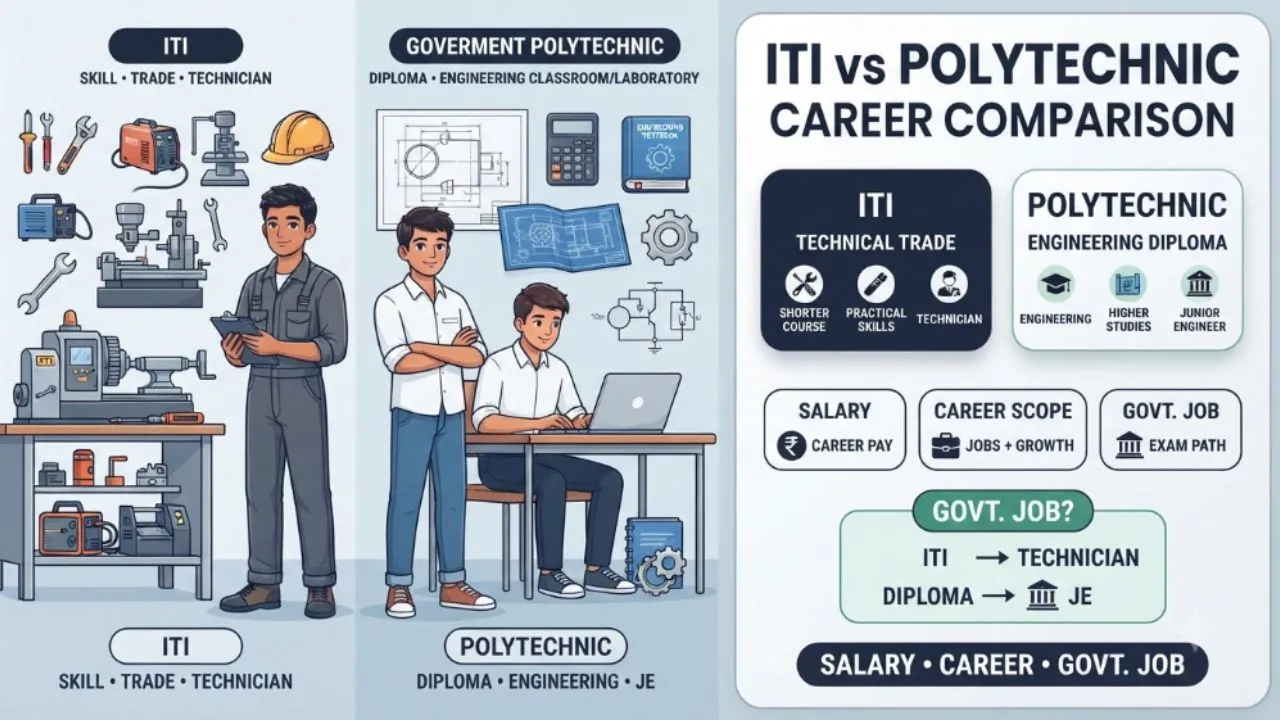
ITI courses are usually shorter and focus strongly on trade-based practical skills. Polytechnic diploma programmes provide broader engineering knowledge and are generally considered a step closer to an engineering degree. The better option depends on how quickly you want to enter employment, the type of technical work you prefer and whether you plan to pursue higher education later.
Table of Contents
ITI vs Polytechnic: Key Differences
| Factor | ITI | Polytechnic Diploma |
| Entry qualification | Usually Class 10, depending on trade | Usually Class 10 |
| Course duration | Generally 1–2 years, depending on trade | Generally 3 years |
| Main focus | Trade skills and practical work | Engineering concepts with practical training |
| Learning depth | Specific trade-based training | Broader technical and engineering subjects |
| Common roles | Technician, fitter, electrician, machinist, welder | Junior Engineer, technician, supervisor, technical assistant |
| Industry position | Skilled trade workforce | Diploma-level technical workforce |
| Higher study route | Can progress to Polytechnic through eligible lateral-entry routes | Can pursue B.Tech through lateral entry where permitted |
| Government recruitment | Strong for trade-based posts and apprenticeships | Strong for diploma-level technical posts |
| Starting career speed | Usually faster | Takes longer because the course is longer |
| Career ceiling | Can improve with experience and further qualifications | Generally broader opportunities for technical and supervisory progression |
The difference is not simply about which course is better. ITI prepares a person for a particular trade, while Polytechnic provides a wider engineering foundation.
What Is an ITI Course?
Industrial Training Institute courses are designed around specific technical trades. Popular options include Electrician, Fitter, Welder, Turner, Machinist, Mechanic Motor Vehicle, Electronics Mechanic and other trade-based programmes.
The duration depends on the trade. Some courses can be completed in one year, while several popular trades require two years. Practical training forms a major part of ITI education. Students spend considerable time learning how tools, machines and industrial equipment are operated.
This makes ITI suitable for someone who wants to acquire a specific skill and enter the workforce relatively quickly. After completing an ITI trade, candidates can pursue apprenticeships, private technical jobs and government recruitment for posts where the particular trade qualification is accepted.
What Is a Polytechnic Diploma?
A Polytechnic Diploma in Engineering is a broader technical programme, generally lasting three years after Class 10. Common branches include Mechanical Engineering, Civil Engineering, Electrical Engineering, Computer Engineering, Electronics Engineering and Automobile Engineering.
The curriculum includes mathematics, engineering science, technical subjects, laboratory work, workshops and project-based learning. A diploma holder therefore develops a wider understanding of an engineering discipline than someone trained only in a specific ITI trade.
For example, an ITI Electrician learns practical electrical installation and maintenance skills, while a Diploma in Electrical Engineering covers electrical machines, power systems, measurements, control systems and other engineering subjects.
This broader academic foundation becomes particularly useful for students who eventually want to pursue B.Tech through lateral entry.
Which Course Gets a Government Job Faster?
If the only objective is to enter a government technical job as quickly as possible, ITI can have an advantage because many trades can be completed within one or two years.
Railway apprenticeships and technician-related recruitment frequently include ITI-based eligibility for specific trades. Government departments, public-sector organisations and industrial employers also recruit ITI candidates for trade-specific positions and apprenticeship training.
A Polytechnic Diploma takes longer, but it can open a different category of technical recruitment. Diploma holders can become eligible for various Junior Engineer and other diploma-level technical posts, depending on the recruiting organisation and branch requirements.
So, the faster route depends on the type of government job you are targeting. For a trade-based technician or apprentice position, ITI can be the quicker route.
For Junior Engineer recruitment, a relevant Polytechnic Diploma is generally the more appropriate qualification.
Government Job Eligibility Map: ITI vs Polytechnic
The qualification required for government recruitment is decided by the individual notification. There is no universal rule that every PSU or government department prefers ITI or Diploma candidates.
Railways
Railway recruitment includes opportunities for both ITI and Diploma holders. ITI candidates are particularly relevant for trade-based apprenticeships and technician positions where a specific trade is prescribed.
Diploma holders can qualify for technical posts that specifically require a diploma in an engineering discipline.
For example, an ITI Fitter and a Diploma Mechanical Engineering candidate may both work in technical railway environments, but they are not necessarily eligible for the same recruitment.
PSUs and Industrial Organisations
Public-sector companies such as BHEL, NTPC, SAIL, ONGC, Coal India subsidiaries and other industrial organisations periodically recruit apprentices, technicians or diploma trainees.
ITI candidates are commonly considered for trade apprenticeship and skilled technician categories.
Diploma holders are more relevant to technician apprenticeships, diploma trainee positions and engineering-related technical posts where a diploma is prescribed.
The exact branch requirement matters. A Diploma Civil Engineering candidate cannot automatically apply for a post requiring Electrical Engineering.
State PWDs and Technical Departments
State Public Works Departments and other state technical departments commonly advertise Junior Engineer and similar positions.
These posts often require a diploma or degree in the relevant engineering discipline.
As a result, Polytechnic has an advantage when the target is a Junior Engineer career in Civil, Electrical, Mechanical or another specified branch.
ITI qualifications generally do not replace the diploma requirement for a Junior Engineer post unless the notification specifically permits it.
Electricity Boards and Utilities
State electricity departments and power utilities can recruit both ITI and Diploma candidates.
ITI Electricians may qualify for technician, lineman or trade-related positions when the required qualification and certificates are mentioned.
Diploma Electrical Engineering candidates can target technical and Junior Engineer-level recruitment where a diploma is prescribed.
Again, the designation alone is not enough. The eligibility section of the recruitment notice determines who can apply.
Salary Comparison: ITI vs Polytechnic
Salary varies significantly according to the employer, location, trade, branch, recruitment category and experience.
ITI candidates entering apprenticeships may receive a stipend rather than a regular employee salary during training.
After apprenticeship, earnings depend on whether the candidate joins a private company, clears government recruitment or develops specialised technical skills.
Polytechnic diploma holders can also start with modest salaries in private companies, particularly as freshers.
However, diploma holders who qualify for Junior Engineer recruitment or other structured technical positions can access higher starting pay scales than many entry-level trade roles.
Government salary should always be checked against the specific recruitment notification because basic pay, allowances and benefits differ between organisations.
A candidate should therefore avoid comparing ITI and Diploma solely through advertised salary figures.
Career Scope After ITI
ITI provides a direct route into skilled technical work. A Fitter can work in maintenance and manufacturing environments. An Electrician can find opportunities in electrical installation, maintenance and industrial services.
Machinists can work with manufacturing equipment, while Motor Vehicle Mechanic candidates can enter automobile workshops and service operations.
Apprenticeships are another important route. Industrial organisations often use apprenticeship programmes to provide practical training to candidates with ITI qualifications.
With experience, additional certifications and specialised skills, an ITI-qualified worker can progress into more responsible technical positions.
Entrepreneurship is also possible. Electricians, mechanics, welders, fabricators and other skilled tradespeople can establish their own service businesses after gaining sufficient experience.
Career Scope After Polytechnic
A Polytechnic Diploma provides a wider technical career structure. Depending on the branch, graduates can work as Junior Engineers, site supervisors, technical assistants, maintenance staff, CAD operators, production personnel or other technical employees.
Civil diploma holders can explore construction, infrastructure and surveying-related work. Mechanical diploma holders can enter manufacturing, production, maintenance and automobile industries.
Electrical diploma holders can work in power, electrical maintenance, industrial systems and infrastructure. Computer and IT-related diploma holders can pursue technical support, networking, software-related and other technology roles depending on their skills. The diploma also creates a pathway towards higher engineering education.
ITI to Polytechnic: The Progression Path
One of the biggest advantages of choosing ITI is that the qualification does not necessarily end your technical education.
Eligible ITI holders can pursue Polytechnic through lateral-entry admission in states or institutions where such provisions are available.
Under applicable rules, candidates may be admitted directly into an advanced stage of a diploma programme rather than starting from the beginning. The exact eligibility differs by state, trade, institution and admission authority.
Some routes require a specific ITI trade, while others may specify the duration of the ITI course or additional academic requirements.
For this reason, an ITI student planning to move into Polytechnic should check the latest lateral-entry notification in the state where admission is sought.
This progression can be useful for someone who wants to start with practical trade training and later build a broader engineering qualification. The pathway can look like this:
Class 10 → ITI → Work/Apprenticeship → Eligible Lateral Entry into Polytechnic → Diploma → Further technical jobs or B.Tech lateral entry
Not every ITI trade automatically qualifies for every Polytechnic branch. The trade and diploma discipline usually need to satisfy the admission authority’s rules.
Which Is Better for Quick Placement?
ITI generally has the advantage when speed is the main priority. A one- or two-year trade course can get a candidate ready for apprenticeship or entry-level technical work sooner than a three-year diploma.
Polytechnic becomes more attractive when the goal is a broader technical career, Junior Engineer recruitment or eventual progression into B.Tech.
The difference is particularly clear for students targeting government jobs. Someone aiming for a Railway trade apprenticeship may find ITI more directly aligned with the requirement.
Someone preparing for a Junior Engineer vacancy in a state PWD or technical department will generally need the relevant diploma.
Which Course Should You Choose?
Choose ITI if you want to learn a specific trade, prefer hands-on work and want to enter the workforce quickly.
It is particularly suitable for students interested in electrical work, fitting, welding, machining, automobile repair and similar technical occupations.
Choose Polytechnic if you want broader engineering education and are considering Junior Engineer recruitment, supervisory technical roles or B.Tech later.
The choice should also consider the quality of the institute, available trade or branch, local employment opportunities and total education cost.
A strong ITI with good practical training can be more useful than a poorly equipped diploma college.
Likewise, a good Polytechnic with laboratories, experienced faculty and industrial exposure can provide a stronger foundation for long-term engineering careers.
Final Verdict
ITI and Polytechnic serve different purposes within technical education. ITI is usually the faster route to a skilled trade, apprenticeship or technician-level employment. Polytechnic takes longer but offers broader engineering knowledge and stronger access to diploma-level technical positions. For Railway apprenticeships and trade-specific technician recruitment, ITI can be the more direct qualification. For Junior Engineer positions in Railways, PWDs, utilities and other technical organisations where a diploma is prescribed, Polytechnic is generally the better route.
There is also no need to view the two as completely separate paths. An ITI holder who meets the applicable requirements can progress into Polytechnic through lateral-entry admission and continue building qualifications. If earning sooner through a specific technical trade is the priority, ITI deserves serious consideration. If you want broader engineering options and plan to target Junior Engineer roles or pursue B.Tech, a Polytechnic Diploma is usually the stronger starting point.