Government jobs remain a popular career choice after Class 12 because they offer stable employment, structured salaries and opportunities for long-term growth. The challenge is choosing an exam that matches your qualification and preparation level.
Not every government recruitment exam requires advanced mathematics, difficult reasoning or years of preparation. Some exams have comparatively simple syllabi and allow candidates to compete with a manageable preparation strategy.
However, “easy” does not mean that selection is guaranteed. Competition, vacancies, category-wise cutoffs and recruitment rules change from one notification to another.
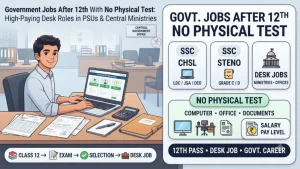
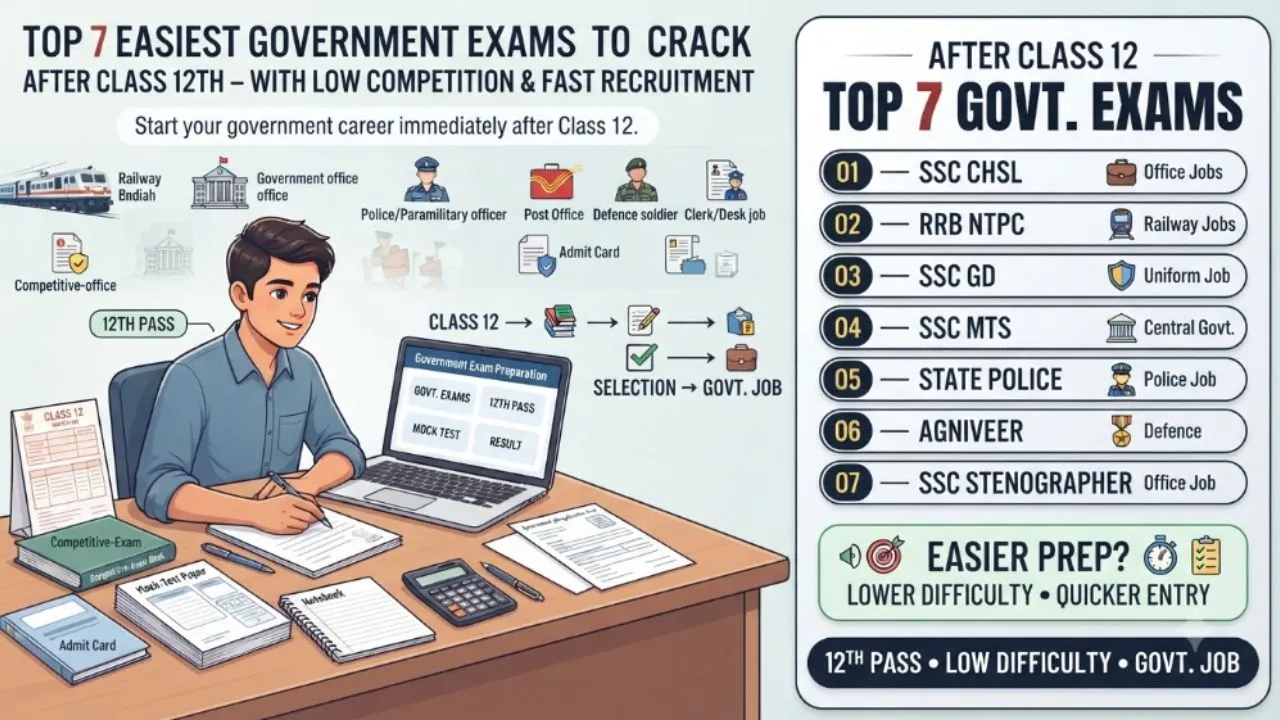
For Class 12 pass candidates, exams such as SSC CHSL, SSC MTS, RRB Group D, India Post GDS and State Police Constable recruitment can be practical options. Other state-level and departmental recruitments can also provide opportunities.
Table of Contents
What Makes a Government Exam Easier to Crack?
An exam becomes comparatively easier when its syllabus matches the level of the candidate and the selection process does not involve highly specialised subjects. For many Class 12 candidates, basic mathematics, reasoning, English, general awareness and elementary computer knowledge are easier to prepare than advanced technical subjects.
The number of vacancies also matters. A recruitment drive with more posts can provide more opportunities, although the number of applicants can still be very high. The selection process is another factor. Some recruitments involve only written tests and document verification, while others include physical tests, skill tests or medical examinations. For this reason, candidates should compare the complete selection process rather than looking only at the written examination.
1. SSC CHSL
The Staff Selection Commission Combined Higher Secondary Level examination is one of the most popular government exams for Class 12 pass candidates.
SSC CHSL recruits candidates for posts such as Lower Division Clerk, Junior Secretariat Assistant and Data Entry Operator, depending on the recruitment cycle.
The written syllabus mainly covers English, General Intelligence, Quantitative Aptitude and General Awareness.
For a candidate with reasonable Class 10 and Class 12 fundamentals, the syllabus is manageable with regular practice.
The main challenge is competition. SSC examinations attract a large number of applicants, so accuracy and speed become extremely important.
There is no physical fitness test for the standard CHSL selection process. Some posts can have additional requirements, so candidates should check the notification carefully.
Why SSC CHSL Can Be a Good Choice
The exam provides access to central government departments and offers several clerical and data-entry positions.
Candidates preparing for CHSL can also develop a foundation useful for other SSC examinations.
The recruitment process can take time because several stages and administrative procedures are involved. Therefore, it should not be considered a guaranteed quick recruitment route.
2. SSC MTS
SSC Multi-Tasking Staff is another entry-level central government recruitment option. The examination is designed around basic-level mathematics, reasoning, general awareness and English.
The academic difficulty is generally lower than that of many graduate-level competitive examinations. That makes SSC MTS attractive to candidates who want to enter government service without preparing for advanced quantitative or technical subjects.
The actual selection process can include examination stages and, for certain posts or categories of recruitment, additional requirements. Candidates should read the relevant notification because eligibility, vacancies and selection stages can change.
SSC MTS is particularly suitable for candidates who are consistent with basic arithmetic, reasoning questions and general awareness.
3. RRB Group D
Railway recruitment is among the most sought-after options for candidates looking for government employment after school-level education. RRB Group D recruitment covers various Level 1 posts in the Indian Railways.
The written examination generally tests Mathematics, General Intelligence and Reasoning, General Science and General Awareness.
The syllabus is based largely on school-level fundamentals, but the competition can be intense because of the large number of applicants.
Unlike SSC CHSL and some other clerical examinations, RRB Group D also involves a Physical Efficiency Test after the computer-based examination. Candidates therefore need both academic preparation and physical fitness.
The qualification for RRB Group D is determined by the specific recruitment notification and can include Class 10 or ITI-related eligibility. Class 12 candidates can apply when they satisfy the prescribed conditions.
Why RRB Group D Is Worth Considering
Railway recruitment offers a large employment network and multiple work locations. Candidates interested in technical and operational railway work may find the job structure attractive.
The recruitment timeline, however, depends on the Railway Recruitment Boards and the particular recruitment cycle. Large-scale railway recruitment should not automatically be treated as fast recruitment.
4. India Post GDS
India Post Gramin Dak Sevak recruitment is different from the other examinations on this list because selection is generally based on Class 10 marks rather than a conventional competitive written examination.
This is one reason GDS is often considered a relatively low-barrier government recruitment option.
Candidates must meet the eligibility requirements specified in the notification, including educational qualifications and other conditions. The merit-based process makes Class 10 academic performance particularly important.
There is no conventional competitive written test for the standard GDS selection process. That does not mean everyone with good marks will receive a post. Selection depends on merit, vacancies, category, preferences and other rules applicable to the recruitment cycle.
For candidates with strong Class 10 marks who want to avoid a difficult written examination, GDS can be an option worth monitoring.
5. State Police Constable Recruitment
State Police Constable recruitment provides another route for Class 12 pass candidates. The exact eligibility and selection process differs between states, but recruitment commonly includes a written examination followed by physical tests and medical assessment.
The written examination usually covers general knowledge, reasoning, basic mathematics and state-specific awareness. The academic difficulty is often manageable compared with higher-level competitive examinations.
The physical stage is where many candidates face difficulty. Running, height, physical measurements and other requirements vary according to the state and category.
Anyone considering police recruitment should start physical preparation alongside written preparation. A candidate with good fitness and reasonable academic fundamentals can find this route practical.
6. State-Level Group C and Clerical Recruitment
State governments periodically conduct recruitment for clerical, assistant, data-entry and other Group C positions. Eligibility can range from Class 10 to Class 12 or graduation, depending on the post.
These examinations often include subjects such as general knowledge, reasoning, mathematics, language and computer awareness.
The advantage of state-level recruitment is that candidates can target jobs within their state and prepare around a familiar syllabus.
State-specific general knowledge can become an important scoring area. The competition varies considerably between states and recruitment boards.
Candidates should track their state public service commission, subordinate services board and other official recruitment authorities for notifications matching their qualification.
7. State Forest Guard Recruitment
Forest Guard recruitment can be another option for candidates who meet the educational and physical requirements.
The written examination generally covers general knowledge, reasoning, mathematics, science and state-specific topics.
The academic level is often manageable for candidates with strong school fundamentals. Physical fitness is an important part of this recruitment.
Depending on the state, candidates may have to meet requirements related to height, physical measurements, walking or running tests and medical fitness. The job itself can involve outdoor duties, field inspections and work in forest areas.
It therefore suits candidates who prefer active field-based government work rather than a desk-based position.
Comparing the Difficulty and Selection Process
Among these options, India Post GDS has one of the lowest written-exam barriers because standard GDS selection does not involve a conventional competitive examination.
SSC MTS and SSC CHSL mainly require preparation in basic mathematics, reasoning, English and general awareness. CHSL usually demands greater speed and accuracy because of the level of competition and the nature of its posts. RRB Group D has a school-level academic syllabus but adds a physical efficiency stage.
Police Constable and Forest Guard recruitment can have relatively manageable written papers, but physical requirements can become a major selection barrier.
State-level clerical recruitment falls somewhere in between because difficulty depends heavily on the particular examination and the number of applicants.
There is no universal ranking of the easiest government exams. A candidate strong in academics may find SSC examinations easier, while someone with strong physical fitness may prefer police or forest recruitment.
Which Exam Has the Fastest Recruitment?
Recruitment speed depends more on the conducting authority and recruitment cycle than on the difficulty of the examination.
A simple exam can still take months because applications, examinations, answer keys, results, document verification and appointments require administrative processing.
Large national recruitments can take considerable time because they involve thousands of candidates. State-level recruitment can sometimes move faster, but this is not guaranteed.
Candidates should therefore avoid choosing an examination solely because someone describes it as a “fast government job.” The better approach is to prepare for several compatible recruitments at the same time.
How to Prepare Alongside Diploma or Degree Studies
Preparing for government examinations does not require leaving regular education. A practical schedule can give you enough preparation time without affecting college work.
Start with two hours a day during normal academic periods. Use one session for mathematics and reasoning, another for English or general awareness, and reserve additional time for mock tests on weekends.
During examination breaks, increase preparation time and focus more heavily on full-length tests. The syllabus overlaps significantly across SSC, railway and several state-level examinations.
For example, arithmetic topics such as percentages, profit and loss, ratio, averages and simple interest appear across multiple competitive exams. Reasoning topics such as coding-decoding, series, analogy, classification and basic logical questions are also widely useful.
A Practical Preparation Strategy
Begin by completing the basic concepts rather than immediately attempting difficult mock papers. Once the fundamentals are clear, solve previous-year questions regularly.
Keep a separate notebook for repeated mistakes. If you repeatedly lose marks in percentages or time-and-work questions, revise those topics instead of simply attempting more random questions.
General awareness requires consistent revision because the syllabus is broad. Read current affairs regularly and revise important national, state and government-related developments.
For police and forest recruitment, add physical training several months before the expected examination period. Do not wait for the written result before starting physical preparation.
Final Words
SSC CHSL, SSC MTS, RRB Group D, India Post GDS, State Police Constable, state-level clerical recruitment and Forest Guard exams can provide practical government job opportunities for eligible Class 12 candidates.
SSC exams are suitable for candidates comfortable with mathematics, reasoning, English and general awareness. Railway, police and forest recruitment can suit candidates who are prepared to meet physical requirements along with the written syllabus.
The smartest approach is not to search for an exam that requires the least effort. Instead, select examinations with overlapping syllabi and prepare consistently alongside your diploma or degree. That approach gives you more opportunities without forcing you to start preparation from scratch for every government recruitment notification.