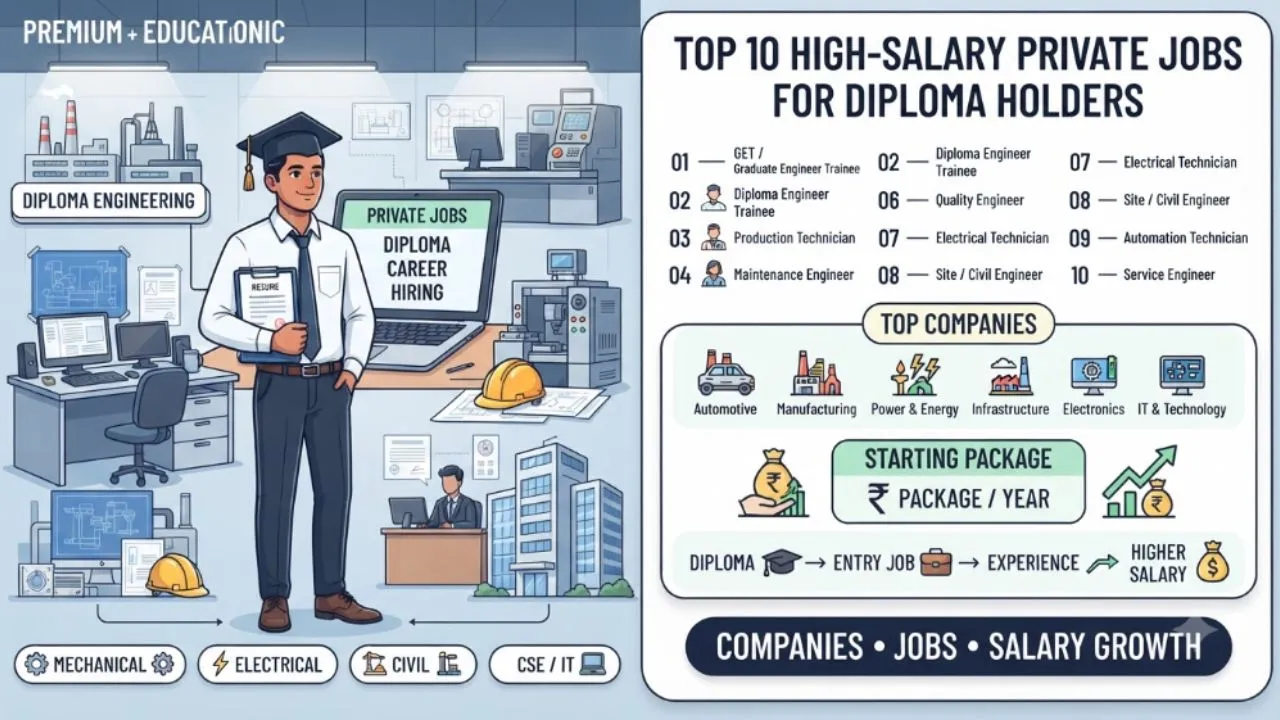
A diploma can lead to several private-sector careers without requiring a B.Tech degree first. Manufacturing, construction, automobiles, power, electronics, and IT companies regularly hire diploma holders for technical positions.
The starting salary depends on the branch, location, company, practical skills, and recruitment route. A Mechanical diploma holder, for instance, may enter production or maintenance, while a Computer diploma holder may begin in technical support or software-related operations.
For candidates planning to start working soon after a three-year diploma, private employment can provide both income and valuable industry experience.
Table of Contents
1. Junior Engineer
Junior Engineer is one of the most common private-sector roles for diploma holders, particularly in Civil, Electrical and Mechanical Engineering.
The work varies by industry. Civil diploma holders may handle site supervision, measurements, drawings and contractor coordination. Electrical and Mechanical candidates can work with equipment, maintenance and production systems.
Companies generally look for candidates who understand technical drawings, safety procedures, equipment operation and basic documentation.
Freshers may start around ₹15,000 to ₹25,000 per month, although reputed employers and specialised locations can offer more.
With experience, the role can progress toward Senior Engineer, Supervisor or other technical leadership positions.
2. Diploma Engineer Trainee (DET)
Diploma Engineer Trainee, commonly called DET, is a popular entry route in manufacturing and engineering companies.
A DET normally undergoes structured training before moving into a regular technical position. The training may cover production processes, quality control, maintenance, safety and plant operations.
Mechanical, Electrical, Automobile, Electronics and related diploma branches are commonly considered for these positions.
Starting packages can range from around ₹2.5 lakh to ₹4.5 lakh annually, depending on the company and location.
DET positions are particularly useful for freshers because the first year combines employment with practical exposure to industrial systems.
3. Graduate Engineer Trainee and Technician Roles
Diploma holders should distinguish between GET and DET vacancies before applying.
GET usually refers to Graduate Engineer Trainee and is primarily intended for engineering degree holders. Diploma candidates should generally search for DET, Diploma Engineer Trainee, Technician Trainee, Junior Engineer or similar positions.
Some companies use different job titles for comparable entry-level technical positions. Reading the eligibility section carefully can prevent applications for unsuitable vacancies.
Technician trainee roles can offer approximately ₹18,000 to ₹30,000 per month at entry level, depending on the employer and technical discipline.
4. Production Engineer or Production Technician
Production is a major employment area for Mechanical, Automobile, Electrical and related diploma holders.
Production professionals monitor manufacturing lines, machines, output quality and production schedules. They may also coordinate with maintenance and quality teams when technical problems affect production.
Automobile and engineering manufacturing companies recruit diploma holders for shop-floor positions because practical knowledge is particularly valuable in these environments.
Large manufacturers may offer starting packages around ₹2.5 lakh to ₹4.5 lakh annually. Shift allowances and overtime can sometimes increase overall earnings.
After two or three years, experienced employees can move into production supervision, process coordination or specialised manufacturing roles.
5. Maintenance Engineer or Technician
Maintenance is another strong private-sector career path for diploma holders.
Factories depend on electrical, mechanical and instrumentation teams to keep machinery operating safely. Maintenance employees inspect equipment, identify faults and assist with preventive maintenance.
Electrical and Mechanical diploma holders are particularly relevant for these positions.
Typical entry salaries can fall around ₹2.4 lakh to ₹4.2 lakh annually. Candidates with experience in PLCs, industrial automation, hydraulics, pneumatics or electrical control systems can improve their prospects.
Industries such as steel, cement, automobiles, power, mining and heavy engineering provide substantial maintenance opportunities.
6. Quality Control Technician
Quality control roles suit diploma holders who are comfortable with measurements, technical standards, inspection procedures and documentation.
A quality technician may inspect raw materials, monitor production output, record measurements and identify defects. In engineering plants, knowledge of instruments and technical drawings can be valuable.
Mechanical, Electrical, Automobile and Production-related diploma holders can find opportunities in this area.
Freshers may receive around ₹2.2 lakh to ₹4 lakh annually, with higher packages possible in specialised manufacturing companies.
Additional knowledge of quality tools, measurement equipment and manufacturing standards can help candidates move into quality engineering positions.
7. Site Engineer or Construction Supervisor
Civil Engineering diploma holders have a strong presence in construction and infrastructure projects.
Private construction companies hire diploma holders to supervise site activities, coordinate workers, check measurements and assist engineers with project execution.
The work can involve residential projects, commercial buildings, roads, industrial structures and infrastructure development.
Entry salaries commonly fall between ₹15,000 and ₹28,000 per month, depending on the project and location.
Site experience becomes increasingly valuable over time. After three years, a capable diploma holder may handle larger responsibilities as a senior site supervisor or project coordinator.
8. Electrical Technician and Maintenance Specialist
Electrical diploma holders can explore opportunities in manufacturing plants, infrastructure companies, commercial facilities, power-related businesses and industrial maintenance.
Typical responsibilities include electrical installation, equipment inspection, preventive maintenance, troubleshooting and basic control-system work.
Starting packages may range from ₹2.4 lakh to ₹4.5 lakh annually.
Candidates familiar with PLCs, control panels, industrial wiring, motor systems and electrical safety have an advantage in many industrial vacancies.
The field can also provide a pathway toward automation and instrumentation roles after additional training.
9. IT Support and Network Technician
Computer Science, Information Technology and related diploma holders can enter private-sector IT support roles.
Common responsibilities include troubleshooting hardware and software problems, installing systems, managing basic networks, supporting users and maintaining company devices.
Entry-level salaries often range from ₹2.2 lakh to ₹4 lakh annually.
Candidates can improve their prospects by learning networking, Linux, cloud fundamentals, cybersecurity basics, database management and programming.
After gaining experience, the career can move toward network administration, system administration, cloud support or cybersecurity operations.
10. CAD Designer and Design Technician
CAD-based jobs are particularly relevant for Mechanical, Civil and Automobile diploma holders.
Design technicians use software such as AutoCAD and other engineering tools to prepare drawings, modify designs and support engineers during project development.
Mechanical candidates can work with machine components and manufacturing drawings, while Civil diploma holders may work on building plans, structural drawings and site documentation.
Freshers can expect roughly ₹2.4 lakh to ₹4.5 lakh annually, depending on their software skills and employer.
Strong CAD knowledge can make a noticeable difference during private-sector recruitment.
Top Companies Hiring Diploma Holders
Several large Indian companies and multinational employers recruit diploma holders for technical and operational positions.
Some commonly known names include Tata Motors, Larsen & Toubro, Mahindra & Mahindra, Maruti Suzuki, Ashok Leyland, Bosch, JSW, Tata Steel, UltraTech Cement, Siemens, Schneider Electric and Bharat Forge.
Recruitment requirements differ between companies and individual vacancies.
A Mechanical diploma holder may find opportunities in automobile, manufacturing or steel companies. Civil candidates may focus on construction and infrastructure employers, while Electrical candidates can target manufacturing, power equipment and industrial automation.
Computer diploma holders have a different hiring landscape, with IT support, networking and technical operations providing more relevant entry-level opportunities.
Campus Recruitment vs Off-Campus Jobs
Campus recruitment is often the easiest starting point for diploma students because companies visit colleges to conduct tests, interviews and technical assessments.
A campus candidate may also benefit from placement-cell guidance and a structured recruitment process.
Off-campus applications provide a much wider pool of opportunities. Companies advertise vacancies through their career pages, recruitment platforms, consultants and professional networks.
Students should not depend entirely on campus recruitment.
A strong resume, practical project portfolio and relevant technical skills can help candidates compete for off-campus vacancies as well.
For freshers, applying consistently is often more useful than waiting for one particular company.
Salary Growth Over the First Three Years
Salary growth for diploma holders is not identical across industries.
A fresher might begin at ₹2.5 lakh annually. After gaining practical experience, the package could rise toward ₹3.5 lakh or ₹5 lakh, depending on performance and the employer.
By the third year, employees with specialised skills can move into better-paying technical positions.
For example, an Electrical diploma holder who starts in basic maintenance can learn PLC programming and industrial automation. A Mechanical candidate can develop expertise in CNC, CAD, quality systems or production planning.
Skill development often matters more than simply completing another year of experience.
Which Diploma Branch Has Better Private-Sector Demand?
There is no single branch that guarantees the highest salary.
Computer-related diplomas offer opportunities in IT support, networking and software-related services. Mechanical Engineering remains relevant across manufacturing, automobiles and industrial operations.
Electrical Engineering has strong applications in manufacturing, power systems and automation. Civil Engineering remains closely connected with construction and infrastructure.
Electronics and Automobile Engineering can also provide specialised opportunities in electronics manufacturing, embedded systems and automotive operations.
The strongest choice depends on both market demand and the technical area you are prepared to develop.
How to Get a Higher Salary After Diploma
The diploma provides the qualification, but employers also assess what a candidate can actually do.
Mechanical candidates can learn CAD, CNC, PLCs and quality tools. Electrical candidates can develop automation, control systems and industrial electrical skills.
Civil candidates can strengthen AutoCAD, quantity estimation, surveying and project documentation. Computer diploma holders can build skills in networking, Linux, databases, cloud platforms and programming.
Internships and apprenticeships are equally useful because they provide exposure to real workplace systems.
Final Takeaway
Private-sector jobs can provide diploma holders with an early entry into technical careers across manufacturing, construction, automobiles, IT, power and engineering services.
The highest starting package is not always the most important factor. A role that provides strong technical exposure can create better opportunities after two or three years.
Candidates should compare the job role, training, location, working conditions, salary structure and growth opportunities before accepting an offer.
For fresh diploma holders, DET, technician, junior engineer, production, maintenance, quality, CAD and IT support roles are among the most practical entry points.
With relevant skills and consistent experience, a diploma can become the starting point for a long-term private-sector career rather than simply a qualification for the first job.