For students planning a diploma after Class 10, private polytechnic colleges offer another route alongside government institutes. They provide diploma courses in engineering, technology and other technical fields, often with modern laboratories, campus facilities and industry-oriented training.
Private colleges can also be useful for students who do not secure their preferred government seat. However, fees are usually higher because government institutions benefit from state funding and subsidies.
Admission rules, course availability, fees and placement opportunities differ considerably from one institute to another. Direct admission is available at some colleges, but the term “management quota” does not mean that every private polytechnic can admit students without following regulatory requirements.
Table of Contents
Why Choose a Private Polytechnic College?
Government polytechnic colleges remain popular because of their lower fees. Private institutes, on the other hand, may offer greater flexibility in admissions and a wider range of facilities.
Some private colleges have dedicated placement cells, industry partnerships, modern workshops and computer laboratories. Larger universities may also allow diploma students to continue their education on the same campus.
Another advantage is location. A private institute closer to home can reduce hostel and travel expenses, even when its tuition fee is higher.
The important point is to compare the total cost and actual facilities, rather than choosing a college only because its advertisement promises high placements.
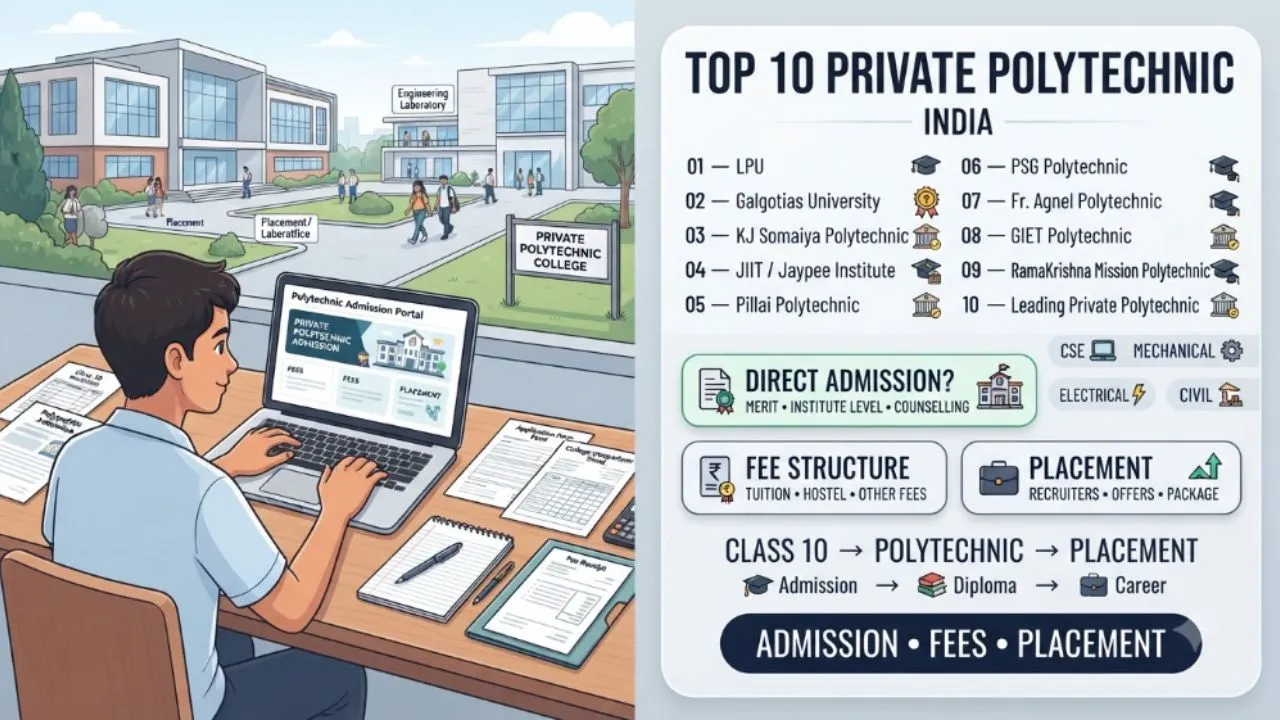
Top 10 Private Polytechnic Colleges in India
There is no single official national ranking that places all private polytechnic colleges in a fixed order. The following institutes are notable names to consider based on their broader technical education ecosystem, infrastructure, programmes and career opportunities. Course availability and diploma offerings should be checked for the specific admission year.
1. Lovely Professional University, Punjab
Lovely Professional University is a large private university with a broad technical education ecosystem.
Its campus offers several engineering and technology programmes, while students can also find diploma-level options depending on the current academic offering.
The major attraction is the university’s large campus environment, extensive facilities and access to placement activities across different disciplines.
Students considering LPU should check the exact diploma programme, eligibility, annual fee and admission route before applying.
2. Galgotias University, Greater Noida
Galgotias University has developed a strong presence in technical and professional education.
Its location in the Delhi-NCR region provides access to a large industrial and corporate market. Students interested in engineering and technology can benefit from exposure to companies, internships and technical events.
The university’s broader placement network is an important factor for applicants, although placement statistics for degree programmes should not automatically be treated as placement figures for diploma students.
3. K. J. Somaiya Polytechnic, Mumbai
- J. Somaiya Polytechnic is a recognised name in diploma-level technical education in Maharashtra.
The institute offers technical diploma programmes and has a long-standing presence in Mumbai’s education sector.
Its location is another advantage because Mumbai and the surrounding industrial belt provide opportunities across engineering, manufacturing, services and technology-related sectors.
Before applying, applicants should check the latest Maharashtra admission rules and the institute’s current fee structure.
4. VIT Polytechnic, Maharashtra
VIT Polytechnic is associated with the broader educational ecosystem of Vishwakarma Institute of Technology in Pune.
Pune has a substantial engineering and manufacturing base, making the location relevant for students interested in mechanical, electrical, electronics and related technical fields.
The surrounding industrial environment can provide opportunities for internships, industrial visits and entry-level technical employment.
Students should distinguish between the placement record of the larger engineering institution and the opportunities specifically available to diploma students.
5. Thakur Polytechnic, Mumbai
Thakur Polytechnic is another private technical education option in Maharashtra.
Its location in Mumbai makes it accessible to students looking for diploma education within a major metropolitan employment market.
The institute offers diploma-level technical education across engineering disciplines. Applicants should compare the current course list, admission requirements, infrastructure and placement information before making a final decision.
6. Rustomjee Academy for Global Careers, Maharashtra
Rustomjee Academy for Global Careers focuses on vocational and technical education and has programmes connected with industry-oriented skills.
For students who prefer practical learning, institutes with strong vocational and industry exposure can be worth considering.
The right choice depends on the specific diploma or technical programme, its recognition, duration and progression opportunities.
7. Chaitanya Bharathi Institute of Technology-related Diploma Options
Hyderabad and Telangana have a large technical education ecosystem, with several private institutions offering diploma-level technical education.
Students looking at private polytechnics in the region should focus on institutes approved and affiliated under the applicable state technical education framework.
Admission through the state’s counselling or entrance system can be different from direct institutional admission, so applicants should not assume that every private college offers management quota seats.
8. Sardar Patel Institute of Technology-linked Technical Ecosystem
Mumbai has several private and aided technical institutions with strong industry connections.
For diploma applicants, the key consideration should be the specific polytechnic department rather than the reputation of an unrelated degree programme at the same institution.
Check the diploma branch, laboratory facilities, internship opportunities and previous placement information before paying any admission fee.
9. Bharati Vidyapeeth Polytechnic, Maharashtra
Bharati Vidyapeeth has a large educational network and operates institutions across several technical and professional fields.
Its polytechnic-level options can appeal to students looking for private technical education with access to an established educational ecosystem.
Applicants should verify the current diploma programmes, fee structure and admission procedure because offerings can change between academic sessions.
10. Private Polytechnic Institutes in Delhi-NCR and Major Industrial Hubs
Delhi-NCR, Pune, Mumbai, Bengaluru, Hyderabad, Chennai and Ahmedabad have numerous private technical institutes.
Rather than selecting an institute only because it appears on an online “top 10” list, compare its approval status, affiliation, branch-specific placement record, fee structure and student facilities.
A smaller institute near a strong industrial cluster can sometimes provide better practical exposure than a larger college with limited industry interaction.
Private Polytechnic Fee Structure
Private polytechnic fees vary widely according to the state, institute, branch and facilities.
Government polytechnics often charge lower tuition because public funding and subsidies cover part of the educational cost. Private colleges generally depend more heavily on student fees to operate their campuses.
For many private diploma programmes, annual tuition can range from roughly ₹30,000 to more than ₹1 lakh, although premium institutions may charge more.
The complete cost can include:
- Tuition fee
- Admission charges
- Examination fee
- Laboratory charges
- Development or institutional charges
- Hostel fee
- Transportation
- Books and equipment
- Uniform and other campus expenses
A college advertising low tuition may still become expensive after hostel, transport and additional institutional charges are included.
Direct Admission in Private Polytechnic Colleges
Direct admission does not have one uniform meaning across India.
Some private institutes may admit students based on Class 10 marks, institutional eligibility rules or available seats. Others participate in state-level counselling and require students to follow the official admission process.
Applicants should therefore check whether the institute is:
- Affiliated with the relevant technical education authority
- Approved by the applicable regulatory body
- Offering the desired diploma branch
- Accepting direct applications
- Participating in state counselling
- Charging fees according to applicable regulations
Never assume that paying a large “management quota” amount guarantees a recognised diploma or a confirmed job.
Management Quota Admission Rules
Management quota provisions depend on the state, institution and applicable regulations.
Where such seats are legally available, the college still has to follow eligibility requirements and other admission rules. A candidate who has not met the basic qualification requirements cannot simply bypass those conditions by paying an additional fee.
Before paying for a management quota seat, ask the college for a written fee breakup and admission confirmation.
Also verify whether the seat is part of an officially permitted category. Avoid cash-only arrangements, unofficial agents and promises of guaranteed admission or employment.
Government Subsidies vs Private Polytechnic Fees
The major difference between government and private polytechnics is the financial structure.
Government colleges receive public funding, which allows them to keep tuition comparatively low. Private colleges have higher operational expenses and usually recover a larger portion through student fees.
This does not automatically make private colleges better or worse.
A government college with excellent workshops and experienced faculty may provide better value than an expensive private institute. Similarly, a well-managed private college may offer better infrastructure or industry exposure in a particular branch.
The decision should be based on actual facilities and outcomes.
Placement Records: What Should You Check?
Placement claims require careful examination.
A college may advertise the highest package received by one graduate, but that figure says little about what the average diploma student earns.
Look for branch-specific information covering:
- Number of students eligible for placements
- Number of students actually placed
- Median or average salary
- Major recruiters
- Internship opportunities
- Job roles offered
- Branch-wise placement performance
- Apprenticeship opportunities
A strong placement record in B.Tech or MBA programmes should not automatically be treated as evidence of similar results for diploma courses.
Best Polytechnic Branches for Private College Students
Computer Engineering and Computer Science remain attractive for students interested in programming, software and IT support.
Mechanical Engineering continues to offer opportunities in manufacturing, maintenance, production and automobile-related industries.
Civil Engineering is relevant to construction, infrastructure, surveying and site supervision.
Electrical Engineering can lead towards industrial maintenance, electrical installations, power systems and technical services.
Electronics and Communication Engineering covers areas such as embedded systems, electronics, communication equipment and automation.
The best branch depends on the student’s interests and career plans. A popular branch is not automatically the right choice for everyone.
How to Select the Right Private Polytechnic
Start by checking whether the institute and specific diploma programme are properly recognised and affiliated.
Then compare the total three-year cost rather than only the first-year tuition.
Visit the campus if possible. Check laboratories, workshops, classrooms, hostel facilities and transportation.
Placement information deserves particular attention. Ask for branch-specific data rather than accepting general claims about the university.
Finally, look at progression options. A diploma can lead to employment, apprenticeships, government technical recruitment and, where eligible, lateral entry into a B.Tech programme.
Final Words
Private polytechnic colleges can provide a useful alternative for students who want technical education after Class 10. Their biggest advantages can include modern infrastructure, flexible admission options, industry exposure and access to larger educational campuses.
At the same time, higher fees make careful comparison essential. Management quota or direct admission should always be checked against the applicable state and institutional rules.
Before selecting a college, verify recognition, affiliation, total fees, branch-specific placements, internship opportunities and further-study options. A good private polytechnic is not simply the one with the highest advertised package. It is the institute that offers credible technical education at a cost that makes sense for your career plans.