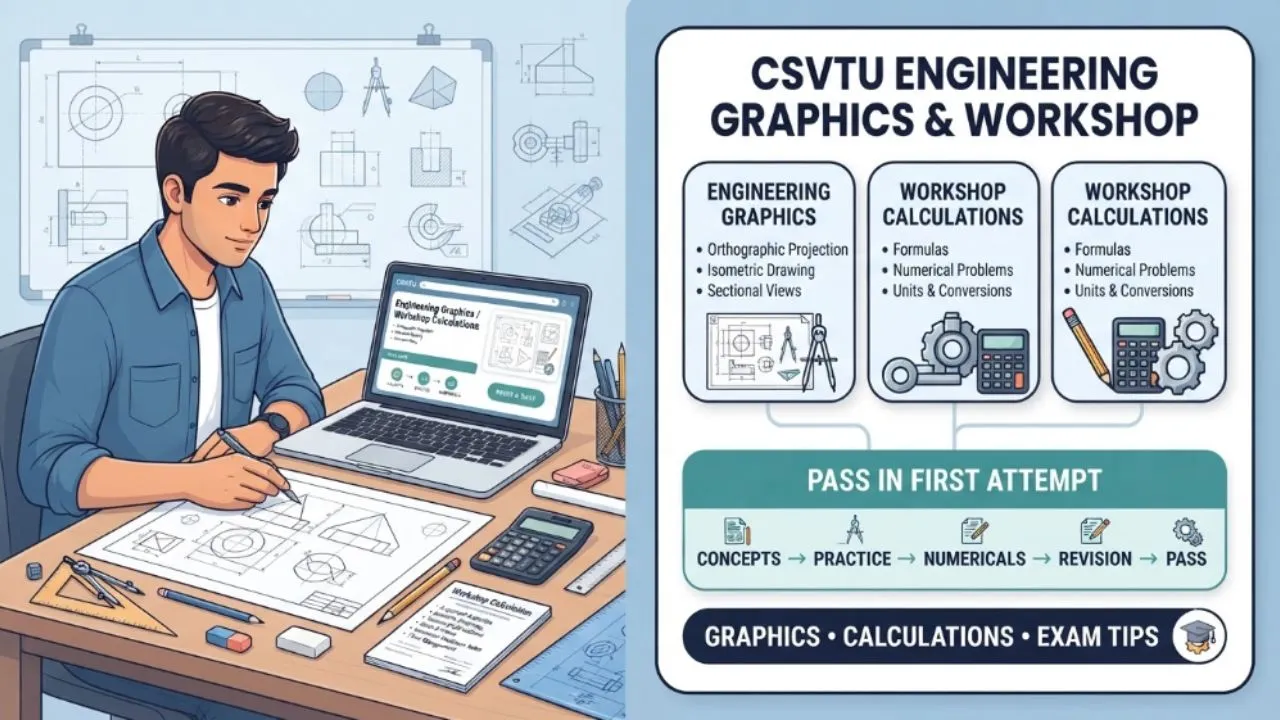
Engineering Graphics and Workshop Calculations can feel difficult during the first semester, especially when a student is still adjusting to engineering-level technical subjects. The good news is that these subjects are highly practice-oriented. At CSVTU-affiliated colleges, students usually encounter Engineering Graphics through technical drawing, geometrical construction, projections, sectional views, development of surfaces and related drawing methods. Workshop Calculations, meanwhile, requires comfort with formulas, units, measurements and basic engineering mathematics.
Neither subject needs endless memorisation. Regular practice, correct presentation and a clear understanding of basic concepts can make a significant difference in semester examinations. If the target is to pass CSVTU Engineering Graphics and Workshop Calculations in the first attempt, preparation should begin with the fundamentals rather than difficult questions.
Table of Contents
Understand the Nature of Both Subjects
Engineering Graphics and Workshop Calculations require different preparation styles. Engineering Graphics is largely based on accuracy and drawing practice. Knowing the theory is useful, but examination performance also depends on how correctly a drawing is constructed and presented.
Workshop Calculations is more numerical. Questions can involve measurements, units, ratios, percentages, basic workshop-related calculations, formula application and engineering quantities. This means reading the textbook repeatedly is not enough.
For Graphics, the drawing instrument should become familiar through regular practice. For calculations, solving numerical problems repeatedly is more effective than simply reading solved examples.
Start With the Basic Concepts
Many students make the mistake of beginning with previous-year papers before understanding the fundamentals. That approach can create confusion.
Start by identifying the major topics included in your current CSVTU syllabus. Divide them into three categories: topics you understand, topics that require practice and topics that currently seem difficult.
Engineering Graphics usually becomes easier when basic drawing conventions are clear. Students should become comfortable with lines, lettering, dimensioning, scales, geometrical constructions and the basic principles of projection before moving to more complicated drawings.
Workshop Calculations should begin with units, conversions, formulas and basic mathematical operations. If these foundations are weak, advanced numerical problems will take considerably longer to solve.
How to Prepare Engineering Graphics
Engineering Graphics is a subject where practice directly affects performance. Do not restrict preparation to reading diagrams from a textbook. Draw them yourself.
Keep your drawing instruments ready and practise on proper drawing sheets whenever possible. Begin with simple constructions and gradually move towards projections, sections and other syllabus topics.
While practising, pay attention to the sequence of construction. A technically correct drawing can still lose marks if the construction is unclear, dimensions are missing or the final presentation is untidy.
Learn the purpose of different lines and follow standard drawing conventions consistently. Construction lines, visible outlines, hidden details and dimensions should be distinguishable.
The objective is not to make the drawing decorative. It should be accurate, clean and easy to evaluate.
Practise With Proper Instruments
A large part of Engineering Graphics becomes easier when students learn to handle their instruments properly. A poorly adjusted compass can affect circles and arcs.
An incorrectly positioned set square can produce inaccurate projections. Even small measurement errors can become noticeable in a technical drawing.
Spend some time practising basic operations with the drawing board, T-square or parallel bar, set squares, compass, divider and scale. The more comfortable these instruments become, the less time is wasted during the examination.
Before the actual paper, check whether your instruments are working properly. Carry the required equipment and keep pencils sharpened to suitable points.
A technical drawing paper is not the place to discover that a compass is loose or a pencil is too blunt.
Focus on Accuracy Before Speed
Many students try to finish drawings quickly because they are worried about the examination time. Speed matters, but accuracy should come first during the learning stage.
Suppose a student can complete a projection in ten minutes but repeatedly makes measurement errors. Another student takes fifteen minutes and produces an accurate drawing. The second approach provides a better foundation. Once the construction method becomes familiar, speed naturally improves.
During practice, record approximately how long each type of question takes. After several attempts, try to reduce the time without compromising accuracy. This creates a practical examination strategy rather than relying on last-minute speed.
How to Prepare Workshop Calculations
Workshop Calculations becomes manageable when formulas are organised properly. Prepare a separate formula notebook for the subject. Do not simply copy formulas from the textbook. Write the formula, define the symbols and add one simple example below it.
For instance, if a formula contains diameter, radius, length or area, make sure each quantity is clearly identified. This reduces mistakes during the examination.
Units deserve special attention. A numerical answer can become incorrect if millimetres, centimetres, metres, kilograms or other units are used inconsistently.
Before solving a question, identify the units given in the problem. Convert them when required and then apply the formula.
Do Not Skip Basic Mathematics
Workshop calculations often becomes difficult because students struggle with the mathematics rather than the engineering concept. Revise fractions, decimals, percentages, ratios, averages, algebra and basic geometry.
Practise multiplication and division involving decimal values. Also revise unit conversions relevant to the topics included in your syllabus.
These calculations may appear simple, but mistakes in the first step can affect the entire answer. A calculator, where permitted, should be used carefully rather than as a substitute for understanding.
First understand the calculation. Then use the calculator to reduce arithmetic errors.
Solve Numerical Problems Step by Step
Avoid jumping directly to the final answer. A well-presented numerical solution should generally show the given information, relevant formula, substitution and final result with the correct unit.
For example, if a question provides several measurements, write them down before selecting the formula. Then substitute the values carefully.
This method makes the solution easier to check and also reduces calculation mistakes. If the final answer looks unrealistic, review the calculation instead of immediately moving to the next question. A quick estimate before calculation can sometimes help identify an obvious error.
Use Previous-Year Questions Properly
Previous-year CSVTU question papers are useful for understanding the style and difficulty of examination questions. However, they should not be treated as a guaranteed list of questions that will appear again.
Start using them after completing the basic syllabus. Solve one paper without looking at the answer. Mark the questions where you made mistakes or needed too much time.
Then return to those topics and practise them again. After covering the syllabus, attempt previous papers under examination conditions. This will help with time management and reveal which areas still require attention.
Create a Practical Seven-Day Revision Plan
If only one week remains before the examination, avoid trying to learn the entire syllabus randomly. Spend the first two days revising concepts and formulas. Use the next two days for Engineering Graphics practice and numerical problems.
On the fifth day, solve important questions from different topics. Use the sixth day for a complete mock paper. Keep the final day for formula revision, drawing conventions and correcting common mistakes.
The exact schedule can be adjusted according to the student’s preparation level. Someone who has already completed most of the syllabus should spend more time solving papers than reading basic theory again.
How to Manage Time in the Examination
Read the entire question paper before starting. Identify questions that you can answer confidently and plan the available time accordingly.
For numerical questions, avoid spending too long on one calculation. If a problem is taking unusually long, leave some space and move to another question.
Return to the difficult problem later. In Engineering Graphics, spend a few moments understanding the question before starting the construction.
A rushed beginning can lead to an incorrect projection that takes much longer to correct. Keep some time at the end for checking dimensions, labels, calculations and units.
Common Mistakes That Reduce Marks
Several small mistakes can affect performance even when the student understands the topic. In Engineering Graphics, common problems include incorrect dimensions, poor line quality, missing labels, incomplete construction and untidy presentation.
In Workshop Calculations, unit errors, incorrect formula selection, arithmetic mistakes and missing steps are frequent problems. Another common mistake is leaving questions incomplete because too much time was spent on one difficult problem.
Practice should therefore focus not only on getting the answer right but also on presenting it efficiently.
How to Score Better With Presentation
Presentation matters in technical subjects because the examiner needs to understand the work clearly. Use suitable pencil grades for different drawing requirements where prescribed.
Keep construction lines controlled and avoid unnecessary overwriting. Write dimensions and labels clearly. For numerical answers, maintain enough space between steps.
Box or clearly mark the final answer when appropriate. Do not fill the answer sheet with unnecessary explanations when a concise calculation or labelled drawing is sufficient.
Clean work is easier to evaluate and reduces the possibility of important details being overlooked.
What to Do If Your Basics Are Weak
A weak foundation does not mean the subject is impossible. Start with the easiest topics and build confidence gradually. For Graphics, practise basic constructions before attempting complex projections. For Workshop Calculations, solve simple numerical examples before moving to multi-step problems.
Use classroom notes, textbooks and reliable educational resources together rather than depending on one source. If a particular concept remains unclear, ask the subject teacher or discuss the problem with a classmate who understands it. Do not allow one difficult chapter to prevent preparation for the rest of the syllabus.
Final Strategy for Passing in the First Attempt
The most reliable approach is simple: understand the basics, practise regularly and solve questions under time limits. Engineering Graphics improves through repeated drawing practice.
Workshop Calculations improves through repeated numerical practice. Neither subject is well suited to one-night preparation. Even 60 to 90 minutes of focused practice each day can produce better results than several hours of rushed study immediately before the examination.
Keep a formula notebook for calculations and a dedicated practice file for Graphics. Track the mistakes you repeatedly make and correct them before the final revision. Most importantly, prepare according to the latest CSVTU syllabus and examination pattern applicable to your batch rather than relying entirely on older notes or question papers.
With consistent practice, accurate calculations, clean drawings and sensible time management, passing CSVTU Engineering Graphics and Workshop Calculations in the first attempt becomes a realistic target.