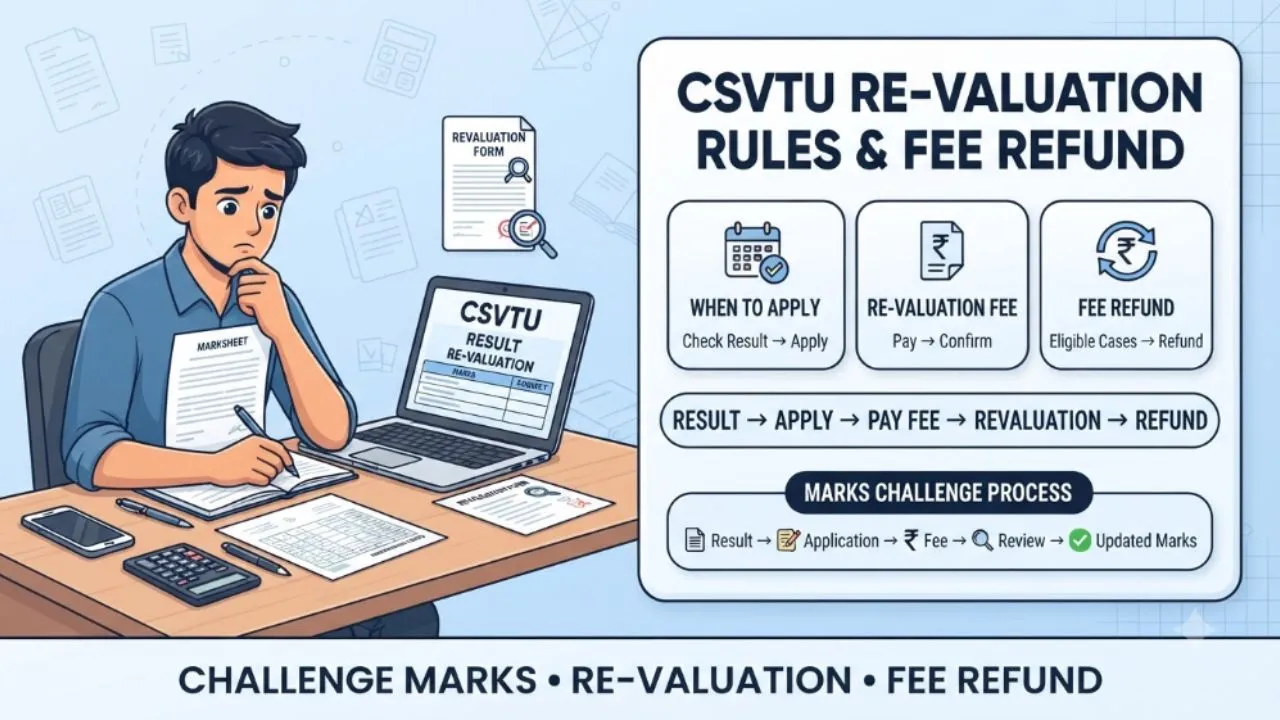
A low score in a diploma examination can be frustrating, especially when the marks do not seem to match your performance. For students studying under Chhattisgarh Swami Vivekanand Technical University (CSVTU), revaluation can provide a formal way to request another assessment of an answer script.
The process is not the same as simply asking for marks to be increased. Students have to follow the university’s prescribed procedure, pay the applicable fee and submit the request within the notified deadline.
The rules can also differ depending on the examination, semester and notification issued by CSVTU. Therefore, students should always check the latest examination notice before submitting a revaluation application. This guide explains how CSVTU diploma revaluation generally works, when a student can challenge marks, what the fee means, how a refund may apply and what to do after the revised result.
Table of Contents
What Is CSVTU Diploma Revaluation?
Revaluation is a process through which an answer script is assessed again according to the university’s examination rules. It is different from requesting a photocopy or simply asking the university to correct a clerical error.
If a student believes the marks awarded in a particular subject do not accurately reflect the answers written in the examination, revaluation can be considered when the university opens the facility for that examination. The purpose is to provide another academic assessment, not to guarantee an increase in marks.
A revised evaluation can result in higher marks, the same marks or, depending on the applicable university rules, a change that does not benefit the student. For this reason, the decision to apply should be made after understanding the rules mentioned in the current CSVTU notification.
When Can Diploma Students Apply for Revaluation?
CSVTU usually announces the applicable procedure after examination results are released. The opportunity is generally available only during a specified application window. A student cannot assume that a revaluation request can be submitted at any time during the academic year.
The result notification or examination notice normally provides important details such as:
- Eligible examinations or subjects
- Application deadline
- Applicable fee
- Application procedure
- Payment method
- Documents or details required
- Date or process for revised results
The deadline is particularly important. If the revaluation application is submitted after the prescribed period, it may not be accepted. Students who are considering revaluation should therefore check the examination portal and college notices soon after the result is published.
Which Marks Can Be Challenged?
A revaluation request is generally linked to a specific answer script or subject rather than the entire semester. The exact number of subjects allowed and other restrictions depend on the relevant CSVTU examination notification.
Before applying, check whether the subject is eligible for revaluation under the current rules. A student should also distinguish between a genuine concern about evaluation and simple disappointment with the result.
For example, if a student expected 75 marks but received 60, that difference alone does not establish an evaluation error. A stronger reason to consider revaluation is when the marks appear inconsistent with the student’s answers, previous assessment pattern or the marks expected from the attempted paper. Even then, the final decision remains with the university’s evaluation process.
CSVTU Diploma Revaluation Fee
Revaluation is normally subject to a fee prescribed by CSVTU for the relevant examination. The amount can change based on the examination and the rules applicable during that academic session. Students should not rely on an old fee amount found on an unofficial website or from a previous semester.
The current examination notification should be treated as the final reference for the applicable fee. The payment receipt should also be saved after completing the application.
Keep a copy of the submitted form, transaction details and any acknowledgement generated by the examination portal. These details can become useful if there is a problem with the application or payment.
Is the Revaluation Fee Refunded?
The question of a fee refund is important because students sometimes assume that the amount will automatically be returned if their marks change. That is not necessarily the case.
A revaluation fee is generally charged for processing and evaluating the request. A refund, if available, depends on the specific CSVTU rules or notification applicable to that examination. Students should therefore read the refund clause carefully before submitting the request.
A notification may specify conditions under which a fee can be refunded, adjusted or retained. The outcome of revaluation and the refund of the application fee are two separate matters. An increase in marks does not automatically mean that every student will receive a refund unless the applicable university rules specifically provide for it.
How to Apply for CSVTU Diploma Revaluation
The application procedure can change depending on the examination system used by CSVTU. When the revaluation facility is opened online, students generally need to access the designated examination portal through their login credentials.
The process usually involves selecting the relevant examination and subject, entering the required details and completing the fee payment. Before final submission, carefully verify the enrolment number, semester, subject code and other information.
A small mistake in the subject code can create problems if the wrong paper is selected. After submitting the application, download or save the acknowledgement and payment receipt.
If the college handles part of the application process, follow the instructions issued by the institution. Do not submit information through unofficial websites claiming to process CSVTU revaluation applications.
Documents and Details to Keep Ready
Students should keep basic academic and identification details available before starting the application. These can include the CSVTU enrolment number, examination details, semester information, subject code and result details.
The university may also require transaction information or an application acknowledgement. If the college asks for a printed copy, submit it within the specified time.
Maintaining a digital copy of everything is useful as well. A folder containing the result, application form, payment receipt and communication from the college can make it easier to resolve any issue later.
What Happens After Revaluation?
Once the application is submitted, the answer script goes through the revaluation process prescribed by the university. The student does not normally participate in the evaluation itself.
After the process is completed, CSVTU publishes or communicates the revised result according to its examination procedure. The revised marks should be checked carefully against the original result.
If the marks have changed, students should also verify whether the change affects their pass status, semester result, division or other academic requirement. Do not assume that a revised mark automatically updates every academic record immediately. If the college requires any further action, follow its instructions.
Should You Apply for Revaluation?
There is no universal answer. For some students, revaluation can be worthwhile when there is a reasonable concern about the evaluation of a paper.
For others, paying the fee may not be useful if the marks are broadly consistent with the answers attempted and there is little reason to expect a different result.
The decision should also consider the importance of the subject. A student who has narrowly missed the passing requirement may have a stronger reason to examine the available remedy than someone who simply wants a few additional marks.
Similarly, a subject that affects eligibility for the next semester or a specific academic requirement may deserve closer attention.
Revaluation vs Supplementary Examination
Revaluation and supplementary examinations serve different purposes. Revaluation challenges the assessment of an already-written examination paper.
A supplementary examination gives an eligible student another opportunity to appear for a subject when the applicable rules permit it. A student who has failed a subject should not assume that revaluation is the only available option.
Depending on the result and current CSVTU regulations, supplementary or back-paper examination provisions may also apply. The correct option depends on the student’s result and the examination rules for that semester.
In some cases, students may need to make a decision within a short period, so checking the notification promptly is important.
What If There Is a Mistake in the Result?
Not every examination problem is a revaluation issue. A clerical mistake, missing mark, incorrect subject entry or discrepancy in personal details may require a different correction procedure.
For example, if a student believes that marks for an answer are missing from the result, the appropriate remedy may be result correction or verification rather than revaluation. Contact the college examination section when the problem appears administrative rather than related to evaluation.
Explain the issue clearly and provide the relevant documents. Using the wrong process can delay resolution.
Important Points Before Applying
Before submitting a CSVTU diploma revaluation request, check the current examination notice carefully. Confirm that the subject is eligible and that the application window is still open.
Check the exact fee instead of relying on figures from older examination cycles. Enter the correct subject code and examination details. Save the payment receipt and application acknowledgement. Also read the university’s instructions regarding revised marks and fee refunds.
Most importantly, do not treat revaluation as a guaranteed way to increase marks. The final outcome depends on the evaluation carried out under the university’s prescribed procedure.
Final Words
CSVTU diploma revaluation gives eligible students a formal route to request another assessment when they have concerns about their examination marks. The process involves more than paying a fee. Students need to identify the correct subject, follow the notified procedure, submit the application within the deadline and retain proof of payment and submission.
The fee refund policy should also be checked carefully because payment and refund conditions depend on the applicable CSVTU rules. Students who have received lower-than-expected marks should first understand their result and then decide whether revaluation is appropriate.
If the issue involves a failed subject, a supplementary examination may also need to be considered where permitted. Since examination procedures, fees and deadlines can change between sessions, the latest CSVTU notification should always take priority over older information. A careful approach can help diploma students avoid missed deadlines, incorrect applications and unnecessary expenses while challenging their examination results.