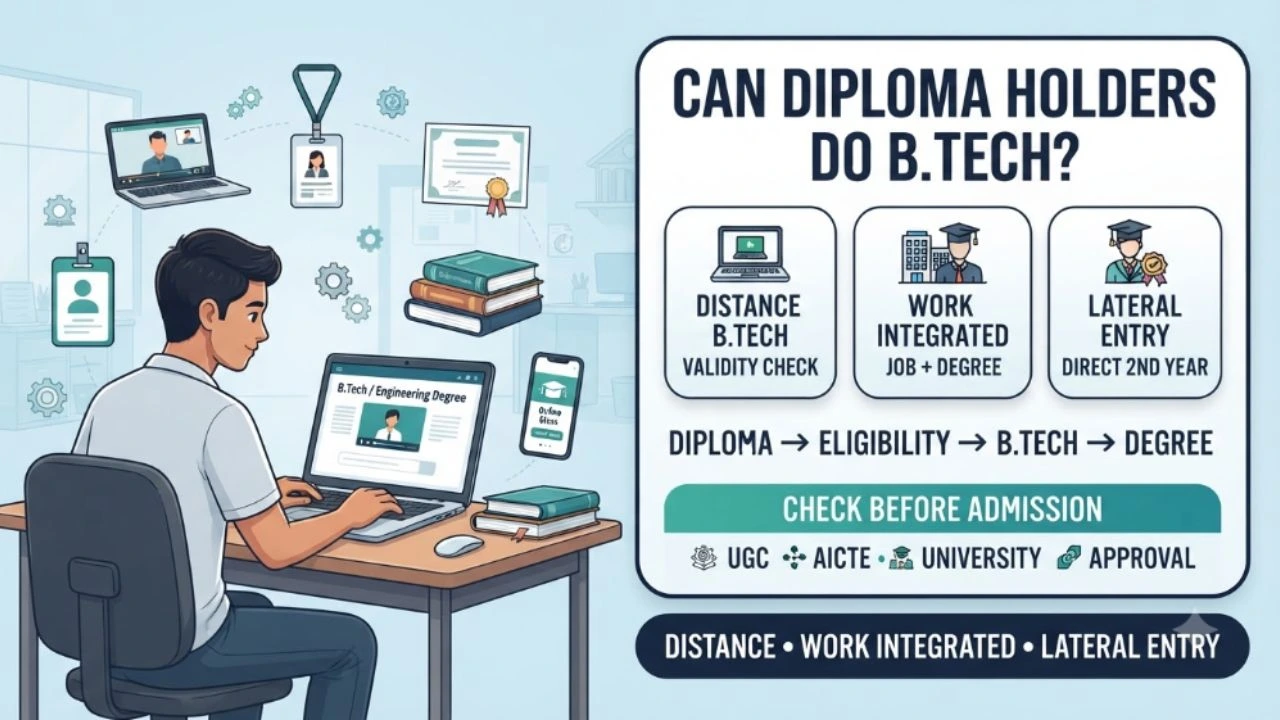
A polytechnic diploma can lead to a B.Tech degree, but the route is not the same as regular B.Tech admission after Class 12. For diploma holders, the most common pathway is lateral entry into the second year of an approved engineering degree programme. This route allows eligible students to continue their technical education without starting B.Tech from the first year.
The situation becomes more complicated when the options are described as “distance B.Tech” or “work integrated B.Tech.” Engineering education has specific regulatory requirements, and students should not assume that every online, distance or weekend programme is equivalent to a regular engineering degree. Before paying fees or joining any programme, it is necessary to understand how these routes work and which options are actually recognised.
Table of Contents
Can a Polytechnic Diploma Holder Do B.Tech?
Yes, a polytechnic diploma holder can pursue B.Tech through lateral entry, subject to the eligibility and admission rules applicable in the state or institution. In a typical lateral-entry route, a student completes a three-year diploma after Class 10 and then applies for admission directly into the second year of B.Tech.
This means the student normally studies the remaining three years of the engineering degree instead of completing all four years from the beginning. The exact admission process differs across states and universities. Some conduct a separate lateral-entry entrance examination, while others use diploma marks or a counselling process.
The diploma branch also matters. A student generally needs an appropriate or related diploma discipline for admission to a particular B.Tech branch. For instance, a Diploma in Mechanical Engineering may provide eligibility for selected Mechanical or related engineering programmes, depending on the institution’s rules.
What Is B.Tech Lateral Entry?
B.Tech lateral entry is the established route designed for diploma holders who want to move into an engineering degree programme. Instead of entering B.Tech through the first year after Class 12, eligible diploma holders enter at an advanced stage of the programme.
The advantage is straightforward. A student can build on the technical education already completed during the diploma. The admission process may include state-level counselling, an entrance test or institution-specific selection, depending on the applicable rules.
Students should check the admission notification for the relevant academic year because eligibility, branch mapping, seat availability and selection procedures can change. Lateral entry is generally the safer option for diploma holders who want a recognised engineering degree and are willing to attend an approved programme.
Can B.Tech Be Done Through Distance Education?
This is where students need to be particularly careful. A conventional engineering B.Tech programme involves practical laboratory work, workshops, engineering projects and other hands-on components.
Because of these requirements, a programme advertised simply as “distance B.Tech” should not automatically be considered equivalent to a regular B.Tech degree. Students sometimes find advertisements offering B.Tech programmes through correspondence, online classes, weekend attendance or flexible learning schedules.
The important question is not whether classes are available online. The important question is whether the specific engineering programme is legally and academically recognised for the intended purpose.
Before enrolling, verify the current recognition and approval status of the exact programme and institution through the appropriate regulatory and university channels. Do not rely only on advertisements, education agents or claims made by admission consultants.
A degree that does not meet the required recognition conditions can create problems later during government recruitment, higher education admission or professional employment.
What About Work Integrated B.Tech?
Work-integrated learning sounds attractive to diploma holders because many are already interested in combining employment with higher education. Such programmes may allow students to continue working while completing academic requirements through flexible schedules, blended learning or structured workplace components.
However, “work integrated” is not automatically a separate approval category that makes every engineering degree valid. The recognition of the degree depends on the institution, programme structure and applicable regulations.
Students should therefore verify whether the exact B.Tech programme is recognised and whether the mode of delivery is permitted for that engineering qualification. The employment component does not by itself convert an unrecognised programme into a recognised engineering degree. This distinction becomes especially important for students planning government jobs or technical positions where qualification rules are strict.
Why Lateral Entry Is Usually the Practical Choice
For most diploma holders, regular lateral-entry B.Tech is the more straightforward route. It provides structured classroom teaching, laboratory work, engineering projects and interaction with faculty.
The student also gets the opportunity to participate in internships, campus activities and placement processes, depending on the institution. A regular degree can be particularly useful for students targeting engineering roles that specify a B.Tech or B.E. qualification.
It also provides a clearer academic path for those who later want to pursue postgraduate education. That does not mean every regular B.Tech college will provide strong placements. The institution, branch, location, faculty, laboratories and industry connections still matter. The degree alone should not be treated as a guarantee of employment.
Can Diploma Holders Do B.Tech While Working?
This depends on the programme and the institution. A diploma holder who has already started working may find it difficult to attend a conventional full-time B.Tech programme. Some universities and institutions may offer flexible academic arrangements for eligible working professionals, but students should verify the status of the exact programme before admission.
The phrase “working professional” does not automatically mean that a student can complete an engineering degree entirely through distance learning. Engineering education has practical requirements that need to be addressed through the approved programme structure.
If flexibility is the main reason for choosing a programme, ask the institution how laboratory sessions, examinations, projects and other practical requirements are conducted. Also check whether the final degree will meet the requirements of the jobs or examinations the student plans to pursue.
B.Tech After Diploma: Eligibility
Eligibility for lateral-entry B.Tech varies across states and universities. A common requirement is a three-year diploma in engineering or technology from a recognised institution. The diploma usually needs to be in an appropriate engineering discipline.
Minimum marks can also apply. Some institutions specify a particular percentage in the diploma, while reserved-category candidates may receive relaxation according to applicable rules. There can also be additional conditions related to domicile, entrance examinations or counselling.
Because these requirements differ, students should not depend on eligibility information from another state or university. The admission notification for the specific programme is the correct reference point.
Admission Process for Lateral Entry B.Tech
The process usually begins with checking eligibility and identifying institutions that accept diploma holders through lateral entry. The next step may involve registration for a state-level entrance examination or direct application to an eligible institution.
After the application process, candidates may have to appear for an entrance test if required. The merit list or rank is then used during the admission process. Eligible candidates participate in counselling or institutional selection and choose their preferred college and branch based on available seats. Documents normally include diploma marksheets, certificates, identity proof, photographs and other documents requested by the admission authority.
Students should keep original documents available for verification. The process can be different for autonomous universities, state universities and other institutions, so checking the current admission notification is essential.
Is Work Integrated B.Tech Better for Working Students?
For someone already employed, flexibility can be useful. A work-integrated programme may reduce the difficulty of balancing employment and education if the programme is properly recognised and its academic structure fits the student’s needs.
But flexibility should not be the only factor. Consider the total fee, duration, examination arrangements, practical requirements, degree recognition, branch offered and eligibility for future employment.
A programme that appears convenient but does not meet the qualification requirements of a future employer may create a much bigger problem later. Students should also ask whether the programme is suitable for government recruitment if that is their target.
Government job notifications often specify the required qualification and recognised mode of education. The fact that an institution issues a certificate does not automatically mean every recruiting organisation will accept it.
Career Benefits of Completing B.Tech After Polytechnic
The diploma-to-degree route can broaden career options. After completing B.Tech, a candidate can apply for positions that specifically require an engineering degree, subject to the recruitment rules.
Private-sector opportunities can include design, production, software, infrastructure, testing, quality control, engineering services and technical management. The branch remains important.
A diploma holder who completes B.Tech in Computer Science may target software and technology roles, while someone continuing in Mechanical Engineering may focus on manufacturing, design or maintenance.
Similarly, Civil and Electrical Engineering graduates can pursue careers across infrastructure, construction, power and industrial sectors. Further education is another option. Depending on eligibility, B.Tech graduates can consider postgraduate programmes and professional certifications.
What About Government Jobs After B.Tech?
A B.Tech degree can expand eligibility for some government recruitment examinations and technical posts. However, eligibility depends entirely on the individual recruitment notification.
Some government positions accept diploma holders, while others specifically require a bachelor’s degree in engineering or technology. Therefore, completing B.Tech can open additional opportunities, but it does not automatically make a candidate eligible for every government engineering post.
Candidates should always check the required branch, recognised qualification, percentage, age limit and other conditions before applying.
How to Avoid Fake or Unrecognised B.Tech Programmes
The popularity of flexible engineering education has also created confusion for students. Be cautious if an institution promises a B.Tech degree with almost no attendance, no practical training or an unusually short duration.
Promises such as “guaranteed government job eligibility” or “100% accepted everywhere” should also be treated carefully. Before making a payment, verify the university and programme through official regulatory and institutional information.
Ask specifically about the mode of education and the recognition status of the exact engineering programme. Do not depend on a brochure that only mentions general university accreditation.
The programme itself needs to meet the requirements relevant to your intended career.
Polytechnic to B.Tech: Which Route Makes Sense?
For a diploma holder who wants a recognised engineering degree, lateral-entry B.Tech is generally the clearest route. It builds directly on the diploma and normally allows eligible candidates to enter the second year of a suitable engineering degree programme.
Distance or work-integrated options require more careful verification because engineering qualifications have practical and regulatory requirements. A working student may prefer a flexible programme, but flexibility should never come at the cost of recognition.
If the main objective is a government job, professional engineering role or future higher education, qualification validity should be checked before convenience.
Final Words
Polytechnic does not have to be the final stage of technical education. A three-year diploma can become the starting point for a B.Tech degree through lateral entry, giving students another route into graduate-level engineering education.
Distance and work-integrated programmes require greater caution. Not every programme marketed as flexible, online or work-based carries the same recognition as an approved regular engineering degree. For most diploma holders, the practical approach is to identify recognised lateral-entry B.Tech programmes and compare their fees, admission rules, branch options, laboratories, placement record and location.
The right choice depends on the student’s career goal, financial situation and ability to attend a structured engineering programme. A diploma followed by a properly recognised B.Tech can provide a strong combination of practical training and degree-level engineering education.