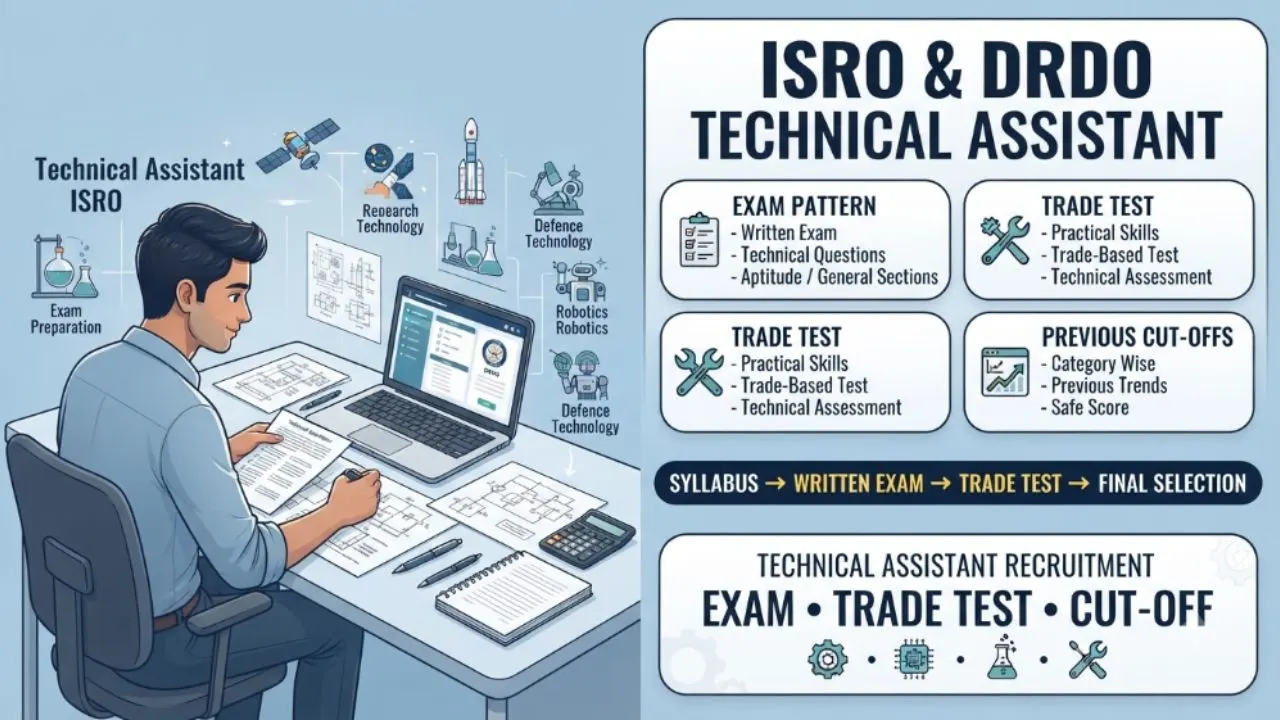
For diploma holders in engineering, technical recruitment at ISRO and DRDO is among the most attractive government career options. Both organisations recruit technical personnel for laboratories, centres and specialised engineering activities. The selection process, however, is different for each organisation and can change with individual recruitment notifications.
ISRO Technical Assistant recruitment generally involves a curriculum-based written examination followed by a skill test. DRDO recruits technical candidates through its CEPTAM system, where the examination structure can include Tier-I, Tier-II and, for Technician-A posts, a qualifying trade test.
For diploma students preparing for these jobs, understanding the examination pattern is more useful than simply collecting previous-year questions. The syllabus, marking scheme, qualifying requirements and selection method should all be part of the preparation plan.
Table of Contents
ISRO Technical Assistant Recruitment
ISRO Technical Assistant is a technical post generally suitable for candidates holding a first-class diploma in the required engineering discipline. The exact diploma discipline depends on the vacancy announced by the concerned ISRO centre.
Common technical areas can include Mechanical, Electrical, Electronics, Computer Science and other specialised disciplines. The post is placed at Level 7 of the Pay Matrix, with a basic pay range of ₹44,900 to ₹1,42,400 under ISRO’s published recruitment norms.
The upper age limit for an unreserved candidate is generally 35 years, although individual notifications should always be checked for the applicable conditions. ISRO’s recruitment structure makes one point particularly important: qualifying the skill test does not normally add marks to the final merit position. The written examination carries the selection weight, while the skill test is qualifying in nature.
ISRO Technical Assistant Exam Pattern
ISRO Technical Assistant examinations are generally based on the curriculum of the prescribed diploma qualification. A recent ISRO recruitment pattern used 80 multiple-choice questions for 90 minutes.
Each correct answer carried one mark, while an incorrect response attracted a negative marking of one-third mark. The questions are designed to examine both theoretical understanding and practical knowledge of the prescribed curriculum.
This makes preparation different from general government examinations. A candidate cannot depend entirely on reasoning, mathematics or general awareness. The technical syllabus remains the core of the examination.
For example, a Mechanical Engineering candidate should revise subjects such as manufacturing, thermodynamics, machine design, engineering mechanics, materials and workshop-related concepts according to the prescribed curriculum.
An Electrical Engineering candidate should focus on electrical machines, circuits, measurements, power systems and related diploma-level subjects. The exact syllabus should be taken from the recruitment notification for the particular post.
ISRO Skill Test
The ISRO Technical Assistant skill test is an important stage, but it is not normally used to add marks to the final merit list. Candidates are shortlisted for the skill test based on their written examination performance.
In a recent recruitment pattern, candidates were shortlisted at approximately a 1:5 ratio against vacancies, subject to the prescribed conditions.
The skill test is conducted on a go-no-go basis.
In simple terms, the candidate has to demonstrate the required practical ability and qualify.
A candidate who performs extremely well in the skill test does not gain additional selection marks over another candidate who also qualifies.
The written examination remains the deciding factor for final merit.
This is why candidates should not treat the skill test as a substitute for written examination preparation.
At the same time, practical preparation should not be ignored.
The skill test can involve tasks related to the discipline for which the candidate has applied.
Candidates should therefore revise practical concepts, tools, instruments, measurements and workshop procedures relevant to their diploma branch.
DRDO Technical Assistant Recruitment Through CEPTAM
DRDO’s technical recruitment is handled through the Centre for Personnel Talent Management, commonly known as CEPTAM.
The current CEPTAM-11 recruitment cycle includes the posts of Senior Technical Assistant-B, commonly referred to as STA-B, and Technician-A.
The two posts have different educational requirements and selection processes.
For diploma holders, STA-B is particularly relevant because the post is linked to specific technical disciplines.
The examination is conducted in computer-based test mode.
The current CEPTAM-11 pattern contains two CBT stages for STA-B.
Tier-I is used for screening, while Tier-II is used for provisional selection.
This structure means that candidates cannot treat Tier-I as the final examination.
A strong Tier-I performance is required to reach the technical paper in Tier-II.
DRDO STA-B Tier-I Exam Pattern
Under the current CEPTAM-11 pattern, Tier-I contains 150 questions carrying 150 marks.
The examination duration is 120 minutes.
The paper covers four areas:
General Science
General English
Quantitative Aptitude or General Mathematics
General Intelligence and Reasoning
General Science contains 40 questions, General English contains 30, Quantitative Aptitude or General Mathematics contains 40, and General Intelligence and Reasoning contains 40 questions.
The examination has negative marking.
A wrong answer results in a deduction of 0.25 marks.
The minimum qualifying requirement for Tier-I is 40% for UR, OBC and EWS candidates, while it is 35% for SC, ST and PwBD candidates under the current CEPTAM-11 rules.
However, simply crossing the qualifying percentage does not guarantee progression.
Candidates are shortlisted for Tier-II based on merit, generally in a 1:10 ratio against vacancies, subject to the conditions in the recruitment notification.
DRDO STA-B Tier-II Exam Pattern
Tier-II is much more important for final selection because it tests the technical subject associated with the post.
The current CEPTAM-11 pattern contains a personality test followed by a subject-specific examination. The personality test is mandatory, but its performance is not counted in the merit calculation.
The technical Part II contains 120 questions carrying 120 marks and has a duration of 120 minutes. The syllabus is based on the subject connected with the candidate’s post code and prescribed educational qualification. Negative marking of 0.25 marks applies to each incorrect answer in Tier-II Part II.
The merit list for STA-B is prepared using performance in the subject-specific portion of Tier-II. This makes technical preparation the most important part of the DRDO selection process after clearing the screening stage.
DRDO Technician-A Trade Test
The trade test is mainly relevant to DRDO Technician-A recruitment rather than the STA-B technical assistant route. Technician-A candidates go through Tier-I and Tier-II before appearing for the trade test.
The trade test is practical and is based on the relevant ITI-level trade syllabus. Its purpose is to check whether candidates can actually perform practical tasks related to their trade.
The trade test is qualifying in nature. Under the current CEPTAM-11 rules, candidates from UR, OBC and EWS categories need at least 50% marks, while SC, ST and PwBD candidates need at least 45%, subject to the notification’s applicable conditions.
The trade test does not function like another written examination. Candidates should therefore prepare by practising actual trade skills rather than simply memorising theory.
Previous Cut-Offs for ISRO Technical Assistant
There is no single previous cut-off for ISRO Technical Assistant recruitment. Cut-offs are normally connected with the particular ISRO centre, discipline, vacancy count and candidate category. The competition can also change considerably between recruitment cycles.
For example, an earlier ISRO Technical Assistant Computer Science recruitment listed a CBT cut-off of 111 for UR candidates, 92 for OBC candidates, 74 for SC candidates, 47 for ST candidates and 32 for PwBD candidates.
These figures belong to that particular recruitment and should not be treated as a universal ISRO Technical Assistant cut-off. The number of vacancies and difficulty level can make a significant difference.
A candidate preparing for a new recruitment should therefore use previous cut-offs only as a reference point. Targeting a score comfortably above an earlier cut-off is more sensible than preparing around the exact previous figure.
Previous Cut-Offs for DRDO
DRDO cut-offs also vary by recruitment cycle, post code, category and vacancy. The earlier CEPTAM examinations used different structures from the current CEPTAM-11 pattern.
For example, previous STA-B recruitment cycles have used Tier-I as a screening examination with minimum qualifying requirements for different categories. The current CEPTAM-11 system has a different distribution of questions and a different Tier-II structure.
This is why candidates should avoid copying an old cut-off target without checking the examination pattern for the current recruitment. Previous cut-offs can help indicate the level of competition. They cannot guarantee the score required for selection in a future cycle.
ISRO vs DRDO Preparation Strategy
The biggest difference between the two examinations is the role of the technical paper. ISRO Technical Assistant preparation should focus heavily on the diploma curriculum because the written test is curriculum-based.
DRDO STA-B preparation has two distinct stages. The first stage requires general subjects such as reasoning, mathematics, English and science.
The second stage requires detailed preparation for the technical discipline. A candidate preparing for both organisations can therefore combine preparation intelligently.
Diploma subjects can form the common technical foundation, while separate time can be allocated to DRDO’s general aptitude sections.
Regular practice is important because both examinations use negative marking. Guessing too many answers can reduce the final score.
How to Prepare for the Technical Paper
Begin with the diploma syllabus rather than random competitive-exam books. Prepare one subject at a time and identify topics where concepts are weak. After completing a chapter, solve objective questions based on that topic.
Previous-year papers are useful because they show the type of concepts repeatedly tested. Mock tests should be introduced after completing a reasonable portion of the syllabus.
For ISRO, technical mock tests should receive greater priority because the written examination determines merit. For DRDO, candidates need separate mock practice for Tier-I and technical Tier-II. Practical revision should also be included for candidates targeting posts involving skill or trade tests.
Common Mistakes Candidates Should Avoid
One common mistake is preparing only general knowledge and reasoning for a technical government job. That approach is particularly risky for ISRO Technical Assistant and DRDO STA-B.
Another mistake is studying from a degree-level syllabus when the recruitment examination is based on the prescribed diploma curriculum. Higher-level material can be useful, but the basic diploma syllabus should be mastered first.
Candidates should also avoid depending completely on previous cut-offs. A cut-off is a result of competition, vacancies and examination performance in a particular recruitment.
It is not a permanent benchmark. Another problem is ignoring practical preparation until the final stage. Candidates shortlisted for a skill or trade test should already be comfortable with the relevant practical work.
Final Words
ISRO and DRDO offer strong career opportunities for technically qualified candidates, but their recruitment examinations require focused preparation. ISRO Technical Assistant selection is strongly dependent on the written examination, with the skill test serving a qualifying role.
DRDO STA-B recruitment uses Tier-I for screening and Tier-II for technical selection, while Technician-A candidates also face a practical trade test. Previous cut-offs can help candidates understand competition, but they should never be treated as fixed targets for 2026 recruitment.
The better strategy is to master the relevant diploma syllabus, practise objective questions, improve examination speed and prepare separately for practical assessments where required. For diploma holders targeting technical government jobs, consistent preparation is more useful than chasing unofficial cut-off predictions. The recruitment notification for each vacancy should remain the final reference for eligibility, syllabus, examination pattern and selection rules.