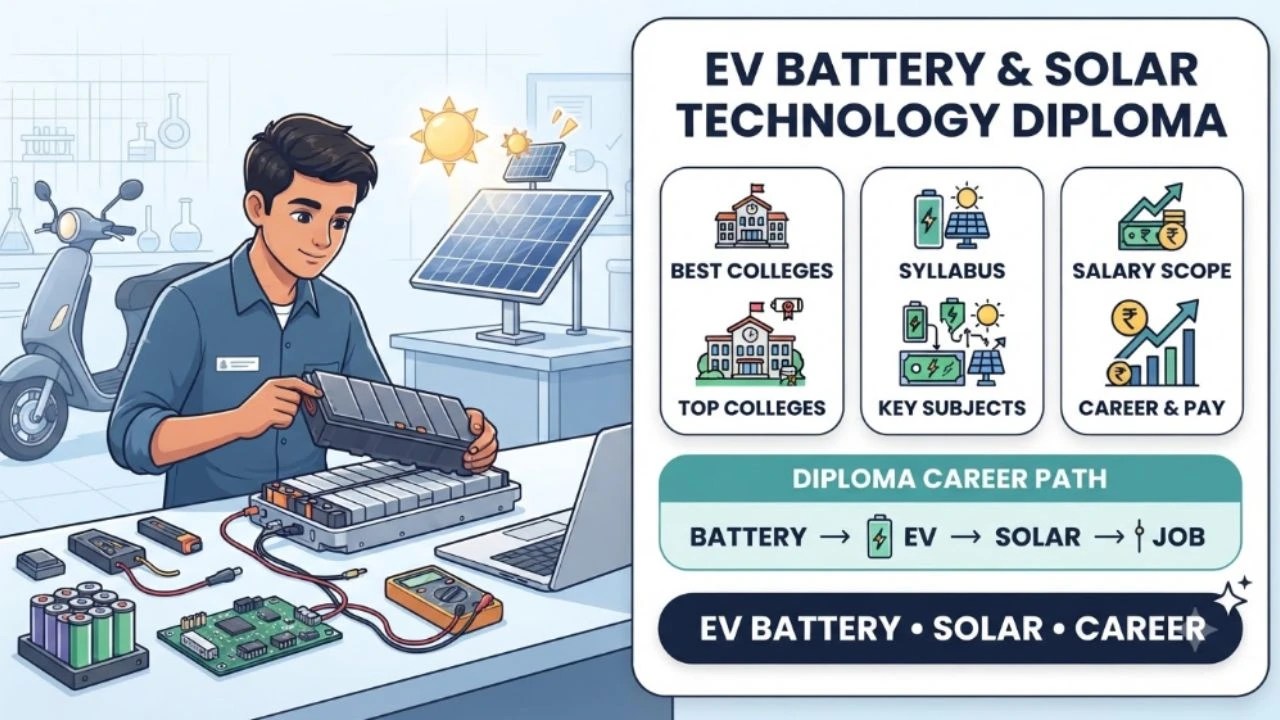
Electric vehicles and renewable energy are changing the way India produces, stores and uses electricity. This shift is creating demand for technicians and diploma holders who understand batteries, charging systems, solar equipment and electrical installations.
For students completing Class 10, diploma courses related to EV Battery Technology and Solar Technology can offer an alternative to conventional engineering branches. These programmes combine electrical concepts with practical training in batteries, electronics, renewable energy systems and maintenance.
The right course depends on the institute, curriculum and the type of technical work a student wants to pursue. Some colleges offer dedicated programmes, while others cover EV or solar technology through electrical, electronics, mechanical or renewable-energy diploma courses.
Table of Contents
What Are EV Battery and Solar Technology Diploma Courses?
EV and battery-focused diploma programmes teach the fundamentals of electric vehicles, battery packs, charging infrastructure and related electrical systems.
Students can learn about lithium-ion batteries, battery management systems, electric motors, power electronics and charging equipment. Practical sessions may include battery testing, wiring, fault identification and basic EV maintenance.
Solar technology courses focus on photovoltaic systems and renewable-energy applications. The syllabus can include solar panels, inverters, batteries, charge controllers, installation methods and system maintenance. These fields overlap in some areas, particularly energy storage and electrical systems.
A student interested in both technologies can therefore build a useful foundation through an Electrical Engineering, Electronics Engineering, Renewable Energy or specialised EV-related diploma.
Why EV and Solar Technology Are Growing
India’s electric mobility sector has expanded alongside government support, private investment and increasing consumer interest in electric vehicles.
At the same time, solar power has become an important part of India’s renewable-energy expansion. Electric vehicles need charging infrastructure, battery servicing and trained technical personnel. Solar installations require people who can install, inspect, maintain and troubleshoot photovoltaic systems. The growth of both industries does not mean every diploma holder will immediately receive a high-paying job.
Entry-level opportunities depend on technical skills, location, employer requirements and practical experience. The advantage is that these sectors create several types of technical roles beyond conventional manufacturing jobs.
Best Diploma Courses for EV and Solar Careers
There is no single diploma course that is mandatory for every EV or solar job. Students can choose a course based on the type of work they want to enter.
Diploma in Electric Vehicle Technology
A specialised EV diploma can cover electric vehicle architecture, batteries, motors, charging systems, vehicle electronics and maintenance. This is suitable for students who specifically want to work with electric two-wheelers, cars, commercial vehicles or charging infrastructure.
Diploma in Electrical Engineering
Electrical Engineering remains one of the broadest options for students interested in energy systems.
The course provides fundamentals in electrical machines, power systems, measurements, wiring, electronics and industrial equipment. These skills can later be applied to EV charging systems, solar installations and energy-storage projects.
Diploma in Electronics Engineering
Electronics plays an important role in battery management systems, vehicle controllers, sensors and charging equipment. Students interested in the electronic side of EVs can consider this route.
Diploma in Renewable Energy
Renewable-energy programmes can provide focused exposure to solar photovoltaic systems, energy storage, installation practices and renewable-energy applications. Availability of this specialised diploma varies between states and institutions.
EV Battery Technology Syllabus
The exact syllabus differs between colleges, but an EV or battery-focused diploma can include several core areas.
Students may study electrical fundamentals, electronic components, battery chemistry and energy-storage systems. Lithium-ion battery technology is particularly important because it is widely used in modern electric vehicles and portable energy-storage systems.
Other topics can include battery pack construction, charging and discharging, battery management systems and battery safety. Electric motors and controllers are another major part of EV technology.
Students can also learn about regenerative braking, vehicle wiring, charging stations and basic vehicle diagnostics.
Practical training is important because battery technology involves safety procedures and careful handling. The curriculum may also introduce thermal management, battery testing and methods used to identify common electrical faults.
Solar Technology Diploma Syllabus
Solar-focused courses generally combine electrical fundamentals with photovoltaic system design and installation.
Students can learn how solar panels generate electricity and how different components work together. Important topics may include photovoltaic modules, solar inverters, charge controllers and batteries. Installation practices are another major component.
Students may learn how to assess a site, position panels, connect wiring and test system performance. Maintenance and troubleshooting are equally important because solar systems need regular inspection.
The syllabus may also cover grid-connected and off-grid systems, solar water pumps, energy storage and basic electrical safety. Some programmes introduce students to solar system sizing and simple project calculations.
Best Colleges for EV and Solar Diploma Courses
Students should be careful when searching for a college offering an EV or solar diploma. A specialised course title alone does not guarantee better career opportunities. Government polytechnic colleges and state technical institutes can offer affordable diploma education in Electrical, Electronics, Mechanical and related disciplines.
Some private technical institutes also offer specialised EV, automobile or renewable-energy programmes. When comparing colleges, check the affiliation, approval status, laboratory facilities, curriculum and practical training arrangements.
For an EV-focused course, look for battery testing equipment, electric motors, controllers, charging equipment and diagnostic facilities. For solar courses, inspect whether the institute provides working photovoltaic panels, inverters, batteries and installation training.
The location also matters. Colleges near automobile manufacturing, renewable-energy projects, industrial clusters or large service networks can provide better access to internships and practical exposure. Do not choose an institute solely because it advertises a high salary package.
Admission Eligibility After Class 10
Many diploma engineering programmes admit students after Class 10. The usual requirement is passing Class 10 from a recognised board, with Mathematics and Science often required for engineering-related branches.
Some states conduct entrance examinations for polytechnic admission, while others use merit-based selection or counselling. The exact eligibility depends on the state and institution.
Students should check the latest admission notification before applying because minimum marks, entrance requirements, domicile rules and admission procedures can change.
Candidates who have completed Class 12 may also have additional options depending on the course and institution.
Career Options After an EV Diploma
EV technology creates opportunities across vehicle manufacturing, servicing, charging infrastructure and battery-related businesses.
A diploma holder may start in roles such as EV service technician, battery technician, charging-station technician or electrical maintenance technician.
Some employers may recruit candidates for testing, assembly and production-related positions. Experience can help candidates move into supervisory and specialised technical roles.
Additional training in diagnostics, battery management systems and vehicle electronics can also strengthen a candidate’s profile. The automobile service sector is another potential area because electric vehicles require technicians who understand high-voltage systems and electronic controls.
Career Options After a Solar Diploma
Solar technology provides opportunities in installation, maintenance, operations and technical support.
Entry-level roles can include solar installation technician, photovoltaic technician, maintenance technician and site technician. Experienced workers can move into supervisory positions or specialise in system design, commissioning and troubleshooting.
Some diploma holders also work with solar EPC companies that handle engineering, procurement and installation projects. The sector also offers opportunities for self-employment.
A technically trained person can build experience in residential solar installation, maintenance and small commercial projects before considering independent work. However, electrical safety and applicable regulations must be followed carefully.
Salary Scope After EV and Solar Diploma
Salary varies significantly by branch, employer, location, skills and experience. Fresh diploma holders generally begin in entry-level technical positions, where the starting salary can differ considerably between small workshops and established manufacturing companies.
Candidates working with larger automobile companies, battery manufacturers, charging infrastructure providers or specialised technical firms may have different salary structures.
Solar salaries also depend on whether the role involves installation, maintenance, site supervision or system design. It is better to treat advertised salary figures as employer-specific rather than assuming they represent the standard income for all diploma holders.
Practical skills can influence salary growth over time. Candidates who understand battery diagnostics, electrical safety, charging systems, solar installation and troubleshooting can become more valuable as they gain workplace experience.
Skills That Can Improve Job Prospects
A diploma provides the foundation, but employers also look for practical ability. EV students should develop skills in electrical measurements, battery testing, vehicle diagnostics, wiring and safety procedures.
Understanding battery management systems can be useful for candidates targeting battery-related roles. Solar students should learn panel installation, inverter configuration, electrical testing and system troubleshooting.
Basic computer knowledge is useful in both sectors. CAD skills, technical documentation and data analysis can also help depending on the role.
Communication matters as well, especially for technicians working at customer sites or coordinating with engineers and supervisors. Internships and industrial training can make these skills easier to demonstrate during recruitment.
EV and Solar Diploma vs Traditional Diploma Branches
A specialised EV or solar programme can provide focused knowledge, but a traditional branch may offer broader career flexibility. Electrical Engineering, for example, can lead to opportunities across manufacturing, power, automation, construction, renewable energy and EV infrastructure.
Mechanical Engineering remains relevant to vehicle manufacturing, production and maintenance. Electronics Engineering can connect with vehicle electronics, embedded systems and automation.
For students who are uncertain about their long-term specialisation, a broader diploma may provide more options. A specialised EV or solar course can make more sense for someone who already has a strong interest in the sector.
Higher Studies After Diploma
Students do not have to stop after completing a diploma. Eligible diploma holders can pursue lateral entry into B.Tech or B.E. programmes, depending on the rules of the relevant state or university.
An Electrical, Electronics, Mechanical or specialised diploma can provide a foundation for further engineering education. Higher studies can also help candidates move toward engineering design, project management, research or other advanced technical positions.
Some students choose to work first and continue their education later. The choice depends on finances, career goals and the type of position they want to pursue.
Final Words
EV Battery and Solar Technology are emerging areas within India’s broader electrical, automobile and renewable-energy industries. A diploma can provide an affordable route into these sectors, particularly for students who prefer practical technical education after Class 10.
However, the course title is only one part of the decision. Check the college’s laboratories, faculty, industrial training, affiliation, curriculum and placement record before taking admission.
Students should also consider broader diploma branches such as Electrical, Electronics and Mechanical Engineering if they want more flexibility. The strongest career prospects will come from combining a recognised technical qualification with practical skills, industrial exposure and continuous learning.
As electric mobility, battery storage and solar power continue to develop, technicians who understand these technologies can find opportunities across manufacturing, installation, maintenance and technical services.