A Diploma in Fire, Industrial Safety and Environment is a practical technical programme for students interested in workplace safety, fire prevention, industrial risk management and environmental protection. The course is particularly relevant in industries where workers deal with machinery, chemicals, electrical systems, construction activity, petroleum products or other workplace hazards.
Unlike conventional engineering programmes, safety-focused diploma courses concentrate on identifying risks and preventing accidents before they occur. The curriculum can include fire protection, industrial safety, occupational health, environmental management, emergency response and basic risk assessment.
For students planning a career in India or the Gulf region, this field can offer several employment routes. However, the value of a diploma depends heavily on the institute, course recognition, practical training, certifications and the requirements of individual employers.
Table of Contents
What Is a Diploma in Fire, Industrial Safety and Environment?
This diploma combines three closely connected areas: fire safety, industrial safety and environmental management. Fire safety covers fire prevention, firefighting equipment, emergency procedures and evacuation planning. Industrial safety focuses on hazards associated with machinery, construction sites, electrical systems, chemicals and industrial processes.
The environmental component deals with subjects such as pollution control, waste management, environmental regulations and safe handling of industrial waste. The exact syllabus varies between institutions. Some programmes are designed mainly around industrial safety, while others give greater attention to fire technology or environmental management.
Before taking admission, check the course curriculum, practical facilities, recognition, training arrangements and eligibility requirements rather than selecting a programme based only on its title.
Course Duration and Eligibility
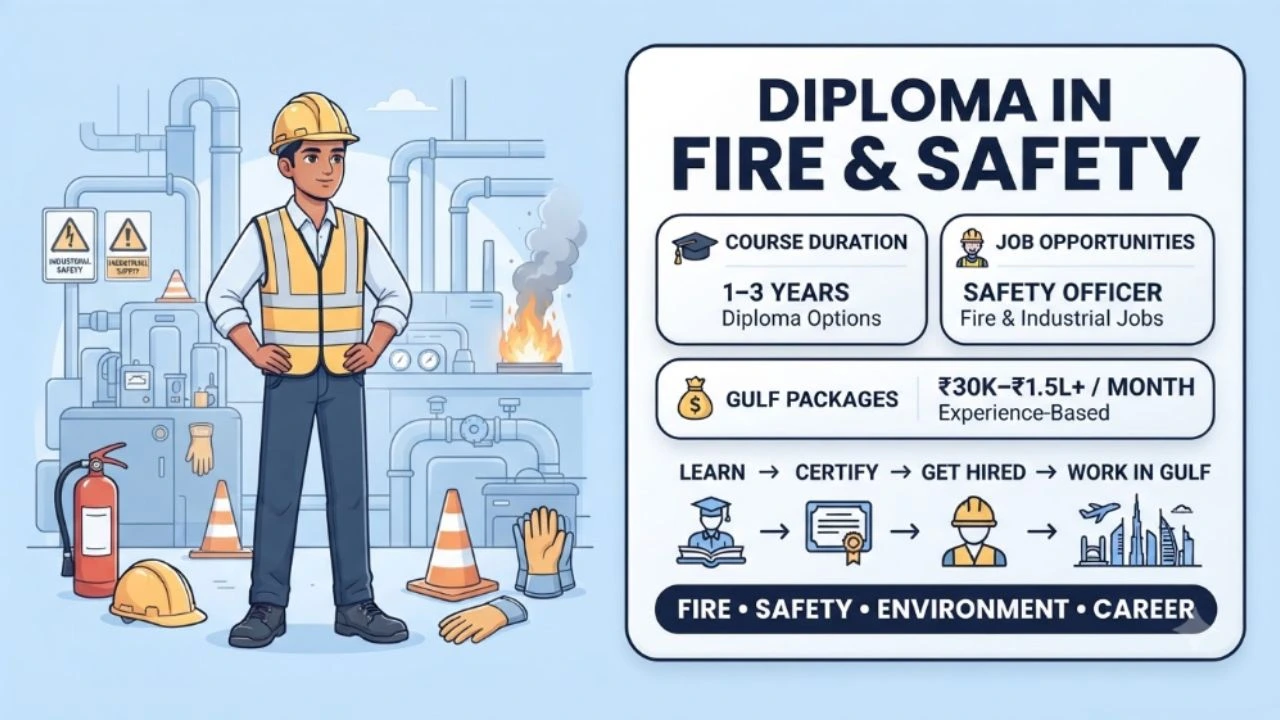
Diploma courses in Fire and Industrial Safety generally range from one to three years, depending on the institution and programme structure. There is no single duration applicable to every diploma carrying a similar name. Some institutes offer a three-year technical diploma after Class 10, while other institutions offer shorter specialised programmes for candidates who have already completed Class 12 or another technical qualification.
Eligibility also differs. For a regular three-year diploma, Class 10 with Science and Mathematics may be required. Some specialised programmes accept Class 12 students, ITI holders or candidates with other technical qualifications.
Age limits, minimum marks and subject requirements depend on the institution. Students should verify these details before paying an admission fee because the word “diploma” is used for courses with very different structures and recognition levels.
What Do Students Learn?
The course is designed around workplace hazards and emergency preparedness. Common subjects can include fire prevention and protection, industrial safety, occupational health, first aid, disaster management and safety legislation.
Students may also study electrical safety, construction safety, chemical safety, personal protective equipment and industrial risk assessment. Environmental topics can cover air and water pollution, waste disposal, environmental monitoring and basic environmental regulations.
Practical training is particularly important in this field. A good programme should expose students to firefighting equipment, emergency drills, safety inspections, hazard identification and other workplace procedures.
Classroom knowledge alone is not enough for a safety professional. The ability to recognise a hazard and recommend a practical control measure becomes increasingly important during employment.
Job Opportunities After the Diploma
Fire and industrial safety graduates can find employment across several sectors. Construction companies require safety personnel to monitor work sites, equipment use, protective gear and emergency procedures.
Manufacturing plants need safety staff because production environments can involve heavy machinery, electrical systems, chemicals and moving equipment. Oil and gas facilities, warehouses, logistics companies, hospitals, hotels and large commercial buildings also maintain fire and safety systems.
Possible job titles include Safety Supervisor, Safety Officer, Fire and Safety Officer, Fire Technician, HSE Assistant and Safety Executive. The exact designation depends on the employer and the candidate’s qualifications.
Fresh diploma holders may initially work under experienced safety professionals. With practical experience and additional certifications, they can progress into roles involving greater responsibility.
Fire and Safety Jobs in Construction
Construction is one of the major sectors where safety personnel are required.
Construction sites can involve work at height, lifting equipment, temporary electrical systems, excavation, welding and heavy machinery.
A safety professional may monitor whether workers are using appropriate protective equipment and whether site procedures follow established safety requirements.
Daily inspections, toolbox meetings, incident reporting and emergency preparedness can also form part of the job.
Students interested in construction safety should develop a good understanding of work-at-height safety, scaffolding, lifting operations, electrical hazards and personal protective equipment.
Experience at construction sites can become useful when applying for larger infrastructure projects later.
Industrial Safety Career Path
Industrial safety offers opportunities in manufacturing, engineering, chemicals, power, mining and other sectors.
A junior safety professional may assist with inspections, safety documentation, training sessions and workplace risk assessments.
With experience, responsibilities can expand to safety audits, incident investigations, emergency planning and safety management systems.
The career path is not limited to one industry.
A candidate who develops strong knowledge of occupational safety can move between sectors, although specific jobs may require additional qualifications or industry experience.
For this reason, practical exposure during the diploma can be valuable.
Students should pay attention to industrial visits, internships and project work instead of treating them as formalities.
Additional Certifications Can Matter
A diploma provides the foundation, but safety recruitment often looks beyond the basic qualification.
Depending on the career path, employers may value certifications in areas such as occupational health and safety, fire safety, first aid, industrial emergency response and environmental management.
Internationally recognised safety qualifications can become particularly relevant for candidates targeting Gulf employment.
The right certification depends on the intended role and country.
Students should avoid collecting certificates without understanding their relevance. A recognised qualification combined with actual site experience is generally more useful than a long list of unrelated short-term certificates.
Salary in India
There is no fixed salary for Fire and Industrial Safety diploma holders.
Pay depends on experience, location, industry, company size, qualifications and job responsibilities.
Freshers may begin in junior safety or fire-safety positions, while experienced professionals can move into supervisory and management roles.
Construction, manufacturing, oil and gas, mining and large infrastructure projects can have different salary structures.
A candidate working in a major industrial project may receive a different package from someone working as a safety supervisor at a small local company.
Instead of relying on a single “average salary,” candidates should compare actual job descriptions and employer requirements.
Additional certifications and relevant site experience can improve earning potential over time.
Opportunities in the Gulf Countries
The Gulf region is an attractive destination for many Indian technical professionals, including those working in health, safety and environment-related positions.
Countries such as the United Arab Emirates, Saudi Arabia, Qatar, Oman, Kuwait and Bahrain have large construction, infrastructure, energy, manufacturing and industrial sectors.
These industries require safety systems because workplaces can involve heavy equipment, high-rise construction, energy facilities and hazardous materials.
Possible roles include HSE Supervisor, Safety Officer, Fire and Safety Officer, HSE Assistant and Safety Technician.
However, a diploma alone does not guarantee a Gulf job.
Employers may look for previous site experience, English communication skills, safety certifications and familiarity with international safety practices.
Some positions may also require specific qualifications recognised by the employer or local authorities.
Gulf Salary and Package Expectations
Gulf packages vary significantly according to country, employer, experience and qualification.
A fresher with no industrial experience should not expect the same package as an experienced HSE professional who has worked on major construction or energy projects.
Entry-level safety positions can offer modest salaries, while experienced professionals with strong credentials may command substantially higher packages.
Accommodation, transport, medical insurance, annual leave and air tickets can also form part of an employment package.
This is why salary alone should not be used to compare two Gulf job offers.
For example, an offer with a lower basic salary but employer-provided accommodation and transport may have greater overall value than a higher salary without these benefits.
Candidates should always check the complete employment contract before accepting an overseas position.
Skills Needed for a Successful Career
Technical knowledge is only one part of a safety professional’s job.
Communication skills are important because safety officers regularly interact with workers, supervisors, engineers and management.
Report writing is another useful skill. Candidates should be able to document incidents, inspections and corrective actions clearly.
Basic computer knowledge is also necessary for preparing reports, maintaining records and handling safety documentation.
A strong understanding of workplace hazards is essential.
Students should learn how to identify unsafe conditions, assess risks and suggest practical control measures.
Leadership becomes increasingly important as professionals move into supervisory positions.
English proficiency can be particularly useful for Gulf employment because safety documentation, meetings and workplace instructions are often conducted in English.
Is This Diploma Good for Gulf Jobs?
The diploma can provide an entry point into the safety profession, but Gulf employment should be viewed as a longer-term career target rather than an immediate guarantee.
A stronger profile can include a recognised diploma, practical industrial experience and relevant safety certifications.
Candidates can also benefit from experience in construction, manufacturing, oil and gas, mining or other high-risk industries.
For someone planning to work abroad, gaining one or two years of relevant experience in India may make the profile more competitive for suitable overseas vacancies.
The requirements vary between employers, so candidates should check each vacancy carefully.
How to Choose the Right Diploma Institute
The institute matters considerably in a safety-related course.
Before admission, check whether the qualification is recognised for the type of employment you are targeting.
Look at the practical training facilities, fire-fighting equipment, laboratories and industrial training arrangements.
Ask whether students receive actual site exposure or only classroom instruction.
The faculty background also matters because safety education benefits from instructors with real industrial experience.
Students should also check whether the institute has a transparent placement record.
Avoid choosing a course solely because an advertisement promises a high Gulf salary.
A credible programme should clearly explain its curriculum, duration, recognition and career pathways.
Career Growth After the Diploma
Career progression usually depends on a combination of education, experience and professional certifications.
A candidate may begin as a Safety Assistant or Fire and Safety Technician.
With relevant experience, the next step can involve Safety Supervisor or Safety Officer responsibilities.
Experienced professionals can progress toward HSE Engineer, HSE Manager or other senior safety positions, subject to the qualifications required by the employer.
The route is different for every candidate.
Some professionals specialise in construction safety, while others move into oil and gas, manufacturing, mining or environmental management.
Those who want broader technical responsibilities can also pursue higher education in safety management, environmental management or related engineering disciplines.
Final Words
A Diploma in Fire, Industrial Safety and Environment can be a practical career option for students interested in workplace safety, fire prevention and environmental protection. The field offers opportunities across construction, manufacturing, mining, power, logistics, hospitals and other industrial sectors.
Gulf countries can provide additional career opportunities, particularly for candidates with relevant industrial experience and recognised safety certifications. Choose a programme with credible recognition, practical training and useful industry exposure. Build communication and technical skills alongside the diploma, then add certifications that match the type of safety career you want.
For students targeting Gulf employment, gaining relevant experience in India before applying abroad can also strengthen the profile. A safety career develops gradually, but the combination of technical education, practical exposure and professional qualifications can create opportunities in both Indian and international industrial markets.