CG PPT is the main entrance route used for admission to diploma engineering courses in Chhattisgarh. For Class 10 students, the exam is an important step toward securing a seat in a government polytechnic college.
The preparation does not require advanced engineering-level knowledge. The syllabus is largely connected with Class 10 Mathematics and Science, so students who build strong fundamentals can prepare effectively without relying entirely on coaching.
The biggest advantage comes from studying the right chapters first, practising questions regularly and understanding how previous counselling cutoffs have moved.
Table of Contents
CG PPT Exam Pattern and Subject Weightage
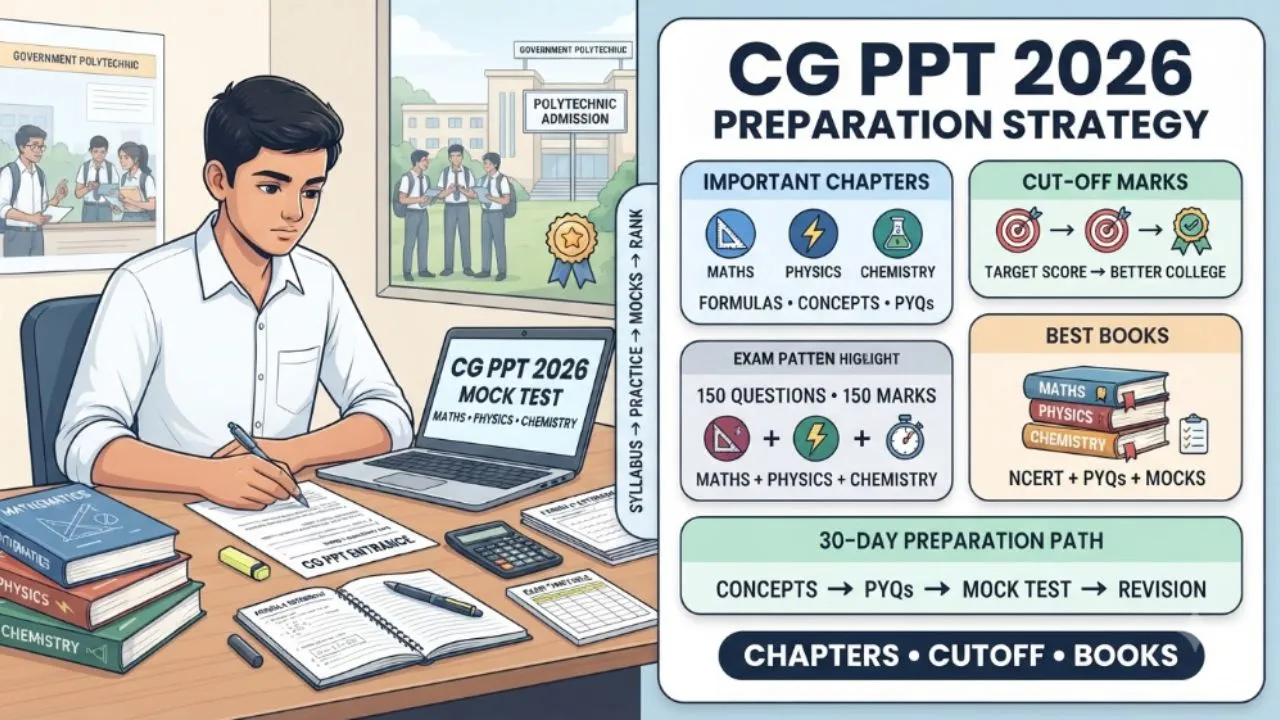
CG PPT is based on three main subjects: Physics, Chemistry and Mathematics. Each subject carries equal weightage. The paper has 150 questions for 150 marks, with 50 questions from each subject.
Mathematics therefore contributes 50 marks, Physics contributes 50 marks and Chemistry contributes another 50 marks. This equal distribution matters when planning preparation. Spending almost all your time on Mathematics while ignoring Chemistry can reduce your overall score considerably.
The paper is based around the Class 10 level, making NCERT and state-board fundamentals particularly useful. For a student targeting a government polytechnic, the aim should not simply be clearing the examination. A stronger score gives more flexibility during counselling, especially when popular branches and colleges are involved.
How Much Time Should You Give Each Subject?
Equal marks do not necessarily mean every student should spend exactly the same amount of time on each subject. A student who is already strong in Mathematics may need more practice in Physics and Chemistry.
Another student may find numerical problems difficult and therefore need additional Mathematics practice. A practical daily schedule could include two study sessions for Mathematics, one for Physics and one for Chemistry, followed by mixed-question practice.
The important part is consistency. Instead of studying one subject for an entire week, rotate the subjects throughout the week. This keeps earlier chapters fresh and helps identify weak areas before the examination.
Mathematics: Important Chapters for CG PPT
Mathematics can become the strongest scoring section if the basic concepts are clear. Class 10 students should first concentrate on chapters that involve formulas, calculations and repeated question patterns.
Important areas include:
- Real Numbers
- Polynomials
- Pair of Linear Equations
- Quadratic Equations
- Arithmetic Progressions
- Triangles
- Coordinate Geometry
- Trigonometry
- Circles
- Areas and Volumes
- Statistics
- Probability
Trigonometry deserves special attention because students often lose marks through incorrect identities or calculation mistakes. Coordinate Geometry and Mensuration are also worth regular practice because questions can usually be solved quickly once the required formulas are familiar.
Do not spend most of your preparation time memorising formulas. Solve questions immediately after learning each formula. This makes it easier to understand when and how the formula should be applied.
For Mathematics, solving previous papers and timed practice sets is more useful than repeatedly reading the same chapter.
Physics: Focus on Concepts and Numericals
Physics can feel difficult initially because many questions require both conceptual understanding and calculation.
Important Class 10 areas include:
- Light and reflection
- Refraction
- Human eye and optical instruments
- Electricity
- Magnetic effects of electric current
- Sources of energy
- Work, power and energy
- Motion
- Force and basic mechanics
Electricity deserves considerable attention. Students should be comfortable with current, voltage, resistance, electrical power and basic numerical problems.
Optics is another area where diagrams and formulas need regular practice. Do not simply memorise definitions.
After studying a concept, solve numerical questions and explain the concept in your own words. If you can do both, the topic is usually well prepared.
Chemistry: Build a Strong Class 10 Foundation
Chemistry can provide reliable marks when reactions, concepts and basic terminology are clear.
Important areas include:
- Chemical reactions and equations
- Acids, bases and salts
- Metals and non-metals
- Carbon compounds
- Periodic classification of elements
- Chemical properties and reactions
Chemical equations should be practised rather than memorised passively. Students should understand why a reaction occurs and identify the products correctly.
The periodic table also deserves regular revision. Make short notes containing important properties, formulas, reactions and exceptions. Revising these notes repeatedly during the final weeks can save considerable time.
Best Books and Study Material for CG PPT
Class 10 students should not begin with books written for engineering entrance examinations. The first priority should be the Class 10 NCERT or Chhattisgarh Board textbooks, depending on the student’s school curriculum.
For Mathematics, use the textbook exercises first and then move to a dedicated objective-question book for additional practice. For Physics and Chemistry, NCERT or the relevant state-board Science textbook should form the foundation.
After completing textbook exercises, use:
- CG PPT previous-year papers
- Chapter-wise objective questions
- CG PPT mock tests
- Class 10 Mathematics question banks
- Class 10 Science question banks
- Short revision notes
The purpose of additional books is practice, not replacing the textbook. Using five or six books at the same time usually creates unnecessary confusion.
One reliable textbook, one objective practice source and previous-year papers are enough for most students.
A 90-Day CG PPT Preparation Strategy
A three-month preparation plan can be divided into three stages.
First 30 Days: Complete the Fundamentals
Use the first month to revise the complete Class 10 syllabus.
Do not worry about attempting hundreds of questions at this stage.
Focus on understanding formulas, concepts, definitions and important reactions.
Make a separate notebook for mistakes and difficult questions.
This notebook becomes particularly useful during final revision.
Next 30 Days: Practice Questions
The second month should be more practice-oriented.
Start solving objective questions after completing each chapter.
Try to solve questions without immediately checking the answer.
Mark questions that take too much time or involve repeated mistakes.
At the end of every week, take a short test covering the topics studied during that week.
Final 30 Days: Mock Tests and Revision
During the final month, begin full-length mock tests.
Try to recreate examination conditions.
Sit for the complete test without checking notes or using a calculator.
After every mock test, analyse the mistakes.
There is little value in taking ten mock tests if the same errors continue appearing in every paper.
Spend time understanding why the answer was wrong.
CG PPT Cut-Off Marks and Government College Competition
CG PPT cutoff should not be treated as one fixed number. The closing score changes according to the college, branch, category, counselling round and number of available seats.
For this reason, previous-year cutoff data is useful for estimating competition but cannot guarantee admission in 2026. Recent counselling records have shown government polytechnic seats closing at different scores depending on the institute and branch.
For example, 2024 Round 2 records included a Computer Science and Engineering seat at Government Girls Polytechnic Bilaspur with a UR opening score around 46.14 and closing score around 41.10.
Government Polytechnic Ambikapur’s Civil Engineering OBC seat in the same round opened around 46.20 and closed around 42.09. Government Polytechnic Durg’s Civil Engineering OBC seat was around 47.41 to 47.35.
These figures show why students should compare the specific college, branch and category rather than looking for one statewide cutoff. Another important point is that CG PPT counselling data is commonly presented through opening and closing scores, rather than a simple nationwide-style rank table.
Therefore, students searching for the “last three years’ opening and closing ranks” should check the actual counselling allotment records for each year and round. The 2025 trend also showed that scores around 100 or above were considered competitive for several government polytechnic options, while 120 or higher represented a stronger position in broad score-based estimates.
These are useful preparation targets, not guaranteed admission cutoffs.
How to Set a Target Score for 2026
Instead of preparing only to cross the minimum qualifying level, aim considerably higher. A student targeting government colleges should ideally work toward a score of 100+ out of 150, while a target around 120+ provides a stronger cushion for competitive choices.
The exact score needed will depend on the college, branch, category and counselling round. Students interested in popular branches such as Computer Science, Electrical or Electronics should generally aim higher than someone willing to consider less competitive branches or later counselling rounds.
Keep multiple college and branch choices ready during counselling. A slightly lower score does not automatically mean that government polytechnic admission is impossible.
Later rounds can have different closing scores because seats become available as candidates change their choices or move to other institutions.
How to Improve Your Score in the Last Month
The final month should not be used to start completely new books. Revise formulas every day.
Practise Mathematics calculations without unnecessary breaks. Revise important Physics formulas and Chemistry reactions regularly.
Take timed mock tests and analyse every incorrect answer. Maintain a list of frequently repeated mistakes.
If a particular chapter repeatedly causes problems, revise the concept before attempting another set of questions. With 150 questions, students need to manage time carefully. Avoid spending several minutes on one difficult question while easier questions remain unanswered.
Final Preparation Advice
CG PPT preparation becomes much easier when Class 10 fundamentals are strong. Mathematics needs regular problem-solving, Physics requires a balance of concepts and numericals, while Chemistry rewards careful revision of reactions and core concepts. A student who studies for three focused hours and analyses mistakes can make better progress than someone who spends six hours reading without solving questions. For government polytechnic admission, keep a realistic target of 100+ marks and aim higher if you want greater flexibility in college and branch selection. A strong preparation strategy is therefore simple: complete the Class 10 syllabus, practise all three subjects, solve previous papers, take timed mocks and keep improving the areas where marks are being lost.