Cyber security has become an important part of almost every digital business. Banks, government departments, hospitals, e-commerce companies and technology firms all depend on secure computer systems and networks.
This has created demand for professionals who understand network security, ethical hacking, digital forensics and information security. A Diploma in Cyber Security and Ethical Hacking can be an entry point for students interested in this field. Depending on the institution, such programmes are available after Class 10, Class 12 or as specialised diploma courses for candidates with a computer-related background.
The course is practical in nature and usually covers networking, operating systems, security tools, ethical hacking, cyber laws and forensic investigation. For students already holding a Computer Science or Computer Engineering diploma, cyber security can also become a useful specialisation through additional certifications and advanced training.
Table of Contents
What Is a Diploma in Cyber Security and Ethical Hacking?
A Diploma in Cyber Security and Ethical Hacking is a technical programme focused on protecting computers, networks, applications and digital information from cyber threats.
The ethical hacking component teaches how security professionals identify vulnerabilities in systems with proper authorisation.
The objective is not to teach illegal hacking. Instead, students learn controlled security testing techniques used to identify and fix weaknesses.
Depending on the college and course structure, the programme can cover network defence, penetration testing, digital forensics, cyber security tools, cryptography and security management.
The duration also varies. Some diploma programmes are designed as three-year technical diplomas after Class 10, while specialised post-Class 12 or computer-diploma programmes can have shorter durations.
Students should check the exact course structure before applying because the term “diploma” is used for different types of programmes.
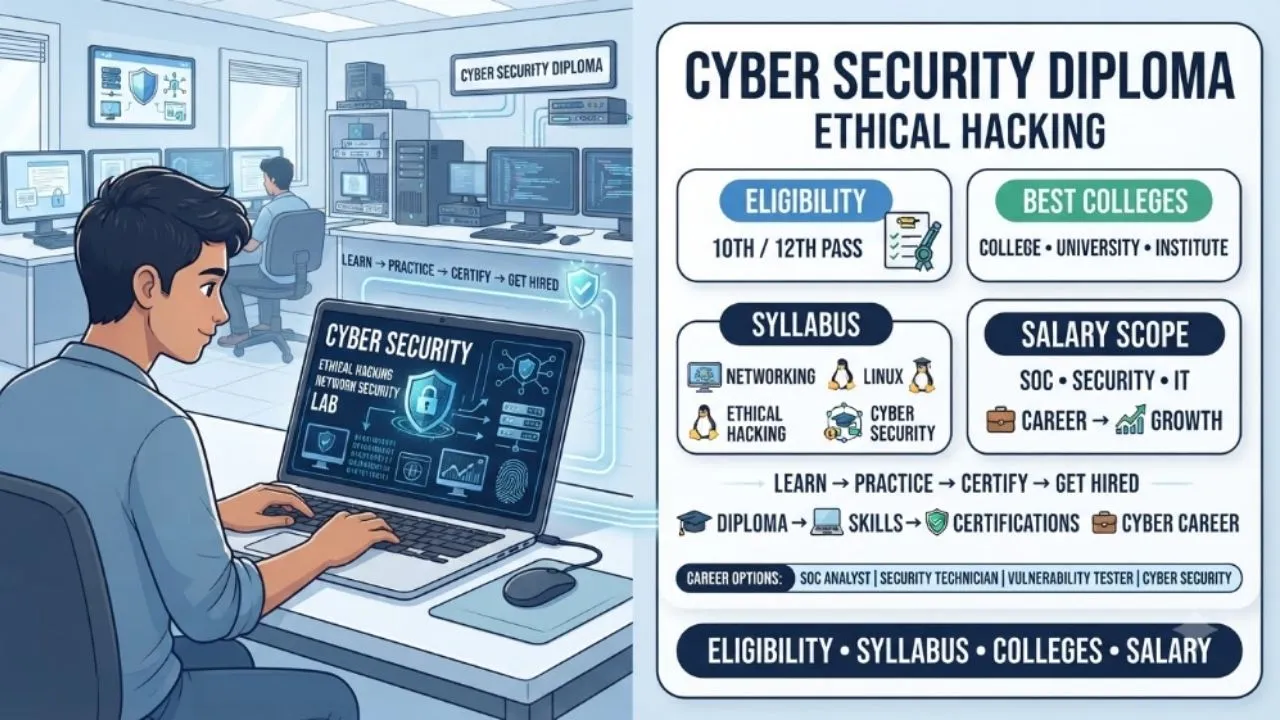
Eligibility for Diploma in Cyber Security
Eligibility depends mainly on the type of diploma being offered.
For a regular technical diploma after Class 10, candidates generally need to pass Class 10 from a recognised board. Mathematics and Science requirements may apply depending on the institute and programme.
Some specialised cyber security diplomas accept candidates after Class 12.
Students from Science, Mathematics or Computer-related backgrounds may find such programmes easier to follow because basic computing and logical concepts are useful throughout the course.
There is another route for candidates who already have a Diploma in Computer Science, Computer Engineering or Information Technology.
Such students may not need to start from basic computer subjects again. Instead, they can pursue a cyber security specialisation, certification or advanced diploma covering areas such as penetration testing, network defence and digital forensics.
The exact eligibility, admission method and duration should always be checked with the individual institution.
10th vs 12th vs Computer Diploma: Which Route Is Better?
Students completing Class 10 can enter a technical diploma route and start learning computing and engineering subjects earlier.
This option suits candidates who already have a clear interest in technology and prefer practical education.
A Class 12 student has a different set of options. After 12th, candidates can choose specialised cyber security programmes or pursue a degree such as B.Tech in Computer Science, Cyber Security or Information Technology.
Students who already hold a Computer Science or IT diploma have a stronger technical foundation.
They are likely to be familiar with programming, databases, operating systems and computer networks. This can make advanced cyber security topics easier to understand.
For long-term career growth, the qualification level also matters. A diploma can help with entry-level technical roles, while a B.Tech or another higher qualification may provide access to a broader range of engineering and security positions.
Core Syllabus of Cyber Security and Ethical Hacking
The syllabus varies between colleges, but several subjects commonly appear in well-designed cyber security programmes.
Network Security
Network security is one of the foundations of cyber security.
Students learn how networks operate and how attackers attempt to exploit weaknesses in network infrastructure.
Topics can include firewalls, intrusion detection, VPNs, network monitoring, access control and secure communication.
Basic networking knowledge is particularly important because many cyber attacks involve compromised network services or poorly configured systems.
Ethical Hacking and Penetration Testing
Ethical hacking teaches students how authorised security testing is performed.
The course may introduce reconnaissance, vulnerability assessment, penetration testing and security reporting.
Students can learn how security professionals test websites, networks and applications for weaknesses.
Practical labs are important here because security concepts become easier to understand when students can work with controlled environments.
Digital Forensics
Digital forensics focuses on investigating digital evidence after a security incident.
Students can learn how evidence is collected, preserved and analysed while maintaining its integrity.
The subject can include disk analysis, file recovery, log examination, incident investigation and basic forensic reporting.
Digital forensics is useful for students interested in cyber crime investigation and incident response.
Forensic Auditing
Forensic auditing combines technical investigation with examination of digital records and activities.
It can involve reviewing system logs, transactions, access records and other information to identify suspicious activity.
This area can be relevant to organisations investigating fraud, unauthorised access or data misuse.
Cryptography
Cryptography explains how information is protected through encryption and related security techniques.
Students may encounter concepts such as symmetric encryption, asymmetric encryption, hashing, digital signatures and key management.
A strong understanding of these concepts helps explain how secure communication and authentication systems work.
Cyber Laws and Security Policies
Technical knowledge alone is not enough for professional cyber security work.
Students also need to understand the legal and ethical boundaries surrounding security testing and digital evidence.
Courses may introduce cyber crime laws, privacy principles, compliance requirements and responsible security practices.
This subject is especially important for ethical hacking because testing systems without proper permission can create serious legal problems.
Practical Skills Students Should Develop
Cyber security is a hands-on field.
Students should spend time working with operating systems, networking tools, security platforms and controlled laboratory environments.
Linux is particularly useful because it is widely used in security testing and server environments.
Basic programming is also valuable. Python, Bash or another scripting language can help automate repetitive security tasks.
Students should understand how websites, databases and computer networks function before attempting advanced security testing.
A strong foundation in these areas often matters more than simply collecting certificates.
Industry Certifications: CEH and CompTIA Security+
Professional certifications can supplement a diploma and demonstrate knowledge in specific areas.
Certified Ethical Hacker, commonly known as CEH, is an established certification focused on ethical hacking and security testing concepts.
It can be useful for candidates who want to demonstrate knowledge of penetration testing and offensive security fundamentals.
CompTIA Security+ is another widely recognised entry-level security certification.
It covers areas such as threats, vulnerabilities, security architecture, identity management, risk management and incident response.
Neither certification guarantees a job.
Their value depends on the candidate’s actual knowledge, practical ability and the requirements of the employer.
For a diploma holder, combining one relevant certification with practical projects can be more useful than collecting several unrelated certificates.
Best Colleges and Institutes for Cyber Security
There is no single official ranking that determines the best college for a Diploma in Cyber Security and Ethical Hacking across India.
The quality of a programme depends on factors such as curriculum, laboratory facilities, faculty expertise, accreditation, industry exposure and practical training.
Government polytechnic institutes can be attractive because their fees are often lower than private institutions.
Students should check whether the cyber security programme is an actual diploma qualification or a short-term certificate course.
Private universities and specialised training institutes also offer cyber security programmes, but fees can vary considerably.
Before admission, check the institute’s recognition, course duration, syllabus, laboratory facilities and placement record.
A course with modern security labs and practical assignments can be more useful than one that focuses mainly on classroom theory.
Career Options After Cyber Security Diploma
A diploma can provide a foundation for several entry-level technical roles.
Possible job profiles include Security Support Technician, Junior Cyber Security Analyst, SOC Support Associate, Network Security Technician and IT Support Specialist.
Some employers may expect additional certifications or experience for dedicated security positions.
Students with stronger networking and Linux skills can explore Security Operations Centre roles.
Candidates interested in ethical hacking can move towards vulnerability assessment and penetration testing after gaining the necessary knowledge and authorised practical experience.
Digital forensics is another option for those interested in investigation and evidence analysis.
Government organisations, banks, technology companies, consulting firms and large enterprises can all require cyber security professionals.
Starting Salary After a Cyber Security Diploma
Starting salary depends on qualification, technical skills, location, employer and job role.
For fresh diploma holders entering entry-level IT or security-support positions, an approximate starting range of ₹2.5 lakh to ₹5 lakh per year can be a realistic broad benchmark.
Candidates with strong networking skills, Linux knowledge, security certifications and practical projects may qualify for better opportunities.
However, salary figures vary significantly between employers.
A candidate working as general IT support may earn differently from someone entering a Security Operations Centre.
Experience can also make a substantial difference. Cyber security professionals who develop specialised skills in penetration testing, cloud security, incident response or digital forensics can move into higher-paying positions over time.
Students should therefore look beyond the first salary package when evaluating this career.
How to Build a Strong Cyber Security Profile
A diploma provides the academic foundation, but practical work is what makes the knowledge useful.
Build small security projects using legal and controlled environments.
Practise networking and Linux administration.
Learn basic Python scripting.
Create a home laboratory using virtual machines and deliberately vulnerable systems designed for security practice.
Document what you learn through technical notes and project reports.
Certifications such as CEH or CompTIA Security+ can then complement this practical experience.
Internships and apprenticeships can provide another important advantage because they introduce students to real workplace systems and security procedures.
Never test a website, server, account or network without explicit permission.
Final Words
A Diploma in Cyber Security and Ethical Hacking can be a practical starting point for students interested in information security.
The route after Class 10 is different from the options available after Class 12 or a Computer Science diploma, so choosing the right programme requires careful comparison.
Network Security, Ethical Hacking, Digital Forensics, Forensic Auditing, Cryptography and Cyber Laws form important parts of the subject.
Certifications such as CEH and CompTIA Security+ can strengthen a candidate’s profile when combined with genuine technical skills.
For starting salaries, diploma holders can expect entry-level opportunities, but earnings depend heavily on the role, employer, location and practical ability.
The strongest approach is to build a solid foundation in computers and networking first, then develop specialised security skills through projects, authorised labs, certifications and industry exposure.