Industrial training is an important part of diploma and engineering education under CSVTU. After completing the training, students usually have to prepare a report explaining where they trained, what they learned and what practical work they observed.
A well-prepared industrial training report should be clear, properly formatted and easy for the examiner to follow. It does not need complicated language. The focus should remain on the training experience, technical learning and weekly activities.
The report also becomes useful during the viva, where external examiners can ask questions based on the work described in it.
This guide explains the CSVTU industrial training report format, page arrangement, front-page template, formatting rules, weekly log structure and important viva questions.
Table of Contents
What Is a CSVTU Industrial Training Report?
An industrial training report is a written record of the practical training completed by a student at a company, factory, workshop, institution or other approved organisation.
It normally contains details about the training organisation, department, duration, activities performed and technical knowledge gained during the training period.
The exact requirements can differ between programmes and institutes. Students should follow the format prescribed by their department if a specific template has been provided.
For most reports, the objective is straightforward: document the training in an organised and professional manner.
A report should not simply contain copied information about the company. The examiner should be able to understand what the student actually observed, learned and worked on.
CSVTU Industrial Training Report Format
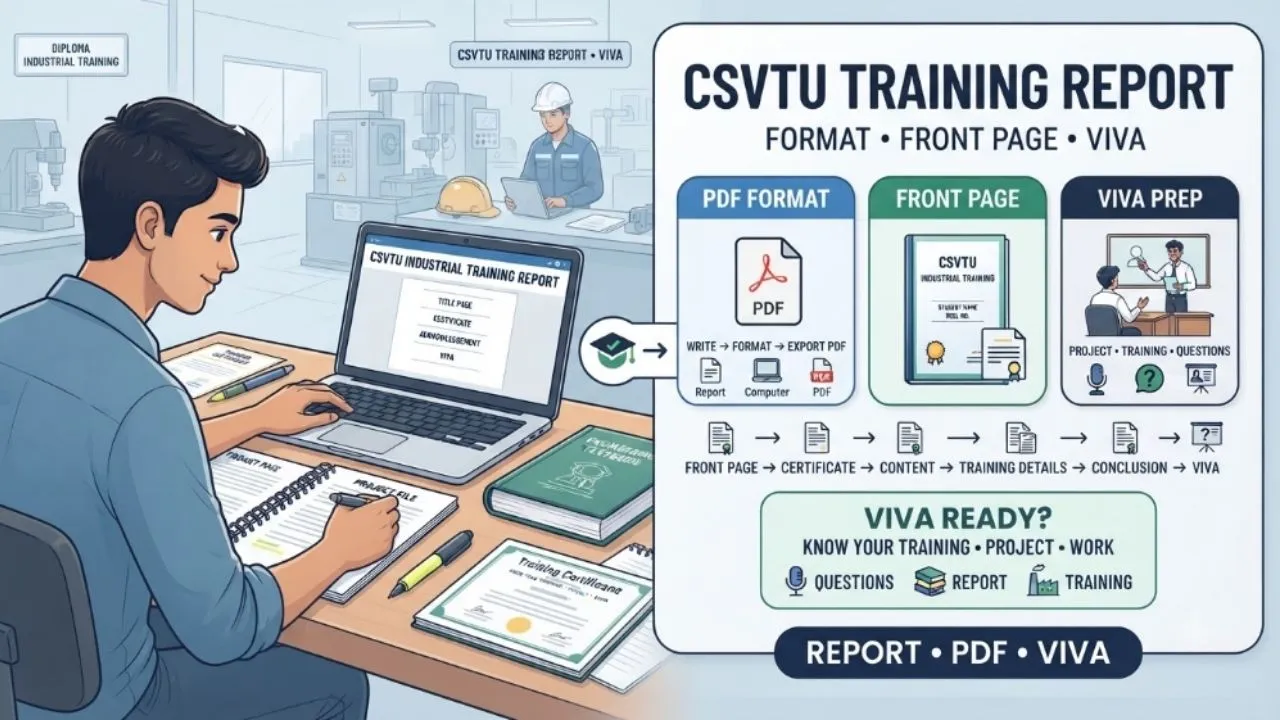
A typical industrial training report can be arranged in the following sequence:
- Title Page
- Certificate of Completion
- Declaration, if required
- Acknowledgement
- Table of Contents
- Introduction
- Company or Organisation Profile
- Training Objectives
- Department or Work Area
- Technical Details and Activities
- Weekly Training Logs
- Skills and Knowledge Gained
- Problems or Challenges Faced
- Conclusion
- References, if required
- Appendices, where applicable
The order may change according to the instructions issued by your college or department.
Do not add unnecessary chapters simply to increase the page count.
1. Title Page or Front Page
The title page is the first page of your industrial training report. It should look clean rather than crowded.
A standard front page can contain:
INDUSTRIAL TRAINING REPORT
ON
[TITLE OF TRAINING / PROJECT]
Submitted in partial fulfilment of the requirements for
[Diploma/B.Tech Programme Name]
[Branch Name]
Chhattisgarh Swami Vivekanand Technical University (CSVTU), Bhilai
Submitted by:
Name: [Student Name]
Roll Number: [Roll Number]
Enrollment Number: [Enrollment Number]
Semester: [Semester]
Training Organisation:
[Company/Organisation Name]
Training Duration:
[Start Date] to [End Date]
[College Name]
Academic Session: 2025–26 / 2026–27
If your college has an official logo or prescribed front-page design, use that format instead of creating a completely different layout.
Keep the title page simple and properly aligned.
2. Certificate of Completion
The certificate confirms that the student completed industrial training at the concerned organisation.
It normally includes the student’s name, course, college, training organisation and training period.
A typical certificate page may begin with:
CERTIFICATE
This is to certify that [Student Name], a student of [Course and Branch], [College Name], has successfully completed industrial training at [Organisation Name] from [Date] to [Date].
The certificate should be signed and stamped by the authorised training supervisor or organisation representative where required.
Do not create a false company signature or stamp.
If the organisation has already issued a completion certificate, include a scanned copy or photocopy according to your college’s submission instructions.
3. Acknowledgement
The acknowledgement is a short section thanking the people and organisations that supported your training.
Mention your training organisation, industrial supervisor, college faculty member, department and others who provided genuine assistance.
Keep it brief.
There is no need to write several pages of formal appreciation.
A good acknowledgement usually fits within one page and sounds personal without becoming overly casual.
4. Table of Contents
The table of contents helps the examiner find individual sections quickly.
Include the chapter or section name along with its page number.
For example:
- Introduction
2. Objectives of Industrial Training
3. Company Profile
4. Department Overview
5. Training Activities
6. Weekly Training Log
7. Skills Acquired
8. Conclusion
Update the page numbers after completing the report.
If you are preparing the document in Microsoft Word, the automatic Table of Contents feature can make this easier.
5. Introduction
The introduction should explain the purpose of the industrial training.
Mention why practical exposure is relevant to your course and what you expected to learn.
For a Mechanical Engineering student, the introduction could discuss exposure to manufacturing, maintenance or production processes.
For Computer Science students, it could focus on software development, networking, databases or related technical work.
Avoid writing generic statements about how industrial training is “very important for every student.”
Connect the introduction with your actual training.
6. Company or Organisation Profile
The company profile should provide basic information about the organisation where you completed training.
You can include:
- Company name
- Location
- Year of establishment
- Main products or services
- Major departments
- Industry sector
- Relevant technical operations
Use information that you can verify from the organisation’s official material or your training documents.
Do not copy several pages from the company’s website.
The examiner is more interested in understanding the environment where you received practical exposure.
7. Training Objectives
Clearly mention what you intended to learn during the training.
Objectives may include:
- Understanding industrial processes
- Learning workplace safety practices
- Observing machinery or software systems
- Understanding maintenance procedures
- Applying classroom concepts
- Developing technical and communication skills
- Learning professional workplace practices
Keep the objectives connected to your branch and actual training.
8. Weekly Training Logs
The weekly log is one of the most useful parts of the report.
Instead of writing only:
“Week 1: Learned about the company.”
provide specific information.
A stronger weekly entry could mention the department visited, equipment observed, software used, practical activities performed and concepts understood.
For example:
Week 1: Introduction to the organisation, safety rules, department structure and basic workplace procedures.
Week 2: Observed machine operation, maintenance schedules and safety precautions followed by technical staff.
Week 3: Studied the workflow of the assigned department and assisted with supervised technical activities.
Week 4: Worked on assigned tasks, recorded observations and discussed technical problems with the supervisor.
The number of weeks should match your actual training duration.
Do not invent activities simply to make the report look more detailed.
9. Technical Work and Learning
This section should contain the main technical content of the report.
Explain the machines, tools, software, processes or systems you encountered.
Use diagrams, photographs or screenshots when permitted.
For technical processes, explain them in your own words.
A good report answers three basic questions:
What did you observe?
How does it work?
What did you learn from it?
This makes the report more useful during the viva because the examiner can ask questions directly from your documented experience.
10. Standard Formatting Guidelines
Formatting should remain consistent throughout the document.
A commonly used academic format includes:
- Font: Times New Roman
- Main text: 12 pt
- Chapter headings: 16 pt
- Section headings: 14 pt
- Line spacing: 1.5
- Text alignment: Justified
- Paper size: A4
- Normal margins: around 1 inch
- Page numbers: consistent throughout the report
These are general formatting recommendations. If your college or department has issued specific formatting instructions, those instructions should take priority.
Use bold formatting for important headings rather than combining several decorative fonts.
Keep the same heading style throughout the report.
Images should be clear and properly labelled.
11. PDF Preparation and Submission
After completing the report, review the document carefully before converting it to PDF.
Check the following:
- Page numbers are correct.
- The table of contents matches the actual pages.
- Images are visible.
- Headings are consistent.
- No blank pages have appeared.
- Certificates and signatures are readable.
- Spelling errors have been corrected.
- Weekly logs are complete.
- Your name and roll number are correct.
Save the editable Word document separately before creating the final PDF.
Use a simple file name such as:
Name_RollNo_IndustrialTraining_Report.pdf
Avoid names such as “finalfinalnew2.pdf” because they can create confusion during submission.
12. How to Prepare for the Industrial Training Viva
The viva usually tests whether you understand the training described in your report.
External examiners may not ask only theoretical questions. They can also ask why you selected a particular company, what work you performed and what you learned.
Read your complete report at least once before the viva.
You should remember the training duration, company name, department, major activities, equipment or software used and important technical concepts.
Do not memorise every sentence.
Understand the work you have written about.
Top Viva Questions Asked by External Examiners
Prepare answers for questions such as:
- Where did you complete your industrial training?
Give the company name, location and department.
- What was the duration of your training?
State the exact starting and ending dates if possible.
- Why did you choose this organisation for training?
Give a practical reason related to your branch and learning objectives.
- What did you learn during the training?
Mention two or three specific technical areas rather than giving a general answer.
- Which department did you work in?
Explain the department’s basic function and your involvement.
- What equipment, software or tools did you use?
Mention only tools you actually encountered.
- Explain one technical process you observed.
Choose a process discussed clearly in your report and explain it step by step.
- What safety precautions were followed?
Discuss the actual safety practices relevant to your workplace.
- What was the most useful part of your training?
Choose a genuine experience and explain what you learned from it.
- What problem did you face during training?
Mention a real difficulty and explain how you or your supervisor addressed it.
- How is your industrial training connected with your course?
Connect the practical experience with subjects studied in your diploma or degree.
- What skills did you develop?
Mention technical skills along with workplace skills such as communication, teamwork or documentation.
- What is the difference between theoretical and practical knowledge?
Explain how classroom concepts were applied or observed in the workplace.
- What would you improve if you repeated the training?
Give a realistic answer based on your experience.
Final Checklist Before Submission
Before submitting your CSVTU industrial training report, check the complete document from the first page to the last.
Make sure the title page contains accurate personal and college information.
Verify the certificate, acknowledgement and contents pages.
Check every weekly log against your actual training record.
Review technical explanations and make sure you can explain them during the viva.
Finally, convert the completed document into PDF only after checking its formatting on the final version.
A good industrial training report does not depend on excessive pages or complicated language. Its value comes from accurate documentation, clear technical explanations and genuine details about the training. When the report reflects what you actually learned, viva preparation also becomes easier because most questions can be answered from your own experience.