Technical education in India is moving towards a more flexible academic structure, especially under the broader reforms linked with the National Education Policy. For polytechnic students, one of the biggest changes is the growing focus on academic credits, flexible learning pathways and smoother movement between diploma and degree-level education. The traditional system followed a fairly fixed route. A student joined a diploma course, completed the required semesters and then either entered employment or applied for lateral entry into an engineering degree.
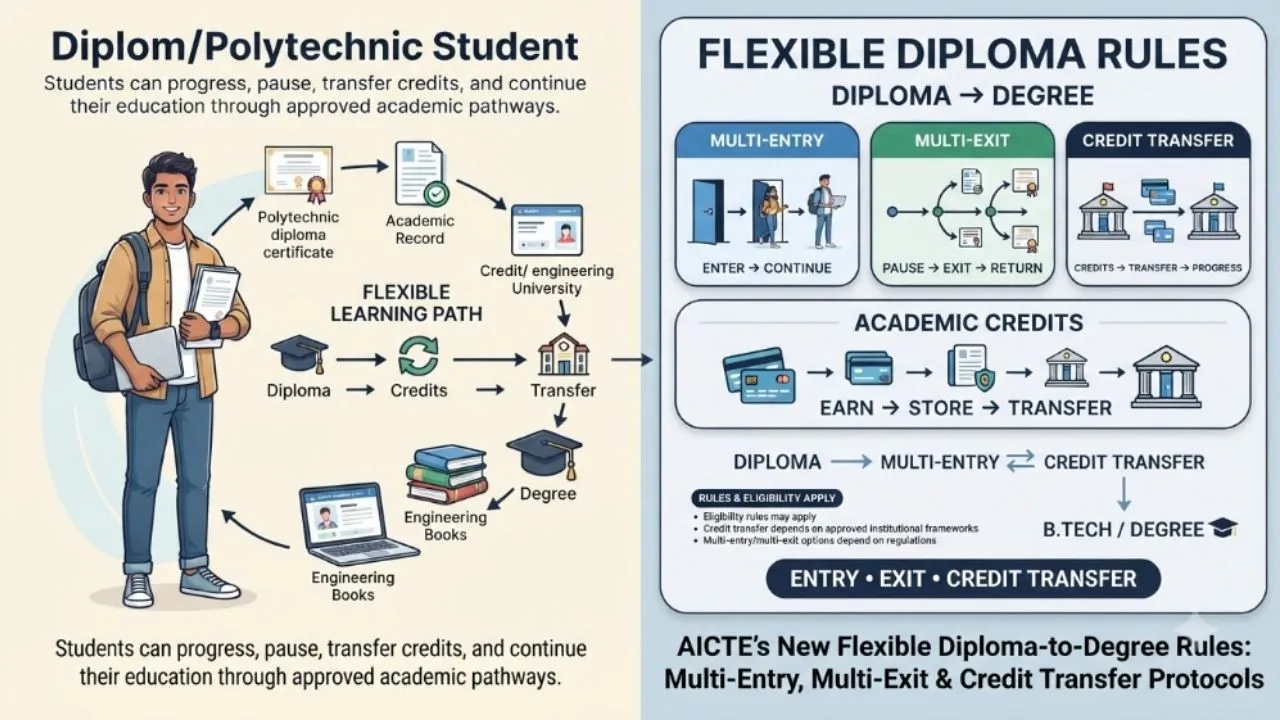
The newer approach aims to make academic progression more flexible. Terms such as multi-entry, multi-exit, Academic Bank of Credits and credit transfer are now becoming increasingly relevant across higher and technical education. However, these terms can also create confusion among diploma students and parents.
A flexible academic system does not mean that every diploma holder can automatically enter or leave any course at any stage. Admission rules, institutional approval, available credits and university regulations continue to play an important role. This article explains the changing framework around AICTE polytechnic rules, diploma to B.Tech credit transfer and NEP polytechnic reforms in simple terms.
Table of Contents
Why Flexible Diploma Education Is Becoming Important
The conventional education system was designed around a fixed academic journey. Once a student entered a course, completing the full programme was usually the expected route. Leaving midway could create problems because there was often no formal mechanism for recognising the learning already completed.
The broader education reforms now focus more strongly on recognising academic progress through credits. A credit represents a defined amount of learning completed through a recognised academic programme. When institutions follow compatible academic frameworks, these credits can help document a learner’s progress.
This creates the possibility of more flexibility. A learner may complete part of an academic journey, pause education for a valid reason and later continue, subject to the rules of the institution and programme.
For polytechnic education, this idea is particularly important because diploma holders often follow different career paths. Some enter employment immediately after completing their diploma.
Others prepare for government recruitment examinations. Many pursue lateral entry into B.Tech programmes.
Some may need to pause their education because of financial, family or employment responsibilities. A flexible academic structure attempts to make these transitions more manageable while maintaining academic standards.
Understanding Multi-Entry in Technical Education
Multi-entry refers to the possibility of entering an academic programme through different recognised pathways. In the context of engineering and technical education, entry requirements still depend on the programme and institution.
A regular B.Tech applicant may enter after completing Class 12 with the required subjects and eligibility. A diploma holder may become eligible for lateral entry into an engineering degree, depending on the rules followed by the university, state admission authority or institution.
The important point is that multi-entry does not remove eligibility requirements. A student cannot simply claim admission into the second or third year of a degree programme because of unrelated academic credits.
The previous qualification must be relevant to the programme, and the institution must recognise the academic pathway. For diploma holders, the familiar example is lateral entry into B.Tech or B.E.
Eligible candidates can apply through the admission process prescribed by the relevant university or state authority. The new focus on flexibility could improve how previous learning and recognised credits are documented, but it does not replace the formal admission process.
What Multi-Exit Means for Diploma Students
Multi-exit is another concept that often receives more attention than necessary. It refers to a structured system where learners may exit an academic programme at specified stages and receive recognition for the education completed, provided the programme rules allow it.
The actual award received after an exit depends on the approved academic structure. This is important because not every exit point automatically results in a diploma, certificate or degree.
The institution must have an approved framework defining what qualification is awarded at each stage. For polytechnic students, the main question is whether leaving before completing the full diploma programme will result in a recognised qualification.
The answer depends on the applicable regulations and institutional framework. Students should not assume that completing one or two semesters of a three-year diploma automatically guarantees a recognised exit certificate.
Before leaving a programme, confirm the academic consequences with the college and the relevant examining or technical education authority. A flexible system is intended to support academic mobility, but recognition still requires a formally approved structure.
Academic Credits and Their Role
The credit-based system is central to discussions about flexible education. Under a traditional approach, academic progress was mainly measured through completed years, semesters and examinations.
Credits add another way of recording completed learning. A student earns credits after successfully completing the required academic components according to the rules of the programme.
These credits create an academic record of the learning completed. In a compatible system, recognised credits may later be considered when moving between programmes or institutions.
This does not mean every credit is automatically transferable. The receiving institution has to determine whether the completed subjects and learning outcomes match its own academic requirements.
Consider a diploma student who has completed recognised coursework in engineering mathematics, basic electrical concepts and computer applications. If the student later applies to another approved programme, the receiving institution may examine whether those completed courses match the subjects offered under its own curriculum. The decision depends on academic equivalence and the rules governing credit transfer.
Diploma to B.Tech Credit Transfer
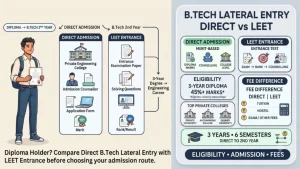
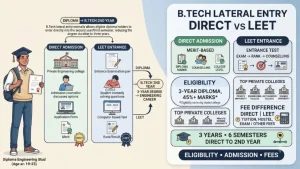
The phrase “diploma to B.Tech credit transfer” can sound like a completely new alternative to lateral entry. In reality, diploma holders have already had established pathways for entering engineering degree programmes through lateral entry, subject to applicable admission rules.
The developing credit framework may support better recognition and documentation of prior academic learning. However, a credit transfer system should not be confused with guaranteed direct admission.
A diploma holder still needs to meet the eligibility conditions for the target B.Tech programme. The admission authority may require a particular diploma discipline, minimum marks or a separate entrance and counselling process. The university may also decide how previous coursework is recognised.
In many established lateral-entry systems, eligible diploma holders enter the second year or third semester of an engineering programme. This route is based on the equivalence between diploma-level learning and the initial stage of the engineering degree.
The exact rules can differ across states and universities. For this reason, candidates should check the current lateral-entry notification rather than relying on an assumption that a national credit framework automatically guarantees entry into a particular semester.
How NEP Reforms Affect Polytechnic Education
NEP-related reforms have encouraged educational institutions to think more seriously about learner mobility and flexible academic progression. The broader goal is to reduce unnecessary barriers between different stages of education while maintaining academic quality.
For polytechnic students, this could support a more structured connection between diploma education, higher education, skill development and future degree programmes. The traditional idea that education follows only one straight path is gradually changing.
A learner may combine formal education with skill development, apprenticeships and industry experience at different stages of a career. Technical education is particularly suitable for this approach because practical learning and workplace experience already play an important role in diploma programmes.
However, implementation is not identical across India. Polytechnic education is closely connected with state technical education boards, universities and institutional systems.
As a result, the practical application of multi-entry, multi-exit and credit transfer may differ between states and institutions. A rule available at one university should not automatically be treated as a nationwide rule.
What Polytechnic Students Should Expect in 2026
The direction of technical education is becoming more flexible, but students should remain realistic about what these reforms mean in practice.
The first major benefit is better recognition of completed academic work.
Instead of viewing education only as a complete or incomplete journey, the credit-based approach creates the possibility of recording recognised learning in a more structured manner.
The second benefit is improved academic mobility.
Where institutions and programmes follow compatible frameworks, a learner may have more opportunities to move between approved academic pathways.
The third benefit is flexibility for those who need to take a break from education.
A student may pause studies because of financial pressure, employment or personal responsibilities. Formal recognition of completed learning can make a later return easier where the applicable rules permit it.
The practical benefits will still depend on implementation.
Students should not leave a diploma programme based on the assumption that they can return automatically after several years.
Re-entry periods, credit validity and institutional rules may apply.
Multi-Entry and Multi-Exit Do Not Replace Lateral Entry
This is one of the most important points for diploma holders planning a B.Tech degree.
Lateral entry remains a separate admission route governed by the rules of the relevant institution or admission authority.
The NEP-related flexible education framework does not automatically replace that process.
A diploma holder seeking admission to B.Tech should continue to check the official eligibility criteria.
Important details can include the required diploma branch, minimum percentage, entrance examination requirements and counselling procedure.
A student with a diploma in Mechanical Engineering may find lateral-entry opportunities in Mechanical Engineering or related programmes, depending on the university rules.
The same principle applies to Civil, Electrical, Computer and other diploma branches.
Branch compatibility should always be checked before applying.
The credit-based framework may support academic recognition, but admission eligibility remains the responsibility of the relevant authority.
How Credit Transfer May Work Between Institutions
Credit transfer requires more than simply moving marks from one college to another.
The receiving institution normally needs to assess the academic value of the completed coursework.
Subjects may differ in syllabus, contact hours, laboratory requirements and learning outcomes.
Suppose a student transfers after completing a recognised technical programme.
The new institution may examine the completed subjects and compare them with its own curriculum.
Equivalent subjects may be considered for recognition, while missing subjects may need to be completed separately.
This process protects academic standards.
Without equivalence checks, two students could receive the same qualification despite completing very different coursework.
For this reason, students considering a transfer should collect detailed academic records, including marksheets, course information and other documents required by the receiving institution.
Do not assume that a college transfer is automatic simply because both institutions are recognised.
What to Check Before Leaving or Changing a Course
Before using a multi-exit or transfer option, obtain clear information from the institution.
First, confirm whether the programme officially provides an exit option at the stage you have reached.
Next, check what qualification or academic recognition is provided.
Ask whether the completed credits remain valid if you return later.
The re-entry period can be particularly important.
A student should also confirm whether rejoining depends on seat availability, revised syllabus requirements or additional academic conditions.
If planning a transfer, ask the receiving institution how it evaluates previous credits.
Get the important information in writing whenever possible.
A verbal assurance from an unofficial source is not enough when making a major academic decision.
Final Words
Flexible academic pathways represent an important shift in the way technical education is being structured in India. Multi-entry, multi-exit and credit-based recognition could give diploma learners more options to continue, pause or redirect their education.
For polytechnic students, the biggest practical advantage may be better documentation and recognition of completed learning. The established diploma-to-B.Tech lateral-entry route also remains important for those planning to continue towards an engineering degree. AICTE guidelines, university regulations, state technical education rules and institutional policies all influence how these reforms work in practice.
For anyone planning to use diploma to B.Tech credit transfer or another flexible academic route in 2026, the safest approach is simple. Check the current rules of the college, university or admission authority before making an academic decision. The reforms are designed to create more flexibility, but understanding the exact pathway remains essential for making that flexibility useful.