Industrial training viva is one of those diploma assessments where practical understanding matters more than memorising a long answer. Examiners want to know whether you actually observed the workplace, understood your department and maintained the training record properly.
For CSVTU diploma students, preparation should begin with three things: the industrial training report, daily logbook and presentation. These documents should tell the same story. If your PPT says you worked in maintenance but the logbook mainly contains production entries, expect questions about the difference. This CSVTU Diploma Industrial Training Viva Guide covers common viva questions, PPT structure, logbook defense and practical ways to prepare for the final evaluation.
Table of Contents
What Examiners Usually Check in an Industrial Training Viva
The viva is not meant to test the entire diploma syllabus. Most questions are connected with the industry, plant, workshop, office or technical department where the training was completed. An examiner may begin with a simple question about the organisation and then move towards your assigned department.
For example, an Electrical Engineering student trained at a power plant might be asked about transformers, protection systems or electrical safety. A Mechanical student could face questions about pumps, bearings, maintenance or manufacturing processes.
Civil students should be ready to discuss site activities, materials, drawings and surveying. Mining students can expect questions related to mine operations, machinery, ventilation, surveying and safety. CSE students may need to explain the software, networking, database or IT support work they observed. The strongest answers connect a technical concept with something actually seen during training.
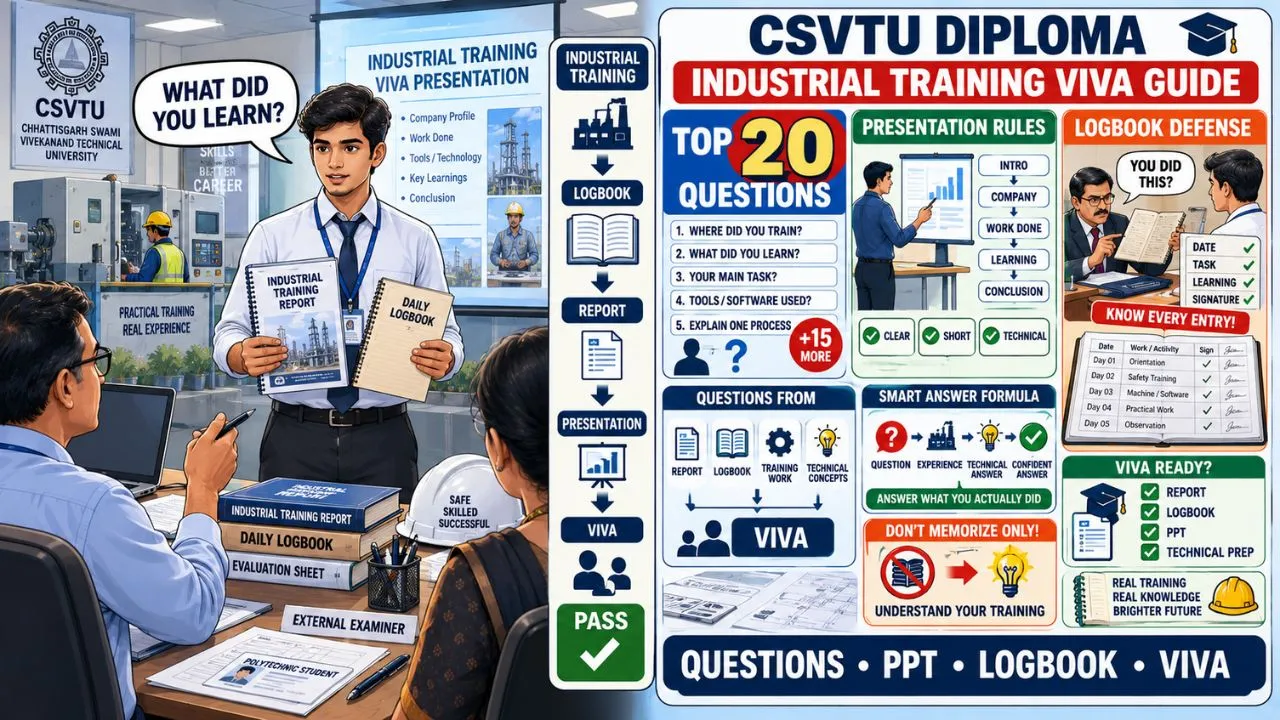
Top 20 Industrial Training Viva Questions for Diploma Students
These questions are useful across branches. The exact technical follow-up will depend on your training organisation and department.
- Where did you complete your industrial training?
State the organisation, location, department and training duration clearly. - What does the company or organisation do?
Explain its main products, services or operations in two or three sentences. - Which department were you assigned to?
Mention the department and briefly describe its function within the organisation. - What was your daily routine during training?
Explain reporting time, department activities, observation work and practical tasks without exaggerating your responsibilities. - What was the most important process you observed?
Choose one process you understand properly and explain it step by step. - Draw or explain the process flow.
Prepare a simple flow from input to final output. Examiners frequently use process-flow questions to check practical understanding. - Which major machines or equipment did you observe?
Know the names, basic functions and important specifications of the equipment mentioned in your report. - Explain the working principle of one machine.
Select equipment relevant to your branch and prepare its working principle in simple technical language. - What safety rules were followed at the workplace?
Mention actual measures such as PPE, isolation procedures, warning signs, restricted areas, fire protection or equipment-specific precautions. - Which personal protective equipment was required?
Depending on the workplace, this could include helmets, safety shoes, gloves, goggles, masks, reflective jackets or hearing protection. - What is the layout of the plant or department?
Understand how major sections are arranged and why materials, people or information move between them. - What problem did you observe during training?
Discuss a genuine operational, maintenance, workflow or technical issue if you observed one. - How is preventive maintenance different from breakdown maintenance?
This is particularly useful for Mechanical and Electrical students working around industrial equipment. - Which diploma subjects helped you understand the training?
Connect two or three subjects with actual activities instead of listing the entire syllabus. - Did you operate any equipment yourself?
Answer accurately. If you only observed a machine under supervision, say so. Never claim independent operation simply to impress the examiner. - What technical skill did you learn?
Choose something specific, such as equipment identification, surveying, drawing interpretation, troubleshooting, testing or documentation. - What is one specification of the equipment mentioned in your report?
Revise ratings, capacities, dimensions or other relevant values that you have actually recorded. - What did you learn that was not covered properly in the classroom?
Workplace safety, maintenance routines, documentation and coordination are good areas if they genuinely match your experience. - How will this training help your future career?
Connect the experience with your branch, future job role or higher studies. - If you received the same training again, what would you learn differently?
Give a practical answer. You might want more exposure to maintenance, testing, software, site measurements or a particular production stage.
How to Answer Technical Cross-Questions
The first answer is rarely the end of a viva question. Suppose you say that you observed a transformer. The examiner may immediately ask its rating, purpose, cooling method or protection system. If you mention a pump, be ready for its type, working principle and application.
Mining students mentioning ventilation should understand why airflow is required and what safety risks it controls. Civil students mentioning concrete should know the grade or mix used at their training site if it appears in their report.
This is why reading your own report is more useful than memorising dozens of unrelated definitions. Highlight every machine, process, specification and technical term in the report. Prepare at least two possible follow-up questions for each important item.
Logbook vs. Industrial Training Report
The industrial training report explains your overall experience in an organised format. The logbook records what happened during individual training days. Examiners can compare both.
Suppose your report describes extensive work in a testing department, but your daily entries barely mention testing. You may be asked when you visited that section and what exactly you did there.
Before the viva, check dates, department names, activities and supervisor signatures. Daily entries should sound realistic. A logbook filled with identical statements such as “learned about machine” for several days gives very little technical information. A useful entry briefly records the activity, equipment or process observed and what was learned.
How to Defend Training Attendance and Daily Entries
Questions about attendance are usually straightforward when the logbook has been maintained properly. Know your training start date, completion date and approximate duration. Check whether required supervisor signatures or verification have been completed. Do not add or imitate a supervisor’s signature yourself.
If there was an absence, department change or unusual gap that is genuinely recorded, explain it accurately rather than creating a complicated story. You should also remember the sequence of major activities. You do not need to memorise every sentence written months earlier, but you should be able to explain the main work performed during each stage of training.
Most importantly, never claim that you personally performed a hazardous or specialised task when you only observed it.
CSVTU Industrial Training Viva PPT Presentation Setup
A clean presentation is easier to defend than a PPT filled with paragraphs. Unless your department provides a specific template or slide limit, keep the presentation focused on the work you actually completed.
A practical sequence is:
Slide 1: Title Slide
Include your name, enrolment details, branch, institute, organisation and training period.
Slide 2: Organisation Introduction
Briefly explain what the organisation does and its main industrial activity.
Slide 3: Plant or Workplace Overview
Show the major departments, plant layout or organisational structure relevant to your training.
Slide 4: Assigned Department
Explain where you worked and the department’s purpose.
Slides 5-7: Technical Process or Work Flow
This should form the core of the presentation. Use diagrams, process flows or equipment images where permitted.
Slide 8: Equipment and Safety
Cover major equipment observed and important safety procedures.
Slide 9: Learning Outcomes
Mention specific technical and workplace skills gained.
Slide 10: Future Applications and Conclusion
Explain how the training connects with your diploma branch and future career.
If your college gives a prescribed presentation format, that format should take priority.
Presentation Rules That Improve Viva Performance
Avoid reading complete paragraphs directly from the screen. Slides should act as visual support while you explain the technical details yourself. Keep fonts large enough to read from the examiner’s desk. Use short points instead of lengthy descriptions. Diagrams should have readable labels.
Do not add equipment photographs that you cannot identify. The same applies to technical diagrams copied from the internet. If a diagram appears in your presentation, the examiner can reasonably ask you to explain it.
Carry the presentation in more than one accessible format or storage location where permitted. Opening the file once before entering the viva room can prevent last-minute formatting problems.
Understanding the Industrial Training Viva Scoring
Students often search for a fixed CSVTU industrial training viva marks distribution covering PPT, report, logbook and Q&A. The exact assessment pattern can depend on the applicable CSVTU diploma scheme, subject code, institute instructions and evaluation format. Do not assume an unofficial percentage split is valid for every branch or semester.
In practical terms, prepare for four areas: presentation performance, industrial training report, logbook or training record, and direct viva questions.
A polished PPT cannot compensate for weak technical understanding. Similarly, excellent answers can still create problems if the report or training records are incomplete. For the exact marks allocation applicable to your batch, follow the current CSVTU scheme and instructions provided by your department.
Final Preparation Before the Viva
Read your report at least twice and mark every technical term that could generate a question. Revise the company profile, assigned department, process flow, plant layout, major equipment, safety rules and important specifications. A strong CSVTU Diploma Industrial Training Viva performance comes from knowing what you observed, understanding why it matters and being able to defend what you have written in your report and logbook.