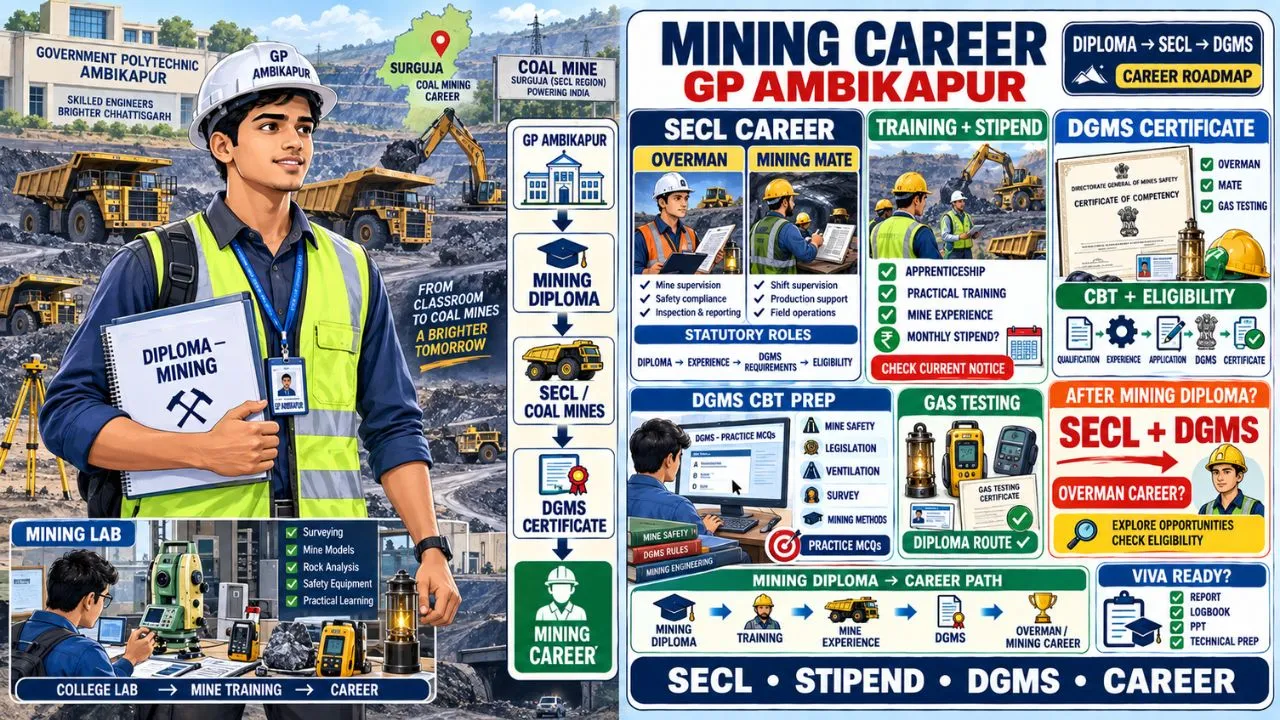
Mining Engineering at Government Polytechnic Ambikapur has a practical connection with the coal-producing belt of northern Chhattisgarh. For diploma students interested in mine operations, surveying, safety and technical supervision, the course can lead towards apprenticeships, private mining jobs and eligible PSU recruitment.
SECL is naturally a major target because of its presence in the region. However, completing a Mining Engineering diploma does not automatically qualify a candidate for every statutory mining position. Posts such as Mining Sirdar, Mining Mate or Overman can require specific competency certificates, practical experience and safety qualifications prescribed under mining regulations. Understanding this career path early can save students from discovering these requirements only after graduation.
Table of Contents
Mining Engineering at GP Ambikapur and the Surguja Advantage
Government Polytechnic Ambikapur has offered Mining Engineering for several decades, reflecting the importance of coal and mineral resources around the Surguja region. The diploma introduces subjects connected with mine surveying, geology, mining machinery, underground and opencast mining methods, ventilation, safety and other technical areas.
Laboratory and surveying practice also helps students become familiar with instruments and safety equipment used in mining. This local setting gives GP Ambikapur students an interesting advantage. They are studying Mining Engineering in a region where coal mining is already an important industrial activity.
Still, location alone does not secure employment. Students need to combine their diploma with practical exposure, statutory certification and recruitment preparation.
SECL Recruitment Routes After Mining Diploma
South Eastern Coalfields Limited is one of the first organisations many Mining Engineering students in Chhattisgarh consider after completing their diploma. There are several possible routes, but they should not be confused with one another.
Apprenticeship is primarily a training route. SECL periodically announces apprenticeship opportunities for eligible graduate, diploma and other candidates depending on its requirements. A technician apprenticeship can provide practical industrial exposure and a monthly stipend during the training period. The number of vacancies, eligible branches, stipend and other conditions can change between recruitment cycles.
An apprenticeship does not automatically convert into permanent SECL employment. Regular technical recruitment is different. SECL can separately advertise mining-related posts when vacancies arise. Candidates then have to satisfy the qualification, age, certificate and selection requirements mentioned in that notification.
Mining Mate, Mining Sirdar and Overman Career Path
Mining students frequently hear terms such as Mining Mate, Mining Sirdar and Overman, but these should not be treated as interchangeable job titles. They relate to operational and supervisory responsibilities in mines, with eligibility governed by the applicable mining regulations and employer requirements.
An Overman generally carries greater supervisory responsibility in mine operations. Recruitment for such positions can require an Overman’s competency certificate of the appropriate type along with other prescribed qualifications.
Mining Sirdar and Mining Mate roles also involve statutory responsibilities, and the exact certificate requirement depends on the mine category, regulations and recruitment notification. A Diploma in Mining Engineering provides an important academic foundation, but the diploma itself should not be assumed to replace every competency certificate.
Students targeting these positions should study the latest DGMS requirements alongside their CSVTU diploma syllabus.
Why DGMS Certification Matters
The Directorate General of Mines Safety, commonly known as DGMS, has an important role in mining safety and statutory competency examinations in India. Certain mine positions require competency certificates under the applicable regulations. For a diploma student, this creates two parallel goals. The first is completing the Mining Engineering diploma successfully.
The second is understanding which statutory certificates are required for the role the student eventually wants. This distinction matters because a candidate can have a Mining Engineering diploma yet remain ineligible for a particular statutory post if the recruitment notice asks for an additional competency certificate. Students should therefore start researching DGMS certification before finishing the course rather than waiting for a vacancy.
Gas Testing Certificate Preparation
Gas testing is particularly important in underground coal mining because potentially dangerous mine gases can create serious safety risks. A Gas Testing Certificate may be required alongside other qualifications for certain statutory mining positions. Candidates should understand mine gases, their properties, detection methods, safety procedures and the use of approved testing instruments. College subjects related to mine ventilation and mine safety provide a useful academic base.
Practical understanding is equally important. Students should know why testing is performed, how hazardous conditions are recognised and what action is expected when unsafe conditions are identified. The application procedure, examination requirements and eligibility should always be checked through the current DGMS rules and notifications because statutory requirements can change.
First Aid Certification
Mining is a safety-sensitive profession, making first-aid knowledge more than an additional resume skill. Certain recruitment notices for statutory mining posts can require a valid First Aid Certificate from an accepted authority. Students should therefore check the exact certificate prescribed for their intended position instead of completing an unrelated short course and assuming it will be accepted. First-aid training should cover practical emergency response rather than only theoretical questions.
A mining workplace can involve injuries associated with machinery, falls, electrical systems and other industrial hazards. For GP Ambikapur students targeting operational mining careers, recognised first-aid training can form an important part of career preparation.
Building a DGMS Preparation Strategy During Diploma
DGMS preparation becomes easier when it runs alongside diploma studies. Students can begin with core subjects such as mining methods, mine ventilation, surveying, machinery, geology and mine safety. Instead of memorising definitions only for semester examinations, focus on understanding how each concept applies inside a working mine.
Mining legislation and safety regulations deserve separate attention. Candidates targeting competency examinations should become comfortable with statutory terminology, duties of mine officials and safety responsibilities.
Previous examination patterns can help identify frequently tested areas, but preparation should remain based on the current syllabus and regulations. Practical exposure through industrial training or apprenticeship can also make theoretical concepts easier to understand.
Career Opportunities in the Surguja Coal Belt
The Surguja region gives Mining Engineering graduates access to a broader mining ecosystem rather than a single employer. SECL remains particularly relevant because of its coal operations in Chhattisgarh. Students can also watch opportunities across other Coal India subsidiaries, including Northern Coalfields Limited, when their recruitment conditions permit applications from candidates outside the immediate region.
Private mining operators, mine-development contractors and companies connected with coal, power and infrastructure provide another route. Jindal Power and other industrial employers connected with mining and power operations can have technical requirements, although openings depend entirely on current projects and recruitment needs.
Diploma holders can explore positions connected with mine operations, surveying, safety support, machinery and technical supervision. Some opportunities involve opencast mines, while others can involve underground working conditions.
The working environment should be considered carefully before choosing a role.
Opencast vs Underground Mining Careers
Opencast and underground mining can provide very different working experiences. Opencast operations involve large surface mines, heavy earth-moving machinery, drilling, blasting, haul roads and production planning.
Students interested in large equipment and surface operations may prefer this environment. Underground mining requires working below the surface under stricter conditions involving ventilation, roof control, gas monitoring, transport and emergency preparedness.
Safety procedures become especially critical. A candidate should not select underground work only because a particular allowance appears attractive. The working conditions, physical demands, shift pattern and safety responsibilities need equal consideration.
Industrial training can help students understand these differences before making a long-term career choice.
Salary, Stipend and Mining Allowances
There is no single salary applicable to every Mining Engineering diploma holder. An apprentice receives a stipend rather than the regular salary of a permanent employee. The amount depends on the apprenticeship category, employer and applicable rules.
Regular PSU positions follow the pay structure attached to the advertised grade. Basic pay can be supplemented by applicable allowances and benefits according to company rules.
Mining employees working under specific conditions can also receive allowances linked to their posting, duties or underground work. Underground allowance should not be treated as a fixed amount available to every diploma holder. Its eligibility and calculation depend on the employer’s wage structure, designation and actual working conditions.
Private-sector salaries vary even more widely. A fresh diploma holder working with a contractor may start at a different level from a candidate appointed to a regular PSU technical position.
For this reason, students should compare the complete compensation structure rather than focusing only on a headline monthly figure.
Apprenticeship or Direct Recruitment: Which Is Better?
For a fresh diploma holder without industrial experience, apprenticeship can provide a useful transition from college to the mining workplace. It offers structured exposure while the candidate receives a stipend.
Direct recruitment is more attractive when a candidate already satisfies the required qualifications and statutory certification for a regular vacancy.
Students do not necessarily have to choose one career route permanently. A practical plan can involve completing the diploma, obtaining relevant safety and competency certificates, gaining suitable industrial exposure and simultaneously tracking PSU recruitment.
Private employment can also provide useful experience while a candidate prepares for statutory examinations or future vacancies.
Final Words
The Mining Engineering career path at GP Ambikapur can extend well beyond completing a three-year diploma. Students targeting SECL, Mining Mate, Mining Sirdar or Overman roles need to understand the difference between an academic qualification and statutory eligibility.
DGMS competency requirements, Gas Testing and recognised First Aid certification can become important parts of that journey, depending on the position. The Surguja coal belt provides useful exposure to both PSU and private mining activity, while opportunities elsewhere can expand the job search further.
A sensible strategy is to build strong mining fundamentals during the diploma, take industrial training seriously, understand DGMS requirements early and track genuine recruitment notifications. For students comfortable with fieldwork, technical responsibility and strict safety procedures, Mining Engineering at GP Ambikapur can provide a focused route into India’s coal and mining sector.