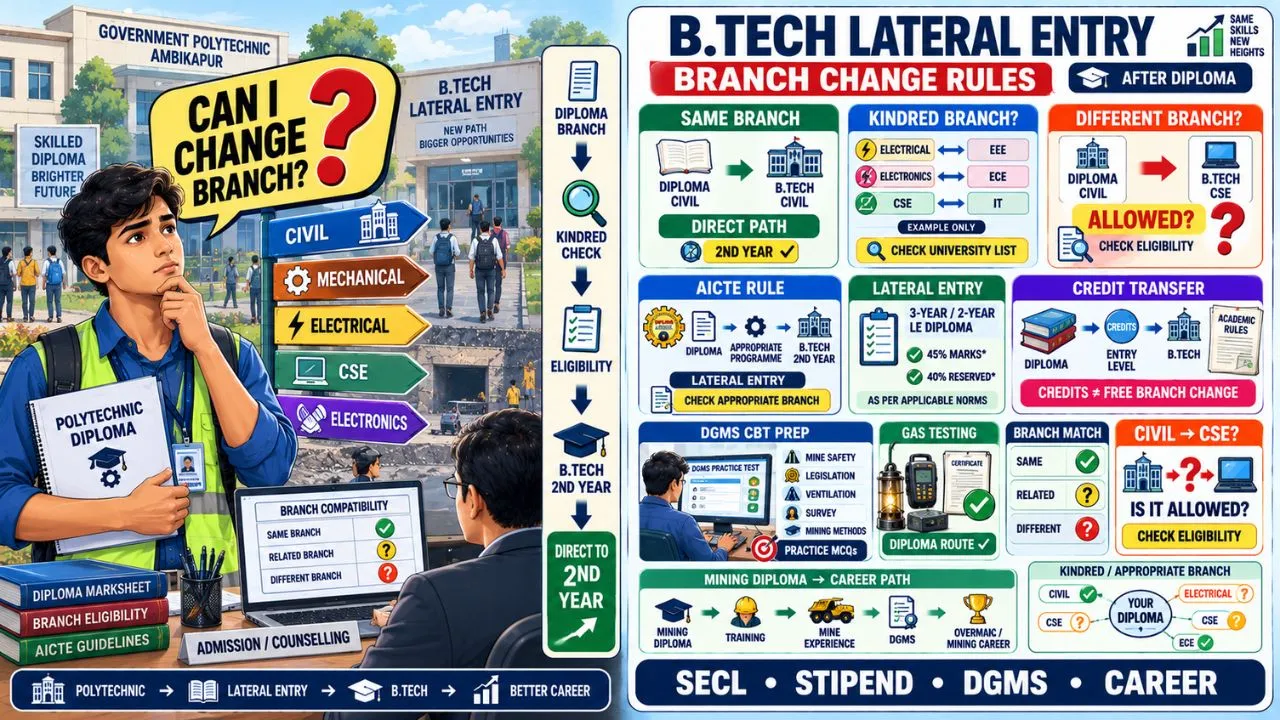
Completing a polytechnic diploma gives students two common choices: start working or continue engineering through B.Tech lateral entry. The second option becomes confusing when a student wants to change the engineering branch studied during the diploma. A Mechanical Engineering diploma holder may want Computer Science Engineering because of growing interest in software jobs. An Electrical diploma student may consider Electronics and Telecommunication Engineering. The obvious question is whether such a branch change is allowed.
There is no single rule that guarantees every diploma holder admission to every B.Tech branch. AICTE norms, university regulations, state counselling rules, kindred branch mapping and vacant seats can all affect eligibility. Understanding these rules before filling the lateral entry counselling form can prevent students from choosing combinations that their university does not permit.
Table of Contents
How B.Tech Lateral Entry After Polytechnic Works
B.Tech lateral entry allows eligible diploma holders to enter an engineering degree after completing their diploma instead of starting again from the first year. Admission is normally made into the second year or third semester of the B.Tech programme. The exact process depends on the state, university and institution.
A student still needs to complete the remaining curriculum prescribed by the university. Lateral entry does not simply convert a three-year diploma into the first year of B.Tech. The important issue is branch eligibility.
Some admission systems allow diploma holders to compete for a broad range of engineering branches. Others maintain a mapping between the diploma discipline and the B.Tech programme available through lateral entry. This is where the concept of kindred or allied branches becomes important.
What Are Kindred or Allied Branches?
A kindred branch is an engineering discipline considered academically related to another branch for admission purposes. The terminology can differ between universities. Some use “allied branch”, while others publish eligibility or branch-equivalence lists.
Consider an Electrical Engineering diploma holder. Electrical and Electronics Engineering or certain electronics-related programmes share parts of their technical foundation. A university may therefore recognise one or more of these programmes as related branches.
The situation becomes more complicated when the academic connection is much weaker. A diploma holder in Mechanical Engineering who wants B.Tech Computer Science and Engineering is moving between two substantially different technical areas. Mechanical Engineering focuses heavily on machines, manufacturing, thermodynamics and design, while CSE depends on programming, algorithms, computer systems and related subjects.
Such a switch should never be assumed to be automatically valid. Whether it is permitted depends on the lateral entry eligibility rules applicable to that admission session.
AICTE Rules and the Branch-Switch Confusion
Students frequently search for “AICTE lateral entry branch change rules” expecting to find one national list showing exactly which diploma branch can enter which B.Tech course.
The actual admission process is more layered. AICTE provides the broader regulatory framework for technical education, but admission eligibility is also implemented through state authorities, universities and individual institutions under their applicable regulations.
This means a student should not interpret a general AICTE provision as confirmation that a particular university must accept a specific diploma-to-B.Tech branch combination.
The counselling brochure matters. The university ordinance matters. The approved branch mapping for that academic session matters. If these documents restrict lateral entry to relevant or eligible diploma disciplines, students have to follow that mapping even when seats remain vacant.
Can Electrical Diploma Students Switch to ET&T?
Electrical Engineering to Electronics and Telecommunication Engineering is an example where students may find academic overlap. Subjects such as basic electrical engineering, circuits, measurements and electronics can appear across related programmes, although the complete curricula remain different.
This makes the transition more academically connected than a switch from Mechanical Engineering to Computer Science. Still, similarity does not create automatic eligibility.
Suppose a university’s current lateral entry matrix recognises Electrical Engineering as an eligible diploma for Electronics and Telecommunication Engineering. In that case, the student can participate according to the applicable counselling rules.
If the mapping excludes Electrical diploma holders, personal similarity between the courses does not override the published eligibility conditions. Always check the current branch-equivalence matrix before selecting preferences.
Can Mechanical Diploma Students Move to CSE?
This is one of the most important questions because many core engineering diploma holders now consider moving towards software. A Mechanical Engineering diploma followed by B.Tech CSE represents a major academic transition.
Whether it is possible depends heavily on the institution and admission system. Where broader lateral entry eligibility is permitted, a Mechanical diploma holder may have access to CSE subject to the university’s conditions, available seats and admission rules.
Under a stricter kindred-branch system, the same combination may not be available at all. Students should therefore avoid taking admission based on verbal statements such as “any diploma can take CSE.” Ask the institution to show the applicable eligibility rule or admission brochure. This is particularly important before paying a non-refundable admission amount.
Bridge Courses After Changing Your Engineering Branch
Entering a different B.Tech branch creates another problem: missing first-year academic foundations. A student entering directly into the second year has not completed the regular first-year B.Tech curriculum at that university.
When the diploma discipline is also different, the knowledge gap can become larger. Universities can prescribe bridge courses or additional subjects to address this difference. For someone moving towards Computer Science, these subjects may cover programming or other foundational areas required for the degree. A student moving between other engineering disciplines may receive different bridge requirements.
These courses are not punishments for changing branches. Their purpose is to give lateral entry students the prerequisite knowledge needed for higher-semester subjects. The actual bridge curriculum and credits depend on the university regulations applicable to the programme.
Credit Equivalence Does Not Mean Every Diploma Subject Transfers
Another misunderstanding concerns credit transfer. Students sometimes assume that every subject completed during a polytechnic diploma will receive equivalent B.Tech credits. Diploma and B.Tech programmes are separate qualifications with different curriculum structures.
A university determines what academic requirements a lateral entry student must complete after admission. Previous diploma study is the basis for lateral entry eligibility, but it does not necessarily produce a subject-for-subject transfer across the remaining B.Tech curriculum.
This becomes especially relevant after changing branches. A diploma subject such as Manufacturing Technology cannot simply replace a higher-semester Computer Science subject because both carry similar credit values. Credit value and academic equivalence are not the same thing.
Students should examine the university’s lateral entry curriculum rather than assuming that previous credits will automatically reduce their B.Tech workload.
State Engineering Colleges and Strict Branch Mapping
Students targeting government engineering colleges need to pay particular attention to state counselling rules. State admission systems commonly work through predefined eligibility conditions, sanctioned seats and branch-wise seat matrices.
For a Chhattisgarh polytechnic student, this means checking the current lateral entry counselling rules issued for that admission cycle along with the regulations applicable to the participating university or college.
A student from a CSVTU-affiliated diploma programme should not assume that completing the diploma automatically provides access to every B.Tech branch under CG DTE counselling.
The permitted combination depends on the applicable eligibility and seat-allotment rules. Government colleges also cannot simply create a CSE lateral entry seat because a candidate wants to switch branches.
Seat availability and approved intake matter. This makes branch planning especially important for students targeting affordable government engineering colleges.
Private and Deemed Universities Can Have Different Rules
Private and deemed-to-be universities can have their own admission structures within the regulatory framework applicable to them. Some institutions may provide greater flexibility in accepting diploma holders from different engineering disciplines.
That flexibility can make a significant branch switch easier than under a strict state counselling matrix. But “private university” does not mean “no eligibility rules.”
The university still has to follow its approved academic and admission regulations.
Before taking admission, ask for written confirmation that your diploma discipline is eligible for lateral entry into the selected B.Tech branch. Also check whether bridge subjects are required and whether they carry additional academic workload.
Recognition and programme approval should be verified independently rather than relying on an admission counsellor’s assurance.
Switching to CSE or IT: What Do You Gain?
The strongest reason for switching from a core diploma branch to CSE or IT is usually a genuine interest in software and technology careers. A student who enjoys programming can use B.Tech to build deeper knowledge in software development, databases, computer networks, cloud technologies and related areas.
The switch can broaden private-sector career options.
It can also be difficult. A Mechanical or Civil diploma holder entering CSE may initially compete with students who have already spent years learning programming.
The degree title alone will not remove that gap.
Programming practice, projects, internships, problem-solving and technical skills become essential. Switching only because CSE appears popular can therefore be risky if the student has little interest in coding.
The Government JE Exam Trade-Off
Branch switching deserves extra thought for students preparing for government Junior Engineer recruitment. SSC JE, RRB JE, state JE recruitment, PSU technical posts and departmental vacancies commonly specify particular engineering qualifications.
Eligibility is determined by each recruitment notification. Suppose a student has a Civil Engineering diploma and later completes B.Tech CSE. The diploma may still be relevant for some Civil JE recruitments where the notification accepts that diploma qualification.
However, candidates should never assume that a higher degree in an unrelated branch will automatically satisfy every branch-specific eligibility condition. Staying within the same core discipline can provide stronger academic continuity for JE preparation.
A Civil diploma followed by Civil B.Tech keeps subjects such as structures, surveying, estimation and construction central to the student’s studies. The same principle applies to Mechanical and Electrical Engineering.
For someone primarily targeting government core-engineering recruitment, continuity can be more useful than changing branches merely because IT salaries look attractive.
How to Decide Before Changing Your Branch
Start with your target career rather than the popularity of a B.Tech branch. If your priority is software development and you are prepared to build coding skills seriously, switching to CSE or IT can be worth exploring where permitted. If SSC JE, RRB JE, state engineering departments or core PSU technical recruitment are your main targets, staying with the diploma discipline can keep your preparation more aligned.
Before submitting a lateral entry application, verify four things: whether your diploma branch is eligible, whether the desired B.Tech branch has lateral entry seats, whether bridge courses apply, and whether the new degree fits your intended career. Do this using the current admission rules for your university and counselling session.
Final Words
Changing your B.Tech branch after a polytechnic diploma is possible in some admission systems, but it is not an unrestricted right. Kindred branch mapping, university eligibility, lateral entry seat availability and bridge-course requirements can decide whether a particular transition is accepted. Related changes such as Electrical to an electronics-oriented programme may have stronger academic overlap, while Mechanical to CSE represents a much larger transition. Neither should be considered valid until the current admission rules confirm it.
For students targeting private IT careers, a permitted CSE or IT switch can create a new direction if supported by strong technical skills. For government JE aspirants, remaining in the core diploma branch can preserve syllabus continuity and keep the qualification path easier to understand. The safest strategy is simple: decide your career direction first, then check the current lateral entry and kindred branch rules before choosing the B.Tech branch.