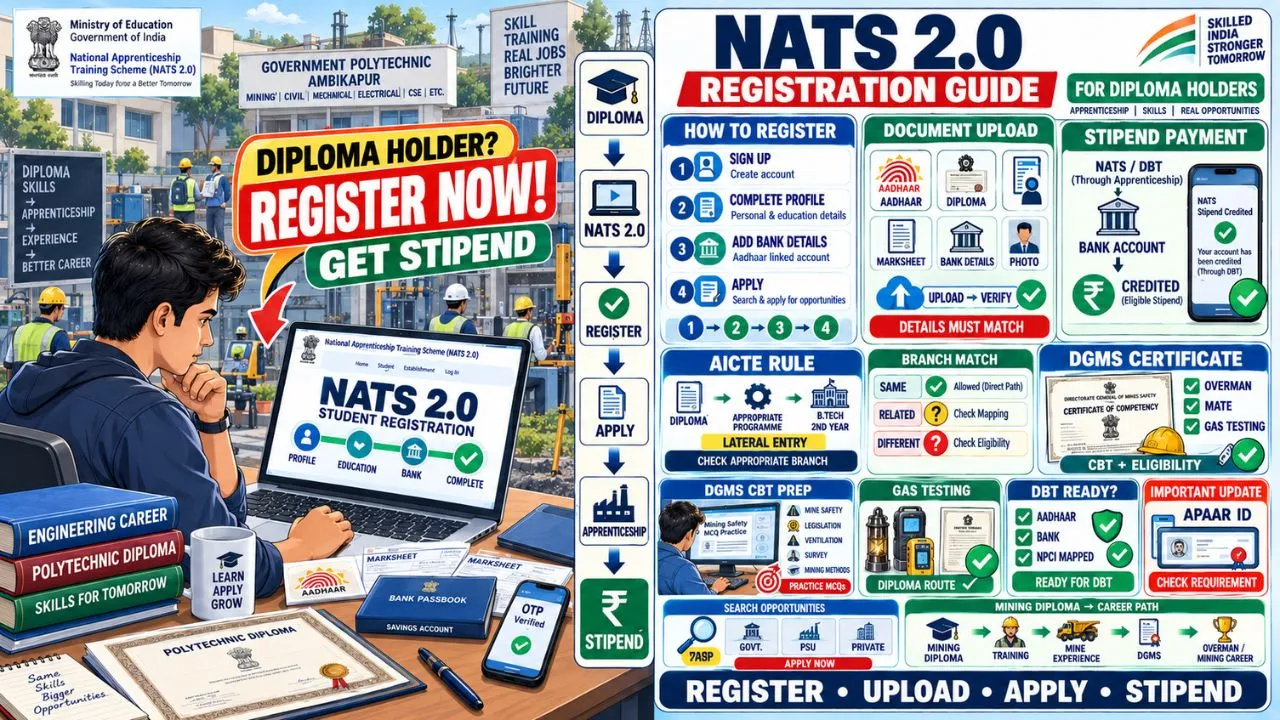
For many polytechnic diploma graduates, an apprenticeship is the first practical step from college into an engineering workplace. Central and state PSUs, government organisations and other establishments regularly use the National Apprenticeship Training Scheme to engage eligible candidates for apprenticeship training.
The NATS 2.0 portal brings registration, opportunity search, applications and apprenticeship-related records into one online system. Completing NATS portal apprenticeship registration for diploma correctly is important because incorrect academic details or unclear documents can create problems when applying for opportunities.
Diploma holders from Civil, Electrical, Mechanical, CSE and related technical branches can use the portal to build their profile and search for apprenticeships matching their qualifications. Here is how the process works and what you should prepare before starting.
Table of Contents
What Is the NATS 2.0 Portal?
The National Apprenticeship Training Scheme supports apprenticeship training for eligible graduates, diploma holders and vocational candidates under applicable apprenticeship rules. Instead of treating apprenticeship as a permanent job, think of it as structured workplace training. A diploma holder can gain practical exposure under an employer while receiving the stipend applicable to the apprenticeship engagement.
NATS 2.0 acts as a digital platform connecting candidates, educational institutions and establishments participating in the scheme. For diploma graduates, NATS portal apprenticeship registration for diploma creates the profile needed to access relevant opportunities available through the system. Registration itself does not guarantee selection. Employers still decide eligibility and selection according to their apprenticeship notifications.
Who Should Register on NATS 2.0?
Engineering diploma holders looking for apprenticeship experience should check whether their qualification and passing year meet the conditions for available NATS opportunities.
This is particularly useful for candidates from branches such as:
- Civil Engineering
- Electrical Engineering
- Mechanical Engineering
- Computer Science Engineering
- Electronics and Telecommunication
- Mining and other eligible engineering disciplines
Students from Government Polytechnic Ambikapur or other CSVTU-affiliated polytechnic institutes can also use the portal when their qualification meets the requirements. Do not assume that every organisation accepts every branch.
A Mechanical diploma vacancy, for example, does not automatically accept Civil or CSE candidates. Read the discipline mentioned in the apprenticeship advertisement before submitting an application.
Documents to Keep Ready Before Registration
Prepare your documents before opening the registration form. This reduces mistakes and makes it easier to enter academic information consistently. Keep your Aadhaar details, active mobile number, personal email address, recent photograph, diploma marksheets and diploma certificate or provisional certificate ready. You may also need Class 10 and Class 12 details where applicable.
Candidates belonging to reserved categories should keep the relevant category certificate available when required. Bank details should belong to the candidate and should be entered carefully whenever the portal or apprenticeship process requests them.
The spelling of your name across Aadhaar, educational documents and other records deserves particular attention. If your diploma certificate says one version of your name while another document contains a substantially different version, verification can become difficult. For CSVTU or polytechnic graduates, use academic information exactly as printed on the official marksheets and certificates.
Step 1: Start NATS 2.0 Student Registration
Begin by opening the official NATS 2.0 portal and selecting the student registration or enrolment option available for candidates. Choose the appropriate student category and enter the requested personal details. During NATS portal apprenticeship registration for diploma, avoid entering temporary or incorrect information simply to move to the next screen.
Use a mobile number and email address that you personally access. Important apprenticeship communication can be connected with your registered details, so using someone else’s number can create unnecessary difficulty later. Complete mobile or email verification whenever the portal requests an OTP. Create secure login credentials and keep them safely recorded.
Step 2: Enter Personal Details Carefully
The next stage generally requires basic information such as your name, date of birth, gender, address and other profile details. Enter your name according to your official records.
Do not casually add initials, change surname order or use a nickname.
Your date of birth should also match the supporting document.
Address details should be complete enough for official records.
Before saving this section, read each field again.
A two-minute check during registration is easier than discovering an error while applying for an apprenticeship.
Step 3: Add Polytechnic and Diploma Qualification Details
This is one of the most important parts of NATS portal apprenticeship registration for diploma.
Enter your diploma qualification, engineering branch, institution, board or university details, passing year and marks according to your official academic record.
For a CSVTU-affiliated diploma, use the qualification information shown on your marksheets and final or provisional certificate.
Do not convert CGPA into percentage using your own formula unless the portal or relevant authority specifically requires a prescribed conversion method.
Similarly, do not round marks simply because the final figure looks better.
Your branch should match the diploma certificate.
A student who studied Electrical Engineering should not select a similar-looking discipline merely because more apprenticeship vacancies appear under it.
Employers can verify academic records during selection.
Step 4: Upload Diploma Certificates and Other Documents
Document upload is where many applicants need extra attention.
Scan certificates clearly before uploading them. The candidate’s name, institution, roll or enrolment information, marks and passing details should remain readable.
Avoid photographs taken at an angle, dark scans or files with cropped corners.
Check the file type and maximum upload size shown on the portal before submitting.
If a file is too large, compress it while keeping the text readable.
For diploma holders who have not yet received their final certificate, use the acceptable provisional or academic document only when the portal or concerned apprenticeship notification permits it.
Never upload an edited certificate to solve a mismatch.
If an academic record contains an actual error, contact the issuing institution or university for the appropriate correction process.
Step 5: Complete Bank and Aadhaar-Related Information
Accurate identity and banking information is particularly important where stipend processing involves Direct Benefit Transfer or another digital payment mechanism.
During NATS portal apprenticeship registration for diploma, enter Aadhaar and bank-related information only through the official system when those details are requested.
Check the account number carefully.
The bank account should be active and suitable for receiving payments.
Your identity and bank records should also be kept consistent wherever the applicable payment process requires verification.
A stipend is not an admission scholarship. It is connected with apprenticeship training and is paid according to the applicable scheme, contract and attendance or training conditions.
The amount can differ according to the apprentice category and current rules.
Step 6: Review the Profile Before Final Submission
Do not submit immediately after completing the final field.
Review the entire profile once.
Check your name, date of birth, engineering branch, diploma passing year, institution, marks, email address and mobile number.
Open uploaded documents if the portal provides a preview.
Confirm that each document is readable and belongs to the correct category.
After successful NATS portal apprenticeship registration for diploma, save your enrolment or registration information for future use.
Taking a screenshot or keeping the relevant registration details in a secure folder can help when you begin applying for apprenticeship vacancies.
Step 7: Search and Apply for Apprenticeship Opportunities
Creating an account is only the beginning.
Log in regularly and search for opportunities relevant to your diploma discipline.
A Civil diploma holder can look for Civil or closely specified eligible apprenticeship positions. Electrical and Mechanical candidates can search for their respective technical disciplines, while CSE graduates should focus on opportunities that specifically accept computer-related diplomas.
Read the complete eligibility conditions before applying.
Check the required qualification, passing year, age conditions, training location, apprenticeship duration and selection process.
Some establishments may shortlist candidates using academic marks. Others may follow a different selection procedure stated in their notice.
Do not apply blindly to every listing.
A smaller number of correctly matched applications is more useful than applications submitted to posts for which your diploma is not eligible.
How Direct Stipend Payment Works
One major concern for new apprentices is how the monthly stipend reaches them.
Under the applicable apprenticeship framework, stipend payment can involve the employer and government-supported payment mechanisms, including DBT arrangements where prescribed.
The apprentice therefore needs accurate bank and identity information.
After joining, payment also depends on the terms of the apprenticeship and completion of the required training formalities.
Do not assume that simply completing NATS portal apprenticeship registration for diploma starts stipend payments.
Registration, selection and joining are separate stages.
First, you create the candidate profile. Then you apply for a suitable opportunity. If selected, you complete the employer’s joining and apprenticeship requirements. Stipend becomes relevant after the apprenticeship engagement begins.
The applicable monthly amount should always be checked in the current advertisement or apprenticeship contract rather than relying on an old figure found online.
Common Registration Mistakes to Avoid
A rushed application creates avoidable problems.
The most common mistakes include entering a different name from the academic documents, selecting the wrong engineering discipline, uploading unreadable marksheets and providing an inactive mobile number.
Another mistake is confusing NATS registration with job selection.
An enrolment number does not mean that a PSU has selected you.
Candidates should also be careful with unofficial agents claiming they can guarantee apprenticeships in organisations such as SECL, NTPC or other PSUs after payment.
A genuine application should follow the process mentioned in the official apprenticeship notification.
Keep copies of applications and important documents instead of depending entirely on emails or messages.
How Diploma Holders Can Improve Their Selection Chances
Complete NATS portal apprenticeship registration for diploma before the application deadline of the organisation you are targeting.
Keep your profile updated and check opportunities regularly.
Revise core diploma subjects because technical knowledge can become useful during screening, interviews or later workplace training.
Mechanical candidates should remain comfortable with workshop technology, machines and maintenance basics.
Electrical candidates should revise machines, circuits, measurements and electrical safety.
Civil candidates can strengthen surveying, construction materials, estimation and drawing knowledge.
CSE diploma holders can maintain practical knowledge of programming, networking, databases and basic troubleshooting.
Industrial training completed during the diploma should also be documented properly because it gives you something practical to discuss when employers assess your background.
Final Words
NATS 2.0 gives engineering and polytechnic diploma graduates a structured route to discover apprenticeship opportunities and build practical industry experience.
The process becomes easier when documents are prepared before registration and every academic detail is entered exactly as recorded.
For candidates from Civil, Electrical, Mechanical, CSE and related branches, NATS portal apprenticeship registration for diploma should be treated as the first administrative step, not as a guarantee of employment.
Create the profile carefully, upload clear certificates, maintain accurate bank and identity details, and apply only for opportunities matching your qualification.
Most importantly, check the conditions of each apprenticeship before applying. Passing-year limits, eligible branches, stipend terms and selection methods can change between employers and recruitment cycles.
A correctly completed NATS portal apprenticeship registration for diploma can put your profile in the right place when suitable PSU and industry apprenticeship opportunities become available.