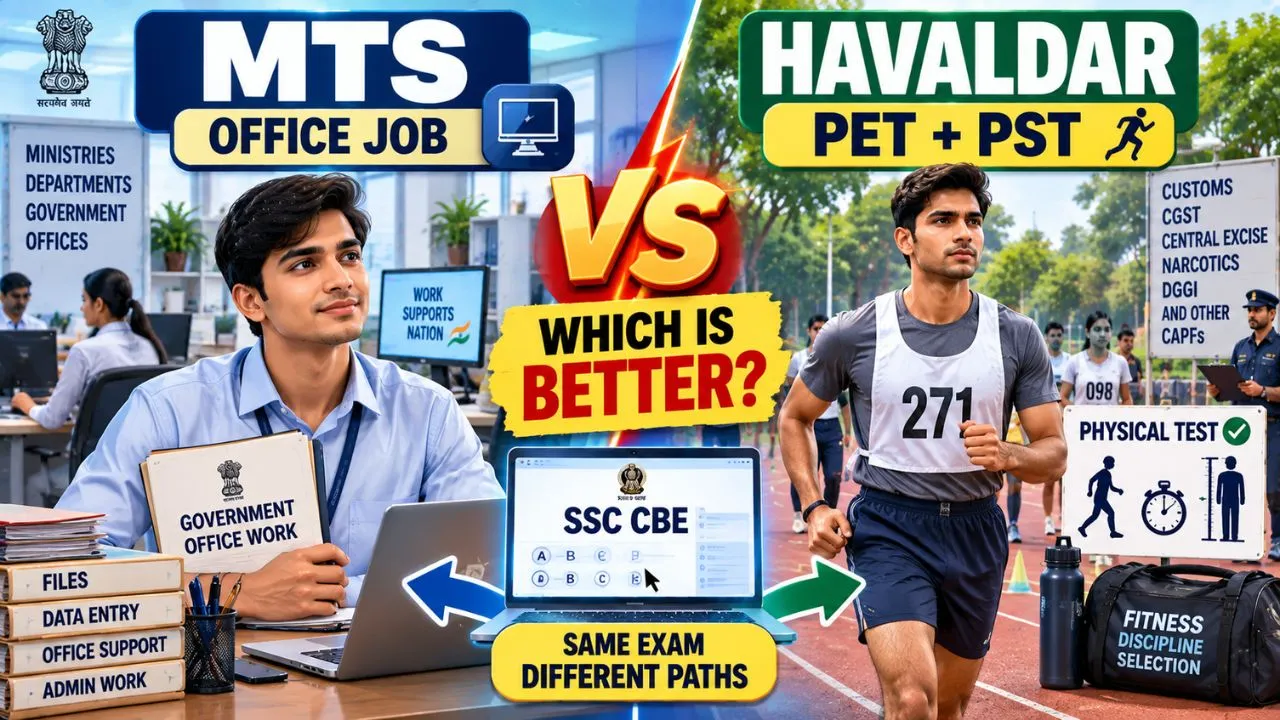
SSC MTS and Havaldar recruitment attracts a large number of Class 10 pass candidates because it offers an entry route into Central Government service without requiring graduation. Both posts come through the Staff Selection Commission, but their actual duties and physical requirements are quite different.
MTS is mainly associated with support work in Central Government ministries, departments and offices. Havaldar vacancies are specifically connected with CBIC and CBN and can involve more active or field-oriented duties.
Understanding the SSC MTS job profile and promotion structure is important before selecting post preferences. Salary level may be similar at entry, but daily work, physical testing, posting environment and career experience can differ significantly.
Table of Contents
SSC MTS and Havaldar: What Is the Basic Difference?
Multi-Tasking Staff, commonly called MTS, performs general support duties in different Central Government offices.
The exact work depends on the department and office where a candidate is posted. An MTS employee may handle files, assist with routine office work, maintain records, deliver documents within the office and perform other non-clerical support duties assigned to the post.
Havaldar is recruited for the Central Board of Indirect Taxes and Customs and the Central Bureau of Narcotics.
This makes the working environment different from a typical MTS posting. Havaldar duties can involve office support as well as work connected with field formations, depending on the department and place of posting.
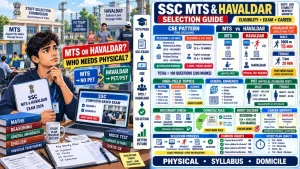
The biggest selection difference is physical testing. MTS candidates do not undergo the Havaldar-specific Physical Efficiency Test and Physical Standard Test. Candidates considered for Havaldar have to satisfy those additional requirements.
SSC MTS Eligibility for 10th Pass Candidates
SSC MTS is designed as an entry-level recruitment examination.
Candidates are generally required to have passed Matriculation, or Class 10, from a recognised board by the qualification cut-off date stated in the notification.
Graduation is not required.
A Class 12 certificate, ITI qualification or polytechnic diploma can be an additional qualification in a candidate’s educational background, but the basic recruitment requirement remains tied to Matriculation under the applicable notification.
Age limits vary according to the posts and departments covered by recruitment. Reserved-category candidates can receive age relaxation according to Central Government rules.
Candidates should check the current notification rather than depending on eligibility information from an older recruitment cycle.
SSC MTS Exam Pattern
The Computer Based Examination is divided into two sessions that test basic numerical ability, reasoning, general awareness and English.
Session I covers Numerical and Mathematical Ability along with Reasoning Ability and Problem Solving.
Session II covers General Awareness and English Language and Comprehension.
A major advantage for Class 10 pass candidates is that the syllabus does not require specialised technical or graduation-level subjects.
That does not make the examination automatically easy.
SSC recruitment attracts candidates from across India, and marks can be lost through weak calculation speed, poor English basics or insufficient practice.
Anyone researching SSC MTS job profile and promotion should first build a preparation plan around arithmetic, reasoning, English and general awareness instead of collecting too many books.
Previous-year questions and regular computer-based mock tests are particularly useful.
Does Havaldar Have a Different Written Examination?
MTS and Havaldar candidates appear through the same SSC MTS recruitment examination structure.
The important difference comes after the computer-based stage.
Candidates being considered for Havaldar posts have to qualify in the prescribed Physical Efficiency Test and Physical Standard Test.
This means someone targeting only MTS does not need to prepare for the Havaldar physical test.
A candidate who wants Havaldar should begin physical preparation much earlier. Waiting until the written examination is over can make the walking requirement difficult to achieve comfortably.
SSC Havaldar Physical Efficiency Test
The Physical Efficiency Test for Havaldar focuses on walking rather than a complicated set of running, jumping and throwing events.
Under the established SSC MTS/Havaldar pattern, male candidates have been required to walk 1,600 metres within 15 minutes.
Female candidates have been required to walk 1 kilometre within 20 minutes.
These benchmarks make the Havaldar physical test different from examinations such as SSC CPO, where candidates face running and additional physical events.
Still, the walking test should not be taken casually.
Candidates should practise brisk walking under timed conditions and gradually develop the pace required to complete the distance comfortably.
Always verify the exact PET requirements in the current recruitment notice because SSC can revise examination conditions.
Physical Standard Test for Havaldar
Havaldar candidates must also meet prescribed physical measurements.
For male candidates, the established general standard has included a minimum height of 157.5 cm. Chest measurement has also been prescribed, with a minimum expansion requirement.
For female candidates, the established minimum height has been 152 cm, along with a prescribed minimum weight standard.
Relaxations can apply to specified categories according to the recruitment rules.
A candidate should not assume eligibility simply because the difference from the general standard appears small.
Physical measurements are checked during the selection process, so candidates intending to apply for Havaldar should measure themselves properly beforehand and read the category-specific provisions in the latest notification.
What Does an SSC MTS Employee Actually Do?
The SSC MTS job profile and promotion path begins with basic support responsibilities within the allotted Central Government office.
Traditional MTS duties can include carrying files and papers, maintaining records, assisting sections with routine tasks, photocopying, delivering official documents and helping with general office functioning.
Actual assignments differ considerably between offices.
An employee posted in a small regional office may have a different routine from someone working in a large ministry or department.
Candidates should also understand that MTS is not a conventional clerical post such as Lower Division Clerk. Computer work may still be assigned where appropriate, but the position is primarily a multi-tasking support role.
For someone who prefers an office-oriented Central Government job and does not want a physical selection stage, MTS can be the more suitable option.
What Does an SSC Havaldar Do?
Havaldar posts under CBIC and CBN have a different departmental setting.
CBIC works in areas connected with indirect taxes and customs administration, while CBN functions in the narcotics control and regulatory framework assigned to it.
A Havaldar can be attached to departmental offices or field formations depending on posting requirements.
The work may involve assisting departmental staff, movement of documents, general support duties and tasks connected with the functioning of the assigned formation.
Candidates should not interpret “Havaldar” as automatically meaning a police or armed-force position.
It is a Central Government post within the organisations specified in the SSC recruitment notification.
The presence of PET and PST does, however, make it more physically demanding at the recruitment stage than regular MTS.
MTS vs Havaldar: Which Has the Better Work Profile?
There is no single answer because the better post depends on the candidate’s preferences.
MTS is more suitable for someone who wants a largely office-based support position and would prefer to avoid a mandatory physical test.
Havaldar can suit candidates comfortable with physical eligibility requirements and a departmental environment where field-related duties may form part of the work.
While studying the SSC MTS job profile and promotion, candidates should think beyond the job title.
Posting location, department, nature of duties and future departmental opportunities can affect long-term job satisfaction more than the name of the post.
Candidates willing to qualify PET/PST can keep Havaldar as an additional preference where eligible rather than limiting themselves unnecessarily.
SSC MTS Salary and Benefits
MTS and Havaldar are placed at Pay Level 1 under the Central Government pay structure.
Basic pay is only one component of monthly earnings.
Applicable allowances can include Dearness Allowance, House Rent Allowance and Transport Allowance according to government rules, posting location and eligibility.
Deductions also affect the amount credited to the employee’s bank account.
For this reason, a single “in-hand salary” figure seen online should not be treated as valid for every MTS or Havaldar employee.
City classification, current allowance rates and deductions can change the final amount.
Candidates should focus on the official pay level and applicable government rules rather than exaggerated salary claims.
SSC MTS Job Profile and Promotion Opportunities
The SSC MTS job profile and promotion structure depends considerably on the department in which the candidate is appointed.
MTS is an entry-level position, but it does not necessarily mean an employee remains in exactly the same role throughout service.
Career progression can take place through departmental promotion rules, seniority, qualifying service and departmental examinations where applicable.
Some employees may become eligible for movement to higher posts when they satisfy the conditions prescribed by their department.
The availability and speed of promotion are not identical across every ministry or office.
Vacancies matter as well.
This is why claims such as “MTS becomes clerk after a fixed number of years” should be treated carefully. Promotion is governed by the applicable recruitment and service rules rather than a universal automatic timeline.
Candidates who continue their education after joining can also prepare for other SSC examinations and government recruitment opportunities.
Can You Prepare for Higher SSC Posts After Joining MTS?
Yes. This is one reason the SSC MTS job profile and promotion topic attracts young candidates who want to enter government service early.
A Class 10 pass candidate can join when eligible and continue completing Class 12 or graduation through an appropriate recognised route.
After gaining the required educational qualification, the employee can independently apply for examinations such as SSC CHSL, SSC CGL or other eligible recruitments, subject to their rules.
This should be treated separately from departmental promotion.
Clearing another competitive examination means obtaining a new post through its selection process, while promotion takes place under departmental service rules.
For ambitious candidates, an MTS job can therefore provide government work experience while they continue preparing for higher-level examinations.
Which Post Should a 10th Pass Candidate Choose?
For candidates comparing SSC MTS job profile and promotion prospects with Havaldar, the first question should be about preferred working conditions.
Choose MTS as the stronger preference if you want an office-support role and do not want PET/PST requirements.
Consider Havaldar if you meet the physical standards, can comfortably clear the walking test and are open to working within CBIC or CBN formations.
Do not select Havaldar merely because the designation sounds more attractive.
Similarly, do not reject MTS because it is an entry-level post. For a Class 10 pass candidate looking for Central Government employment, it can provide a structured starting point.
Preparation Strategy for MTS and Havaldar
Candidates should keep preparation simple.
Start with Class 10-level arithmetic and reasoning fundamentals. Build calculation speed through daily practice rather than memorising shortcuts without understanding them.
English preparation should cover basic grammar, vocabulary and comprehension.
For general awareness, revise important static topics and relevant current affairs without spending the entire day collecting news.
Solve previous SSC questions regularly.
Candidates targeting Havaldar should add timed walking practice to their weekly schedule from the beginning.
A balanced routine works better than completing the written syllabus first and thinking about fitness later.
Final Words
The difference between SSC MTS and Havaldar is mainly about department, working environment and physical requirements.
MTS offers an entry-level Central Government support role without the Havaldar-specific PET/PST. Havaldar provides opportunities in CBIC and CBN but requires candidates to satisfy the prescribed physical standards and walking test.
Understanding the SSC MTS job profile and promotion structure also helps candidates set realistic expectations. Promotion exists, but it depends on departmental rules, qualifying service, vacancies and other applicable conditions.
For a 10th pass candidate seeking a simple route into Central Government employment, both posts are worth considering. The better choice is the one that matches your physical ability, preferred working environment and longer-term career plan.