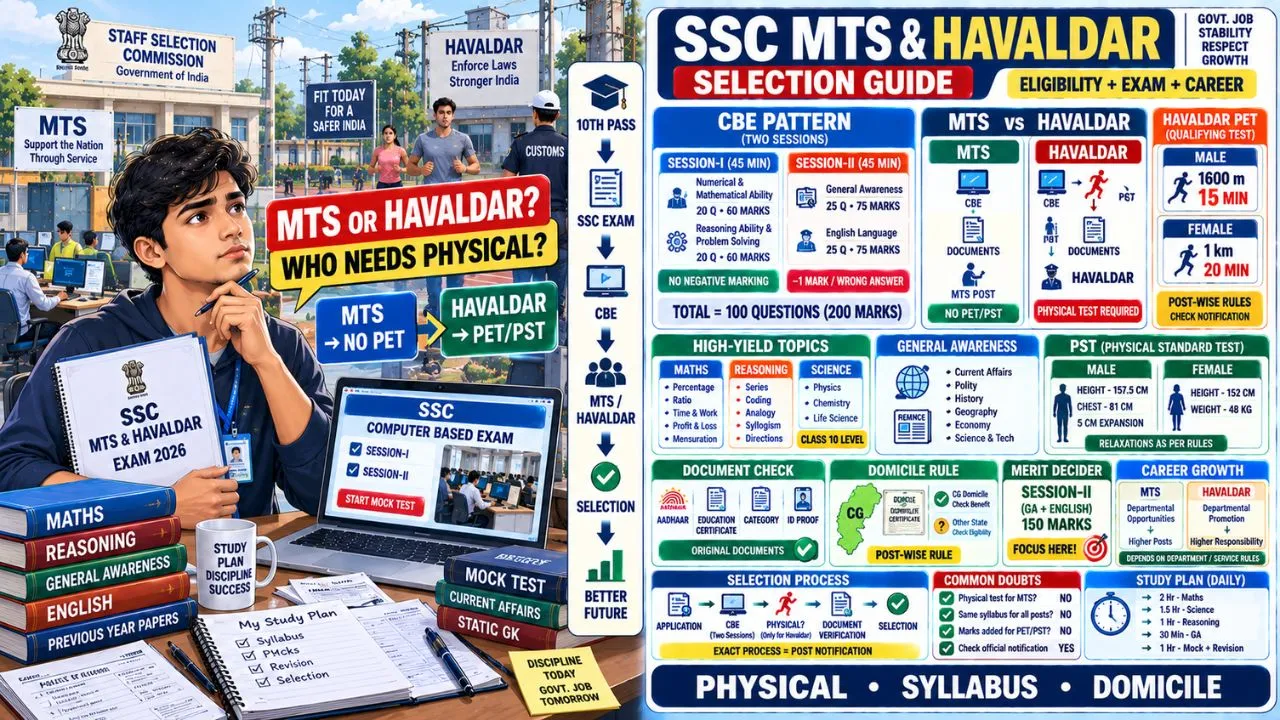
For a 10th-pass candidate looking for a central government job without a lengthy multi-tier written examination, SSC MTS and Havaldar are popular options. Both posts are recruited through the Staff Selection Commission, but their duties and final selection requirements are not identical.
The SSC MTS non technical selection process mainly revolves around the Computer Based Examination (CBE). Havaldar candidates must clear the same written examination and then qualify in the Physical Efficiency Test (PET) and Physical Standard Test (PST).
This difference becomes important when deciding which post to prefer. MTS is largely an office-support position, while Havaldar posts under CBIC and CBN can involve more field-oriented responsibilities.
Here is how the exam pattern, physical requirements, daily work and promotion opportunities differ.
Table of Contents
What Are SSC MTS and Havaldar Posts?
Multi-Tasking Staff, commonly called MTS, is a Group C, non-gazetted, non-ministerial central government post.
Candidates selected as MTS can be posted in different ministries, departments and offices of the Government of India.
The work depends on the department and office. Common responsibilities can include maintaining records, carrying files, assisting with routine office work, photocopying, dispatch-related tasks and supporting the regular functioning of a section.
Havaldar is also a Group C post, but vacancies are associated with the Central Board of Indirect Taxes and Customs (CBIC) and Central Bureau of Narcotics (CBN).
Its work environment can include both office support and duties requiring physical movement. This is why Havaldar recruitment includes a physical test after the written examination.
Both posts normally require candidates to have passed Matriculation or Class 10 from a recognised board by the qualification date mentioned in the notification.
SSC MTS Non Technical Selection Process Explained
The SSC MTS non technical selection process is relatively straightforward compared with several other SSC examinations.
For MTS, candidates appear for a Computer Based Examination conducted in two mandatory sessions. Both sessions are held as part of the same examination.
There is no separate descriptive paper.
Candidates competing for Havaldar vacancies first take the same CBE. Those shortlisted for Havaldar must then appear for PET and PST.
The broad route is:
For MTS: CBE → document and eligibility checks → final allocation
For Havaldar: CBE → PET/PST → document and eligibility checks → final allocation
Candidates should not confuse the two sessions of the CBE with two separate examination stages. They form parts of the same computer-based test.
SSC MTS CBT Exam Pattern
Understanding the current paper structure is essential because the two sessions follow different marking rules.
Session I
Session I contains:
- Numerical and Mathematical Ability: 20 questions for 60 marks
- Reasoning Ability and Problem Solving: 20 questions for 60 marks
That gives candidates 40 questions carrying 120 marks.
The allotted duration is 45 minutes.
There is no negative marking in Session I.
Session II
Session II contains:
- General Awareness: 25 questions for 75 marks
- English Language and Comprehension: 25 questions for 75 marks
Candidates therefore attempt 50 questions carrying 150 marks in Session II.
The duration is again 45 minutes.
Unlike Session I, Session II has negative marking. One mark is deducted for every incorrect answer.
Both sessions are mandatory. Candidates cannot simply perform well in one section and ignore the other.
The SSC MTS non technical selection process therefore rewards speed in basic mathematics and reasoning while demanding greater accuracy in General Awareness and English because of Session II’s negative marking.
How to Approach the Two Sessions
Session I gives candidates more freedom to attempt questions because wrong answers do not attract negative marks.
Still, random guessing should not replace preparation. The main challenge is completing straightforward calculations and reasoning questions within the available time.
Session II needs a different strategy.
A candidate who attempts every General Awareness question without sufficient knowledge can lose marks through negative marking. Accuracy becomes more important here.
English preparation should focus on basic grammar, vocabulary, sentence structure and comprehension. General Awareness preparation should cover the areas listed in the current SSC syllabus rather than collecting random facts from multiple sources.
Regular mock tests are useful because the examination tests time management as much as basic knowledge.
Is There a Physical Test for SSC MTS?
No PET or PST is required for candidates being considered only for MTS vacancies.
This is one of the biggest differences between the two posts.
The SSC MTS non technical selection process does not add a running, walking, cycling, height or chest measurement stage for regular MTS selection.
Havaldar candidates, however, have to satisfy physical requirements.
This makes MTS more suitable for candidates who want a central government support job but do not want their selection to depend on physical standards.
Havaldar Physical Efficiency Test Rules
Candidates shortlisted for Havaldar have to qualify in PET and PST.
Under the current SSC MTS and Havaldar examination structure, the PET walking requirement is:
Male candidates: 1,600 metres in 15 minutes.
Female candidates: 1 kilometre in 20 minutes.
These are qualifying requirements rather than a race for additional merit marks.
A candidate should still practise beforehand. Walking at a required pace under examination conditions can feel different from normal daily walking.
Candidates with applicable physical-test exemptions or special provisions should follow the rules stated in the notification for their category.
Havaldar Physical Standard Test
PST checks whether candidates meet prescribed physical measurements.
For male candidates, the standard height requirement is generally 157.5 cm. Chest measurement is generally 81 cm, with a minimum expansion requirement of 5 cm.
For female candidates, the standard height requirement is generally 152 cm, with a minimum weight of 48 kg.
Relaxations in height and other standards apply to specified categories and groups under SSC rules.
Candidates should not assume that a relaxation applies simply because they belong to a reserved category. The exact relaxation depends on the category or group specifically covered by the notification.
Physical standards should be checked before selecting Havaldar preferences, especially when height or chest measurement is close to the prescribed limit.
MTS vs Havaldar: Which Job Profile Is Better?
There is no universal winner because the two jobs suit different candidates.
MTS work is generally connected with the everyday functioning of a government office. A candidate may assist sections with files, records, documents and other support activities assigned to the post.
For someone who prefers an office-based environment, MTS can be the more comfortable choice.
Havaldar duties are linked specifically with CBIC and CBN establishments. Depending on the posting, the work can involve office assistance as well as duties requiring greater physical movement and operational support.
Candidates comfortable with an active job profile may prefer Havaldar.
The SSC MTS non technical selection process is simpler from a physical standpoint, whereas Havaldar adds PET and PST as mandatory qualifying stages for candidates who are not exempt under applicable rules.
What Are the Working Hours?
MTS and Havaldar are central government posts, but there is no sensible way to promise identical daily hours for every posting.
Many government offices operate around standard departmental working schedules. Actual reporting time, weekly offs and duty arrangements depend on the office, department and nature of the assignment.
MTS employees working in regular administrative offices are more likely to follow conventional office schedules.
Havaldar duties can vary more because CBIC and CBN perform functions that are not limited to ordinary desk work.
Candidates should therefore compare the nature of the job rather than choosing solely on assumptions about fixed working hours.
Salary and Pay Level
MTS and Havaldar posts are placed in Pay Level 1 of the 7th Central Pay Commission pay matrix.
The basic pay starts at ₹18,000 under Pay Level 1.
Basic pay is not the same as monthly in-hand salary.
Eligible employees can receive applicable allowances according to central government rules and their place of posting. At the same time, deductions can reduce the final amount credited each month.
This is why online claims promising one fixed MTS or Havaldar in-hand salary across India should be treated cautiously.
Posting city, current allowance rates and applicable deductions all affect take-home pay.
Promotion Pathway for SSC MTS
Candidates sometimes assume that joining MTS means remaining in the same position throughout their career. That is not necessarily the case.
Promotion opportunities exist, but the exact pathway depends heavily on the ministry or department where the candidate is allocated.
An MTS employee can receive financial progression under applicable government rules and may become eligible for departmental promotion opportunities.
In some offices, qualifying departmental examinations and meeting service conditions can create routes towards clerical or other higher posts.
There is no single promotion ladder that applies identically to every MTS employee across all central government departments.
The SSC MTS non technical selection process gets a candidate into the service. Career progression after joining is then governed by the recruitment rules, vacancies and departmental policies applicable to that office.
Promotion Opportunities for Havaldar
Havaldar employees work within CBIC or CBN establishments, so their career path follows the rules applicable to those organisations.
Promotion to higher positions depends on factors such as service period, vacancies, seniority, departmental rules and qualifying requirements.
A candidate should not select Havaldar only because an online post promises a quick promotion to a particular designation.
Government promotions are governed by service and recruitment rules, and timelines can vary considerably.
For long-term career planning, the better approach is to join with realistic expectations and continue preparing for departmental opportunities or higher competitive examinations where eligible.
Which Post Should You Prefer?
Choose MTS if you prefer a comparatively office-oriented support role and do not want PET/PST to become part of your final selection requirements.
Consider Havaldar if you are comfortable with the physical standards and prefer the possibility of a more active work environment under CBIC or CBN.
Candidates can also consider their posting preferences, physical fitness and long-term career plans while filling the application.
For many Class 10 and Class 12 pass aspirants, the attraction is the relatively accessible educational qualification. But the competition remains serious because candidates from higher educational backgrounds can also apply if they meet the prescribed conditions.
Preparation Strategy for SSC MTS and Havaldar
Start with the actual syllabus instead of buying several books for the same subject.
Build speed in basic arithmetic and reasoning for Session I. Since there is no negative marking there, candidates should learn to use the available time effectively.
Give extra attention to accuracy in Session II.
Daily English practice can include vocabulary, grammar and short comprehension exercises. General Awareness preparation should combine syllabus-based study with regular revision.
For Havaldar aspirants, physical preparation should begin alongside CBT preparation rather than after the written examination.
A simple walking routine can gradually improve pace and endurance without distracting from academic preparation.
Most importantly, solve timed mock tests.
Knowing formulas and grammar rules is useful, but the examination ultimately requires candidates to apply them quickly on a computer screen.
Final Words
The SSC MTS non technical selection process offers one of the more straightforward entry routes into Group C central government service for candidates with a Class 10 qualification.
MTS candidates primarily need to focus on the Computer Based Examination, while Havaldar candidates have the additional responsibility of qualifying PET and PST.
Both posts start at Pay Level 1, but their work environments can differ considerably.
MTS generally suits candidates looking for an office-support role. Havaldar can suit those comfortable with physical requirements and work connected with CBIC or CBN establishments.
Before applying, read the current SSC notification carefully for age limits, vacancies, category rules, physical relaxations and eligibility dates.
The SSC MTS non technical selection process may be simpler than many multi-stage examinations, but selection still requires strong basics, accuracy and consistent practice. For 10th and 12th pass aspirants seeking central government entry, focused preparation is far more useful than trying to cover every competitive-exam book available.