RRB Junior Engineer preparation can feel unusual for a diploma holder. Three years of engineering study naturally make technical subjects feel more comfortable, yet CBT-1 demands a different approach.
The RRB JE syllabus for diploma engineers at the CBT-1 stage focuses on Mathematics, General Intelligence and Reasoning, General Awareness, and General Science. There is no separate core engineering section in CBT-1.
That makes non-technical preparation crucial. A candidate strong in Mechanical, Civil or Electrical Engineering can still struggle in the first stage if reasoning, current affairs or basic science is neglected.
The practical strategy is to treat CBT-1 as a separate scoring examination rather than beginning preparation with the technical-heavy CBT-2 syllabus.
Table of Contents
Understand RRB JE CBT-1 Before Starting Preparation
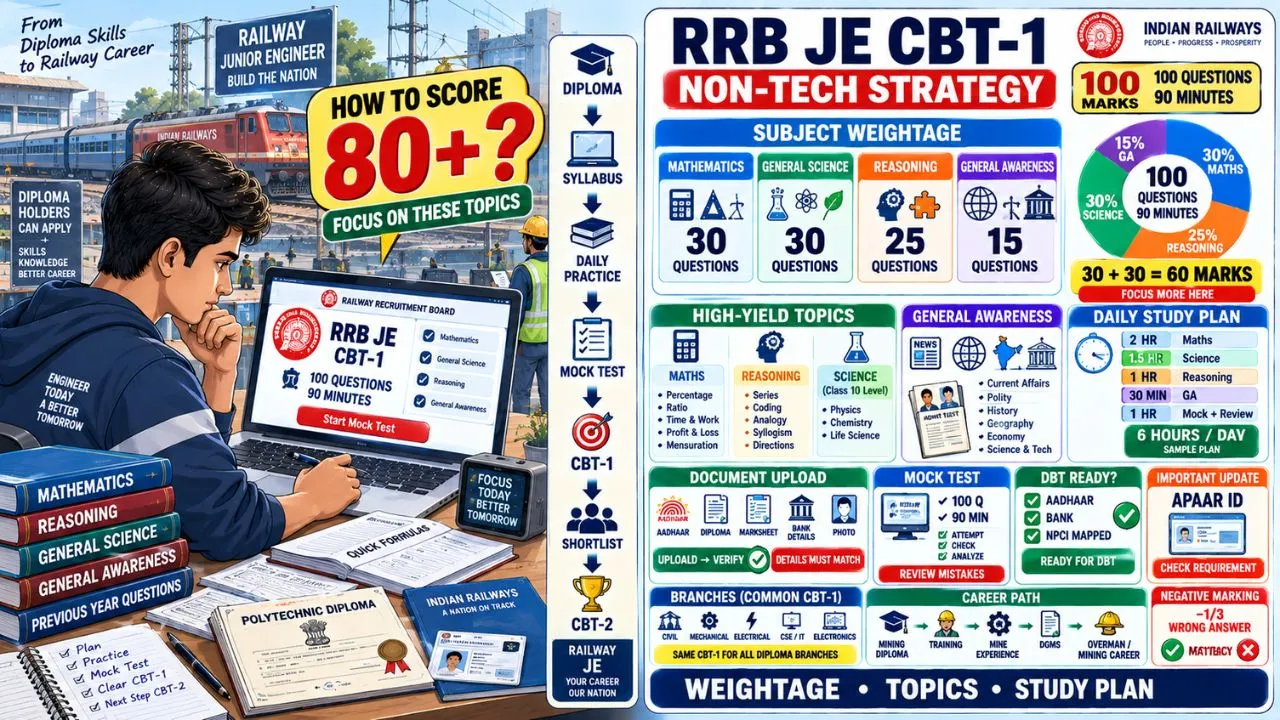
RRB JE CBT-1 is designed as the first screening stage of the recruitment process. Under the standard pattern, the paper contains 100 questions carrying 100 marks, with 90 minutes available to complete the examination.
The usual subject distribution is:
- Mathematics: 30 questions
- General Intelligence and Reasoning: 25 questions
- General Awareness: 15 questions
- General Science: 30 questions
There is normally a penalty of one-third mark for each incorrect answer.
Candidates should still check the latest official RRB JE notification for the recruitment cycle they are applying for because examination rules can be revised.
Looking at the RRB JE syllabus for diploma engineers, General Science and Reasoning together account for 55 questions. Add General Awareness, and 70 questions come from areas many engineering diploma students treat as secondary.
This is why studying only mathematics and technical subjects is a risky approach.
Why Diploma Students Often Lose Marks in CBT-1
Diploma holders generally spend more time on branch-specific concepts such as machines, circuits, surveying, construction or programming.
Reasoning and General Awareness do not receive the same attention during engineering studies.
General Science creates another problem. Questions are generally based on school-level Physics, Chemistry and Life Science, but candidates often assume that easy science requires no preparation.
The concepts may be basic, yet recalling facts quickly during a timed examination requires revision and practice.
Current affairs can become an even bigger distraction. Trying to read everything published in newspapers for months creates a huge workload without guaranteeing useful coverage.
A focused plan solves these problems better than collecting more books and PDFs.
General Science: Make These 30 Questions a Priority
General Science deserves a major place in any RRB JE syllabus for diploma engineers preparation plan because it carries around 30 questions in CBT-1.
The syllabus is broadly based on Physics, Chemistry and Life Sciences up to Class 10 CBSE level.
Diploma students often have an advantage in Physics because engineering courses already involve concepts such as electricity, measurement, force and energy. Biology usually needs more deliberate revision.
In Physics, focus first on motion, force, work, power, energy, heat, light, electricity, magnetism, sound, pressure and basic units.
For Chemistry, revise acids and bases, metals and non-metals, chemical reactions, periodic classification, carbon compounds and everyday chemistry.
In Life Science, prioritise human body systems, nutrition, diseases, cells, reproduction, heredity, plants and basic ecology.
Start with NCERT-level concepts and then move to RRB-style objective questions. There is little benefit in studying advanced engineering Physics for a Class 10-level General Science section.
Reasoning: Build Speed Through Repeated Practice
Reasoning contributes around 25 questions, making it one of the best sections for improving the overall score.
The RRB JE syllabus for diploma engineers includes areas such as analogies, coding-decoding, classification, series, mathematical operations, relationships, syllogism, Venn diagrams, data sufficiency and analytical reasoning.
Reasoning preparation should be question-driven.
Learn the method for one topic, solve a small set slowly, identify mistakes and then practise timed questions.
High-yield areas include number and alphabet series, analogy, classification, coding-decoding, blood relations, direction sense, syllogism, Venn diagrams and simple puzzles.
Do not spend ten minutes fighting one complicated puzzle during practice. CBT-1 rewards overall marks and speed, not attachment to a particular question.
A useful target is to practise reasoning for 45 to 60 minutes daily until common question patterns become familiar.
General Awareness: Prepare Selectively
General Awareness has fewer questions than Science or Mathematics, but it is often the least predictable section.
The RRB JE syllabus for diploma engineers covers current affairs along with Indian geography, history, culture, polity, economy, environmental issues, sports, and developments in science and technology.
Trying to memorise every current event is inefficient.
Divide preparation into static General Knowledge and current affairs.
For static topics, concentrate on Indian Constitution basics, important historical events, geography, major institutions, basic economics, environment and commonly tested factual areas.
For current affairs, prepare concise monthly notes instead of reading several daily newspapers from beginning to end.
Appointments, awards, sports, major government initiatives, important national events, science and technology developments and significant international events deserve attention.
Revise current affairs repeatedly. Reading a fact once rarely makes it exam-ready.
Do Not Ignore Mathematics
Although the main weakness for many diploma candidates is non-technical preparation, Mathematics still carries about 30 questions.
Arithmetic should receive the first priority.
Revise percentages, ratio and proportion, profit and loss, simple and compound interest, time and work, pipes and cisterns, time-speed-distance, averages, age problems and number systems.
Then cover algebra, geometry, mensuration, trigonometry and basic statistics.
The RRB JE syllabus for diploma engineers does not require candidates to approach every question through lengthy engineering-style calculations. Objective exams reward the shortest reliable method.
Practise calculation speed, fractions, percentages, squares and common conversions so that basic arithmetic does not consume unnecessary time.
A Practical Daily Study Plan for Diploma Students
A candidate preparing full-time can begin with roughly five to six focused study hours per day.
Spend about 90 minutes on General Science, 60 minutes on Reasoning and 60 minutes on Mathematics.
Give another 45 minutes to General Awareness and current affairs. Use the remaining time for previous-year questions, revision or a sectional test.
The schedule should not remain fixed forever.
If mock tests show that Science is consistently strong but Reasoning is weak, shift more time towards Reasoning.
Candidates studying alongside college or a job can use a three-hour version: one hour for Science or Mathematics, 45 minutes for Reasoning, 30 minutes for General Awareness and 45 minutes for practice and revision.
Consistency matters more than creating a ten-hour timetable that survives for only four days.
Use a Weekly Preparation Cycle
Covering the RRB JE syllabus for diploma engineers becomes easier when preparation runs in weekly cycles.
Use the first five days for concept study and topic-wise questions. Reserve the sixth day for mixed revision and previous-year questions.
Take a CBT-1 mock test on the seventh day.
After every mock, record three things: topics where concepts were weak, questions lost through careless mistakes and questions that consumed too much time.
This simple error record becomes more useful as the examination approaches.
If the same percentage calculation, syllogism pattern or Biology chapter causes repeated errors, it deserves immediate revision.
Mock tests should diagnose preparation rather than merely produce a score.
Previous-Year Questions Should Guide Your Preparation
Previous RRB JE questions help candidates understand the expected level, common patterns and balance between factual and conceptual questions.
Do not simply solve a paper and check the final marks.
Analyse it subject by subject.
For General Science, identify recurring school-level concepts. In Reasoning, notice which patterns can be solved quickly after enough practice.
For Mathematics, check where calculation time is being lost. For General Awareness, note the type and depth of factual knowledge expected.
The RRB JE syllabus for diploma engineers is broad, so previous papers help decide how deeply a topic actually needs to be studied.
They are particularly useful for preventing over-preparation of low-value areas.
Accuracy Matters Because of Negative Marking
Attempting all 100 questions is not automatically a good strategy.
With one-third negative marking, random guessing can reduce a strong score.
During mocks, classify questions into three groups: confident, solvable with some work and uncertain.
Complete confident questions first.
Return to calculation-heavy or time-consuming questions afterward. Avoid blind guesses when options cannot be reasonably eliminated.
This approach also prevents a difficult question early in the paper from disturbing the rest of the attempt.
Speed matters in CBT-1, but controlled speed with accuracy matters more.
Final 30-Day Strategy
During the final month, stop expanding your study material.
The goal should shift from learning everything to retaining what has already been covered.
Complete the remaining high-priority chapters during the first ten days. Continue sectional tests and revise short notes daily.
During the next ten days, increase full-length mock frequency and analyse every test carefully.
Use the final ten days for rapid revision, previous questions, formulas, science facts, reasoning patterns and current-affairs notes.
By this stage, the RRB JE syllabus for diploma engineers should feel like a collection of familiar topics rather than one enormous syllabus.
Avoid starting several new books during the last week.
Final Preparation Approach
RRB JE CBT-1 is not a technical engineering paper, and diploma holders should prepare accordingly. General Science and Reasoning together carry a major share of the paper, while General Awareness can provide valuable additional marks when revised systematically. Keep Mathematics active, practise objective questions daily and use mock tests to identify where marks are actually being lost. Most importantly, prepare the RRB JE syllabus for diploma engineers according to CBT-1 weightage instead of spending most of the early preparation period on core engineering subjects. A balanced routine covering Science, Reasoning, Mathematics and General Awareness gives diploma candidates a far stronger chance of clearing the first stage and moving towards the technical CBT-2 examination.