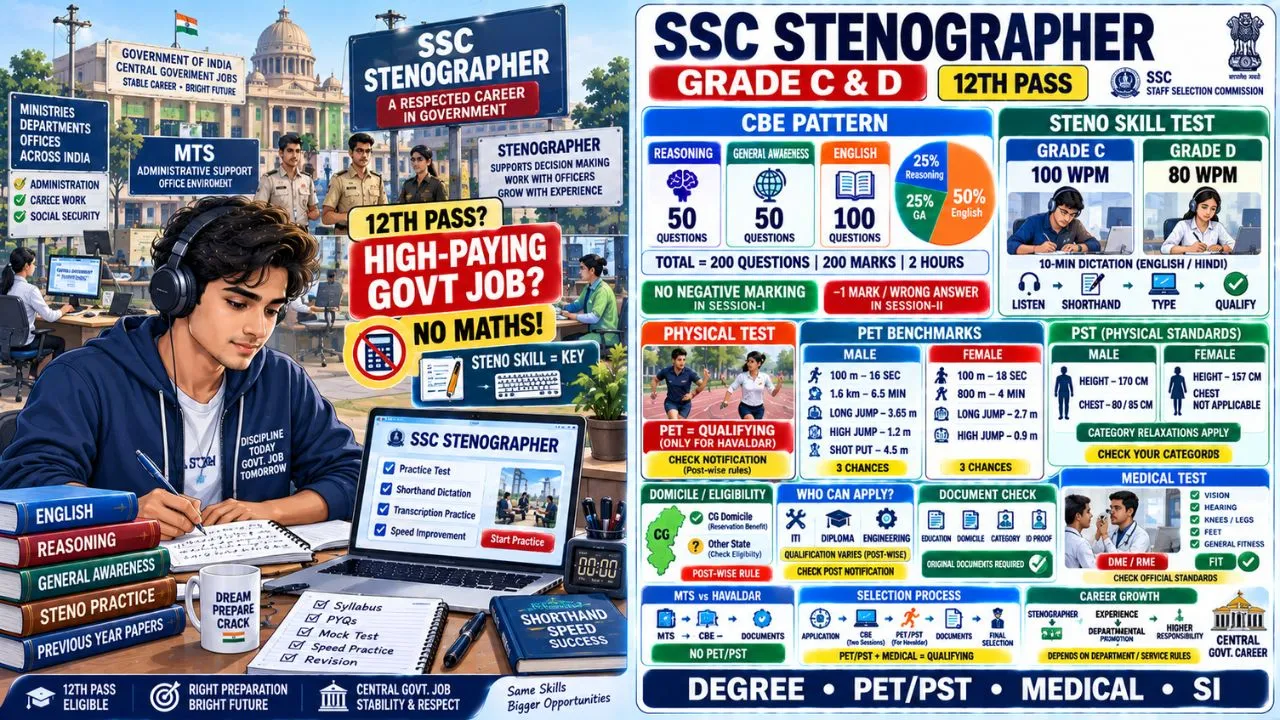
For many 12th-pass and diploma students, central government exam preparation becomes difficult because of quantitative aptitude. Exams such as SSC CGL, CHSL and several railway recruitments require regular mathematics practice alongside reasoning, English and general awareness.
SSC Stenographer offers a different route.
The computer-based examination does not have a separate quantitative aptitude or mathematics section. Instead, candidates answer questions from General Intelligence and Reasoning, General Awareness, and English Language and Comprehension. After qualifying the written examination, they have to clear a stenography skill test.
This makes the exam particularly interesting for candidates who are comfortable with English and willing to learn shorthand.
Understanding the SSC Stenographer selection process is important before choosing it simply because there is no maths section. Shorthand is a specialised skill and requires months of consistent practice.
Table of Contents
What Is SSC Stenographer Recruitment?
The Staff Selection Commission conducts the Stenographer examination for recruitment to Stenographer Grade C and Grade D posts in various ministries, departments and organisations of the Central Government.
The basic educational requirement is normally Class 12 or an equivalent qualification from a recognised board or institution.
This means diploma holders who have also passed Class 12, or whose qualification satisfies the notified equivalent requirement, can examine their eligibility under the current recruitment notice.
A diploma should not automatically be assumed to replace Class 12 for every candidate. Educational eligibility must match the wording of the current SSC notification.
The attraction of this examination comes from its relatively focused written syllabus and the possibility of entering a Central Government office without preparing a dedicated mathematics section.
SSC Stenographer Grade C vs Grade D
SSC recruits candidates for two main categories: Grade C and Grade D.
Grade C is the higher stenographer grade and carries a higher shorthand speed requirement. Grade D has a lower shorthand speed requirement and is often the starting target for beginners.
The posts can involve working with officers in government offices, preparing dictated material, typing documents, maintaining records and assisting with official correspondence.
Actual duties vary according to the ministry, department and office where the candidate is posted.
Candidates should not select a grade based only on salary. The required shorthand speed is an important practical difference.
For Grade D, dictation is generally conducted at 80 words per minute. Grade C requires 100 words per minute.
That 20 wpm difference becomes significant when shorthand passages are dictated continuously.
SSC Stenographer Selection Process
The SSC Stenographer selection process mainly consists of a computer-based examination followed by a stenography skill test.
The computer-based examination contains three sections:
- General Intelligence and Reasoning
- General Awareness
- English Language and Comprehension
The established examination pattern contains 200 questions carrying 200 marks. English receives the largest share with 100 questions, while Reasoning and General Awareness contain 50 questions each.
There is also negative marking for incorrect answers according to the applicable examination rules.
The absence of quantitative aptitude makes the syllabus attractive to candidates who have struggled with maths in other SSC examinations.
However, fewer subjects do not automatically mean easy selection. Competition and the stenography skill requirement still demand serious preparation.
Why No Maths Can Be a Major Advantage
A large number of government exam aspirants spend several months building basic arithmetic before reaching examination-level questions.
Percentage, profit and loss, ratio, time and work, algebra, geometry and data interpretation can consume a substantial part of a beginner’s preparation schedule.
SSC Stenographer removes that burden from its written paper.
A candidate can concentrate on Reasoning, General Awareness and English while simultaneously developing shorthand.
This is one reason the SSC Stenographer selection process can feel more manageable for students from arts, commerce, humanities or diploma backgrounds who do not want mathematics-heavy preparation.
Still, calling it the “easiest” central government examination needs context.
The written syllabus may be easier to manage for a non-maths candidate, but shorthand creates a skill barrier that many other SSC examinations do not have.
English Is the Most Important Written Section
English should receive a major part of the preparation schedule because it accounts for half of the computer-based paper.
Candidates need command over grammar, vocabulary and comprehension rather than advanced literary English.
Preparation should cover topics such as sentence improvement, error detection, synonyms, antonyms, spelling, fill-in-the-blanks, active and passive voice, direct and indirect speech and reading comprehension.
Previous-year SSC questions are useful because the same grammar concepts appear repeatedly in different forms.
A diploma student with weak English should begin with basic grammar instead of immediately attempting full mock tests.
Once accuracy improves, timed sectional tests can help build examination speed.
English preparation also supports the later skill test because stenographers regularly work with dictated material and transcription.
Reasoning Preparation Without Overcomplicating It
General Intelligence and Reasoning contains 50 questions in the computer-based examination.
Common areas include analogy, classification, series, coding-decoding, relationships, directions, non-verbal reasoning and logical patterns.
The best strategy is to identify recurring SSC question types and practise them regularly.
Reasoning should not consume the entire study schedule simply because there is no mathematics section.
After learning a topic, solve previous-year questions and record the types of mistakes being made.
The goal is to reach a level where familiar reasoning patterns can be recognised quickly during the examination.
This leaves more time and mental energy for English, General Awareness and shorthand practice.
General Awareness Preparation
General Awareness is usually the most unpredictable section for beginners.
It can cover history, geography, polity, economics, science, culture and current affairs.
Trying to memorise everything is not practical.
Start with basic static subjects and combine them with concise current-affairs revision. Previous SSC papers can help identify the depth at which questions are generally asked.
Revision matters more than collecting large amounts of material.
One compact set of notes revised several times is often more useful than continuously switching between books, PDFs and online classes.
Candidates following the SSC Stenographer selection process should remember that General Awareness is only one part of the written examination. It should not reduce the daily time required for shorthand.
The Real Challenge: Stenography Skill Test
The skill test is where SSC Stenographer becomes very different from most other 12th-level government examinations.
Candidates who qualify the computer-based examination are called for the stenography test according to the applicable recruitment procedure.
They receive a dictation passage for a prescribed period and must take it down in shorthand.
For Stenographer Grade D, the dictation speed is 80 words per minute.
For Stenographer Grade C, it is 100 words per minute.
After dictation, candidates transcribe their shorthand notes on a computer within the time allowed for the chosen language and grade.
The skill test is qualifying in nature, but candidates must meet the prescribed standards.
This stage is why the SSC Stenographer selection process should never be treated as only a three-subject written examination.
Is 80 WPM Shorthand Easy?
For someone who has never learned shorthand, 80 words per minute can initially look extremely fast.
The speed becomes achievable through systematic training.
Beginners first need to understand shorthand outlines, strokes, vowels, word forms and common phrases. After that, speed is increased gradually through regular dictation.
Trying to jump directly from basic shorthand to 80 wpm usually creates poor outlines and transcription errors.
Start with slower dictation and focus on accuracy.
Once a speed becomes comfortable, increase it gradually. Regular transcription is equally important because taking correct shorthand notes has little value if they cannot be accurately converted into typed text.
Candidates targeting Grade C eventually need to reach the higher 100 wpm standard.
How Long Should You Practise Shorthand?
There is no fixed number of months that works for every candidate.
Someone with strong English, typing ability and regular coaching may progress differently from a complete beginner studying independently.
Consistency matters more than occasional long sessions.
Daily shorthand practice should ideally include theory revision, dictation and transcription.
Do not spend six months preparing only for the computer-based examination and decide to learn shorthand after qualifying it.
The SSC Stenographer selection process rewards candidates who prepare for both stages together.
Even one focused shorthand session every day can build a substantial advantage over candidates who postpone skill preparation.
Salary and Career Benefits
SSC Stenographer is attractive because Grade C and Grade D are Central Government posts with structured pay under the applicable pay matrix, along with admissible allowances according to posting and government rules.
Grade C generally has a higher pay level than Grade D.
Actual monthly in-hand salary is not a single fixed amount. It changes with grade, posting city, applicable allowances and deductions.
This is why candidates should be careful with videos promising one exact “SSC Stenographer salary.”
Apart from pay, the job can appeal to candidates who prefer office-based government work rather than field-oriented posts.
Career progression depends on the department, service rules, experience and available promotional channels.
A Practical Preparation Plan for Diploma and 12th-Pass Candidates
Start by checking your age and educational eligibility in the current notification.
Once eligible, divide preparation between the written examination and shorthand.
English deserves substantial daily attention because it carries 100 questions. Reasoning can be prepared topic by topic, followed by previous-year questions. General Awareness requires concise notes and repeated revision.
Shorthand should run alongside these subjects from the first stage of preparation.
Candidates targeting Grade D can progressively work towards 80 wpm. Those aiming for Grade C need to develop accuracy first and then move towards 100 wpm.
After completing the basic written syllabus, introduce full mock tests.
Analyse incorrect answers rather than simply recording mock scores.
This balanced approach makes the SSC Stenographer selection process much more manageable than preparing separately for each stage.
Is SSC Stenographer Really the Easiest High-Paying Central Job?
For a candidate who dislikes quantitative aptitude and is comfortable learning a practical skill, SSC Stenographer can be one of the more focused Central Government recruitment options after Class 12.
It is not an effortless examination.
The advantage comes from avoiding a dedicated maths section and having a relatively concentrated written syllabus. The difficulty shifts towards English proficiency and shorthand speed.
A candidate unwilling to practise shorthand regularly may find SSC Stenographer harder than expected.
For someone prepared to develop 80 wpm or 100 wpm shorthand, the examination can offer a practical alternative to maths-heavy SSC exams.
The SSC Stenographer selection process ultimately rewards two abilities: performing well in the computer-based examination and demonstrating reliable stenography skills.
For 12th-pass and eligible diploma candidates seeking a Central Government desk job, that combination makes SSC Stenographer a recruitment option worth serious consideration.