Technical education does not improve through new equipment alone. The quality of teaching, practical training and laboratory instruction also determines how effectively students learn engineering skills. For a polytechnic such as Government Polytechnic Ambikapur, faculty development can therefore have a direct effect on classroom teaching and practical education.
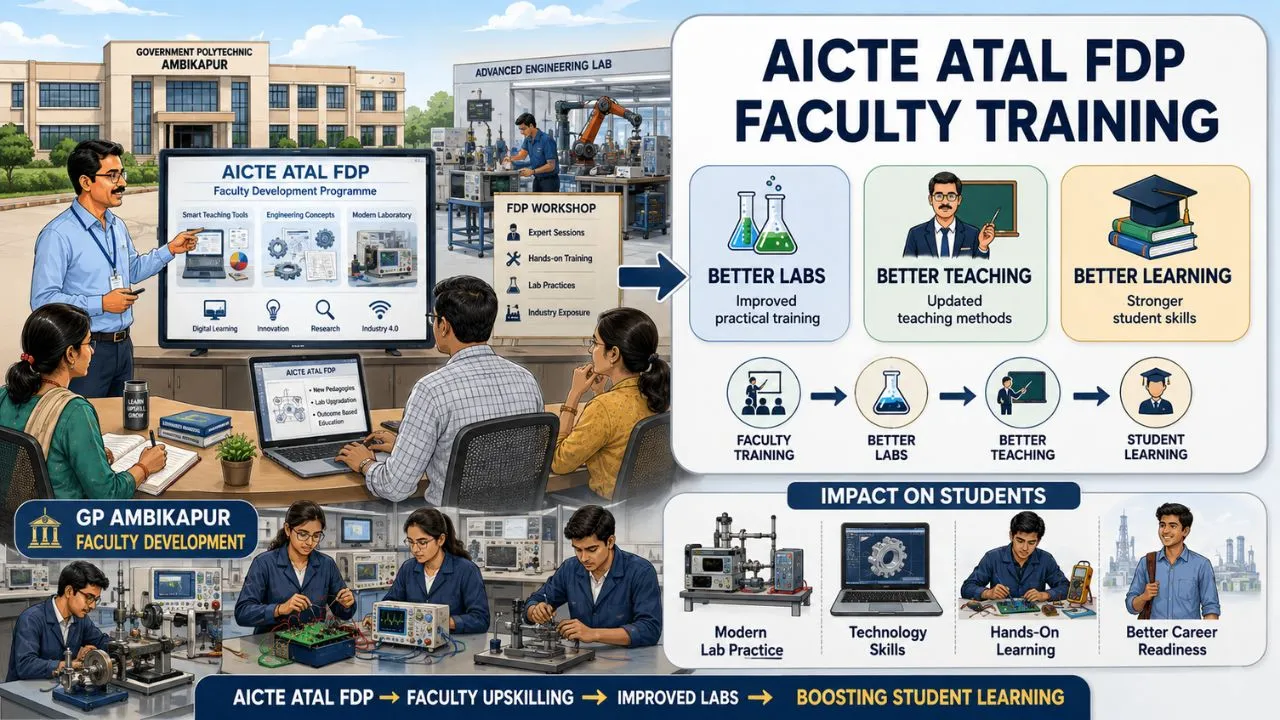
AICTE Training and Learning (ATAL) Faculty Development Programmes are designed to help teachers strengthen their knowledge in emerging technologies, teaching methods, research and other areas relevant to technical education. When faculty members participate in such programmes, the benefits can extend beyond their own professional development. New knowledge can influence laboratory demonstrations, project guidance, practical assignments and the way technical concepts are explained to students.
At GP Ambikapur, this approach is particularly relevant because diploma education depends heavily on hands-on learning. Students studying engineering need more than textbook knowledge. They need opportunities to understand machines, instruments, software, industrial processes and technical problem-solving.
Table of Contents
What Is an AICTE ATAL Faculty Development Programme?
ATAL stands for AICTE Training and Learning Academy. The programme is associated with the All India Council for Technical Education and focuses on professional development for teachers and academic professionals.
Faculty Development Programmes, commonly called FDPs, cover areas such as emerging technologies, engineering applications, pedagogy, research methodology, innovation and entrepreneurship. The subject of an FDP can change depending on the programme and institution conducting it.
A faculty member might attend a programme related to artificial intelligence, data science, Internet of Things, renewable energy, advanced manufacturing or modern teaching techniques. The objective is not simply to provide another certificate.
A useful FDP should help teachers understand new developments and apply that knowledge in their academic work. For diploma students, the real value appears when faculty members bring those concepts into lectures, laboratory work and student projects.
Why Faculty Training Matters in Polytechnic Education
Polytechnic education has a strong practical component. Students spend considerable time in laboratories, workshops and project-based activities. Faculty members have to guide them through equipment, measurements, technical procedures and problem-solving exercises.
Technology also changes quickly. A laboratory that was considered modern several years ago may no longer represent current industry practices.
Faculty training gives teachers an opportunity to update their knowledge without waiting for a complete curriculum revision. For example, an Electrical Engineering teacher who learns about modern industrial automation can introduce students to newer control concepts.
A Computer Engineering faculty member trained in artificial intelligence can explain current applications through practical assignments. Similarly, a Mechanical Engineering teacher exposed to advanced manufacturing techniques can connect traditional workshop concepts with modern production systems. The result is a more relevant learning experience.
How ATAL FDPs Can Improve Laboratory Teaching
Laboratory education becomes more effective when teachers understand both the equipment and the technology behind it. Faculty development can help instructors improve laboratory activities in several ways.
A teacher may redesign an experiment to make students analyse actual results instead of simply following a fixed set of instructions. Practical sessions can also include troubleshooting exercises. Instead of giving students a system that works perfectly every time, teachers can introduce controlled faults and ask learners to identify the problem.
This approach develops technical thinking. Faculty members can also learn about software tools and digital resources that make laboratory instruction more interactive. For engineering students, this can be particularly useful when physical equipment is limited. Simulation tools can help demonstrate concepts before students work with actual laboratory hardware.
The combination of simulation and physical experiments can make difficult concepts easier to understand.
Connecting Classroom Lessons With Industry
One of the biggest challenges in technical education is maintaining a connection between classroom learning and workplace requirements. Industrial processes continue to evolve, and faculty members need regular exposure to new technologies.
FDPs can provide an opportunity to understand recent developments in engineering and technology. Suppose a faculty member learns about industrial IoT during an FDP. Instead of teaching sensors only as a theoretical topic, the teacher can connect them with machine monitoring, data collection and automated systems.
A Civil Engineering faculty member could similarly bring newer approaches to surveying, construction technology or project management into classroom discussions. The objective is not to turn every diploma course into an advanced research programme. It is to help students understand where their fundamental concepts are used in modern technical environments.
Impact on Student Projects
Final-year projects are another area where faculty training can make a noticeable difference. Students often have difficulty selecting project topics that are technically meaningful but still realistic within their available resources.
Faculty members with updated technical knowledge can guide students towards more relevant project ideas. A project involving sensors, automation, energy efficiency or data analysis can be designed around the resources available in a polytechnic laboratory.
The teacher’s role is important in determining whether the project becomes a simple demonstration or a genuine problem-solving exercise. Faculty training can also introduce teachers to better project evaluation methods.
Students can be encouraged to document their design decisions, test results, failures and improvements rather than focusing only on the final model. That process develops skills useful beyond examinations.
Benefits for Computer and Emerging Technology Courses
Technology-focused diploma branches are particularly sensitive to changes in industry. Computer Science, Information Technology, Electronics and related programmes require teachers to keep pace with areas such as artificial intelligence, cloud computing, cybersecurity, data analytics, embedded systems and automation.
An FDP can help faculty members understand the fundamentals of newer technologies and identify ways to introduce them at an appropriate level. For example, students do not necessarily need an advanced AI course at diploma level.
They can begin with basic concepts, simple datasets, practical applications and small projects. The same approach can be applied to IoT and automation. Faculty members can introduce students to sensors, microcontrollers and basic data collection before moving towards more complex applications. This gradual approach makes emerging technology less intimidating.
Improving Teaching Methods Through FDPs
Faculty development is not limited to technical subjects. Teaching methodology is equally important. A teacher may have excellent subject knowledge but still find it difficult to explain complicated concepts clearly.
FDPs that focus on pedagogy can introduce methods such as activity-based learning, project-based teaching, blended learning and outcome-based education. These methods can make technical classes more interactive.
Instead of spending an entire session explaining a concept on the board, the teacher can combine a short explanation with a demonstration, practical activity or problem-solving exercise. This can be particularly effective for diploma students who often learn better when theoretical concepts are connected with something tangible.
Assessment methods can also improve. Faculty members can use practical assignments, project presentations and problem-solving tasks alongside conventional examinations.
Better Use of Laboratory Equipment
Purchasing laboratory equipment is only the beginning. Teachers need to know how to use the equipment effectively and how to design meaningful exercises around it. Faculty training can help identify better applications for existing laboratory resources.
An instrument that is currently used for one standard experiment might support several different learning activities. Teachers can also develop demonstrations that connect multiple subjects.
For instance, a practical activity can combine measurement, electronics, programming and data analysis. This interdisciplinary approach gives students a better understanding of how different engineering concepts work together. It also reduces the tendency to treat every subject as a separate academic unit.
Faculty Development and Student Employability
Students ultimately want their education to prepare them for employment or further study. Faculty training can contribute to employability when it improves the practical relevance of teaching.
Students who work with current tools and realistic technical problems are better placed to understand workplace expectations. This does not mean an FDP automatically improves student placement numbers.
Employment depends on several factors, including student skills, industry demand, branch, internships, communication ability and recruitment opportunities. Faculty development is one part of the larger academic environment. Its value lies in improving the quality of instruction that students receive throughout their diploma programme.
How Faculty Training Can Support Research and Innovation
Faculty development can also encourage research and innovation within an institution. Teachers who participate in technical FDPs may become more familiar with emerging research areas, project development methods and collaborative opportunities.
That knowledge can encourage student participation in technical competitions, innovation projects and applied research activities. For a polytechnic, research does not always have to mean complex laboratory research.
A practical project addressing energy consumption, water management, automation, agricultural equipment or local industrial problems can provide valuable learning. Faculty members can guide students in defining the problem, developing a prototype, testing the solution and presenting the results. This creates a stronger project culture on campus.
Why Continuous Training Is Important
A single FDP cannot keep a faculty member updated for an entire career. Engineering technologies continue to change, and teaching practices also evolve. Continuous professional development is therefore more useful than one-time training.
Faculty members can combine FDPs with online courses, workshops, industrial visits, conferences, technical certifications and professional networking. The institution can also support internal knowledge-sharing.
A faculty member returning from an FDP can conduct a short session for colleagues and explain the techniques or technologies learned during the programme. This multiplies the benefit of one training opportunity. Students can eventually benefit from the knowledge even if they were not directly involved in the original programme.
What Students Can Expect From Better Faculty Training
The impact of faculty development may not always be visible immediately. Students may notice changes gradually through more practical demonstrations, better project guidance and improved laboratory exercises.
A teacher may introduce a new simulation tool. Another may redesign a workshop activity. Someone else may bring an industry-oriented problem into a classroom assignment. These small changes can improve the overall learning experience. The biggest benefit is the connection between theory and application. When students understand why a concept matters and where it is used, technical subjects become easier to relate to real engineering work.
Final Words
AICTE ATAL FDP programmes can play an important role in strengthening faculty capabilities at technical institutions such as Government Polytechnic Ambikapur. The benefit goes beyond individual teacher development.
Updated faculty knowledge can influence laboratory instruction, project work, teaching methods, technology exposure and the practical relevance of diploma education. For GP Ambikapur students, better-trained faculty can mean more meaningful laboratory sessions and stronger connections between classroom concepts and real-world engineering applications.
When these elements work together, technical education becomes more practical and relevant. The real measure of a successful FDP is therefore not the number of certificates issued. It is whether the knowledge gained by teachers eventually improves what happens inside the classroom, laboratory and workshop.