Choosing the right engineering branch after Class 10 can shape the kind of technical skills and career opportunities available later. Diploma and polytechnic courses provide an early introduction to engineering through practical classes, laboratory work, workshops, projects, and industrial training.
However, every branch leads towards a different type of work. Computer Engineering connects with software and technology, while Mechanical Engineering focuses on machines and manufacturing.
Civil Engineering is closely linked with construction and infrastructure. Electrical Engineering deals with power, industrial systems, and electrical equipment. Electronics and Communication Engineering covers electronic devices, communication systems, embedded technology, and several modern applications. This makes branch selection more important than simply choosing the course with the highest expected salary.
Table of Contents
Best Engineering Branches in Diploma/Polytechnic
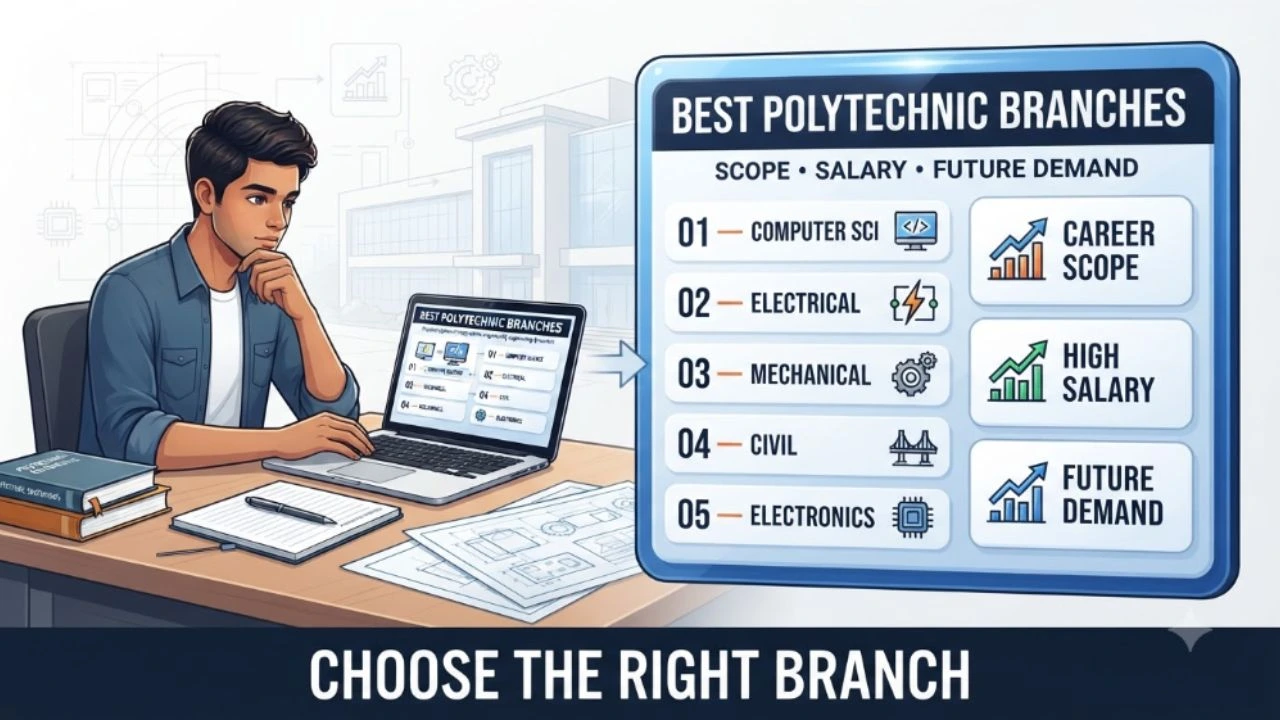
The most popular diploma engineering branches include Computer Engineering, Mechanical Engineering, Civil Engineering, Electrical Engineering, and Electronics. Automobile Engineering, Information Technology, and specialised technology programmes can also provide useful career opportunities.
There is no single branch that guarantees the highest salary or best career. Earning potential depends on technical skills, college quality, location, internships, work experience, employer, and the type of role. The following branches are among the strongest options for diploma students.
1. Diploma in Computer Engineering
Computer Engineering is one of the most attractive diploma branches for students interested in software and digital technology. The course generally introduces students to programming, computer hardware, operating systems, databases, networking, and software development.
Depending on the institution, students may also work with web development, cybersecurity, cloud technologies, and basic data management.
Career Scope
Computer Engineering diploma holders can explore roles such as:
- Computer Technician
- Technical Support Executive
- Junior Programmer
- Network Support Technician
- Hardware Technician
- Web Development Trainee
- IT Support Technician
- System Support Executive
Future Demand
Demand for digital services continues to support technology-related roles across many industries. A diploma holder can also pursue B.Tech through lateral entry after completing the required diploma qualification.
For students interested in technology, Computer Engineering offers a combination of practical learning and multiple career directions.
2. Diploma in Mechanical Engineering
Mechanical Engineering remains one of the most established diploma branches in technical education. The branch covers machines, manufacturing processes, engineering drawing, thermodynamics, materials, production methods, and maintenance. Students usually spend considerable time working with workshop equipment and learning how mechanical systems operate.
Career Scope
Mechanical diploma holders can work in:
- Manufacturing companies
- Automobile industries
- Production units
- Maintenance departments
- Engineering workshops
- Industrial plants
- Fabrication companies
- Machine maintenance services
Common job profiles include Mechanical Technician, Production Technician, Maintenance Technician, CAD Operator, Quality Technician, and Junior Supervisor.
Future Demand
Mechanical Engineering remains relevant because manufacturing, automobiles, industrial machinery, and production systems require trained technical workers. The growth of automation and advanced manufacturing is also changing the skills expected from mechanical diploma holders. Knowledge of CAD software, CNC machines, automation, robotics, and industrial maintenance can make a candidate more competitive.
3. Diploma in Civil Engineering
Civil Engineering is suitable for students interested in construction, buildings, roads, bridges, surveying, and infrastructure development. The diploma generally covers construction materials, surveying, structural concepts, engineering drawing, estimation, and project-related work. Practical exposure is an important part of this branch because construction work involves field measurements and site-based activities.
Career Scope
Civil diploma holders can find opportunities with:
- Construction companies
- Infrastructure firms
- Real estate companies
- Government departments
- Road development projects
- Surveying companies
- Engineering consultancies
Possible job profiles include Site Supervisor, Surveyor, CAD Technician, Junior Engineer, Quantity Survey Assistant, and Construction Supervisor. Government recruitment can also provide opportunities for eligible diploma holders through technical positions.
Future Demand
Infrastructure development creates continuing demand for workers with construction and technical skills. Roads, housing, railways, urban development, water projects, and commercial construction all require civil engineering professionals. Students interested in this field can strengthen their profile by learning AutoCAD, surveying equipment, estimation software, and construction management basics.
4. Diploma in Electrical Engineering
Electrical Engineering is another strong option for students who want to work with electrical systems, power equipment, industrial installations, and maintenance. The course generally covers electrical machines, circuits, power systems, wiring, measurements, control systems, and electrical safety.
Practical laboratory sessions help students understand how electrical equipment works in real situations.
Career Scope
Electrical diploma holders can work in:
- Power distribution companies
- Manufacturing industries
- Electrical contractors
- Industrial plants
- Construction companies
- Renewable energy companies
- Maintenance departments
Common positions include Electrical Technician, Maintenance Technician, Electrical Supervisor, Junior Engineer, Field Technician, and Service Technician. Government departments and public-sector organisations also recruit eligible diploma holders for technical positions through different examinations.
Future Demand
Electricity remains essential across manufacturing, construction, transportation, commercial buildings, and residential infrastructure. The expansion of solar energy, electric vehicles, industrial automation, and smart electrical systems is creating new areas for technical workers.
Students can improve their prospects by learning industrial automation, PLC systems, electrical design software, and renewable energy technologies.
5. Diploma in Electronics and Communication Engineering
Electronics and Communication Engineering suits students interested in electronic circuits, communication equipment, embedded systems, and digital devices. The curriculum may include electronic components, digital electronics, communication systems, microprocessors, microcontrollers, and basic networking.
Practical laboratory work helps students understand circuit design, testing, troubleshooting, and electronic equipment.
Career Scope
Possible employment areas include:
- Electronics manufacturing
- Telecommunications
- Consumer electronics
- Embedded systems
- Industrial automation
- Service centres
- Networking companies
Job profiles can include Electronics Technician, Service Technician, Network Technician, Communication Technician, and Maintenance Technician.
Future Demand
Electronics manufacturing and connected technologies are expanding across several industries. Embedded systems, automation, Internet of Things applications, telecommunications, and electronic manufacturing offer additional areas for skill development. Students who develop knowledge of microcontrollers, embedded programming, PCB design, and basic automation can broaden their career options.
6. Diploma in Automobile Engineering
Automobile Engineering focuses on vehicles, engines, automobile systems, servicing, maintenance, and vehicle technology. The branch can suit students who have a strong interest in cars, commercial vehicles, motorcycles, and automotive technology. With electric vehicles becoming more common, automobile education is also moving beyond conventional engine-based systems.
Career Scope
Diploma holders can work with:
- Automobile manufacturers
- Vehicle dealerships
- Service centres
- Automotive component companies
- Fleet operators
- Repair workshops
- Commercial vehicle companies
Possible roles include Automobile Technician, Service Advisor, Workshop Supervisor, Vehicle Inspector, Maintenance Technician, and Service Engineer.
Future Demand
The automotive industry is changing rapidly because of electric vehicles, battery technology, connected vehicles, and advanced diagnostic systems. Students can therefore benefit from learning EV systems, vehicle diagnostics, battery technology, and electronic control systems. This combination can provide more relevant skills than relying only on traditional automobile repair knowledge.
7. Diploma in Information Technology
Information Technology is closely related to Computer Engineering but generally focuses more heavily on software, information systems, networking, and digital infrastructure. Students may study programming, databases, networking, web technologies, operating systems, and information management.
Career Scope
IT diploma holders can explore:
- IT Support
- Network Support
- Web Development
- System Administration
- Technical Support
- Database Support
- Software Testing
The branch can be particularly useful for students who want to enter the technology sector after completing Class 10. Additional learning outside the syllabus can make a significant difference in this field. Programming, cloud computing, cybersecurity, web development, and data-related skills can improve employment prospects.
8. Diploma in Production Engineering
Production Engineering is closely connected with manufacturing and industrial production. The branch focuses on production processes, manufacturing systems, quality control, engineering materials, machine tools, and industrial operations.
Students interested in factories and manufacturing environments may find this branch suitable.
Career Scope
Employment opportunities can exist in:
- Manufacturing companies
- Automobile plants
- Engineering industries
- Production units
- Quality departments
- Industrial equipment companies
Common positions include Production Technician, Quality Technician, Manufacturing Technician, Machine Operator, and Production Supervisor.
Future Demand
Modern manufacturing is increasingly influenced by automation, robotics, CNC machinery, and computer-controlled production. Students who combine production knowledge with automation, CNC programming, quality systems, and computer-aided manufacturing can improve their career prospects.
Polytechnic Branches Compared
| Diploma Branch | Main Area | Career Scope | Future Demand |
| Computer Engineering | Software and computing | IT, support, development | High |
| Mechanical Engineering | Machines and manufacturing | Production, maintenance, automobiles | Strong |
| Civil Engineering | Construction and infrastructure | Construction, surveying, infrastructure | Strong |
| Electrical Engineering | Power and electrical systems | Power, industry, maintenance | Strong |
| Electronics & Communication | Electronics and communication | Electronics, telecom, embedded systems | High |
| Automobile Engineering | Vehicle technology | Automotive, servicing, EVs | Strong |
| Information Technology | Digital systems | IT, networking, software support | High |
| Production Engineering | Manufacturing | Production and quality | Strong |
These demand categories are broad indicators rather than guarantees of employment or salary.
Actual opportunities differ according to region, employer, technical skills, and economic conditions.
Which Polytechnic Branch Has the Highest Salary?
There is no fixed salary leader across every company and location. Computer Engineering and Information Technology can offer strong earning potential when diploma holders develop programming and specialised digital skills. Electrical, Mechanical, and Electronics branches can also lead to good salaries with experience and industry-specific expertise. Civil Engineering can provide strong opportunities in construction and infrastructure, particularly for candidates who develop practical site skills. A diploma alone does not determine salary. Skills, experience, employer, location, job profile, and additional qualifications matter significantly.
Expected Salary After Polytechnic
Salary figures differ widely between employers and cities, so students should avoid choosing a branch only because of an advertised package. Fresh diploma holders may start with modest salaries, particularly in smaller companies or entry-level technical positions.
With experience, specialised skills, certifications, and stronger responsibilities, earnings can increase. Government technical jobs may follow structured pay scales, while private-sector salaries depend on the organisation and position. For this reason, a realistic comparison should consider career progression rather than only the first salary.
Which Polytechnic Branch Is Best for Future Demand?
The answer depends on what type of work you want to pursue. Computer Engineering and Information Technology are strong choices for students interested in software, networking, and digital technology.
Electrical Engineering is useful for students interested in power, industrial systems, automation, and renewable energy.
Mechanical Engineering remains relevant across manufacturing, automobiles, maintenance, and industrial operations.
Civil Engineering suits students interested in construction and infrastructure.
Electronics and Communication can work well for those interested in electronic devices, embedded systems, telecommunications, and automation.
The best branch is therefore the one that matches your interests while providing realistic opportunities in your preferred career area.
Polytechnic Branches for Government Jobs
A diploma can make candidates eligible for various technical government positions, depending on the recruitment rules.
Civil diploma holders may find opportunities in public works and infrastructure-related departments.
Electrical and Mechanical diploma holders can find technical opportunities in power, transport, manufacturing, and other government organisations.
Computer and Electronics diploma holders may qualify for selected technical and support positions.
Eligibility differs from one recruitment notification to another. Branch requirements, experience, age limits, and examination conditions should always be checked before applying.
Polytechnic Branches for Private Jobs
Private companies recruit diploma holders for technical roles across manufacturing, construction, automobiles, IT support, electronics, and maintenance. The type of company you can target depends heavily on your branch and practical skills.
For instance, a Mechanical diploma holder may target manufacturing or maintenance positions, while a Computer Engineering graduate may focus on IT support or software-related entry-level work. Internships and industrial training can also help candidates understand workplace expectations before applying for full-time jobs.
Can Polytechnic Students Do B.Tech After Diploma?
Yes, diploma holders can pursue B.Tech through lateral entry where the relevant institution and state admission rules allow it. Lateral entry generally allows eligible diploma holders to enter directly into the second year of an engineering degree.
This route can be useful for students who want to begin technical education after Class 10 but later decide that an engineering degree is necessary for their career plans. The exact eligibility, entrance examination, branch matching, and admission process differ across states and universities.
How to Choose the Right Polytechnic Branch
- Do not choose a branch only because someone says it has the highest salary.
- Start by identifying the type of work you actually enjoy.
- If you like computers and programming, Computer Engineering or Information Technology may be suitable.
- If machines, manufacturing, and mechanical systems interest you, Mechanical Engineering can be considered.
- Students interested in construction and infrastructure can explore Civil Engineering.
- Electrical systems, power, automation, and renewable energy are areas covered by Electrical Engineering.
- Those interested in circuits, electronic devices, communication, and embedded technology can consider Electronics and Communication Engineering.
- Also compare the college, fees, laboratory facilities, faculty, placement record, location, and internship opportunities before taking admission.
Skills That Increase Salary After Polytechnic
The diploma provides technical fundamentals, but additional skills can significantly improve employability.
Depending on the branch, useful skills may include:
- Programming
- AutoCAD
- SolidWorks
- CNC operation
- PLC and automation
- Electrical design
- Surveying
- Embedded systems
- Networking
- Cloud computing
- Cybersecurity
- EV technology
- Industrial safety
Communication skills also matter because technical employees regularly work with supervisors, customers, engineers, vendors, and other departments.
A student who combines a recognised diploma with practical skills and project experience can have a stronger profile during recruitment.
Final Verdict
The best engineering branch in diploma or polytechnic depends on your interests, abilities, career plans, and preferred work environment. Computer Engineering and IT can be attractive for students interested in technology and software. Mechanical and Production Engineering remain relevant for manufacturing and industrial careers.
Civil Engineering continues to support construction and infrastructure projects. Electrical Engineering offers opportunities across power, industry, automation, and renewable energy. Electronics and Communication Engineering connects with electronics, communication, embedded systems, and automation. Automobile Engineering can be useful for students interested in vehicle technology and the growing electric vehicle sector.
Instead of searching for one universally “best” branch, compare the actual career paths associated with each option. A good college, strong practical training, relevant skills, internships, and continued learning can matter just as much as the branch itself.