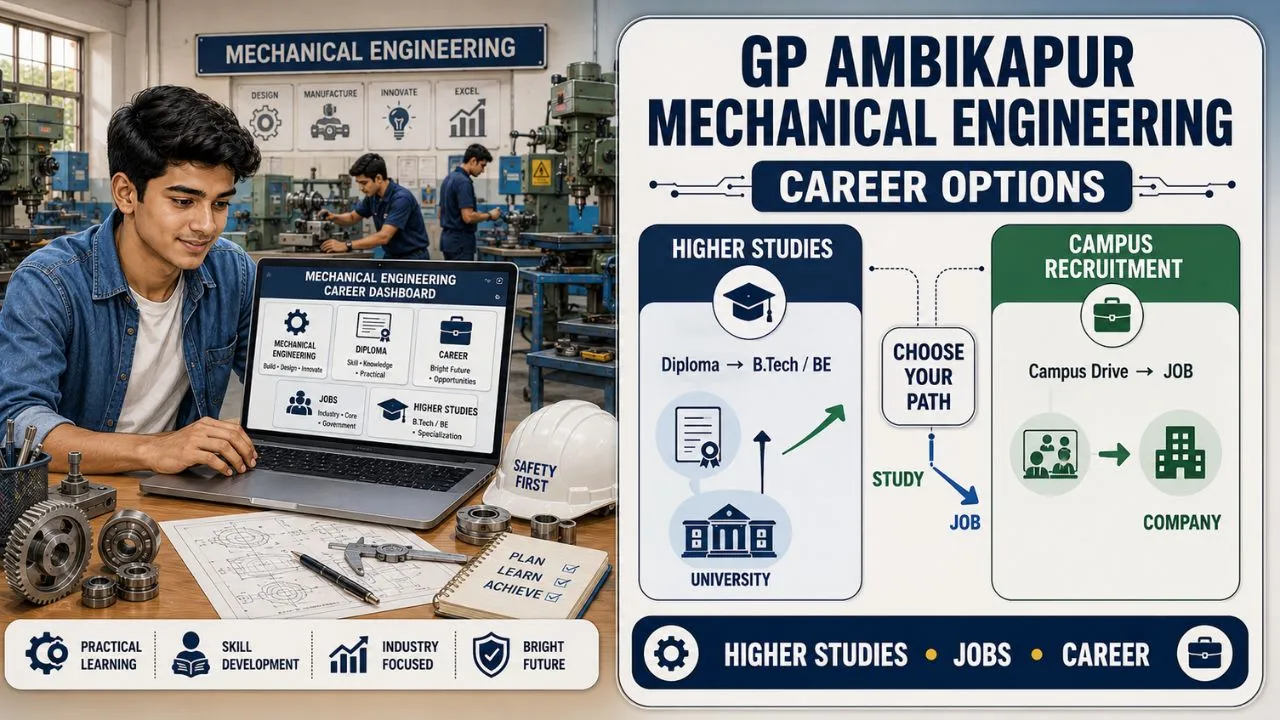
A Diploma in Mechanical Engineering can lead to several career paths after three years of technical education. For students at Government Polytechnic Ambikapur, the decision after graduation often comes down to two practical choices: start working or continue studying. Neither route is automatically better. A student who wants early work experience may prefer campus recruitment, apprenticeships or private-sector jobs. Someone aiming for broader engineering roles may choose higher studies and eventually complete a B.Tech degree.
The right decision depends on finances, academic performance, interest in mechanical engineering, family responsibilities and long-term career plans. For GP Ambikapur students, there is also a third approach worth considering: gaining work experience first and pursuing higher education later.
Table of Contents
Mechanical Engineering Diploma at GP Ambikapur
Mechanical Engineering is one of the established diploma disciplines at Government Polytechnic Ambikapur. The course introduces students to machines, manufacturing processes, engineering drawing, thermodynamics, workshop practices, materials and maintenance.
Practical learning is an important part of the programme. Students work with machines, tools, measurements and workshop equipment rather than relying entirely on classroom theory. The training can provide a foundation for careers in manufacturing, automobile, maintenance, production, construction, power and other industrial sectors.
Mechanical engineering is also a broad field. A diploma holder does not have to restrict the job search to companies carrying the word “mechanical” in their name. Manufacturing plants, workshops, infrastructure companies, power projects and industrial service providers can all require technically trained personnel.
What Can You Do After the Diploma?
After completing the diploma, a student generally has four broad options. The first is to enter employment through campus recruitment or direct applications. The second is an apprenticeship, which provides structured workplace training and can help build practical experience.
The third is government recruitment for eligible technical positions. The fourth is higher education, particularly lateral entry into an engineering degree where the applicable admission rules permit it. These choices can also be combined.
For example, a student may complete an apprenticeship after the diploma, gain experience and later pursue B.Tech through lateral entry. That route can take longer than immediately entering a degree programme, but it gives the student both workplace exposure and a higher qualification.
Campus Recruitment After Mechanical Diploma
Campus recruitment is attractive because it can provide a relatively direct transition from college to employment. Recruiters may look for diploma holders for positions related to production, maintenance, quality control, technical support, operations and supervision.
The exact job titles depend on the company. A fresher may encounter roles such as Junior Technician, Production Trainee, Maintenance Trainee, Quality Technician or Technical Assistant.
A diploma holder can also find work through off-campus recruitment, apprenticeships and industrial contractors. The starting salary varies widely between employers.
Location, company size, technical skills, job responsibilities and previous training can all influence the package. A student should therefore compare the complete offer rather than choosing a company solely because it advertises a particular salary. Working conditions, shift timings, accommodation, travel, overtime rules and opportunities for progression can matter just as much.
What Employers Look for in Mechanical Diploma Holders
A diploma certificate establishes academic eligibility, but employers also look at practical ability. Mechanical students should be comfortable with engineering drawing, basic manufacturing processes, workshop practices and measurement techniques.
Knowledge of computer-aided design can also be useful. CAD skills are particularly relevant in design, drafting and manufacturing-related positions.
Students interested in production should understand basic quality concepts, machining processes and industrial safety. Those targeting maintenance roles can strengthen their knowledge of machines, bearings, pumps, motors and preventive maintenance.
Communication skills also matter. A technician or junior engineer may need to explain a machine problem, prepare a report or coordinate with operators and supervisors. Industrial training can make these skills easier to develop because students see how technical knowledge is applied outside the classroom.
Apprenticeship as a Middle Path
Students who are not ready to commit to a permanent job can consider apprenticeship training. An apprenticeship provides structured workplace exposure and allows diploma holders to understand industrial operations in a practical environment.
For a Mechanical Engineering graduate, relevant opportunities can arise in manufacturing plants, automobile companies, power organisations, engineering workshops and public-sector organisations. Apprenticeships are generally training engagements rather than guaranteed permanent appointments.
That distinction is important. Completing an apprenticeship does not automatically mean that the trainee will receive a permanent position in the same organisation. Its value lies in the experience, technical exposure and workplace understanding gained during the training period. For a fresher, that experience can strengthen future job applications.
Government Job Opportunities
Mechanical diploma holders can also explore government and public-sector recruitment. Depending on the recruitment notification, diploma holders may find technical opportunities in organisations connected with railways, public works, defence production, electricity, manufacturing and other engineering operations.
Posts and eligibility vary significantly. Some positions require a specific diploma discipline, while others may ask for additional experience, certificates or other qualifications. Candidates should always read the current recruitment notification before assuming that a particular post is open to Mechanical diploma holders.
Government recruitment can be attractive because of structured pay scales, allowances and career progression. The selection process can also be competitive. Preparation may involve technical subjects, mathematics, reasoning, general awareness or other sections depending on the examination.
Higher Studies After Mechanical Diploma
A diploma does not have to be the final qualification. One of the major advantages of completing a polytechnic diploma is the possibility of pursuing an engineering degree through lateral entry. Eligible diploma holders can apply for direct admission to the appropriate stage of B.Tech or B.E. programmes under the applicable state or university rules.
The exact admission process differs between states and institutions. Some authorities conduct entrance examinations, while others use merit-based admission or another selection process. Students should check the rules applicable to the year in which they plan to apply. A B.Tech degree can expand eligibility for engineering positions that specifically require a bachelor’s degree. It can also make postgraduate study possible later.
Why Choose B.Tech After Mechanical Diploma?
The biggest advantage of higher education is academic depth. A diploma provides practical technical training, while an engineering degree generally covers engineering concepts in greater depth. During B.Tech, students can study subjects involving advanced manufacturing, machine design, thermal engineering, automation, materials, industrial engineering and other specialised areas.
The degree can also open opportunities beyond technician-level positions. Depending on skills and specialisation, graduates may pursue roles in design, production engineering, quality, project management, operations or other engineering functions. Higher education can be particularly useful for someone who already knows that long-term career growth in engineering is the goal.
Campus Recruitment vs. Higher Studies
The choice becomes easier when the two routes are compared based on personal priorities. Campus recruitment makes more sense for a student who wants to start earning quickly. It can also provide valuable experience that cannot be gained through classroom learning alone.
Higher studies are more suitable for someone who wants to spend additional time building technical knowledge and qualifying for degree-level positions. Financial circumstances also matter. A job provides an income sooner, while B.Tech involves additional tuition, living and other education expenses.
At the same time, a student should not choose immediate employment solely because it provides short-term income. If the long-term goal requires an engineering degree, delaying higher education for too long can make returning to studies more difficult.
When Campus Recruitment Makes More Sense
Campus recruitment can be a practical choice when the student receives a genuine technical role with reasonable learning opportunities. It can be especially useful when the family needs an early income or when the student wants to understand industrial work before deciding on further education. A good first job can teach much more than technical processes.
Students learn how production targets are handled, how maintenance teams work, how quality checks are performed and how workplace responsibilities are managed. That experience can become valuable later if the student moves to another company or pursues higher studies.
When Higher Studies Are the Better Choice
B.Tech can be the stronger option for students who want broader engineering opportunities. It is worth considering when the student has a clear interest in design, engineering development, technical management or specialised engineering fields.
A degree can also be useful for candidates who want to pursue M.Tech, MBA or other postgraduate programmes later. Students interested in research or advanced engineering work may also benefit from continuing their education. However, a degree alone does not guarantee a high-paying job.
Projects, internships, software skills, technical knowledge and communication ability continue to influence employment prospects.
Skills Mechanical Students Should Build
Regardless of the route chosen, technical skills can improve career prospects. Mechanical diploma students can benefit from learning CAD software and improving their understanding of engineering drawings.
Knowledge of CNC machines, manufacturing processes, quality control and industrial automation can also be useful. Students interested in design can explore 3D modelling and computer-aided engineering tools.
Those targeting manufacturing should understand production planning and basic quality systems. An internship or apprenticeship can complement these skills with workplace experience.
Students should also maintain a project portfolio wherever possible. A practical project involving machine design, automation, fabrication or manufacturing can give employers something concrete to discuss during an interview.
A Practical Route for GP Ambikapur Students
There is no requirement to treat employment and higher education as completely separate choices. A student can complete the Mechanical Engineering diploma, take an apprenticeship or entry-level job, gain practical experience and then pursue B.Tech through lateral entry.
Another student may directly enter B.Tech after completing the diploma. A third student may decide to work permanently after the diploma and build a career through experience and additional technical certifications.
Each route has different time and financial requirements. The most sensible decision depends on what the student wants from the next three to five years.
Final Words
A Mechanical Engineering diploma from Government Polytechnic Ambikapur can serve as the starting point for both employment and higher education. Campus recruitment offers an opportunity to enter the workforce earlier, gain industrial experience and start earning after the diploma. Higher studies through lateral entry can take the student towards a B.Tech degree and potentially broader engineering roles. Neither route guarantees a particular salary or career position. The stronger choice is the one that matches the student’s financial situation, learning preferences and long-term goals.
For those who want immediate work, a relevant technical job or apprenticeship can provide a useful beginning. For those aiming for degree-level engineering careers, lateral entry into B.Tech may be worth prioritising. Mechanical Engineering remains a broad field, and students who combine their diploma with practical experience, relevant software skills and continuous learning can keep several career paths open.