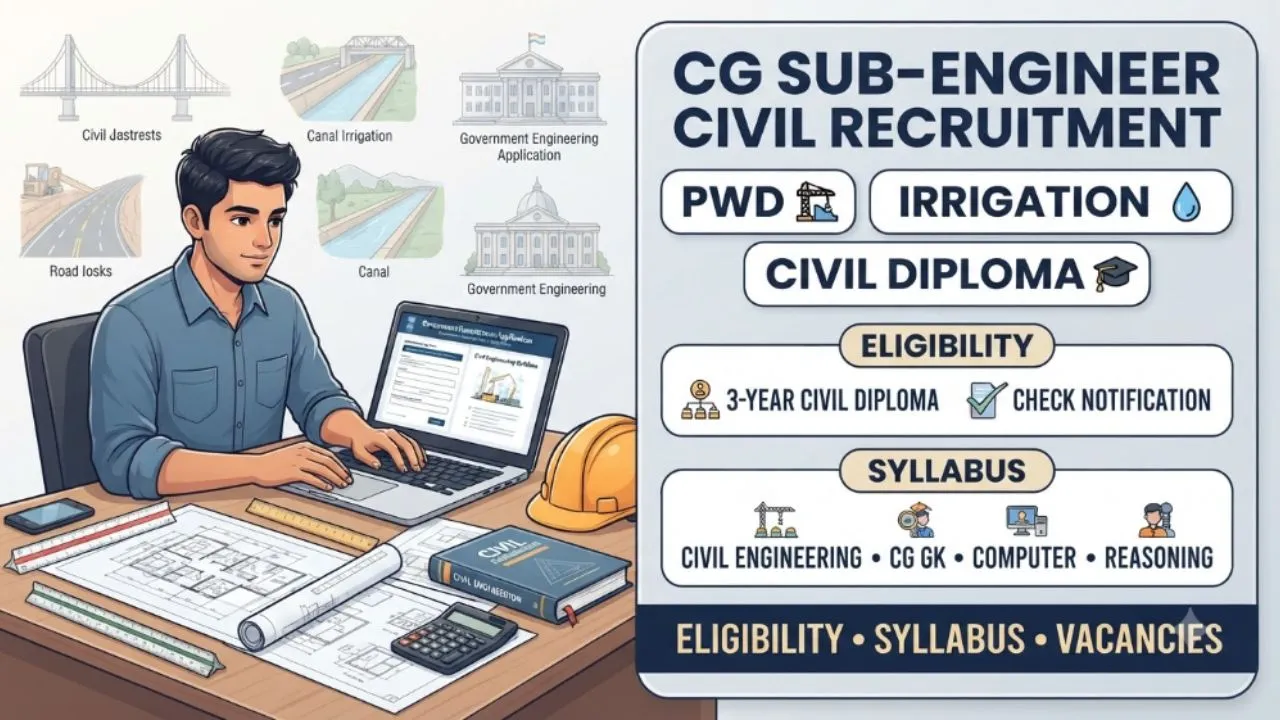
Civil diploma holders in Chhattisgarh have several government career options in departments involved in construction, roads, buildings, water resources and public infrastructure. Among these, Sub-Engineer positions are particularly relevant for candidates with a Diploma in Civil Engineering.
The Chhattisgarh Public Works Department (PWD) and the Water Resources or Irrigation Department regularly require technical staff for field-level engineering work. Recruitment, however, depends on vacancies notified by the concerned authority and the applicable recruitment rules.
For diploma holders, these jobs can offer a combination of technical work, government service benefits and opportunities to build experience in major infrastructure projects. The exact eligibility, age limit, syllabus and selection process can differ from one recruitment notification to another.
Table of Contents
What Does a Sub-Engineer Do?
A Sub-Engineer works at the field and supervisory level on engineering projects. In departments such as PWD and Irrigation, the work is closely connected with construction, measurements, quality checks and project monitoring.
A Civil Engineering Sub-Engineer may be involved in:
- Inspecting construction work
- Taking measurements at project sites
- Preparing measurement records
- Checking materials and workmanship
- Assisting engineers with estimates
- Supervising contractors
- Monitoring project progress
- Checking drawings and technical specifications
- Maintaining site-related records
- Reporting project issues to senior officers
The job is not limited to office work. Field visits can form a significant part of the role, particularly when the department is handling roads, bridges, government buildings, canals, dams or other infrastructure projects.
Eligibility for Civil Diploma Holders
A Diploma in Civil Engineering is generally the key educational qualification for Sub-Engineer recruitment in civil-related government departments.
The exact qualification should always be checked against the recruitment notification because some posts may specify a particular diploma, institution recognition or other technical requirement.
For a typical Civil Sub-Engineer position, candidates may need:
- A Diploma in Civil Engineering from a recognized institution
- Required educational qualification before the application deadline
- Chhattisgarh domicile, where the recruitment rules require it
- Compliance with the prescribed age limit
- Required documents for educational and category verification
Candidates with a B.E. or B.Tech in Civil Engineering may also be eligible for some technical government posts, but eligibility depends on the specific advertisement.
A diploma holder should not assume that every Sub-Engineer vacancy accepts the same qualification. The post-specific notification remains the final authority.
Age Limit and Relaxation
Government recruitment generally specifies a minimum and maximum age for applicants. The permitted age range can change depending on the department, recruitment year and applicable government rules.
Reserved categories may receive age relaxation according to the rules applicable to the recruitment.
Other categories, including government employees or candidates belonging to specific groups, may also receive relaxation when provided under the recruitment rules.
Because these conditions can change, applicants should check the age calculation date mentioned in the notification rather than relying on an older recruitment advertisement.
CG PWD Sub-Engineer Recruitment
The Chhattisgarh Public Works Department handles a wide range of public infrastructure projects. Its responsibilities can include roads, bridges, government buildings and other civil construction work.
A Sub-Engineer working in PWD may spend considerable time at construction sites. The position requires an understanding of civil engineering fundamentals as well as the ability to maintain accurate technical records.
Typical responsibilities can involve site measurements, quality inspection, contractor coordination and checking whether work is progressing according to approved specifications.
The actual duties depend on the division and project to which the employee is assigned.
Irrigation and Water Resources Department Jobs
The Irrigation or Water Resources Department provides another important career route for Civil Engineering diploma holders.
Projects in this sector can include canals, irrigation structures, water distribution systems, dams and related civil works.
Sub-Engineers may be involved in:
- Canal construction and maintenance
- Measurement of civil works
- Inspection of structures
- Field surveys
- Checking construction materials
- Monitoring contractors
- Maintaining project records
- Assisting with estimates and technical reports
The nature of the work can be more field-oriented than some conventional office-based government positions.
CG Sub-Engineer Syllabus
The syllabus for a Civil Sub-Engineer recruitment exam normally combines technical Civil Engineering subjects with general sections. The exact pattern varies according to the recruiting authority.
For diploma-level recruitment, the technical portion generally covers concepts studied during the Civil Engineering diploma.
Engineering Mechanics
Important areas can include force systems, equilibrium, friction, moments, simple machines and basic mechanics.
These concepts are useful for understanding how structures and engineering components behave under different forces.
Building Materials and Construction
This section can cover materials such as cement, concrete, bricks, timber and steel.
Questions may also involve construction methods, foundations, masonry, flooring, roofing and other building components.
Surveying
Surveying is an important subject for Civil Sub-Engineer examinations.
Preparation should include:
- Chain surveying
- Compass surveying
- Levelling
- Theodolite
- Contour surveying
- Area and volume calculations
- Surveying instruments
- Basic modern surveying techniques
Candidates should pay attention to numerical problems because surveying questions often test practical application.
Strength of Materials
This subject deals with the behaviour of materials under different types of loads.
Important topics include stress, strain, bending, shear force, bending moment and basic structural calculations.
Structural Engineering
Preparation can include basic concepts related to reinforced concrete, steel structures and structural members.
Candidates should understand the principles rather than relying only on memorising formulas.
Concrete Technology
Concrete-related questions may cover ingredients, mix design, workability, curing, testing, strength and common construction practices.
Knowledge of cement and concrete testing is particularly useful for technical field positions.
Soil Mechanics and Foundation Engineering
Important topics include soil properties, classification, permeability, compaction, consolidation, shear strength and foundation basics.
Questions can also involve shallow foundations and bearing capacity.
Fluid Mechanics and Hydraulics
This area becomes especially relevant for candidates targeting Irrigation Department positions.
Topics may include fluid properties, pressure, flow measurement, pipes, open channels and basic hydraulic principles.
Irrigation Engineering
Candidates preparing for Water Resources Department recruitment should give particular attention to irrigation engineering.
Important areas can include:
- Irrigation methods
- Canal systems
- Canal structures
- Water requirements
- Dams
- Weirs
- Barrages
- Drainage
- Irrigation efficiencies
Environmental Engineering
Basic concepts of water supply, wastewater treatment, sanitation, solid waste management and environmental pollution can also appear in technical examinations.
Estimation, Costing and Valuation
This is an important area for a Sub-Engineer role because government civil works require proper measurement and cost estimation.
Topics may include quantity estimation, rate analysis, construction costs, valuation and basic tender-related concepts.
Transportation Engineering
Candidates should prepare topics related to roads, highways, pavement materials, traffic basics, road construction and maintenance.
Bridge-related fundamentals may also be relevant depending on the examination syllabus.
General Knowledge and Chhattisgarh Topics
Technical subjects are usually the most important part for Civil diploma holders, but general sections should not be ignored.
Depending on the recruitment examination, candidates may encounter questions related to:
- Indian history
- Indian geography
- Indian polity
- General science
- Current affairs
- Basic mathematics
- Reasoning
- General Hindi
- Chhattisgarh history
- Chhattisgarh geography
- State government schemes
- Chhattisgarh economy and culture
State-specific knowledge can be particularly useful in Chhattisgarh government recruitment examinations.
Selection Process
The selection process depends on the department and recruitment authority. A written examination is commonly used for technical recruitment, but the complete process may include additional stages.
A recruitment process can involve:
- Online application
- Written examination
- Merit preparation
- Document verification
- Medical or other required formalities
- Final appointment
Not every recruitment follows exactly the same sequence.
Some vacancies may be filled through direct recruitment, while others can be conducted through a state-level recruitment authority.
Candidates should therefore prepare according to the specific notification rather than assuming that every Sub-Engineer examination follows the same pattern.
Salary of a CG Sub-Engineer
The salary of a government Sub-Engineer depends on the applicable pay level, department and recruitment rules.
The overall compensation can include basic pay along with allowances permitted under government regulations.
Possible benefits can include:
- Dearness allowance
- House rent allowance where applicable
- Travel-related allowances
- Other government-approved benefits
The actual in-hand salary depends on the posting location, deductions, allowances and current government rules.
Older salary figures should not be treated as the confirmed salary for a new recruitment cycle.
How to Prepare for CG Sub-Engineer Recruitment
A Civil diploma holder should begin preparation with the technical syllabus because it usually forms the core of the examination.
Start by revising diploma-level concepts from subjects such as Surveying, Building Construction, Strength of Materials, RCC, Soil Mechanics, Fluid Mechanics, Transportation Engineering and Estimation.
After revising the basics, solve numerical questions regularly.
Previous recruitment papers can help identify repeated concepts and the expected difficulty level. Mock tests are also useful for improving speed and reducing mistakes.
A practical preparation routine can look like this:
First: Complete the Civil Engineering syllabus topic by topic.
Next: Solve objective questions after every chapter.
Then: Practice previous-year papers and identify weak subjects.
After that: Add Chhattisgarh general knowledge and current affairs to the daily schedule.
Finally: Take full-length mock tests under examination conditions.
Do not spend the entire preparation period reading theory. Sub-Engineer examinations generally require both conceptual understanding and the ability to solve questions within a limited time.
Government Job or Private Civil Job?
A Sub-Engineer position can be attractive for candidates who prefer government employment and field-based technical work.
Private construction companies can provide faster exposure to projects and sometimes offer opportunities for quicker career movement. Government service, on the other hand, can provide a structured career path and benefits governed by applicable service rules.
The better option depends on individual priorities.
For a diploma holder who wants to build a career in public infrastructure, preparing for PWD, Water Resources and other technical government vacancies can be a sensible route.
Career Growth After Sub-Engineer
A Sub-Engineer position can provide valuable experience in construction supervision, measurements, estimation and project execution.
With experience and according to departmental service rules, employees may have opportunities for promotion to higher technical or supervisory positions.
A diploma holder can also continue education while working. Depending on eligibility and institutional rules, a Civil diploma can be followed by B.Tech through lateral entry.
This can expand eligibility for engineering-level positions that specifically require a degree.
Final Words
CG PWD and Irrigation Department Sub-Engineer positions are relevant government career options for Civil Engineering diploma holders in Chhattisgarh. The work combines technical knowledge with field responsibilities, making a strong understanding of Civil Engineering fundamentals essential. Candidates preparing for these vacancies should focus on diploma-level technical subjects, especially Surveying, Construction, Strength of Materials, Soil Mechanics, RCC, Estimation, Transportation and Irrigation Engineering.
At the same time, Chhattisgarh general knowledge, reasoning, mathematics and current affairs should be included wherever the recruitment syllabus requires them. Most importantly, do not rely on an old vacancy advertisement for eligibility, salary or examination details. Recruitment rules can change from one notification to another. Check the latest official notification when a vacancy is announced and prepare according to the syllabus specified for that particular recruitment.