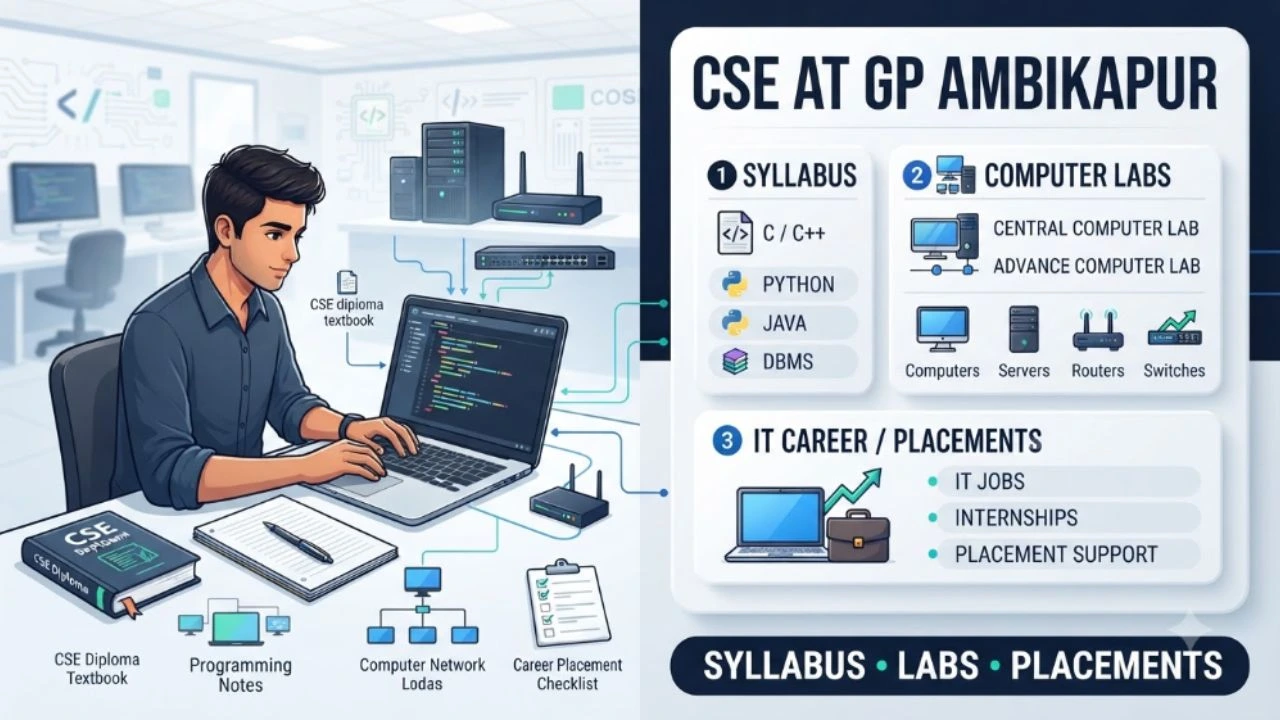
Computer Science and Engineering has become a popular diploma choice for students who want to enter the technology field after Class 10. At Government Polytechnic Ambikapur, the CSE programme combines programming fundamentals with computer hardware, networking, databases and practical training.
Government Polytechnic Ambikapur is a government technical institution located in Ambikapur, Chhattisgarh. The institute offers a three-year Diploma in Computer Science and Engineering for students interested in software, computer systems, networking and other technology-related fields.
For students considering CSE after Class 10, the important questions are not limited to admission. The syllabus, practical exposure, laboratory facilities and career opportunities also deserve attention.
Table of Contents
CSE Diploma at Government Polytechnic Ambikapur
The Diploma in Computer Science and Engineering is designed for students who want technical education without immediately entering a four-year engineering degree.
The programme generally runs for three years. During this period, students study computer-related subjects along with mathematics, science, communication and other foundation subjects included in diploma engineering education.
CSE can be a suitable option for students who enjoy working with computers and want to understand how software, hardware and networks function.
A diploma does not necessarily have to be the final stage of education. After completing the course, eligible students can explore lateral-entry B.Tech programmes, employment opportunities and other higher-study options.
CSE Syllabus at GP Ambikapur
The CSE syllabus is not limited to programming. A diploma student needs to understand several areas of computing, including software, hardware, databases and networking.
The exact subject structure can vary according to the curriculum and academic session. However, students can expect to study several core areas of computer science.
Programming Fundamentals
Programming is one of the most important parts of a CSE diploma. Students learn programming logic, variables, operators, conditional statements, loops, functions and basic data structures. The objective is to understand how a problem can be broken down and converted into a working program.
Programming becomes much more useful when students write and test their own programs instead of only preparing theoretical answers for examinations.
Data Structures and Algorithms
As programming knowledge develops, students are introduced to data structures and algorithms.
These concepts explain how information can be stored, organised and processed efficiently. Arrays, stacks, queues, searching and sorting are examples of topics commonly associated with this area.
This foundation can help students who later want to pursue software development or advanced computer studies.
Database Management
Modern software depends heavily on databases. Students learn how information is stored, organised and retrieved through database systems. Database concepts, tables, relationships and SQL-based operations can form an important part of practical learning.
This knowledge is useful for entry-level roles involving software applications, technical support and web-based systems.
Computer Networks
Networking helps students understand how computers communicate with one another. Topics can include network architecture, communication methods, networking devices, protocols and internet technologies.
Practical networking knowledge can be useful for students interested in technical support, network operations and IT infrastructure.
Operating Systems
Operating systems manage computer hardware and software resources.
Students learn concepts related to processes, memory management, file systems and system operations. This subject provides a better understanding of what happens inside a computer beyond the applications users interact with daily.
Web and Application Technologies
Depending on the curriculum followed during the academic session, students may also work with web technologies and application development.
HTML, CSS, scripting and basic web programming can help students create simple websites and applications. The practical value of these subjects increases when students work on independent projects rather than limiting their preparation to classroom assignments.
Practical Training and Computer Labs
For a computer science diploma, laboratory work is an important part of technical education.
Government Polytechnic Ambikapur has a dedicated Computer Science department and laboratory facilities for technical education. The institute also has classrooms, workshops, a library and other academic facilities. CSE laboratory sessions can involve programming exercises, database tasks, networking practice, operating-system exercises and software development projects.
A student can gain much more from these sessions by experimenting with different approaches, identifying errors and improving projects independently. For example, a basic programming assignment can become a useful learning experience when the student modifies the program, fixes errors and adds new features.
Campus Infrastructure for CSE Students
Government Polytechnic Ambikapur has an established campus with laboratories, workshops, classrooms, library facilities and other student amenities. The institute has multiple engineering departments, including Civil Engineering, Computer Science, Electrical Engineering, Electronics and Telecommunication, Mechanical Engineering and Mining Engineering.
This creates a broader technical environment where students can understand how computer technology connects with other engineering fields. For CSE students, access to computer laboratories and technical learning facilities is particularly important. Regular practical work can help bridge the gap between classroom concepts and workplace requirements.
What Skills Can CSE Students Build?
The value of a diploma depends considerably on the skills developed during those three years.
A CSE student can work towards building skills in:
- Programming and problem solving
- Database management
- Computer hardware basics
- Networking
- Web development
- Operating systems
- Software installation and troubleshooting
- Technical documentation
- Technical communication
- Project development
Students interested in IT careers can also learn additional tools outside the regular curriculum. A diploma provides the foundation, but personal projects, internships, certifications and independent practice can help turn that foundation into practical skills.
IT Placement Opportunities After CSE
Placement is an important consideration when choosing a computer science diploma.
A specific salary package or guaranteed IT job should not be assumed simply because a student completes CSE. Recruitment depends on the employer, candidate’s skills, available vacancies and placement opportunities during the graduating year.
For a diploma CSE graduate, possible entry-level roles include:
IT Support Technician
IT support technicians help users resolve basic software, hardware and connectivity problems.
Technical Support Executive
Technical support professionals handle technical queries, troubleshoot applications and assist customers or internal teams.
Junior Web Developer
Students with good programming and web development skills can apply for entry-level web development positions.
Computer Operator
Computer operators manage computer-based tasks, records and software systems within an organisation.
Network Support Technician
Network support roles involve assisting with network installation, configuration and basic troubleshooting.
Software Support Associate
Software support professionals help users with applications, identify technical issues and assist with resolving problems. The actual job profile depends on the candidate’s skills and the requirements of the recruiting organisation.
How to Improve IT Placement Chances
Completing the diploma is only one part of preparing for an IT career. CSE students can improve their employment prospects by building a portfolio during the course. A useful portfolio could include a simple website, database project, small application, networking project or another technical project related to the student’s interests.
Programming practice is equally important. Students interested in software development should strengthen their knowledge of programming languages and tools relevant to the jobs they want. Communication skills also matter during recruitment. Candidates may be asked to explain their projects, describe how a program works or discuss how they solved a technical problem. Practical knowledge combined with the ability to explain that knowledge clearly can make a significant difference during interviews.
CSE After Diploma: What Next?
Students do not necessarily have to start working immediately after completing the diploma. One option is lateral entry into a B.Tech programme, subject to the eligibility and admission rules applicable to the relevant institution and state. This route allows eligible diploma holders to enter an engineering degree programme at an advanced stage rather than beginning from the first year.
Another option is employment followed by higher education. Some students prefer gaining work experience before continuing their studies. Additional certifications in areas such as networking, databases, cloud computing, cybersecurity or programming can also complement a diploma. The choice depends on the student’s academic plans, financial situation and career goals.
Is CSE at GP Ambikapur a Good Choice?
CSE at Government Polytechnic Ambikapur can be considered by students looking for a government polytechnic environment and an interest in computers and technology. The institute has an established technical campus with laboratories, workshops, classrooms and library facilities. Its CSE programme provides a foundation in computer-related subjects while giving students opportunities for practical learning.
The decision should still go beyond the branch name. Before taking admission, check the latest admission notification, current curriculum, department facilities, available seats, fees and placement information for the relevant academic year. Students should also consider whether they genuinely enjoy programming and computer-based problem solving. CSE involves regular practice and continuous learning as technology changes.
Final Words
Computer Science and Engineering at Government Polytechnic Ambikapur provides a three-year diploma route for students interested in programming, databases, networking and computer technology. The course can help students build technical foundations through classroom study and practical work. After completing the diploma, graduates can consider entry-level technical jobs, lateral-entry B.Tech programmes, certifications or other higher-study options.
For IT placements, expectations should remain realistic. A diploma does not guarantee employment or a particular salary package. Skills, practical experience, communication ability and the availability of suitable recruitment opportunities all influence career outcomes. For students who want to enter the technology field after Class 10, CSE can be a useful starting point. The strongest career prospects usually come when classroom learning is supported by projects, programming practice, internships and continued technical education.