Cybersecurity has moved far beyond the traditional idea of protecting computers with passwords and antivirus software. Colleges and technical institutes now need to prepare students for threats involving data theft, phishing, malware, identity misuse, network attacks and digital fraud.
For diploma students studying Computer Science and related technical subjects, exposure to cybersecurity can provide a useful understanding of how digital systems are protected and investigated.At Government Polytechnic Ambikapur, workshops, seminars and technical activities connected with computing can give students an opportunity to explore areas beyond their regular syllabus. Topics such as digital forensics, cyber safety, network security and cyber resilience are particularly relevant as more services move online.
Digital forensics and cyber resilience are related, but they address different parts of cybersecurity. Digital forensics focuses on investigating digital evidence after an incident, while cyber resilience is concerned with keeping systems operational and recovering effectively when an attack or disruption occurs. Understanding both areas can help CSE students develop a broader view of modern information technology.
Table of Contents
Why Cybersecurity Matters for Polytechnic Students
Computer Science students are expected to understand how software, networks and digital systems work. Security adds another layer to that knowledge. A system can function correctly and still remain vulnerable if access controls, passwords, software updates and network configurations are poorly managed.
Cybersecurity training introduces students to the ways such weaknesses can be identified and reduced. For a diploma student, this exposure can be useful even without plans to become a full-time cybersecurity professional.
A software developer needs to understand secure coding. A network technician needs to know how unauthorised access can occur. A database professional needs to understand data protection. A system administrator needs to recognise suspicious activity and respond appropriately. Cybersecurity therefore connects with several areas of computer technology.
What Is Digital Forensics?
Digital forensics is the process of examining digital information to understand what happened during a suspected security incident. The evidence can come from computers, mobile devices, storage media, networks, servers and other digital systems.
The work is not simply about opening deleted files or searching through a computer. Investigators need to preserve evidence carefully and maintain its integrity. They may examine file metadata, system logs, browser activity, network records and other information to establish a timeline. The objective is to answer questions such as what happened, when it happened and which systems or accounts were involved. Students introduced to digital forensics can therefore learn how technical investigation differs from ordinary computer troubleshooting.
Important Topics in Digital Forensics Workshops
A well-designed workshop can introduce students to several basic concepts. One important area is evidence preservation. Digital information can be changed or destroyed easily, so investigators need controlled methods for collecting and analysing evidence.
Another topic is disk and file-system analysis. Students can learn how information is organised on storage devices and how forensic investigators examine relevant artefacts.
Log analysis is also useful. Servers, operating systems and applications can generate records that help investigators understand unusual activity.
Network forensics introduces another perspective. Instead of examining one computer, investigators may analyse network traffic and related records to identify suspicious connections or unusual communication patterns.
Mobile forensics can also be discussed, particularly because smartphones now contain large amounts of personal and professional information. A seminar does not need to turn students into forensic investigators immediately. The main value is understanding how digital evidence is handled and why proper procedures matter.
Understanding Cyber Resilience
Cyber resilience is slightly broader than cybersecurity prevention. Security controls attempt to reduce the likelihood of an attack. Resilience focuses on the organisation’s ability to continue operating, respond to an incident and recover afterwards.
Consider a college network affected by ransomware. Preventive security could help block the attack. Resilience planning determines what happens if those controls fail.
Are backups available? Can critical services be restored? Who is responsible for responding?
How quickly can affected systems be isolated? How will students and staff be informed?
These questions form part of cyber resilience. For CSE students, understanding this approach provides a more realistic picture of cybersecurity. No security system can promise that an organisation will never experience an incident. Good preparation reduces the damage and improves recovery.
CSE Department Workshops and Practical Learning
Technical workshops are most useful when students can connect theory with practical demonstrations. A cybersecurity seminar can introduce a concept in the classroom and then demonstrate how it appears in a controlled laboratory environment.
For example, an instructor can demonstrate how system logs record activity. Students can then examine sample logs and identify unusual events. Similarly, a workshop on phishing can explain how fraudulent messages are structured and how users can identify suspicious links.
A network-security session can introduce concepts such as authentication, firewalls, access controls and network monitoring. These activities make cybersecurity easier to understand than learning definitions alone. Practical exposure also encourages students to ask questions that may not arise during routine classroom lessons.
Cybersecurity Tools and Laboratory Exposure
Students do not necessarily need expensive commercial systems to understand the fundamentals of cybersecurity. A controlled laboratory environment can be created using computers, virtual machines and open-source tools.
Students can learn basic network analysis, system monitoring, file examination and log analysis in a safe environment. Virtual machines are particularly useful because they allow different operating systems and testing environments to run without affecting the main computer.
The focus should remain on authorised practice. Cybersecurity education must be conducted using systems where students have explicit permission to test and analyse.
That principle is important from the beginning. Learning how a vulnerability works is valuable, but attempting to exploit somebody else’s system without permission is not legitimate cybersecurity practice.
Industry Exposure and Guest Sessions
Industry interaction can add another dimension to cybersecurity education. A professional working in security operations, networking, software development or digital investigation can explain how the field operates outside college laboratories.
Students can learn about the types of incidents organisations actually handle and the skills employers expect from entry-level candidates. Guest sessions can also explain the difference between theoretical knowledge and workplace responsibilities.
For example, a professional may discuss why security teams spend significant time monitoring alerts, documenting incidents and maintaining access controls. These are areas that students may not fully appreciate from textbooks.
Industry speakers can also explain career progression and the importance of continuous learning. Cybersecurity changes quickly, so professionals need to keep developing their knowledge even after completing a diploma or degree.
Skills CSE Students Can Build
Students interested in digital forensics and cyber resilience should first develop strong computer fundamentals. Operating systems, networking and databases provide the foundation for more advanced security topics.
Basic programming knowledge is also useful. Languages such as Python can help with automation, data processing and small security-related projects.
Networking deserves particular attention. Understanding IP addresses, protocols, ports, DNS and common network services makes security concepts much easier to follow.
Students can also develop skills in Linux, command-line tools and system administration. For digital forensics, attention to detail is especially important. Investigators often work with large amounts of information and need to distinguish useful evidence from irrelevant data.
Communication skills matter as well. A technical professional may eventually need to explain an incident to management, clients or another department.
Cybersecurity Projects for Polytechnic Students
A student project can turn workshop knowledge into something practical. One project could involve building a basic log-monitoring system that identifies unusual login attempts from sample data.
Another could demonstrate password security using a controlled dataset. Students can also create a simple phishing-awareness application that teaches users how to recognise suspicious messages.
A backup and recovery project can demonstrate the principles of cyber resilience. For digital forensics, a controlled mock investigation can be developed using prepared evidence files.
The project could ask students to establish a timeline from sample logs and file metadata. Such projects are valuable because they give students something concrete to discuss during internships and job interviews. They also encourage problem-solving instead of passive learning.
Career Opportunities in Cybersecurity
Cybersecurity is not limited to one job title. Students who continue developing their skills can explore roles such as security support technician, network security technician, SOC analyst, cybersecurity analyst, system administrator and digital forensics assistant.
The exact role available to a diploma holder depends on the employer, qualification requirements and practical skills. Some positions may require a bachelor’s degree or professional certifications.
A diploma can provide the technical foundation, while further education and hands-on experience can broaden career options. Students can also move towards specialised areas such as incident response, penetration testing, cloud security, digital forensics or security operations.
Each area requires additional training. There is no single certification that guarantees a cybersecurity job. Employers generally look at a combination of education, technical knowledge, practical projects and relevant experience.
Certifications and Further Learning
After gaining basic knowledge, students can explore recognised cybersecurity certifications according to their career goals. The right certification depends on the student’s existing knowledge and intended role.
Beginners may first benefit more from understanding networking, Linux and operating systems than from immediately pursuing advanced certifications. Students interested in digital forensics can study evidence handling, file systems, incident investigation and forensic analysis.
Those interested in security operations can focus on network monitoring, logs, incident response and security tools. Cloud computing is another useful area because organisations increasingly depend on cloud-based infrastructure.
The important point is to build skills in a logical sequence. Collecting certificates without practical understanding does not create strong technical expertise.
Cyber Safety Beyond the Classroom
Cybersecurity education also has value outside professional careers. Students use online banking, social media, email, cloud storage and digital payment platforms regularly.
Understanding common cyber threats can reduce the risk of becoming a victim. Phishing remains a major concern because attackers often attempt to manipulate users rather than directly break technical security controls.
Students should learn to inspect unexpected messages, verify links, protect account credentials and use strong authentication. They should also understand why passwords should not be reused across important accounts.
Keeping software updated and maintaining reliable backups are simple measures that can make a meaningful difference. A cybersecurity seminar can therefore benefit the entire student community, not only those planning to work in IT.
How Industry Exposure Can Improve Employability
Practical exposure can make a difference when students begin looking for internships or entry-level roles. A candidate who has completed a cybersecurity workshop and can explain what was learned demonstrates more than simple attendance.
The stronger profile comes from applying that knowledge through projects, laboratory exercises and documented practical work. Students can maintain a small portfolio containing project descriptions, technical reports and demonstrations of authorised laboratory work.
GitHub or another suitable platform can be used for appropriate coding and documentation projects. For security-related work, students should never publish confidential information or real-world data obtained without permission.
A professional portfolio should demonstrate technical ability while respecting privacy and security.
Final Words
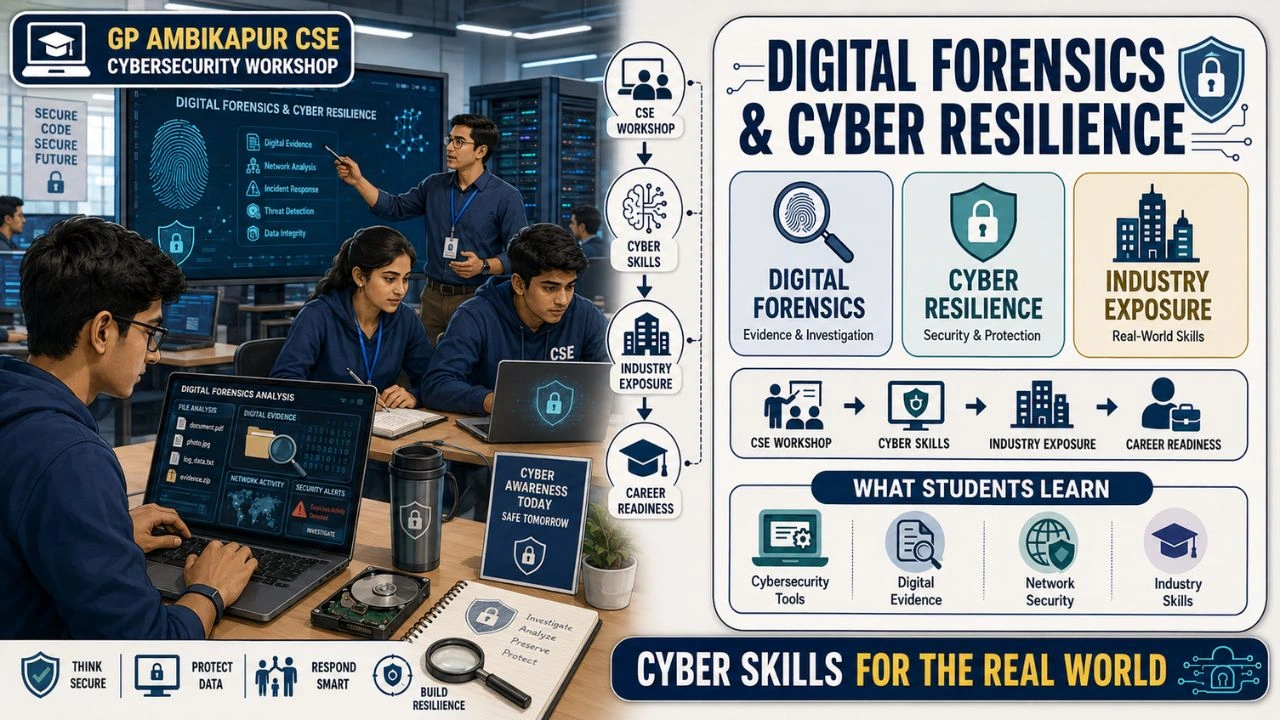
Digital forensics and cyber resilience provide useful areas of learning for Computer Science and related diploma students at Government Polytechnic Ambikapur. Workshops, seminars, laboratory activities and industry interactions can introduce students to the practical side of cybersecurity.
Digital forensics helps explain how incidents can be investigated through digital evidence. Cyber resilience focuses on preparation, response and recovery when systems are disrupted. Networking, operating systems, programming and databases should form the foundation. From there, students can explore security tools, digital investigation, incident response and related technologies through authorised laboratory environments.