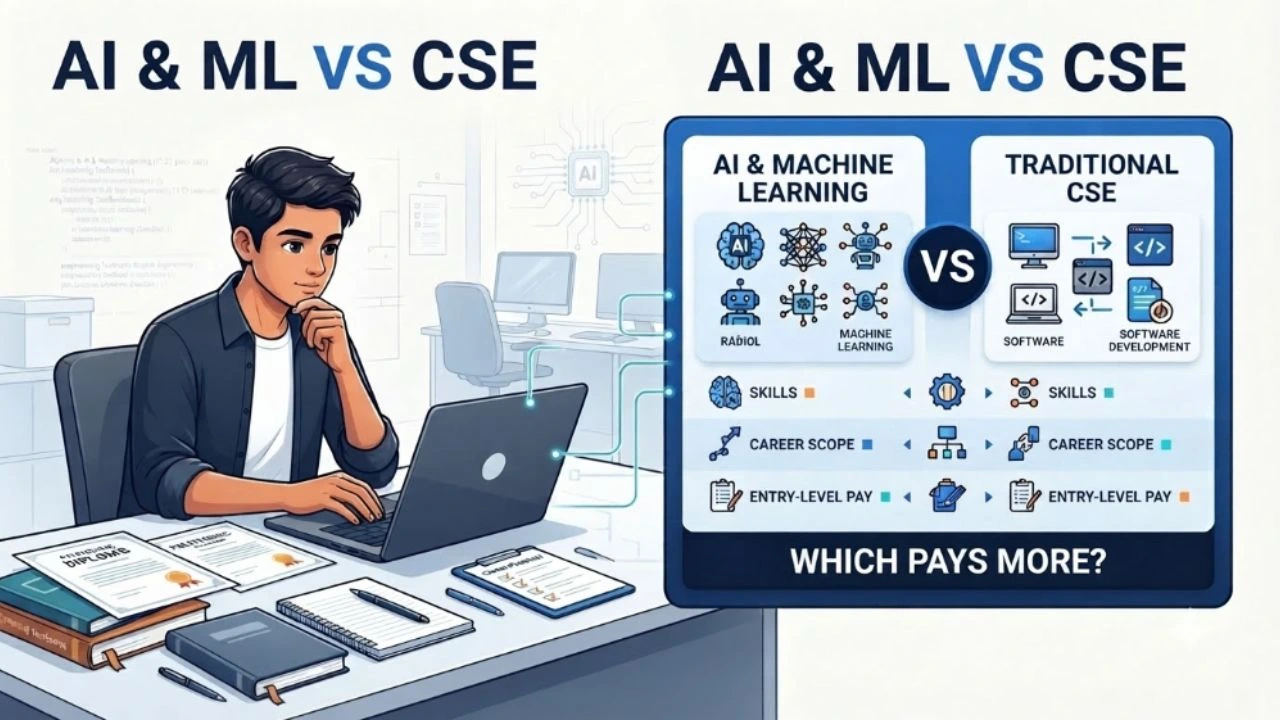
Artificial Intelligence and Machine Learning have changed the way companies build software, analyse data and automate routine work. This has also created new interest in specialised diploma courses focused on AI and ML. At the same time, Computer Science Engineering remains one of the most popular technical fields. It provides a broad foundation in programming, databases, operating systems, networking and software development.
For students planning a technical career, one question naturally comes up: Does a Diploma in AI & Machine Learning lead to a higher starting salary than traditional Computer Science Engineering? There is no universal answer. A specialised AI and ML diploma can provide useful skills for selected entry-level roles, but a CSE programme usually offers broader career options. Starting salary depends on the institute, qualification level, practical skills, projects, location, employer and role. The better choice is therefore not simply the course with “AI” in its name. The curriculum and skills gained during the programme matter much more.
Table of Contents
Diploma in AI & Machine Learning: What Does It Cover?
A Diploma in AI & Machine Learning is generally designed around the fundamentals of intelligent software systems, data handling and automation.
Depending on the institute, the syllabus may include subjects such as:
- Python programming
- Mathematics for computing
- Statistics
- Data structures
- Database management
- Machine learning fundamentals
- Data analysis
- Artificial intelligence concepts
- Neural networks
- Basic deep learning
- Computer vision
- Natural language processing
- AI-based projects
The exact syllabus can differ significantly between institutions. Some diploma programmes focus mainly on introductory programming and AI concepts, while others provide more substantial practical training.
A strong programme should not only teach AI terminology. Students need programming practice, data handling skills and project experience to become employable.
What Is Traditional Computer Science Engineering?
Computer Science Engineering provides a broader foundation in computing and software technology.
A typical CSE curriculum covers:
- Programming
- Data structures and algorithms
- Database management systems
- Computer networks
- Operating systems
- Computer architecture
- Software engineering
- Web development
- Object-oriented programming
- Cybersecurity fundamentals
- Cloud computing
- Computer science mathematics
Students may later specialise in areas such as artificial intelligence, machine learning, data science, cybersecurity, cloud computing or software development. This broad foundation is one of the biggest advantages of CSE. A graduate is not limited to one technology or one type of job.
AI & ML Diploma vs CSE: Basic Comparison
| Factor | Diploma in AI & ML | Traditional CSE |
| Programme type | Diploma | Engineering degree |
| Main focus | AI, ML and related tools | Broad computer science |
| Programming | Important | Core component |
| Mathematics | Important for ML | Important for computing |
| Specialisation | Earlier | Usually later |
| Career flexibility | Moderate to high | High |
| Entry-level roles | AI/ML support, data and software roles | Software, development, testing, IT and more |
| Higher education | Depends on eligibility | Wider postgraduate options |
| Practical exposure | Depends on institute | Depends on college and curriculum |
The comparison is not completely equal because the two programmes can differ in level, duration and admission route. That difference becomes important when employers compare candidates.
Which Course Offers Higher Entry Salaries?
In most cases, CSE offers a stronger overall starting-salary advantage, especially when the comparison involves a recognised engineering degree against a diploma qualification. The reason is not simply the subject. Employers often consider the candidate’s qualification, technical foundation, role, college, internship experience and hiring requirements.
A diploma holder with strong Python, SQL, data analysis and machine learning projects can still secure a good entry-level role. However, many software and engineering positions are structured around bachelor’s degree requirements. For this reason, the title “AI & ML” does not automatically mean a higher salary. A candidate with a specialised diploma but weak programming skills may earn less than a CSE graduate who has built practical projects and completed relevant internships.
Typical Entry-Level Salary Expectations
There is no single salary applicable to all AI, ML or CSE candidates. For diploma holders entering technical roles, starting packages can vary considerably based on the employer and location. Many entry-level opportunities may fall in the lower salary bands, particularly when the role is focused on technical support, testing, junior development or implementation.
CSE graduates can access a wider range of software and technology roles. Entry-level packages can range from modest salaries at smaller companies to significantly higher offers from established technology firms. The difference becomes clearer when the job requires a bachelor’s degree or specialised engineering knowledge.
Instead of focusing only on an advertised salary range, compare the role itself. A slightly lower first salary in a position that provides strong development experience may be more valuable than a higher-paying job with limited technical growth.
Why CSE Has a Broader Career Advantage
One of the strongest benefits of CSE is flexibility.
A CSE graduate can apply for roles in:
- Software development
- Web development
- Mobile application development
- Database administration
- Cloud computing
- Cybersecurity
- Network engineering
- DevOps
- Data analysis
- Artificial intelligence
- Machine learning
- Technical consulting
This does not mean every CSE graduate automatically qualifies for these positions. The student still needs relevant skills, projects and preparation. A CSE degree creates a broader base, but the career direction depends on what the student builds on that foundation.
Where an AI & ML Diploma Can Be Useful
A specialised diploma can be attractive for students who already know that they want to explore artificial intelligence and machine learning.
It can provide an earlier introduction to areas such as:
- Python-based data analysis
- Machine learning models
- Predictive analytics
- Computer vision
- AI applications
- Data preprocessing
- Model evaluation
For someone who prefers practical and specialised learning, this can be useful. However, AI and ML are not isolated from computer science. Programming, databases, algorithms, mathematics and software development remain important.
A student who wants to work seriously in AI should therefore build strong fundamentals alongside the specialised subjects.
Diploma vs CSE: Which Has Better Job Opportunities?
CSE generally wins when the comparison is based on the number of entry-level opportunities available. Software companies recruit for a wide range of positions, while AI and ML roles are more specialised.
A diploma holder may start with positions such as:
- Junior Developer
- Technical Support Associate
- Data Support Executive
- Software Testing Trainee
- Junior Technician
- IT Support Technician
Depending on skills and eligibility, AI-focused candidates may also target junior data or machine learning support roles. CSE graduates can compete for many of the same roles while also applying for graduate-level software engineering positions. That wider eligibility can matter when looking for the first job.
Skills Matter More Than the Course Name
A common mistake is choosing a programme because AI and Machine Learning sound more advanced. Employers still look for practical ability.
For an AI-focused career, useful skills include Python, SQL, statistics, data analysis and machine learning libraries. Students should also understand how to clean data, train models and evaluate results. For CSE students, programming, data structures, algorithms, databases and software development are particularly important.
Both groups benefit from:
- Git and version control
- Problem-solving
- Communication
- Technical documentation
- Project development
- Internship experience
A portfolio can make these skills easier for recruiters to evaluate.
Projects Can Influence the First Salary
A strong project gives an employer something concrete to discuss during an interview. An AI and ML student could develop a basic recommendation system, image classification project, sales prediction model or natural language processing application.
A CSE student could build a web application, mobile app, database project, e-commerce platform or software automation tool. The project does not need to be extremely complex. It should demonstrate that the student understands the technology and can explain how the project works.
Higher Studies After a Diploma
Students who complete a diploma may have opportunities to continue their education, depending on the rules of the institution and state. In some cases, diploma holders can pursue engineering through lateral entry into the second year of a B.Tech or equivalent programme.
This can change the long-term career picture considerably. A student could begin with a diploma, gain practical exposure and later complete an engineering degree. The exact admission route, eligibility and available branches vary by state and university.
This pathway can be useful for students who want an earlier technical start without giving up the possibility of earning an engineering degree later.
Which Option Is Better for a Quick Job?
If the primary goal is entering technical employment as early as possible, a diploma can offer that route because diploma programmes are shorter than conventional engineering degrees. However, quick entry does not necessarily mean higher entry salary.
A CSE graduate normally spends more time completing the degree but can qualify for a wider set of graduate-level positions after graduation. The choice therefore depends on what “quick job” means for the student.
If it means starting work sooner, a diploma may have an advantage. If it means gaining access to broader software roles and stronger long-term qualification value, CSE may be the better route.
Which Course Should You Choose?
Choose a Diploma in AI & Machine Learning if you:
- Want to enter technical education early
- Prefer practical learning
- Have a strong interest in AI and data
- Want to start developing specialised skills sooner
- Are comfortable continuing your education later if required
Choose CSE if you:
- Want a broad computer science foundation
- Plan to pursue software development
- Want wider career options
- Are interested in postgraduate education
- Want access to more graduate-level engineering roles
There is also a third approach worth considering. A student can pursue CSE and specialise in AI and ML through electives, certifications, projects, internships or postgraduate study. This route combines broad computer science knowledge with specialised AI skills.
Final Verdict: AI & ML Diploma or CSE?
For higher and broader entry-level career opportunities, traditional CSE generally has the stronger position, particularly when it involves a recognised engineering degree. A Diploma in AI & Machine Learning can still be valuable for students who want specialised technical exposure and an earlier entry into the field.
The important point is that AI knowledge alone does not guarantee a high salary. Programming ability, mathematics, problem-solving, projects, internships and communication skills all influence employability.
If the priority is a quick technical start after Class 10, a diploma can make sense. If the goal is broader software opportunities and stronger qualification value after Class 12, CSE is usually the safer choice. In either case, the best investment is not just the course fee. It is the practical skill set developed during those years.