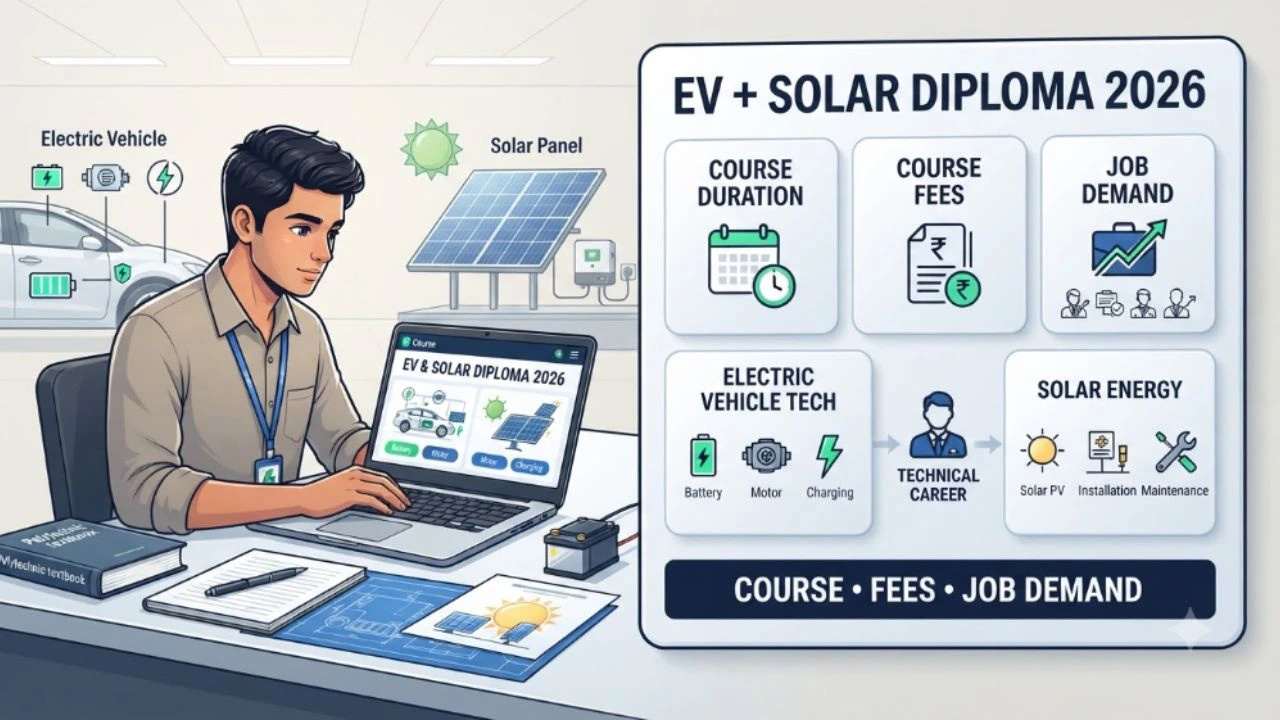
India’s shift towards electric mobility and renewable energy is creating demand for technicians with practical knowledge of batteries, charging systems, solar panels, electrical wiring and energy management. For students interested in technical work after Class 10, diploma courses in Electric Vehicle Technology and Solar Energy offer a relatively direct route into these growing fields.
These programmes combine classroom lessons with laboratory work, equipment handling and project-based training. The exact course name, eligibility, duration and fee depend on the institution and state. Some colleges offer dedicated EV or renewable-energy diplomas, while others cover these subjects through Electrical, Electronics, Automobile or related diploma programmes.
Before choosing a course, it is useful to understand what students actually learn, how much the programme can cost, what jobs are available and whether the qualification can lead to higher studies.
Table of Contents
What Is a Diploma in Electric Vehicle Technology?
A Diploma in Electric Vehicle Technology focuses on the technical systems used in electric cars, two-wheelers, buses and other battery-powered vehicles.
The curriculum may cover electric motors, battery packs, charging systems, power electronics, vehicle control systems, electrical safety and basic automobile engineering. Depending on the institute, students may also work with battery management systems, regenerative braking, diagnostic equipment and EV maintenance procedures.
The course is particularly relevant for students who enjoy mechanical and electrical work but also want to learn about newer vehicle technologies.
Common subjects can include:
- Electric vehicle fundamentals
- Battery technology
- Electric motors and controllers
- Power electronics
- Charging infrastructure
- Automotive electrical systems
- EV maintenance and diagnostics
- Basic electronics
- Workshop practices
- Electrical and workplace safety
A good programme should include practical exposure rather than relying entirely on classroom theory.
What Is a Diploma in Solar Energy?
A Solar Energy diploma focuses on the installation, operation and maintenance of solar power systems. It generally combines electrical fundamentals with renewable-energy concepts.
Students may learn how solar photovoltaic systems generate electricity, how panels are connected, how inverters work and how batteries are used for energy storage. Installation practices, electrical protection and system maintenance can also form part of the curriculum.
Common areas of study include:
- Solar photovoltaic technology
- Solar panel installation
- Solar inverters
- Battery storage systems
- Electrical wiring
- Solar system design
- Energy measurement
- Maintenance and troubleshooting
- Solar water heating
- Renewable-energy fundamentals
Some programmes combine solar energy with other renewable technologies, while others focus mainly on photovoltaic systems.
EV Technology vs Solar Energy: What Will You Study?
The two fields have some overlap because both require electrical knowledge, but the practical work is different.
| Area | EV Technology | Solar Energy |
| Main focus | Electric vehicles | Solar power systems |
| Key equipment | Motors, batteries, chargers | Panels, inverters, batteries |
| Core skills | EV maintenance and diagnostics | Installation and system maintenance |
| Related industries | Automobile, EV manufacturing, charging | Solar installation, EPC, renewable energy |
| Work environment | Workshops, service centres, manufacturing units | Construction sites, rooftops, solar plants |
| Suitable interest | Vehicles and electrical systems | Electricity and renewable energy |
A student interested in automobiles may find EV technology more appealing. Someone interested in electrical installation and renewable power may prefer solar energy.
Course Duration After Class 10
The duration depends on the type of programme.
A conventional engineering diploma after Class 10 is commonly three years. Some specialised programmes in EV technology or renewable energy may have different durations, particularly when offered as vocational or skill-based courses.
Eligibility also differs between institutions. A three-year engineering diploma generally requires Class 10 or an equivalent qualification, while some specialised programmes may have different requirements.
Before applying, check the latest eligibility rules of the specific college and the relevant state admission authority.
Students who have completed Class 12 may also find certificate, diploma or other specialised programmes with shorter durations. These should not automatically be treated as equivalent to a three-year engineering diploma.
Diploma in EV and Solar Energy Fees in 2026
There is no single nationwide fee structure for these courses. Costs depend on the college, state, programme type, facilities and whether the institution is government or private.
As a broad reference, government diploma programmes are generally more affordable than private technical institutes. A specialised private programme with advanced laboratories, EV training equipment or solar installation facilities can cost considerably more.
The total expense may include:
- Tuition fees
- Admission charges
- Examination fees
- Laboratory charges
- Workshop fees
- Equipment or material costs
- Books and study materials
- Uniform and safety equipment
- Hostel and food expenses
When comparing colleges, look at the total cost for the full course, rather than only the advertised tuition fee.
For a student staying at home, a college with slightly higher tuition may still work out cheaper than an institute that requires hostel accommodation and frequent travel.
Admission Process for EV and Solar Diploma Courses
Admission depends on the state and institution.
For a regular engineering diploma, the process may involve a state-level polytechnic entrance examination, merit-based admission or counselling. Some private institutes also have their own admission process.
The usual steps are:
- Check course eligibility.
- Find out whether admission is entrance-based or merit-based.
- Register through the relevant admission portal.
- Submit academic and personal details.
- Upload required documents.
- Pay the application fee, where applicable.
- Appear for an entrance examination if required.
- Participate in counselling or selection.
- Complete document verification.
- Pay the admission fee after receiving a seat.
The process can differ significantly between states. For example, Uttar Pradesh uses JEECUP for several polytechnic admissions, while other states follow their own systems.
Job Demand After an EV Technology Diploma
Electric mobility has expanded beyond passenger cars. Electric two-wheelers, commercial vehicles, buses, charging stations and battery-related businesses have created different types of technical work.
Diploma holders can look for entry-level roles such as:
- EV Service Technician
- Electric Vehicle Technician
- Battery Technician
- EV Maintenance Technician
- Charging Station Technician
- Automotive Electrical Technician
- Testing Assistant
- Production Technician
- Service Advisor
Job opportunities can exist with EV manufacturers, automobile service centres, battery companies, charging infrastructure providers and component manufacturers.
The actual role depends heavily on practical skills. Someone who understands battery safety, electrical troubleshooting and diagnostic equipment may have an advantage over a candidate with only classroom knowledge.
Job Demand After a Solar Energy Diploma
Solar energy provides opportunities in installation, maintenance, electrical work and system operations.
Potential job profiles include:
- Solar PV Technician
- Solar Installation Technician
- Solar Maintenance Technician
- Electrical Technician
- Solar System Installer
- Site Technician
- Solar Operations Assistant
- Solar Service Technician
- Field Technician
Work can involve visiting residential buildings, commercial sites, factories or larger solar installations. Some jobs require travel because technicians may need to install or maintain systems at different locations.
Solar energy can also provide opportunities for self-employment. With suitable technical knowledge, experience and any required local approvals or certifications, an individual may eventually work in solar installation and maintenance services.
Which Field Has Better Job Demand?
It is difficult to declare one field the permanent winner.
EV technology is closely linked to the automobile industry’s transition towards electric mobility. Solar energy, meanwhile, is connected to electricity generation, rooftop installations, commercial projects and renewable-energy infrastructure.
The better choice depends on the kind of work you want.
Choose EV Technology if you are interested in:
- Electric vehicles
- Automobile systems
- Batteries and motors
- Vehicle servicing
- Charging infrastructure
- Automotive electronics
Consider Solar Energy if you prefer:
- Electrical installation
- Solar panels
- Renewable energy
- Wiring and system maintenance
- Energy storage
- Field-based technical work
Students interested in both areas can also build a broader electrical and electronics foundation before specialising.
Salary After Diploma in EV and Solar Energy
There is no fixed starting salary for diploma holders in either field.
Pay depends on the employer, city, technical skills, job responsibilities, internship experience and the type of equipment handled. Freshers may start in technician or assistant-level positions and increase their earnings as they gain experience.
A candidate with hands-on experience in battery diagnostics, EV servicing, solar installation, electrical safety or troubleshooting may have better opportunities than someone with only theoretical knowledge.
Salary comparisons should therefore be made using actual job openings and employer-specific information rather than a single industry-wide figure.
Skills That Can Improve Job Opportunities
The diploma provides the foundation, but practical skills can make a significant difference during recruitment.
For EV technology, useful skills include:
- Battery testing
- Motor troubleshooting
- Basic electronics
- Vehicle diagnostics
- Charging-system knowledge
- Electrical safety
- Battery management systems
For solar energy, useful skills include:
- Solar panel installation
- Electrical wiring
- Inverter configuration
- System testing
- Fault identification
- Battery maintenance
- Solar PV system design
Communication, documentation and basic computer skills also matter in technical workplaces.
Internships and practical projects are especially useful because they give candidates something concrete to discuss during interviews.
Higher Studies After the Diploma
A diploma does not have to be the final stage of technical education.
Eligible diploma holders can pursue B.Tech or B.E. through lateral entry in many institutions. Lateral-entry admissions generally allow diploma holders to enter the second year of an engineering degree, subject to the rules of the university and state.
Depending on the qualification and career objective, other options may include:
- Advanced technical certifications
- Skill-development programmes
- Specialised EV courses
- Solar design and installation training
- Industrial automation courses
- Electrical and electronics certifications
The exact eligibility for higher education depends on the institution and programme.
How to Choose the Right College
Do not select a diploma course only because the subject appears to have high job demand.
Check whether the institute has proper laboratories, workshop equipment and practical training facilities. For EV programmes, look for battery, motor, controller and diagnostic equipment. For solar courses, check whether students get hands-on exposure to panels, inverters, wiring and system testing.
Also examine:
- Course affiliation and approval
- Faculty experience
- Practical training
- Internship opportunities
- Placement record
- Total fees
- Hostel facilities
- Location
- Higher-study options
A lower fee is useful, but a poorly equipped programme may not provide the practical exposure required for technical employment.
EV Technology or Solar Energy: Which Is Better in 2026?
Both fields have relevant career potential, but they suit different interests.
EV Technology may be a better fit for someone who wants to work around electric vehicles, batteries, motors, charging systems and automobile servicing.
Solar Energy may suit someone who prefers electrical systems, renewable power generation, solar installation and field maintenance.
There is no universal answer. The stronger option is the one that matches your interests and gives you meaningful practical training.
Frequently Asked Questions
Is a diploma in EV technology available after Class 10?
Some institutions offer EV-related diploma programmes after Class 10, while others cover electric vehicle technology through Automobile, Electrical or Electronics diploma courses. Eligibility depends on the specific programme.
What is the duration of an EV diploma?
A conventional engineering diploma after Class 10 is generally three years. Specialised EV programmes can have different durations, so the institute’s current course details should be checked before applying.
Is solar energy a good career option after a diploma?
Solar energy offers opportunities in installation, maintenance, electrical services and renewable-energy projects. Career growth depends on technical skills, experience and the type of employer.
Can I do B.Tech after an EV or solar diploma?
Eligible diploma holders can apply for lateral entry into B.Tech or B.E. programmes in many institutions. The available branches and admission rules depend on the university and state.
Which is better, EV technology or solar energy?
Neither is automatically better. EV technology is more suitable for students interested in vehicles and battery systems, while solar energy is a better match for those interested in electrical installation and renewable power.
Can diploma holders start their own business?
Yes, depending on their skills, experience and applicable local requirements. Solar installation and electrical services can provide self-employment opportunities, while EV servicing and repair can also become viable business areas.
Final Words
Diploma courses in Electric Vehicle Technology and Solar Energy offer students an opportunity to enter technical fields that are changing rapidly. EVs are creating new requirements in batteries, charging and vehicle servicing, while solar power continues to expand the need for installation and maintenance professionals.
The course name alone does not determine career success. Practical training, laboratory exposure, internships and technical skills matter just as much when looking for the first job.
Before taking admission in 2026, compare the course curriculum, total fees, college facilities, eligibility requirements and placement record. A programme with strong practical training can provide a much better foundation than one chosen only because the subject sounds promising.