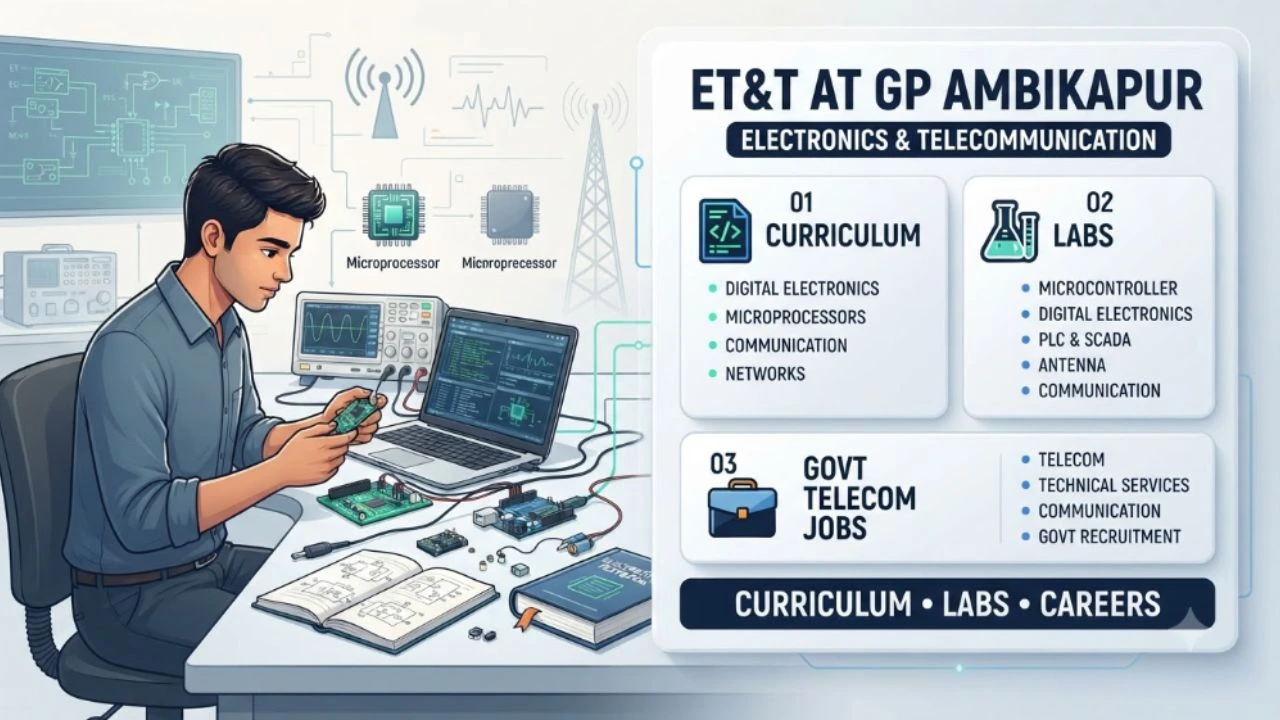
Electronics and Telecommunication Engineering is a technical diploma branch for students interested in electronic devices, communication systems, networking and digital technology.
At Government Polytechnic Ambikapur, the ET&T diploma can be considered by students who want practical engineering training with options in both government and private-sector employment.
The branch combines concepts from electronics, communication, electrical systems, computer technology and networking. This makes it different from branches focused mainly on mechanical machines, construction or power systems.
For students considering government jobs after a diploma, ET&T also offers several possible routes. However, eligibility depends on the branch requirements mentioned in each recruitment notification.
Table of Contents
What Is Electronics and Telecommunication Engineering?
Electronics and Telecommunication Engineering deals with electronic circuits, communication equipment, digital systems and technologies used to transmit information.
The subject area has applications in telecommunications, broadcasting, networking, embedded systems, industrial automation and electronic equipment.
A diploma programme generally combines classroom instruction with laboratory work. Practical training becomes particularly important because electronics concepts are easier to understand when students work with actual circuits and equipment.
The course can suit students who enjoy mathematics, basic physics, electronics and technical problem-solving.
It also provides a foundation for higher studies. After completing the diploma, eligible candidates can explore lateral-entry B.Tech programmes or enter technical employment.
ET&T Curriculum at GP Ambikapur
The exact semester-wise syllabus should be checked against the current curriculum prescribed by the relevant technical education authority.
However, an Electronics and Telecommunication diploma generally covers subjects from several connected areas.
Early semesters usually establish the fundamentals of engineering mathematics, physics, electrical concepts and basic electronics.
As the course progresses, students encounter more specialised subjects related to electronic devices, digital systems and communication technology.
Common areas of study can include:
- Electronic Devices and Circuits
- Digital Electronics
- Analog Electronics
- Electrical and Electronic Measurements
- Communication Systems
- Microprocessors and Microcontrollers
- Computer Fundamentals
- Network and Communication Concepts
- Electronic Instrumentation
- Industrial Electronics
- Basic Programming
- Engineering Drawing
- Workshop and Practical Training
The precise subjects and their sequence can vary according to the applicable curriculum.
Students should therefore use the latest official syllabus rather than relying on an older course structure while planning their studies.
What Students Learn in the ET&T Branch
The first part of the programme generally focuses on understanding basic electronic principles.
Students learn how components such as resistors, capacitors, diodes and transistors behave inside circuits. These concepts become the foundation for more advanced electronic systems.
Digital electronics introduces another important area. Students work with digital logic, electronic switching and systems that form the basis of modern computing and communication equipment.
Communication-related subjects move the course toward telecommunications. Depending on the curriculum, students may study communication methods, transmission systems, modulation concepts, networking and related technologies.
Microprocessors and microcontrollers introduce students to programmable electronic systems.
These areas are particularly useful for understanding embedded devices, automation equipment and electronic control systems.
Practical Training and Laboratory Work
Laboratory sessions are an important part of an ET&T diploma.
Reading theory alone is not enough to understand how electronic circuits behave. Practical work gives students an opportunity to assemble, test, measure and troubleshoot circuits.
Typical practical exposure can involve electronic components, measuring instruments, digital circuits, communication equipment and microcontroller-based systems.
Students may also work with tools such as multimeters, oscilloscopes, power supplies and other laboratory instruments, depending on the facilities available at the institute.
The exact equipment available at GP Ambikapur should be confirmed from the institute because laboratory infrastructure can change over time.
Practical classes can also help students develop a skill that matters during technical recruitment: identifying why a circuit or device is not working correctly.
That troubleshooting ability is useful in electronics maintenance, telecommunications and industrial environments.
Projects Can Make a Difference
Diploma students generally complete practical assignments and projects during their course.
An ET&T project can involve a relatively simple electronic circuit or a more developed system involving sensors, microcontrollers, communication modules or automation.
The purpose is not simply to complete a project for marks.
A well-understood project gives students something concrete to discuss during interviews and technical assessments.
For example, a student who builds a sensor-based monitoring system can explain the circuit, components, programming logic and testing process during an interview.
That practical understanding can be more valuable than simply listing the project title on a resume.
Government Jobs After ET&T Diploma
A diploma in Electronics and Telecommunication Engineering can open several government employment routes.
The important point is that government recruitment does not treat every diploma branch equally.
Some notifications specifically accept Electronics and Telecommunication qualifications. Others may accept Electronics, Communication, Electrical or related disciplines.
The recruitment notification determines whether an ET&T diploma qualifies for a particular post.
Potential employment areas include telecommunications, railways, defence organisations, public-sector companies, broadcasting and technical departments.
Possible job titles can include Junior Engineer, Technician, Technical Assistant and other technical positions.
The actual designation depends on the recruiting organisation.
Government Telecom Jobs
Telecommunication-related government employment is one of the most obvious areas for ET&T diploma holders.
Telecom networks require technical personnel for equipment maintenance, network infrastructure, transmission systems and field operations.
Government and public-sector organisations involved in telecommunications can periodically recruit technical staff.
However, recruitment schedules are not fixed. Vacancies depend on organisational requirements, sanctioned posts and recruitment policies.
Candidates should also check whether the notification specifically lists Electronics and Telecommunication as an eligible qualification.
A diploma alone does not guarantee a telecom job. Candidates still have to satisfy age, qualification and other conditions and clear the applicable selection process.
Railway Jobs for ET&T Diploma Holders
Indian Railways is another sector worth monitoring.
Railway operations depend on extensive electrical, electronic, signalling and communication infrastructure. Recruitment can therefore create opportunities for candidates with relevant technical qualifications.
The exact branch eligibility varies by position.
Some technical posts may accept electronics-related diploma qualifications, while others may require a specific discipline.
Students interested in railway recruitment should read the official notification carefully before applying.
Previous recruitment advertisements can provide an idea of the types of posts available, but they should not be treated as proof of eligibility for a future recruitment cycle.
Defence and Electronics Sector Opportunities
Defence organisations also use sophisticated electronic and communication systems.
Diploma holders with electronics-related qualifications can find technical opportunities in areas involving equipment maintenance, testing, production and support.
Recruitment can occur through different organisations and selection systems.
The work may involve electronic systems, communication equipment, instrumentation or production environments.
For students interested in this sector, technical fundamentals are especially important. Electronics, digital systems, measurements and communication concepts can form part of the technical foundation required for relevant positions.
Public Sector and Technical Recruitment
ET&T diploma holders can also monitor recruitment from public sector organisations and technical institutions.
The opportunities can include maintenance, technical support, equipment operation and other engineering-related responsibilities.
Eligibility varies considerably between organisations.
One recruitment notification may accept Electronics and Telecommunication Engineering, while another may specify Electronics Engineering or Communication Engineering.
This is why students should avoid relying on broad lists claiming that every government department accepts every electronics-related diploma.
The qualification mentioned in the official advertisement should always be treated as the deciding factor.
Private-Sector Career Options After ET&T
Government employment is not the only option after completing an ET&T diploma.
The private sector offers technical roles in electronics manufacturing, telecommunications, networking, automation, testing and maintenance.
Possible entry-level roles include:
- Electronics Technician
- Telecom Technician
- Network Support Technician
- Field Service Technician
- Electronics Maintenance Technician
- Testing Technician
- Technical Support Executive
- Junior Network Technician
The actual role depends on the employer, technical skills and experience.
Students who develop additional skills in networking, embedded systems, programming or industrial automation can broaden their employment options.
Skills Worth Developing During the Diploma
The ET&T curriculum provides the technical foundation, but additional skills can improve employability.
Students can spend time learning basic programming, especially where it connects with microcontrollers and embedded systems.
Networking knowledge can also be useful for students interested in telecommunications and technical support.
Practical circuit troubleshooting is another valuable skill.
Students should become comfortable reading circuit diagrams, using measurement equipment and identifying common faults.
Communication skills matter during interviews and workplace interactions as well. A technically capable candidate still needs to explain problems clearly to supervisors, colleagues and customers.
Higher Studies After ET&T
Students do not have to stop studying after completing their diploma.
Eligible diploma holders can pursue B.Tech through lateral entry, depending on the admission rules of the state, university or institution.
Lateral entry can allow a diploma holder to enter directly into the second year of an engineering degree programme.
The available branches depend on the institution and admission rules.
Students interested in electronics, communication or related fields can therefore use their diploma as the first stage of a longer engineering education.
Higher qualifications can also expand eligibility for certain engineering-level positions that require a degree.
Is ET&T a Good Choice for Government Jobs?
ET&T can be a practical choice for students interested in electronics, communication systems and technical government employment.
Its government career scope is not limited to one department. Depending on eligibility, candidates can explore telecom, railways, defence, public-sector organisations and other technical recruitment.
The number of vacancies is not fixed every year.
Students should therefore avoid selecting ET&T based only on assumptions about a particular recruitment drive.
A better approach is to examine previous notifications, identify the departments that regularly accept electronics-related diplomas and prepare accordingly.
Final Verdict
Electronics and Telecommunication Engineering at Government Polytechnic Ambikapur can suit students who prefer electronics, communication technology and practical technical work. The curriculum builds knowledge across electronic circuits, digital systems, communication technology, measurements and related engineering areas. Laboratory work is particularly important because electronics is a field where practical troubleshooting skills matter.
For long-term growth, lateral-entry B.Tech is another option for eligible diploma holders. The strongest career strategy is not simply choosing ET&T. It is building solid technical knowledge, gaining practical experience, tracking relevant recruitment notifications and developing additional skills alongside the diploma.