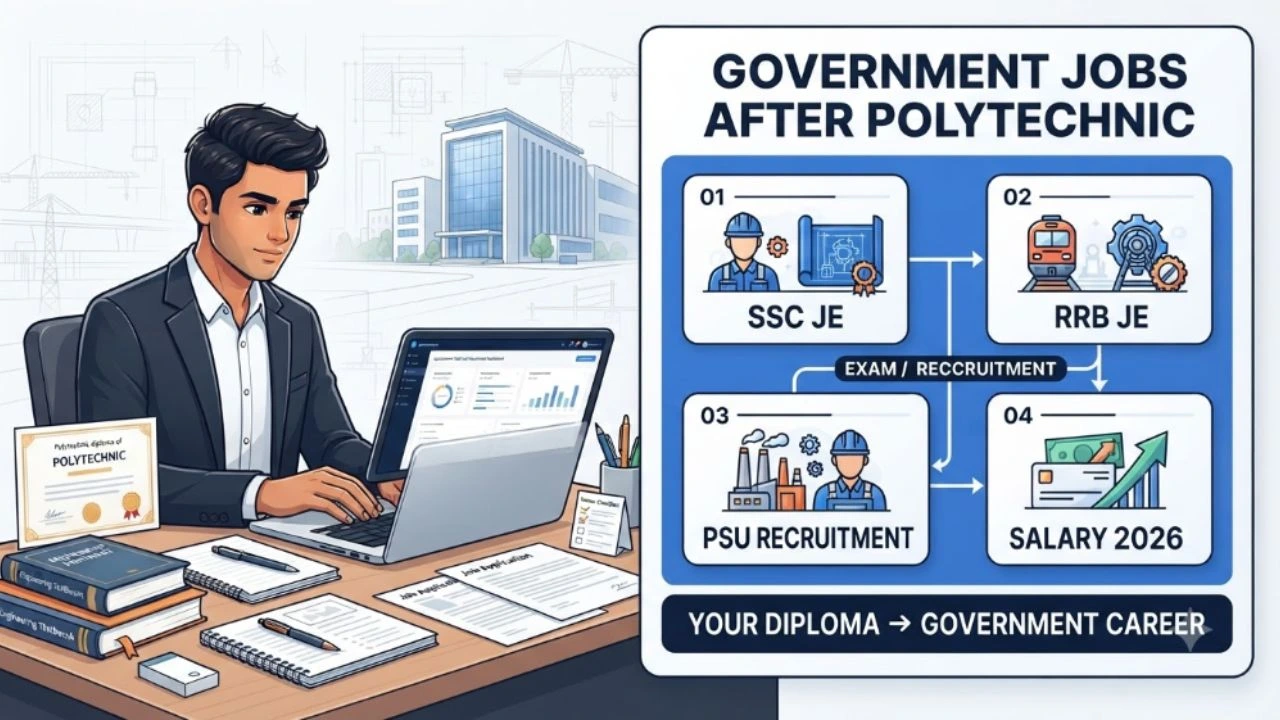
A polytechnic diploma can open several government job opportunities in engineering and technical departments. After completing a diploma in Civil, Mechanical, Electrical, Electronics or a related branch, candidates can apply for selected technical recruitment examinations, apprenticeships and department-level vacancies.
Among the most popular options are SSC JE, RRB JE, state Junior Engineer recruitment and technical positions in PSUs. The eligibility rules are not identical for every post. Some vacancies accept a diploma, while others require a degree or specific experience.
For 2026, candidates should check the recruitment notification before applying because age limits, vacancies, qualifying branches, examination patterns and salary details can change from one recruitment cycle to another.
Table of Contents
Government Jobs After Polytechnic Diploma
A diploma does not limit a candidate to private-sector technician jobs. Depending on the branch and recruitment rules, diploma holders can target positions in railways, public works departments, electricity boards, defence organisations, central government departments and public sector companies.
Some common job options include:
- Junior Engineer
- Technician
- Technical Assistant
- Draftsman
- Supervisor
- Engineering Assistant
- Apprentice
- Maintenance Technician
The Junior Engineer (JE) route is particularly attractive because several government organisations recruit candidates with engineering diplomas for technical positions.
However, every JE vacancy has its own eligibility conditions. A Civil Engineering diploma, for example, does not automatically qualify a candidate for a Mechanical or Electrical post.
SSC JE After Polytechnic
The Staff Selection Commission Junior Engineer (SSC JE) examination is one of the most recognised central government opportunities for engineering diploma holders. SSC JE recruitment covers technical positions in selected central government organisations and departments. Depending on the notification, posts are generally associated with Civil, Mechanical and Electrical Engineering.
Eligibility for SSC JE
Diploma holders can be eligible for certain SSC JE posts, but the exact qualification depends on the department and post.
A candidate may need:
- A diploma in the relevant engineering branch
- The required educational qualification from a recognised institution
- The prescribed age limit
- Any experience specified for a particular post
This distinction matters. Some posts may accept a diploma directly, while others can have additional requirements. Before filling the application form, candidates should carefully match their diploma branch with the post-specific qualification mentioned in the notification.
SSC JE Selection Process
The recruitment process generally involves computer-based examinations followed by the stages specified by SSC for the particular recruitment cycle. The technical section is important because candidates compete with applicants who have studied engineering subjects in considerable depth.
Preparation usually involves:
- Engineering mathematics
- Core technical subjects
- General awareness
- Reasoning
- Previous-year questions
- Mock tests
A diploma student can prepare effectively by building strong command over core subjects instead of relying only on memorisation.
RRB JE After Polytechnic
The Railway Recruitment Board Junior Engineer (RRB JE) examination is another major option for diploma holders interested in technical government employment. Indian Railways recruits Junior Engineers and other technical personnel through recruitment conducted by the Railway Recruitment Boards. Depending on the recruitment notification, diploma holders from relevant engineering disciplines can be considered for technical posts.
What Does an RRB JE Do?
The job profile depends on the department. A Junior Engineer may be involved in areas such as:
- Maintenance
- Inspection
- Technical supervision
- Railway infrastructure
- Electrical systems
- Mechanical equipment
- Engineering records
- Safety-related technical work
The actual duties depend on the post and railway department.
RRB JE Eligibility
Candidates generally need a diploma or degree in the relevant engineering discipline for posts where the diploma qualification is accepted. The age limit, medical standards, nationality requirements and other conditions are specified in the recruitment notification. Since railway recruitment rules can change between cycles, candidates should not rely on an old notification when applying for a 2026 vacancy.
State Government JE Jobs After Polytechnic
State government departments provide another important route for diploma holders. Recruitment can be conducted through state public service commissions, subordinate service selection commissions, technical education departments or individual government departments.
Common employers include:
- Public Works Departments
- Irrigation departments
- Electricity departments
- Water supply departments
- Municipal bodies
- Rural development departments
- State infrastructure agencies
The designation may be Junior Engineer, Technical Assistant or another equivalent technical post.
For example, a Civil Engineering diploma holder may find opportunities related to roads, buildings, water supply and public infrastructure. Electrical diploma holders can look for vacancies connected with power distribution, maintenance and electrical installations.
The major advantage of state-level recruitment is that candidates can target vacancies within their preferred state, although domicile requirements may apply to certain posts.
PSU Recruitment After Polytechnic
Public Sector Undertakings, commonly known as PSUs, also recruit technical candidates. The availability of diploma-level positions varies considerably from one organisation and recruitment year to another. Some PSUs recruit diploma holders for technician, junior technical, operator, apprentice or similar positions.
Possible sectors include:
- Power
- Oil and gas
- Manufacturing
- Heavy engineering
- Steel
- Transport
- Telecommunications
- Energy
A diploma holder should not assume that every PSU engineering vacancy accepts a diploma. Many high-level PSU engineering positions specifically require a B.E. or B.Tech degree.
The recruitment notice should always be checked for the exact educational qualification.
PSU Jobs vs Government JE Jobs
Both routes can provide stable technical careers, but the recruitment process and job structure can differ. A JE position in a government department may involve field inspections, maintenance, construction supervision and departmental work. A PSU technical position may involve plant operations, manufacturing, equipment maintenance, production or specialised industrial systems.
For diploma holders, the better option depends on the branch, job profile, location, work environment and recruitment conditions rather than the organisation name alone.
Government Salary After Polytechnic
Government salary depends on the department, post, pay level, allowances, location and recruitment rules. For this reason, there is no single salary figure for all diploma holders.
Junior Engineer positions in central and state government organisations generally offer a structured pay scale along with applicable allowances. Depending on the organisation and post, the overall monthly compensation can include components such as:
- Basic pay
- Dearness allowance
- House rent allowance
- Transport allowance
- Other applicable benefits
The actual amount received in hand can be lower than the total salary package after deductions. PSU salaries also differ significantly. Technician and apprentice positions can have very different compensation structures from permanent engineering positions.
Candidates should therefore compare the pay level, allowances, probation terms and job status instead of looking only at the headline salary.
Which Polytechnic Branch Is Best for Government Jobs?
There is no single diploma branch that guarantees a government job. However, certain branches regularly appear in technical recruitment.
Civil Engineering
Civil Engineering diploma holders can target jobs connected with:
- Roads and highways
- Buildings
- Irrigation
- Water supply
- Surveying
- Construction
- Public infrastructure
Civil is particularly relevant for JE positions in public works and infrastructure-related departments.
Electrical Engineering
Electrical diploma holders can look at recruitment involving:
- Power distribution
- Electrical maintenance
- Generation
- Industrial systems
- Railway electrical departments
- Government electricity organisations
Mechanical Engineering
Mechanical diploma holders may find opportunities in:
- Manufacturing
- Railway workshops
- Maintenance
- Production
- Heavy engineering
- Industrial operations
Electronics and Communication
Electronics diploma holders can explore technical opportunities related to:
- Communication systems
- Electronics equipment
- Telecommunications
- Instrumentation
- Defence-related technical work
Eligibility varies from one vacancy to another, so the branch should always be matched against the notification.
Apprenticeships After Polytechnic
Apprenticeships can be a useful starting point for diploma holders who want practical experience before applying for permanent positions. Government organisations, PSUs and industrial companies periodically offer apprenticeship opportunities to eligible diploma holders.
An apprenticeship can provide:
- Workplace exposure
- Practical technical experience
- Familiarity with industrial equipment
- Professional discipline
- A stronger resume
An apprenticeship is not the same as a permanent government job. Completion does not automatically guarantee regular employment. Still, the experience can be valuable when applying for future technical positions.
How to Prepare for Government Exams After Polytechnic
Government technical examinations require consistent preparation because competition can be high. Start with the technical subjects covered during the diploma. Revise concepts rather than simply memorising formulas. A practical preparation plan can include:
First, complete the syllabus.
Divide the technical subjects into smaller topics and finish them systematically.
Next, solve previous-year papers.
These papers reveal the type of questions asked and help identify weak areas.
Then, practise timed tests.
Speed becomes important in computer-based examinations, particularly when there are several sections to complete.
Finally, revise regularly.
Keep short notes for formulas, definitions, important concepts and commonly repeated questions.
General awareness and reasoning should also be included when they form part of the examination pattern.
Can Polytechnic Students Become Engineers?
A diploma holder can continue education after completing polytechnic. One important route is B.Tech lateral entry, where eligible diploma holders may enter the second year of an engineering degree programme. The admission process depends on the state, university and institution.
This route allows a diploma holder to build practical technical knowledge first and then obtain an engineering degree. It can also expand eligibility for jobs that specifically require a B.E. or B.Tech qualification. However, lateral-entry rules are not identical across India, so candidates should check the relevant admission notification.
Government Job vs Private Job After Polytechnic
Government employment is attractive because of structured service conditions, job stability and long-term benefits associated with eligible permanent posts. Private companies, on the other hand, can offer faster hiring and opportunities to develop specialised industry skills.
A diploma holder should not wait indefinitely for one government examination if there are useful private-sector or apprenticeship opportunities available. Working in a technical role can provide practical experience while the candidate continues preparing for competitive examinations.
Best Government Job Options After Polytechnic in 2026
For diploma holders, the main options worth tracking include:
| Recruitment Route | Suitable Diploma Fields | Typical Work Area |
| SSC JE | Civil, Mechanical, Electrical, as notified | Central government departments |
| RRB JE | Relevant engineering disciplines | Railways |
| State JE Recruitment | Depends on department | PWD, irrigation, electricity and other departments |
| PSU Technical Recruitment | Depends on vacancy | Manufacturing, energy and industrial sectors |
| Apprenticeships | Multiple diploma branches | Government and industrial organisations |
| Technical Assistant Posts | Depends on notification | Government technical departments |
This table should be treated as a broad guide rather than a list of guaranteed eligibility. Recruitment notifications remain the final authority.
Final Words
A polytechnic diploma can provide a practical starting point for a government technical career. SSC JE, RRB JE, state Junior Engineer recruitment, PSU technical vacancies and apprenticeships are among the routes worth tracking in 2026. The right opportunity depends heavily on the diploma branch and the eligibility conditions mentioned in each recruitment notification.
For candidates targeting government jobs, technical preparation should begin early. Strong fundamentals, previous-year question practice and regular mock tests can make a significant difference. Those who want broader career options can also consider B.Tech lateral entry after completing the diploma. This can open additional opportunities where an engineering degree is required.