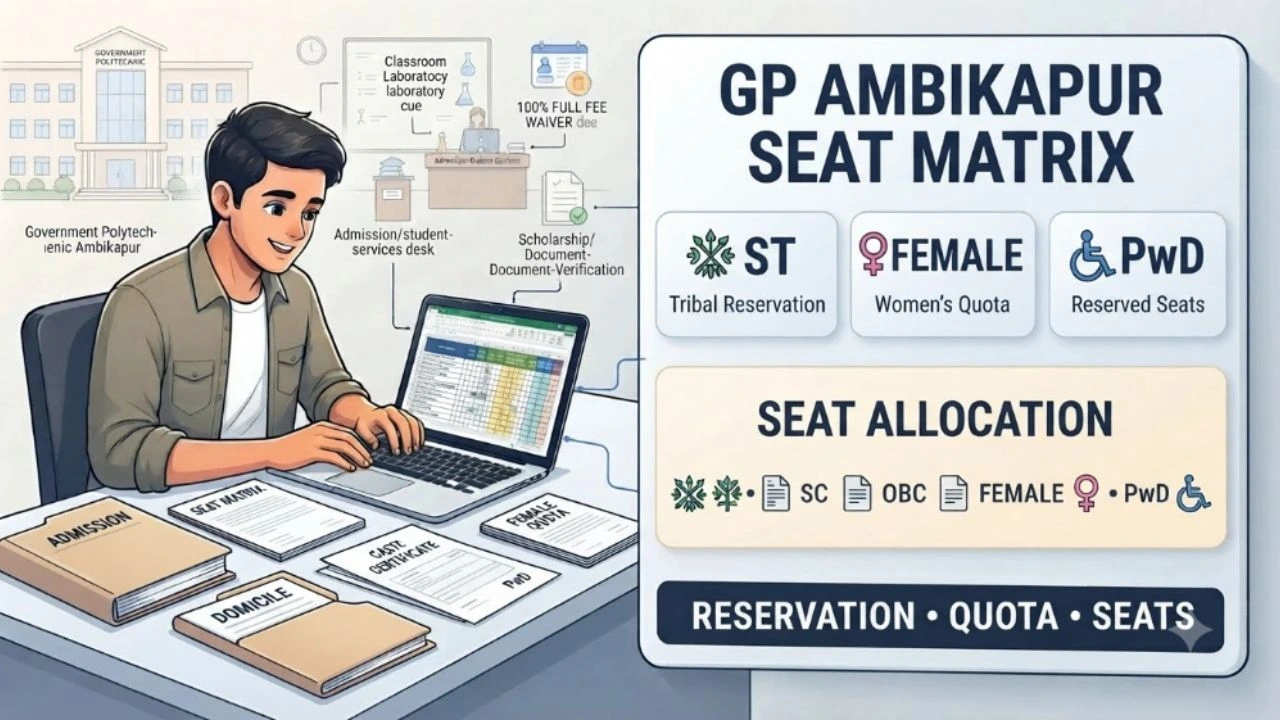
For students applying to Government Polytechnic Ambikapur, understanding the seat matrix is just as important as checking the eligibility criteria. The number of seats available in a branch, the reservation category, female quota and provisions for candidates with disabilities can all affect admission chances.
Government Polytechnic Ambikapur serves students from Surguja and other parts of Chhattisgarh. Since the admission process follows the applicable state-level rules, the final number of seats and category-wise distribution can change from one academic session to another.
This guide explains how the seat matrix works, what Surguja tribal reservation means, how female and PwD provisions are applied, and what applicants should check before choosing a branch.
Table of Contents
What Is a Polytechnic Seat Matrix?
A seat matrix is the official distribution of seats available for admission to a particular course or branch.
Instead of showing only the total intake, a detailed matrix can indicate how seats are distributed across different categories and applicable reservation provisions.
For a diploma branch, the admission authority may consider categories such as:
- Unreserved seats
- Scheduled Caste (SC)
- Scheduled Tribe (ST)
- Other Backward Classes (OBC)
- Economically Weaker Sections (EWS), where applicable
- Female candidates under applicable horizontal reservation
- Persons with Disabilities (PwD)
- Other special categories prescribed under state admission rules
The exact arrangement depends on the admission authority and the rules applicable during that academic year.
This means a student should not assume that a previous year’s seat matrix will remain unchanged for the next admission cycle.
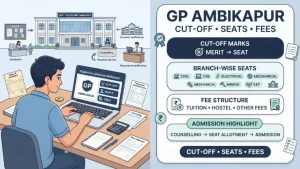
GP Ambikapur Seat Matrix and Branch-Wise Intake
Government Polytechnic Ambikapur offers diploma-level technical education in engineering and related disciplines.
The total number of seats is divided branch-wise. A branch with a larger sanctioned intake will naturally have more seats available during counselling than a branch with a smaller intake.
Popular engineering disciplines may include areas such as:
- Civil Engineering
- Mechanical Engineering
- Electrical Engineering
- Computer-related programmes
- Electronics-related programmes
The actual branch list, sanctioned intake and admission availability should be checked against the current official admission information.
This distinction matters because the number of seats shown during one admission year may not necessarily represent the intake for another year.
Students should also check whether all sanctioned seats are available through the same admission route. Some seats can be affected by institutional rules, counselling rounds or other applicable provisions.
Understanding Surguja Tribal Reservation
Surguja has a significant tribal population, and reservation provisions for Scheduled Tribe candidates are an important part of admissions in the region.
However, the term “Surguja tribal reservation” should not be interpreted as meaning that every seat at Government Polytechnic Ambikapur is reserved exclusively for candidates from Surguja.
Reservation is governed by the applicable Chhattisgarh government rules and admission authority guidelines. Category, domicile requirements and other conditions can determine whether a candidate can claim a particular reserved seat.
Students belonging to the Scheduled Tribe category should keep their valid caste and domicile documents ready where required.
The certificate must meet the requirements specified by the admission authority. A certificate that does not satisfy the prescribed conditions can create problems during document verification.
How ST Reservation Can Affect Admission Chances
Reservation can change the level of competition within a category.
For example, a candidate competing under the ST category may not be assessed in exactly the same seat pool as an unreserved candidate. The relevant counselling rules determine how category seats are allotted and how candidates are considered when seats remain vacant.
A student should therefore check the category-specific eligibility and previous admission trends instead of comparing only the overall closing rank.
The availability of seats can also vary between branches.
A branch with a smaller intake may have fewer reserved seats, while a branch with a larger sanctioned intake may have a broader distribution.
This is one reason why students should examine the branch-wise seat matrix rather than relying on a college-wide seat count.
Female Reservation at GP Ambikapur
Female candidates may benefit from horizontal reservation provisions under the applicable Chhattisgarh admission rules.
Horizontal reservation works differently from a separate vertical category such as SC, ST or OBC reservation.
In simple terms, a horizontal reservation can apply across existing social categories. The exact method of adjustment depends on the admission rules used by the state authority.
For example, a female candidate may belong to the ST category and also qualify under a female reservation provision. The seat allocation process then applies the relevant rules to ensure the reservation is adjusted correctly.
This is why female candidates should not simply subtract a percentage from the total seats and assume that those are additional seats.
The final seat allocation depends on the official counselling procedure and reservation framework.
Why Female Candidates Should Check the Detailed Matrix
A general college brochure may show only the total intake for a branch.
The counselling authority may provide more detailed information during the admission process.
Female candidates should check:
- Total seats in the preferred branch
- Applicable female reservation
- Category reservation
- Domicile requirements
- Counselling rules
- Seat conversion rules, if applicable
- Previous-round allotment information
The same approach is useful for candidates belonging to other reserved categories.
A detailed seat matrix gives a clearer picture of the actual competition.
PwD Seats at Government Polytechnic Ambikapur
Persons with Disabilities may receive reservation under the applicable admission rules.
PwD reservation is generally treated as a horizontal reservation and can apply across different social categories.
Eligibility is not established simply by having a medical condition or disability certificate. Candidates must satisfy the disability-related requirements prescribed by the relevant authority.
A valid disability certificate from the competent authority may be required during admission or document verification.
Candidates should also check whether their disability is considered eligible for the specific diploma programme they want to join.
Certain technical courses may have specific functional or medical requirements, depending on the nature of the programme and applicable regulations.
How PwD Reservation Works With Other Categories
A PwD candidate can also belong to another reservation category.
For example, a candidate may fall under SC-PwD, ST-PwD or OBC-PwD, depending on their eligibility.
This does not mean the candidate receives two completely separate seats.
Instead, horizontal reservation is generally adjusted within the relevant vertical category according to the applicable rules.
The counselling authority handles this calculation during seat allotment.
Candidates should therefore provide accurate category and disability information during application. Incorrect information can affect the admission process and may lead to rejection during verification.
Category Certificates and Document Verification
Reservation benefits are available only when the candidate satisfies the prescribed conditions.
Depending on the category, applicants may need documents such as:
- Class 10 marksheet
- Class 10 certificate
- Domicile or residence certificate
- Caste certificate
- Category certificate where applicable
- PwD certificate, where applicable
- Transfer certificate
- Character certificate
- Recent photographs
- Aadhaar or another accepted identity document
The exact list can differ according to the admission process.
Candidates should use the current admission notification as the final checklist.
A common mistake is waiting until counselling to arrange a category certificate. If a required document is unavailable or does not follow the prescribed format, the candidate may face difficulties in claiming the reserved seat.
Does Reservation Guarantee Admission?
No.
Reservation improves access to the applicable category of seats, but it does not guarantee admission.
A candidate still needs to meet the eligibility conditions and participate correctly in the admission or counselling process.
Admission also depends on factors such as:
- Available seats
- Merit or entrance rank
- Branch preference
- Category
- Number of applicants
- Counselling round
- Seat choices entered by the candidate
A reserved category candidate with a strong rank may have more options than someone with a lower rank, particularly in a competitive branch.
Previous-year cutoffs can provide some guidance, but they should not be treated as guaranteed admission marks or ranks.
Why Branch-Wise Competition Matters
Not every diploma branch has the same level of demand.
Computer-related courses can attract considerable interest from students who want to move into software, IT and digital technology.
Civil Engineering may attract candidates interested in construction and government infrastructure work. Electrical and Mechanical Engineering also remain relevant across manufacturing, utilities, construction and other technical sectors.
The seat matrix should therefore be viewed together with branch demand.
Suppose two branches have similar eligibility requirements but different seat intakes. The branch with fewer seats may become more competitive if demand is high.
This is why students should keep several suitable branch choices during counselling rather than selecting only one option.
How to Use the Seat Matrix During Counselling
Once the current seat matrix is released, start by identifying the branches you are eligible for.
Next, separate the choices into three groups:
First preference: branches and colleges you would choose immediately if allotted.
Realistic choices: branches where your rank and category give you a reasonable possibility of admission.
Backup choices: acceptable branches or institutions that keep your diploma plan on track.
This approach is more practical than filling choices based only on popularity.
If a candidate selects only one highly competitive branch, there is a possibility of missing out even when other suitable seats are available.
A wider choice list can provide more flexibility during counselling.
What Can Change the Seat Matrix?
The final seat distribution can change because of administrative decisions, revised intake, reservation rules, approval requirements or changes in the admission process.
Seats may also be displayed differently across counselling rounds.
For this reason, students should rely on the seat matrix released for the current admission session rather than copying figures from an older article, social media post or unofficial college list.
The same applies to female and PwD reservation percentages.
Reservation rules can change, and the method used to calculate horizontal reservation can also affect the actual allotment.
How to Improve Your Chances of Getting a Seat
There is no guaranteed method of securing a particular branch, but students can make their counselling choices more carefully.
First, understand your category and eligibility before filling preferences.
Next, check the current branch-wise intake and previous admission trends where reliable information is available.
Do not select choices only according to college popularity. Consider whether the branch matches your career plans.
For example, someone interested in software development may prefer a Computer-related diploma, while another student interested in electrical systems may have better reasons to select Electrical Engineering.
Also keep alternative choices available. Counselling is competitive, and the preferred branch may not be available at the desired rank.
Final Takeaway
The GP Ambikapur seat matrix is more than a list of total seats. It helps applicants understand how available seats are distributed across branches and applicable reservation categories.
For students from Surguja and nearby areas, understanding the rules related to Scheduled Tribe reservation can be especially important. Female candidates and PwD applicants should also understand how horizontal reservation works instead of treating these provisions as completely separate seat pools.
The most important point is to check the current admission notification and official seat matrix for the relevant academic session. Reservation percentages, branch intake and counselling rules can change.
Before filling choices, compare the available branches, your category, eligibility, expected competition and career plans. A well-planned choice list can give you more flexibility during counselling and help you make better use of the seats available at Government Polytechnic Ambikapur.