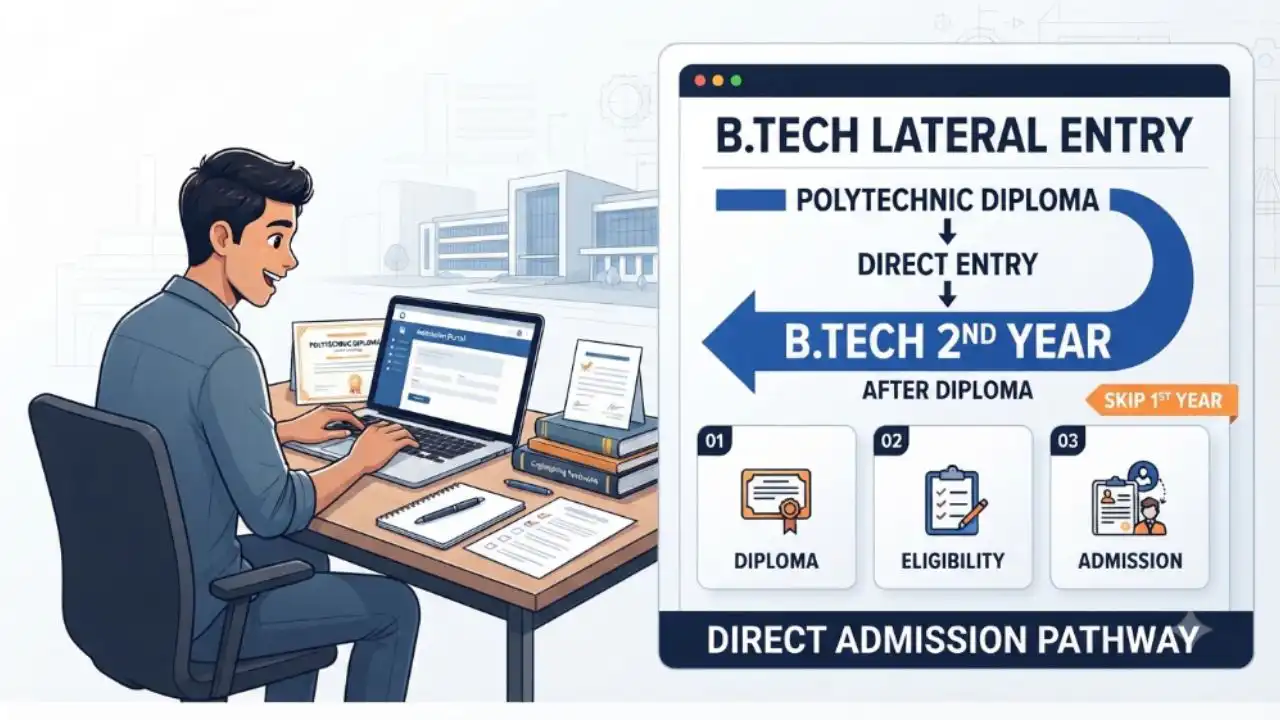
A polytechnic diploma does not have to be the final step in technical education. After completing a diploma in engineering or technology, eligible candidates can apply for direct admission to B.Tech 2nd year through lateral entry. Instead of starting B.Tech from the first year, diploma holders generally enter the third semester, which is the beginning of the second year. This route allows students to build on the technical knowledge gained during their diploma while working towards a full engineering degree.
The admission process varies across states and colleges. Eligibility, entrance exams, application dates, branch requirements and counselling rules can all be different. Therefore, candidates should check the admission notification of the concerned authority before applying for the 2026 session.
Table of Contents
What Is B.Tech Lateral Entry After Diploma?
B.Tech lateral entry is a special admission route for diploma holders who want to pursue an engineering degree. A regular B.Tech programme normally takes four years after Class 12. In lateral entry, an eligible diploma holder can generally join directly in the second year of B.Tech.
For example, a student who completes a Diploma in Mechanical Engineering may apply for B.Tech Mechanical Engineering through lateral entry. If selected, the student normally begins from the third semester instead of the first semester. The diploma provides practical and technical knowledge, while the B.Tech programme adds advanced engineering concepts, design, analysis and broader career opportunities.
Who Can Apply for B.Tech Lateral Entry?
The primary requirement is usually a recognised diploma in engineering or technology. However, the exact eligibility conditions depend on the university, state and admission authority.
Common requirements include:
- A completed diploma in engineering or technology
- Diploma from a recognised institution
- Minimum qualifying marks as prescribed by the admission authority
- A suitable diploma branch for the selected B.Tech course
- Fulfilment of domicile requirements, where applicable
- Other conditions mentioned in the official admission notification
The minimum percentage is not the same everywhere. Some institutions may also have separate requirements for reserved categories. Branch compatibility is another important factor. A Diploma in Civil Engineering may generally be considered for B.Tech Civil Engineering, while a diploma in Electrical Engineering may be considered for a related electrical programme. Candidates should not assume that every diploma branch allows admission into every B.Tech specialisation.
How to Get Direct Admission in B.Tech 2nd Year
The process usually involves several steps. The exact procedure can change from one state or university to another.
1. Complete Your Diploma
First, candidates need to complete the required diploma qualification from a recognised institution.
Keep your marksheets, diploma certificate and other academic documents safely because these are generally required during the application and verification stages.
2. Check Lateral Entry Eligibility
Before applying, check the eligibility criteria of the college or admission authority.
Look at the required diploma percentage, accepted branches, category rules, domicile conditions and any age requirements.
This step is particularly important because admission rules can differ considerably between states.
3. Find the Applicable Admission Route
B.Tech lateral entry admissions can take place through different routes. Some states conduct a dedicated lateral-entry entrance examination. Others provide admission based on diploma marks, while certain universities conduct their own admission process.
For example, states may have their own counselling systems for diploma holders seeking second-year engineering admission. Candidates should identify the correct admission authority instead of applying through an unrelated engineering admission portal.
4. Fill the Application Form
Once applications open, complete the lateral-entry application form online if the concerned authority uses an online system.
The form may ask for:
- Personal details
- Diploma qualification
- Semester-wise marks
- Category information
- Domicile details
- Preferred B.Tech branch
- College preferences
Enter information exactly as it appears on your official documents. Mistakes in marks, qualification details or category information can create problems during verification.
5. Appear for an Entrance Exam if Required
Not every lateral-entry admission requires an entrance test. Where an examination is conducted, the syllabus may be related to diploma-level technical subjects. The examination pattern and marking scheme depend on the authority. Candidates should follow the latest syllabus and examination instructions rather than relying on previous-year patterns.
6. Participate in Counselling
After the entrance examination or merit preparation, eligible candidates may have to participate in counselling. This is an important stage because admission depends not only on eligibility but also on available seats, merit, branch preference and college choices.
During counselling, candidates may be asked to select preferred colleges and B.Tech branches. A practical choice list should include a mixture of preferred options and colleges where admission is realistically possible.
7. Seat Allotment and Admission
After choices are submitted, seats are allotted according to the applicable admission rules. If a seat is allotted, the candidate normally has to accept it within the specified period and pay the required fee. Document verification may follow before the admission becomes final.
Documents Required for B.Tech Lateral Entry
The exact list varies between institutions, but applicants commonly need documents such as:
- Diploma marksheets
- Diploma certificate or provisional certificate
- Class 10 certificate
- Class 10 marksheet
- Transfer or migration certificate, where required
- Character certificate
- Aadhaar or another accepted identity document
- Passport-size photographs
- Category certificate, if applicable
- Domicile certificate, where applicable
- Entrance examination scorecard, if applicable
- Counselling or allotment letter
Keep both original documents and photocopies ready for verification.
Which B.Tech Branch Can You Choose After Diploma?
The available B.Tech branch depends on your diploma qualification and the rules of the institution.
Common combinations include:
Diploma in Computer Engineering → B.Tech Computer Science or related programmes
Diploma in Mechanical Engineering → B.Tech Mechanical Engineering
Diploma in Civil Engineering → B.Tech Civil Engineering
Diploma in Electrical Engineering → B.Tech Electrical Engineering
Diploma in Electronics Engineering → B.Tech Electronics and Communication Engineering
The exact branch mapping can differ. Some colleges may allow related specialisations, while others may restrict admission to specific branches.
Is B.Tech Lateral Entry Better Than Starting B.Tech After Class 12?
For a diploma holder, lateral entry can be a practical way to continue engineering education. The biggest advantage is that the student does not normally repeat the first year of B.Tech. The diploma already provides technical exposure, so the student moves into the second year of the degree programme.
It can also improve career options. Certain engineering positions, graduate-level recruitment opportunities and postgraduate programmes require a bachelor’s degree.
At the same time, lateral entry requires a fresh academic adjustment. B.Tech subjects can be more advanced and may involve mathematics, engineering analysis, programming, design and specialised technical coursework.
Career Options After B.Tech Lateral Entry
After completing B.Tech through lateral entry, graduates can apply for career opportunities available to engineering degree holders, subject to the eligibility rules of the employer.
Possible areas include:
- Software and IT
- Manufacturing
- Construction
- Electrical and power industries
- Automobile sector
- Electronics
- Infrastructure
- Engineering services
- Government recruitment
- Higher education and specialised certifications
The actual career outcome depends on the engineering branch, skills, college, internships, academic performance and recruitment requirements. A B.Tech degree does not guarantee a particular salary or job position. Practical skills and relevant experience continue to matter when applying for employment.
Can Diploma Holders Do M.Tech After B.Tech?
Yes. After completing a B.Tech degree, graduates can pursue postgraduate education if they meet the eligibility requirements of the institution.
Depending on their career goals, they may consider options such as:
- M.Tech
- MBA
- M.S.
- Professional certifications
- Specialised technical programmes
The available options depend on the B.Tech branch and the admission requirements of the next programme.
Final Words
B.Tech lateral entry after diploma gives eligible students a way to continue their engineering education without beginning the degree from the first year. For diploma holders who want a bachelor’s qualification, it can be a useful route towards broader career and higher-study opportunities.
The admission process is not identical across India. Eligibility, minimum marks, entrance examinations, branch combinations, counselling and seat availability depend on the concerned state or institution.
Before applying for B.Tech 2nd year admission in 2026, check the latest notification, confirm your diploma branch eligibility and compare colleges carefully. A recognised programme, suitable branch, reasonable fees and good academic facilities are more useful factors than choosing a college simply because it offers lateral entry.