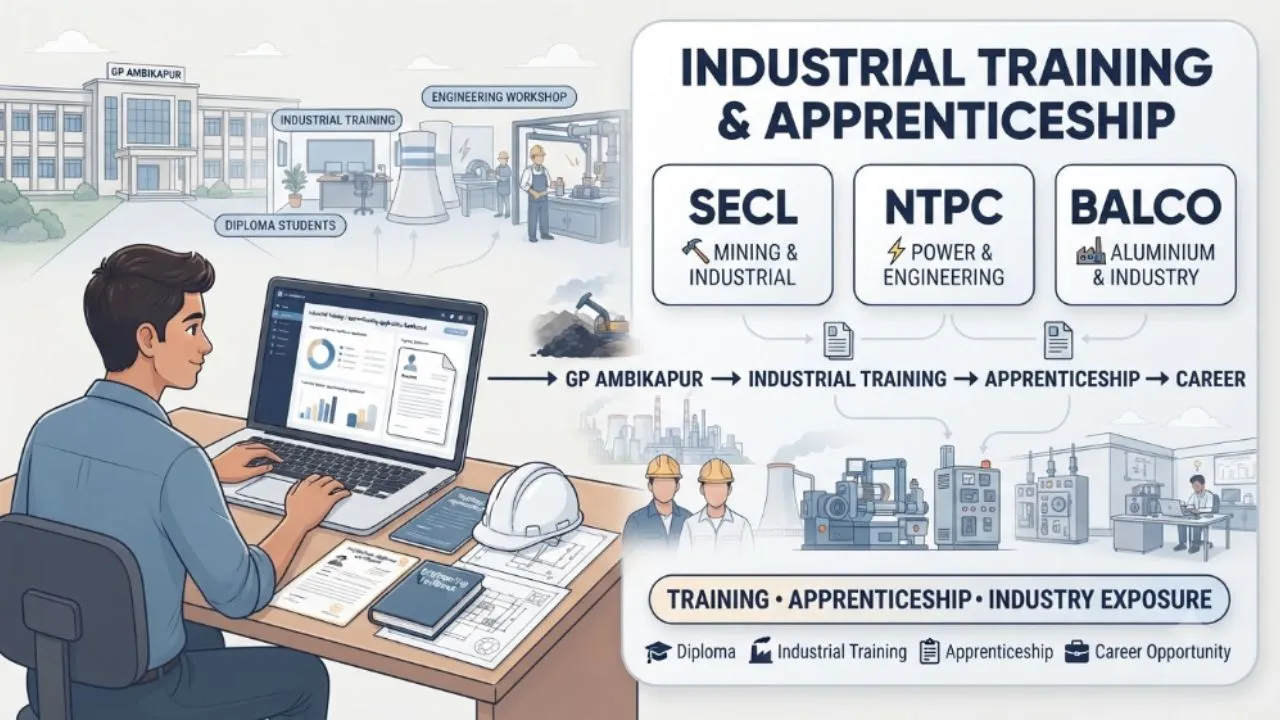
For diploma students, classroom learning is only one part of technical education. Workshops, laboratory sessions and practical assignments build the basics, but industrial training shows how those skills are used at an actual workplace.
For students of Government Polytechnic Ambikapur, this becomes particularly relevant because Chhattisgarh has a strong industrial base covering mining, power generation, metals, manufacturing and infrastructure.
Companies such as South Eastern Coalfields Limited (SECL), NTPC and BALCO operate in sectors closely connected with several diploma branches. Depending on the year, branch and eligibility requirements, students may find opportunities for industrial exposure, apprenticeship training or other forms of practical experience.
An apprenticeship is not the same as a permanent job. It is structured workplace training designed to give candidates practical experience and industry exposure.
For a diploma student planning a technical career, that experience can be valuable when applying for private jobs, future apprenticeships or eligible recruitment opportunities.
Table of Contents
Why Industrial Training Matters for Polytechnic Students
A diploma programme teaches students the fundamentals of their chosen engineering branch. Industrial training takes those concepts outside the classroom.
An Electrical Engineering student may understand transformers and electrical machines in the laboratory. At an industrial plant, the same concepts are connected with power distribution, maintenance, protection systems and workplace safety.
A Mechanical Engineering student can study machines in college and then observe how maintenance schedules, production systems and industrial equipment are managed at a real facility.
Mining students can gain exposure to mining operations, safety procedures, surveying and equipment.
This difference is important. Employers generally want candidates who understand not only technical concepts but also how industrial workplaces function.
Training can help students become familiar with reporting systems, safety rules, teamwork, technical documentation and workplace discipline.
It can also help them understand whether a particular industry actually suits their interests before they commit to a long-term career.
Industrial Training Opportunities for GP Ambikapur Students
Government Polytechnic Ambikapur offers several diploma branches connected with industries operating across Chhattisgarh.
These include areas such as Civil Engineering, Mechanical Engineering, Electrical Engineering, Electronics and Telecommunication, Computer-related disciplines and Mining Engineering.
The type of industrial exposure available can therefore differ from one branch to another.
A Mining Engineering student would naturally look towards mining companies and related contractors, while Electrical and Mechanical students can explore power plants, manufacturing units and industrial maintenance facilities.
Civil Engineering students can benefit from exposure to construction, infrastructure and project work.
Electronics and Telecommunication students can look for training involving automation, communication systems, instrumentation and control technologies.
The important point is to match the training opportunity with the diploma branch.
A well-known company is not automatically the best training destination if the work assigned has little connection with the student’s technical field.
SECL Apprenticeship Opportunities
South Eastern Coalfields Limited is one of the most relevant organisations for diploma holders interested in the mining sector.
SECL is a subsidiary of Coal India Limited and operates coal mines in Chhattisgarh and Madhya Pradesh.
Its apprenticeship programmes can provide opportunities for eligible diploma holders to receive practical exposure within the coal-mining environment.
SECL’s 2026 apprenticeship recruitment included opportunities for technician apprentices along with graduate and other apprentice categories.
The exact number of seats, disciplines, locations and eligibility conditions can change with each notification.
Mining Engineering students are naturally among the candidates who may look at SECL first.
However, opportunities can also be relevant to other technical branches when a notification includes their disciplines.
Candidates should carefully check the qualification mentioned in the current notification before applying.
An apprenticeship with SECL can provide exposure to an industry where safety, machinery, production, surveying and technical supervision play an important role.
That experience can be especially useful for students considering a long-term career in mining or related industries.
What Mining Students Can Learn at SECL
Mining Engineering is closely connected with the industrial environment around Ambikapur and the wider Surguja region.
Training in a coal-mining organisation can help students understand how classroom concepts translate into actual mining operations.
Depending on the assigned department and training programme, exposure may include mine operations, surveying, machinery, safety practices and technical documentation.
Students may also become familiar with the importance of safety procedures in active mining environments.
Mining is a field where theoretical knowledge alone is not enough. Understanding how workers, machinery, supervisors and engineers coordinate at a mine site can provide valuable professional experience.
An apprenticeship should therefore be treated as a learning opportunity rather than simply another certificate for a resume.
NTPC and Power-Sector Training
NTPC is another major organisation that can interest diploma students, particularly those studying Electrical and Mechanical Engineering.
The company operates power-generation facilities across India, including projects in Chhattisgarh.
Power plants provide an industrial environment where students can observe systems that are difficult to replicate fully in a college laboratory.
Electrical students can develop an understanding of power-generation equipment, electrical systems, protection, maintenance and control.
Mechanical students can gain exposure to turbines, boilers, pumps, maintenance systems and other equipment used in power generation.
Instrumentation-related training can also be relevant where opportunities are available.
The availability of apprenticeship seats depends on the recruitment cycle and the disciplines mentioned in the notification.
There is no guarantee that every diploma branch will have an opening in every recruitment cycle.
Students should therefore track apprenticeship announcements rather than assuming that a particular company will recruit their branch every year.
BALCO and the Aluminium Industry
Bharat Aluminium Company Limited, better known as BALCO, is another important industrial name for students in Chhattisgarh.
BALCO operates in the aluminium sector and has its major operations in Korba.
The organisation’s industrial environment can be relevant to diploma students interested in manufacturing, electrical systems, mechanical maintenance and production-related work.
Mechanical Engineering students can benefit from exposure to industrial machinery and maintenance practices.
Electrical students can learn about industrial electrical systems, equipment maintenance and plant operations.
Other technical disciplines may also find relevant opportunities depending on the apprenticeship or training programme announced at the time.
BALCO is particularly useful as an example of why students should look beyond conventional engineering companies when searching for practical exposure.
A large industrial plant can provide experience in safety, maintenance, quality control, production processes and teamwork.
Apprenticeship Is Not a Permanent Job
One point needs to be understood clearly before applying for any apprenticeship.
An apprenticeship is generally a training engagement, not a direct appointment to a permanent position.
Completion of apprenticeship training does not automatically guarantee a permanent job with SECL, NTPC, BALCO or another organisation.
This distinction matters because students sometimes assume that entering an apprenticeship means they have already secured a government or PSU job.
The actual purpose is to develop workplace skills and provide structured industry exposure.
The experience may strengthen a candidate’s profile for future employment, but selection for a permanent position requires meeting the eligibility criteria and selection process applicable to that recruitment.
Students should therefore consider apprenticeships as a bridge between college education and professional work.
How GP Ambikapur Students Can Find Opportunities
Students should not wait until their final semester to start looking for industrial training.
A better approach is to begin tracking opportunities well before the required training period.
Check the official career and apprenticeship pages of companies regularly.
The National Apprenticeship Training Scheme, commonly known as NATS, is also important for diploma and graduate technical apprenticeships.
Some organisations use NATS for registration and apprenticeship-related processes.
Other employers may use the National Apprenticeship Promotion Scheme or their own application systems depending on the type of training.
The application route should always be confirmed from the current notification.
Students should also keep their documents ready.
These can include educational certificates, identity documents, bank details, photographs, category certificates where applicable and proof of registration on the required apprenticeship portal.
The exact documents vary between organisations.
What Students Should Learn Before Applying
Academic marks are only one part of an industrial training application.
Students should also build practical knowledge related to their branch.
Electrical students can revise electrical machines, basic power systems, measurements and safety.
Mechanical students can focus on manufacturing, machine elements, workshop practices, maintenance and technical drawing.
Mining students should strengthen their understanding of surveying, mine machinery, geology and safety.
Civil students can work on surveying, construction materials, estimation and computer-aided design.
Electronics students can revise digital electronics, microcontrollers, communication systems and basic industrial automation.
Computer-related students can build practical skills through programming, databases, networking and small projects.
The goal is not to know everything before entering training.
The goal is to have enough foundation to understand what is happening at the workplace.
Skills That Make Industrial Training More Valuable
Simply completing an apprenticeship does not automatically make a student employable.
The quality of learning during the training period matters much more.
Students should observe how experienced technicians and engineers perform their work.
Ask relevant questions when permitted.
Maintain notes about machines, processes and technical terms encountered during training.
Learn how technical reports and maintenance records are prepared.
Pay attention to workplace safety instead of treating safety instructions as formalities.
Communication also matters.
A technician may have excellent technical knowledge but still struggle in an industrial environment if communication and teamwork are weak.
Basic computer skills are increasingly useful across technical departments as companies use digital maintenance records, monitoring systems and documentation.
Apprenticeship and Future Job Opportunities
Industrial training can help students understand the difference between college qualifications and workplace expectations.
After completing a diploma and gaining practical experience, candidates can explore private-sector technical jobs, government recruitment and further education.
Mining diploma holders can monitor recruitment from coal and mining organisations.
Electrical students can explore power companies and industrial maintenance roles.
Mechanical students can look at manufacturing, automobile, production and maintenance industries.
Civil diploma holders can explore construction and infrastructure companies.
Students can also consider lateral entry into B.Tech programmes where they meet the applicable admission requirements.
The combination of diploma education, industrial experience and a later engineering degree can provide a broader career path.
How to Prepare for SECL, NTPC and BALCO Opportunities
Preparation should begin before an advertisement appears.
Keep academic documents updated and register on the relevant apprenticeship portals when eligible.
Follow official recruitment announcements rather than relying only on social media posts or coaching websites.
Check the branch requirement carefully.
Some notifications may accept specific diploma disciplines while excluding others.
Age limits, passing-year restrictions, percentage requirements, domicile rules and previous apprenticeship conditions can also vary.
Students should also read the training location and duration before applying.
An opportunity may require relocation or daily travel, which should be considered before accepting an offer.
Most importantly, do not pay money to an individual claiming to guarantee an apprenticeship seat.
Use the official application process and verify the notification before submitting personal information.
Making the Most of Training at a PSU or Large Industrial Company
Getting selected is only the first step.
Students should approach training with the mindset of a learner rather than someone simply completing a college requirement.
Try to understand why a process is performed in a particular way.
Observe safety procedures.
Learn the names and functions of equipment.
Understand how maintenance and inspection are documented.
If permitted, take part in supervised practical activities.
Keep a record of the skills and processes learned during training.
This information can later help during job interviews.
When an interviewer asks about industrial experience, a student who can explain a specific machine, process or maintenance activity will usually make a stronger impression than someone who simply says that an apprenticeship was completed.
Final Words
Industrial training can be one of the most useful parts of a diploma education at Government Polytechnic Ambikapur. For students interested in mining, SECL offers a natural connection with the region’s coal industry. NTPC can be relevant to students interested in power generation, while BALCO provides exposure to a major aluminium and industrial manufacturing environment. Opportunities are not identical every year, and selection depends on the eligibility conditions and vacancies mentioned in each notification.
Students should therefore avoid treating SECL, NTPC or BALCO apprenticeship as guaranteed placements. The better approach is to monitor official announcements, apply only when eligible and focus on learning during the training period.
A diploma combined with genuine industrial exposure can give students a much clearer understanding of their chosen profession. For GP Ambikapur students, the biggest advantage of apprenticeship is not simply having a recognised company name on a resume. It is the chance to connect classroom knowledge with real equipment, workplace systems, safety practices and professional responsibilities.