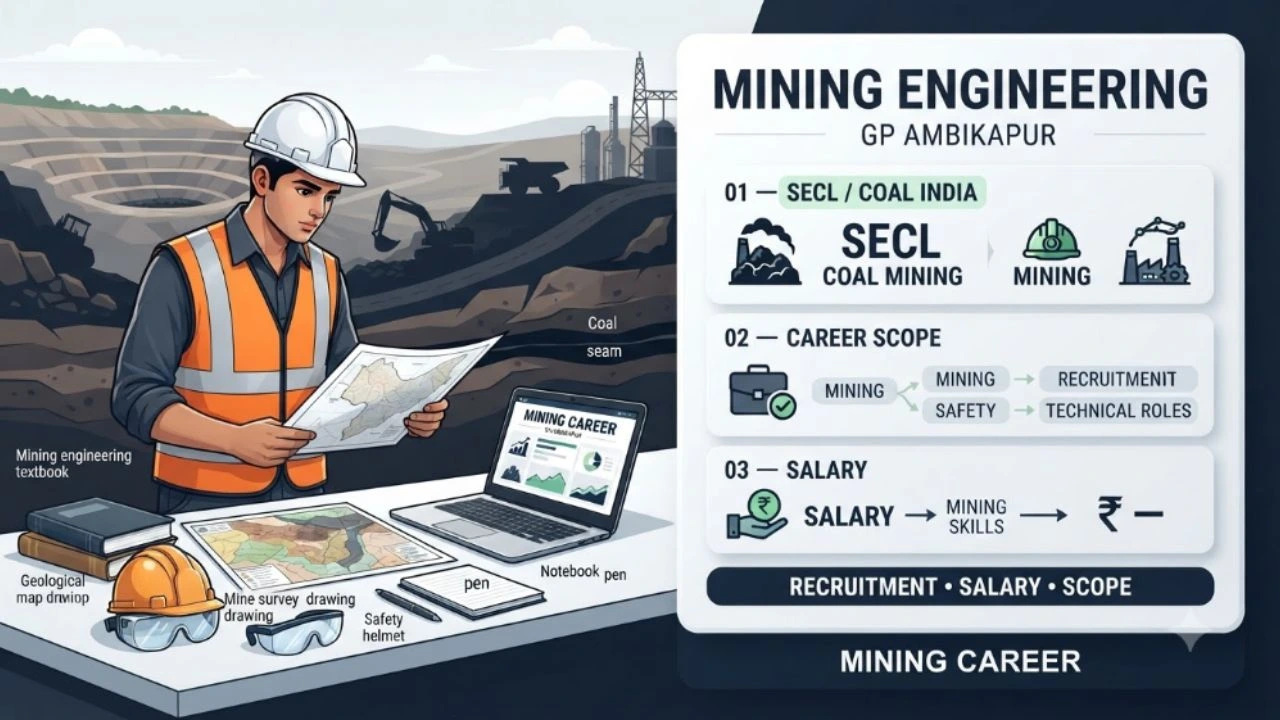
Mining Engineering is a specialised diploma branch for students interested in coal mining, mine operations, surveying, machinery and safety. At Government Polytechnic Ambikapur, the branch has particular relevance because of the mining activity around Surguja.
The institute introduced Mining and Mine Surveying during the 1988-89 session, considering the region’s coal and bauxite resources. For students from Ambikapur, Surajpur and nearby districts, this local connection can make Mining Engineering worth considering.
The course is not limited to coal production. It covers mine planning, geology, surveying, ventilation, machinery, blasting, safety and environmental management. A diploma can also open routes into private mining companies, contractors, government recruitment and further engineering studies.
Table of Contents
Mining Engineering at Government Polytechnic Ambikapur
Government Polytechnic Ambikapur offers a three-year Diploma in Mining Engineering after Class 10. The official department information lists 40 regular seats along with two TFW seats and four lateral-entry seats. The department has dedicated faculty members with Mining Engineering backgrounds and practical facilities related to mining operations.
Its laboratories include Mine Machinery, Survey, Geology, Gas Testing and Mining Model laboratories. The Mine Machinery laboratory includes equipment such as methanometers, carbon monoxide detectors and self-contained breathing apparatus.
The Survey laboratory includes total stations, EDM equipment, digital theodolites and mining instruments. Students therefore get exposure to equipment and concepts that are directly connected with actual mining work.
The course is suitable for students who prefer technical and field-based learning. It also requires comfort with mathematics, science, measurements, machinery and safety procedures.
What Students Learn in Diploma Mining Engineering
Mining Engineering combines classroom learning with practical training related to mineral extraction. The syllabus typically introduces students to mining methods, mine surveying, geology, mining machinery and mine ventilation.
Other important areas include rock mechanics, mine safety, drilling, blasting, mineral processing and environmental considerations. Surveying is especially important because accurate measurements are required during mine development and excavation.
Geology helps students understand rock formations, mineral deposits and the conditions surrounding a mining site. Mine machinery introduces the equipment used for excavation, transportation and other production activities.
Safety is another major part of the field because mining operations involve machinery, gases, blasting and difficult working conditions. This combination makes the diploma different from engineering branches that are primarily classroom or computer-based.
Why Surguja Is Relevant for Mining Students
Surguja has a strong connection with coal mining, which gives Mining Engineering students a useful regional advantage. South Eastern Coalfields Limited, commonly known as SECL, operates coal mining activities across Chhattisgarh and Madhya Pradesh.
The company is a subsidiary of Coal India Limited and remains an important public-sector employer within India’s coal industry. Mining activity around the Surguja region also means students can understand the industry from a nearby geographical perspective.
SECL’s operations in the area include mines around Bishrampur and other parts of the Surguja belt. The region has also seen continuing administrative and operational activity connected with coal mining projects. This does not mean that every Mining Engineering graduate will receive employment locally.
Recruitment depends on vacancies, eligibility, examinations, certificates, experience and the requirements mentioned in each notification. That distinction is important when evaluating the career value of this diploma.
SECL and Coal India Recruitment After Mining Diploma
SECL can be one of the major government-sector targets for candidates interested in mining careers. Recruitment is not conducted through a single permanent examination every year.
Different notifications can introduce different posts, qualifications, selection methods and statutory requirements. In 2026, SECL announced recruitment for 1,055 technical positions covering Mining Sirdar, Deputy Surveyor and Assistant Foreman.
The recruitment included 577 Mining Sirdar posts and 43 Surveyor posts, alongside electrical Assistant Foreman positions. The 2026 notification is a useful example of how mining-related government recruitment works.
It also shows why students should not assume that a Mining Engineering diploma automatically guarantees eligibility. Certain positions can require additional qualifications, certificates or statutory credentials.
Mining Sirdar-related recruitment, for instance, can involve requirements connected with Mining Sirdarship, gas testing and first-aid certification. The exact conditions must always be checked against the recruitment notification applicable to that particular post.
What About Coal India Recruitment?
Coal India Limited is the parent public-sector company under which SECL operates. Its recruitment opportunities cover several technical, managerial and operational categories.
For a diploma holder, the relevant opportunities depend on the qualification and experience requirements specified in individual notifications. Mining graduates should therefore monitor Coal India and SECL recruitment notices rather than relying on old eligibility information.
A recruitment advertisement can specify the required diploma discipline, experience, age limit and statutory certificates. The selection process can also differ between posts.
Some positions may involve written examinations, while others can include document verification, skill requirements or other stages. For this reason, preparation should be based on the exact notification rather than general assumptions about Coal India recruitment.
Government Jobs Beyond SECL
SECL is an important option, but it is not the only possible government career route. Mining diploma holders can explore technical recruitment across government departments, public-sector organisations and mining-related agencies. The actual eligibility varies according to the post and recruitment authority.
Some positions may require a Mining Engineering diploma, while others may require specific statutory certificates or work experience. Candidates can also look for opportunities related to mining operations, surveying, technical supervision and mineral administration.
State-level recruitment can provide another route, particularly when vacancies are announced for technical positions. The Surguja district administration also maintains recruitment notices related to mining and other government activities. This makes official recruitment portals particularly important for candidates searching for local opportunities.
Salary After Mining Engineering Diploma
Salary is one of the most searched topics among students considering Mining Engineering. There is no single salary figure applicable to every diploma holder. Pay depends heavily on the employer, designation, recruitment method, experience and location. Government-sector jobs can offer structured pay scales and allowances according to the applicable rules.
Private mining companies can have considerably different salary structures for technicians, supervisors and other technical employees. Fresh diploma holders should therefore avoid choosing the course based only on advertised salary figures.
The better approach is to compare the starting pay, job responsibilities, working conditions and opportunities for progression. For government recruitment, the official notification is the most reliable source for the applicable basic pay.
For example, the 2026 SECL recruitment for the listed T&S Grade-C technical posts carried a starting basic pay of ₹47,330 per month. That figure applies to the specified recruitment and should not be treated as the universal salary for every Mining Engineering diploma holder.
Private-Sector Career Options
A Mining Engineering diploma can also lead to private-sector employment. Mining contractors, infrastructure companies, drilling firms and equipment-related businesses can require technically trained personnel. Possible roles include mining technician, survey assistant, site supervisor, junior technical staff and machinery-related positions.
The exact designation depends on the organisation and the candidate’s experience. Practical skills can make a noticeable difference during private-sector recruitment. Students who understand surveying equipment, mine safety, machinery and technical drawings can have an advantage. Computer skills are increasingly useful as mining operations become more dependent on digital systems. Knowledge of CAD, surveying software, GPS-based measurements and basic data handling can strengthen a diploma holder’s profile.
Mining Engineering and Further Studies
A diploma does not have to be the end of the educational journey. Students can pursue higher education after completing their Mining Engineering diploma. One possible route is lateral entry into an engineering degree, subject to the admission rules of the university or state.
In such cases, eligible diploma holders can enter an appropriate stage of the B.Tech or B.E. programme. The exact branch, admission year and eligibility conditions differ between institutions. Some students choose this route because an engineering degree can expand the range of technical and supervisory positions available later. Others prefer employment after the diploma and pursue additional qualifications alongside work. The right route depends on the student’s financial situation, career plans and preferred type of work.
Is Mining Engineering Suitable for Students in Surguja?
Mining Engineering can make sense for students who are genuinely interested in the mining sector. The regional presence of coal mining gives the course a clear connection with the local employment landscape. However, the work itself should be understood before choosing the branch. Mining careers can involve field visits, mine sites, machinery, irregular working conditions and strict safety procedures. The profession is different from an office-based engineering career.
A student who prefers practical work, machinery and field operations may find the branch more suitable. Someone interested mainly in software development or computer-based careers may find Computer Science Engineering more aligned with their interests.
The local availability of mining activity should be considered an advantage, not a guarantee of employment.
Skills That Can Improve Career Prospects
A Mining Engineering diploma provides the technical foundation, but additional skills can improve employability. Mine surveying deserves particular attention because accurate measurement is central to many mining activities.
Students can also develop skills related to CAD, technical drawing, mining software and basic computer applications. Knowledge of mine safety procedures is essential for anyone planning to work around active mining operations.
Communication skills also matter when working with supervisors, operators, engineers and other site personnel.
Students should take industrial training seriously because practical exposure helps connect classroom concepts with actual workplace situations.
Relevant certificates can also become useful when specific recruitment notifications mention them as eligibility requirements.
Final Verdict
Mining Engineering at Government Polytechnic Ambikapur has a strong regional connection with the Surguja mining belt. The institute offers a dedicated diploma programme with mining laboratories, surveying equipment and practical facilities. Its location can be useful for students who want to understand the mining industry within a major resource-producing region.
SECL and Coal India can provide attractive government-sector career opportunities, but recruitment remains vacancy-based and eligibility-specific. The 2026 SECL recruitment illustrates the potential available to candidates with relevant qualifications and required certifications. For a student interested in fieldwork, machinery, surveying and mining operations, the diploma can be a practical starting point.
Those seeking broader engineering opportunities can consider lateral entry into a degree programme after completing the diploma. The strongest career strategy is to combine the Mining Engineering qualification with practical training, relevant certifications and consistent preparation for recruitment examinations.