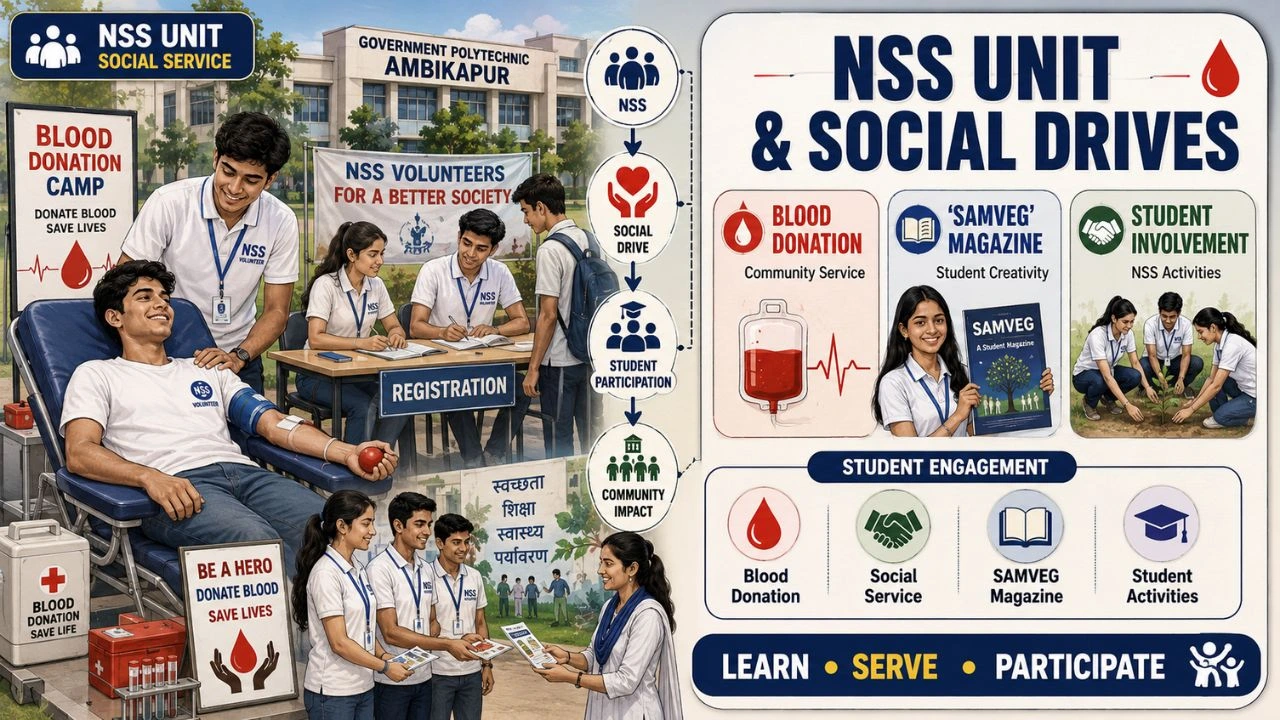
A polytechnic education is not limited to classrooms, laboratories and semester examinations. Students also learn through activities that connect the campus with the wider community. At Government Polytechnic Ambikapur, social and student-focused activities provide another side of campus life. The National Service Scheme (NSS) gives students an opportunity to participate in community-oriented programmes, while the institution’s NSS magazine, ‘SAMVEG’, provides a platform to document and showcase student involvement.
Activities such as blood donation camps, awareness programmes, cleanliness drives and community service can help technical students develop skills that are difficult to gain from textbooks alone. For diploma students, these experiences can build confidence, teamwork and a stronger sense of responsibility alongside their technical education.
Table of Contents
NSS at Government Polytechnic Ambikapur
The National Service Scheme is designed to encourage students to participate in community service and understand social responsibilities. At a technical institution such as Government Polytechnic Ambikapur, NSS activities can complement the practical nature of diploma education.
Students who take part in social drives often work in groups, coordinate with organisers and communicate with people outside their usual classroom environment. This can be particularly useful for students who spend most of their time attending lectures and practical sessions.
The college’s broader educational approach also places emphasis on life skills and value-based education. NSS activities fit naturally into that approach by giving students opportunities to learn through participation. The experience is not about simply attending an event.
Students can become involved in planning, coordination, awareness campaigns, volunteer work and documentation, depending on the activity.
Blood Donation Camps and Student Participation
Blood donation is one of the most meaningful community activities associated with student volunteering. A blood donation camp on or around a college campus can bring together students, faculty members, medical professionals and other volunteers for a common purpose.
For students, participation can involve more than donating blood. Volunteers may help with registration, crowd management, awareness activities, communication and coordination with the medical team.
These responsibilities require discipline and attention to instructions. Students also get an opportunity to understand why voluntary blood donation matters and how organised donation camps are conducted.
At the same time, participation in a blood donation activity should always remain voluntary. Eligibility for donating blood is determined by medical professionals and applicable health requirements. Students who are not eligible to donate can still contribute through other volunteering responsibilities. This makes blood donation camps useful community activities even for students who cannot personally donate.
What Students Learn Through Social Drives
Social service activities can develop several practical skills that are relevant beyond college. Teamwork is one of the most obvious.
A successful community programme usually requires several people to handle different responsibilities. One group may coordinate logistics, another may manage registration, while others interact with participants. Communication becomes equally important.
Students have to explain activities clearly, speak with different groups and sometimes coordinate with external organisations. Planning is another useful skill. Even a small campus activity requires decisions about timing, venue, permissions, volunteers, materials and communication.
Students who take part regularly can gradually become more comfortable handling such responsibilities. These experiences can be useful during job interviews as well. Employers may ask candidates about teamwork, leadership or situations in which they handled responsibility.
An NSS activity does not replace technical skills, but it can give students real examples to discuss when answering such questions.
‘SAMVEG’ Magazine at GP Ambikapur
The college website lists ‘SAMVEG’ as an NSS magazine, giving the publication a connection with student and social-service activities at Government Polytechnic Ambikapur. A college magazine can serve several purposes.
It can document NSS programmes, highlight student participation and preserve important campus activities for future reference. It can also provide students with a platform to express themselves through articles, reports, photographs, creative writing and other contributions.
For technical students, this is a useful change from regular academic assignments.
Writing about a social activity requires students to observe what happened, organise information and present it clearly. Those skills are valuable in professional life.
Engineers and technicians regularly prepare reports, write emails, maintain records and explain technical matters to colleagues. A student who develops clear writing and communication skills alongside technical knowledge can be better prepared for workplace responsibilities.
Why a Student Magazine Matters
A magazine such as SAMVEG can help create a record of campus life that is different from academic documents. Marksheets show academic performance.
A magazine can show another side of student life, including participation, creativity and community involvement. It can also give students an opportunity to work behind the scenes. Editing, collecting material, preparing reports, selecting photographs and organising contributions all require coordination.
Students interested in writing can contribute articles. Those comfortable with photography can document events. Students with design skills can assist with layouts and visual presentation. This makes a student publication a collaborative activity rather than something limited to writers.
For a polytechnic student, such work can also provide an early introduction to professional communication and content preparation.
Cleanliness and Community Awareness Drives
Cleanliness activities are another common area of student volunteering. A campus or community cleanliness drive can encourage students to think about waste management, public spaces and environmental responsibility. The value of such an activity comes from participation rather than the number of photographs taken during the event.
Students can help spread awareness, organise volunteers and encourage responsible disposal practices. Similar campaigns can focus on environmental protection, water conservation, road safety, health awareness or other community concerns.
The exact activities conducted by an NSS unit can vary from one academic session to another. That is why students should look at the current college notices and NSS announcements for information about upcoming programmes.
Student Involvement Beyond the Classroom
College life becomes more useful when students participate in activities outside their regular timetable. A diploma student already spends considerable time studying technical subjects and attending practical sessions.
NSS provides another environment where students can interact with classmates from different branches and take responsibility for shared activities. This can strengthen relationships across the campus. A student from Mechanical Engineering may work with someone from Computer Science or Electrical Engineering during a social campaign.
They may have different academic interests, but the activity gives them a common task. Such experiences can improve cooperation and help students become more comfortable working with people who have different skills. That matters in technical workplaces, where projects are rarely handled by one person or one department alone.
Leadership Opportunities Through NSS
Not every student joins an NSS activity as a leader. Many begin as volunteers and gradually take on more responsibility. A student who consistently participates may eventually help coordinate a particular programme or manage a group of volunteers.
This progression can develop leadership skills naturally. Leadership in this setting is not about giving instructions to others. It involves planning, listening, solving small problems and ensuring that responsibilities are completed properly.
For example, organising a campus awareness drive may require volunteers to arrive on time, distribute materials, communicate with participants and complete the assigned work. A student coordinating the group has to keep all these pieces moving.
Such situations can build practical leadership experience without turning the activity into a formal management exercise.
NSS and Career Development
NSS participation should not be viewed as a substitute for technical preparation. For a diploma student, core technical knowledge remains the foundation of employability. A Civil Engineering student still needs to understand surveying and construction concepts. An Electrical Engineering student needs knowledge of electrical systems and equipment.
A Mechanical Engineering student needs strong fundamentals related to machines and manufacturing. NSS adds another layer to this education. It can help students develop communication, teamwork, confidence, discipline and organisational skills.
These qualities are useful in both government and private-sector workplaces. During recruitment, candidates may be asked about situations involving teamwork or responsibility. A student who has genuinely participated in social activities can use those experiences to give specific answers rather than relying on generic statements.
How Students Can Make the Most of NSS Activities
Students do not need to participate in every activity to benefit from NSS. The quality of involvement matters more than simply collecting participation certificates. When joining a programme, try to understand its purpose.
Take responsibility for an assigned task and complete it properly. If the activity involves documentation, learn how to prepare a short report. If it involves public interaction, practise speaking clearly and respectfully. If it involves a team, learn how responsibilities are divided.
Students can also maintain a simple record of activities they participate in. Note the name of the programme, date, role and key responsibilities. This can make it easier to describe the experience later in applications, interviews or a personal profile. The focus should remain on genuine participation rather than adding activities only for a resume.
Balancing NSS With Academic Work
Technical education already has a demanding schedule. Students need to manage lectures, practical classes, assignments, examinations and project work.
NSS participation should fit around these academic responsibilities. A well-managed social activity can add value to college life, but students should not allow extracurricular commitments to affect attendance or academic preparation.
Time management becomes particularly important during examination periods. The most useful approach is to participate when the schedule allows and contribute responsibly when taking on a task.
Students can also divide responsibilities within a group instead of trying to manage every part of an event themselves. This creates a healthier balance between academic and extracurricular commitments.
Why Social Participation Matters at a Polytechnic College
Technical education prepares students to work with machines, systems, software, structures and industrial processes. Professional life, however, also involves people. Technicians work with supervisors. Engineers coordinate with workers and clients.
Project teams communicate across departments. Managers depend on clear reporting and teamwork. Social activities give students an early opportunity to practise these human aspects of professional life.
Blood donation camps, awareness programmes, cleanliness drives and student publications may appear separate from engineering education. In practice, they can develop communication, coordination and responsibility that remain useful in almost every career.
Final Words
The NSS unit and social activities at Government Polytechnic Ambikapur add an important community-oriented dimension to technical education. Blood donation camps and other social drives allow students to contribute beyond the classroom, while the SAMVEG NSS magazine provides a platform to document and showcase student involvement.
The benefits go beyond participation certificates. Students can develop teamwork, communication, planning, leadership and organisational skills while working with their classmates and the wider community.
For students at GP Ambikapur, these activities can become a valuable part of college life when approached with genuine interest. Technical knowledge remains central to a diploma education, but professional growth also depends on the ability to communicate, cooperate and take responsibility. NSS offers students a practical setting to develop those qualities while contributing to meaningful community activities.