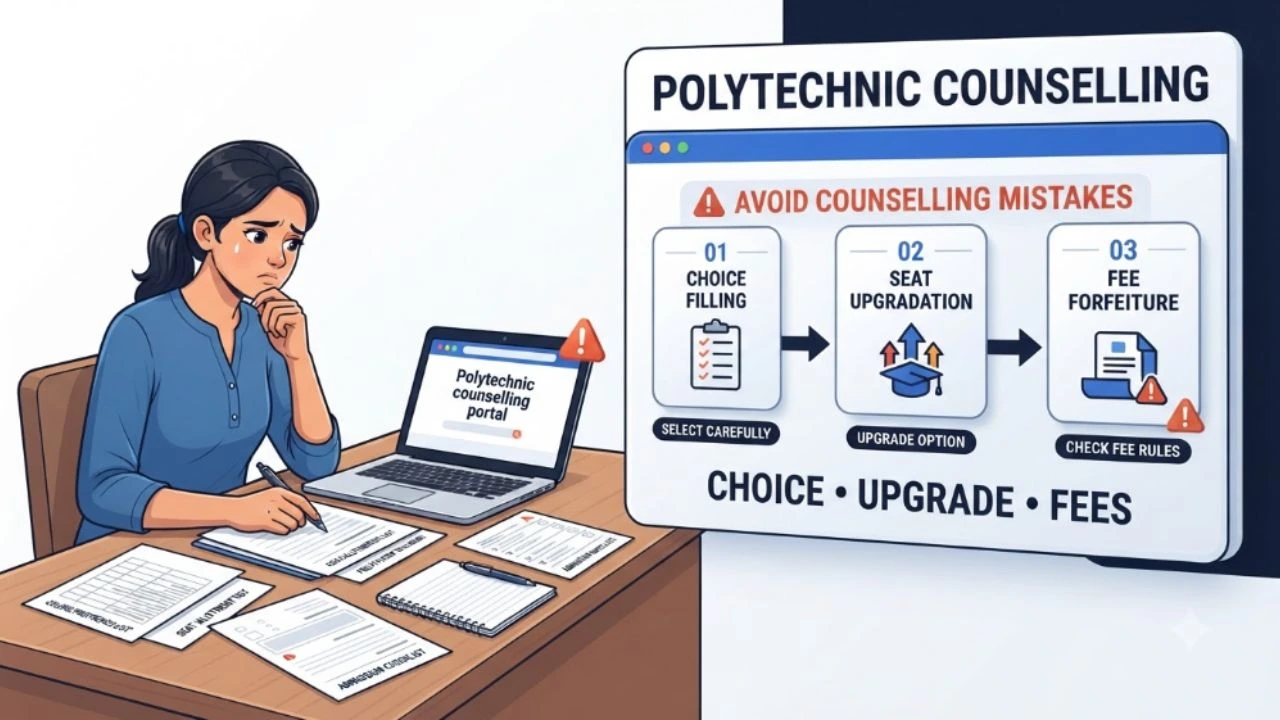
Polytechnic counselling can be confusing, especially when a student receives a seat in one round and then has to decide whether to accept it, wait for an upgrade or participate in another round. A small mistake during choice filling can affect the branch or college available later. Similarly, leaving a seat without understanding the refund rules can result in losing part or all of the amount already paid.
The counselling process differs across states and admission authorities, but the basic decisions are similar. Students usually have to arrange college and branch preferences, check seat allotment results, decide whether to retain or upgrade a seat, complete document verification and pay the required fees within the deadline. Understanding these steps before counselling begins can prevent many avoidable problems.
Table of Contents
What Is Polytechnic Counselling?
Polytechnic counselling is the process through which eligible candidates are allotted seats in diploma programmes based on factors such as entrance rank, merit, category, available seats and the choices entered during registration. In states where admission is conducted through an entrance examination, candidates generally receive a rank after the result. They can then participate in online counselling and select their preferred colleges and branches.
Some states also use merit-based admission instead of a common entrance examination. The exact process depends on the state. The counselling authority’s notification should always be treated as the final source for deadlines, fees, seat acceptance rules and withdrawal conditions.
The Most Common Choice-Filling Mistake
One of the biggest mistakes is filling only a few choices. Suppose a candidate wants Computer Science Engineering at a government polytechnic. The candidate enters only two colleges because those are the preferred options.
If the rank is not competitive enough for either college, the candidate may receive no seat in that round. A better approach is to create a realistic preference list that includes:
- Preferred branches
- Preferred government colleges
- Other suitable government institutes
- Government-aided options where applicable
- Private colleges if they fit the budget
- Alternative branches that the candidate is genuinely willing to study
More choices do not guarantee admission, but they can provide additional possibilities during seat allotment.
How Choice Filling Actually Works
Choice filling is not simply a list of colleges. Each choice generally represents a specific college-branch combination.
For example, these are separate preferences:
- Government Polytechnic A – Computer Engineering
- Government Polytechnic A – Electrical Engineering
- Government Polytechnic B – Computer Engineering
- Government Polytechnic B – Mechanical Engineering
The counselling system considers the candidate’s rank, category, available seats and preference order according to the rules of that admission authority.
If Computer Engineering at College A is your first preference and Electrical Engineering at the same college is your second preference, placing them in that order tells the system which option you prefer when both are potentially available.
Do Not Copy Someone Else’s Choice List
Another common mistake is copying a friend’s choices. A college that works well for one candidate may not be suitable for another. Distance, hostel expenses, branch preference, fees and future plans can be completely different.
Consider two students with similar ranks. One may prefer Civil Engineering because of an interest in construction and government technical jobs. The other may want Computer Engineering and plans to continue into software development. Their choice lists should not be identical. Your preference order should reflect your own priorities, not another candidate’s rank or recommendation.
How Many Choices Should You Fill?
There is no universal number that guarantees a seat. The sensible approach is to include every college and branch combination that you would genuinely accept.
Do not add a branch merely to increase the number of choices if you would refuse that seat later. At the same time, do not make the list unnecessarily narrow.
A practical list can include:
- High-preference choices
- Realistic choices based on rank
- Safer options
- Acceptable backup branches
This creates a balance between ambition and practicality.
What Happens After Seat Allotment?
Once a counselling round is completed, candidates can check their allotment result. There are several possible situations. You may receive your preferred college and branch. You may receive a backup choice. You may receive a different branch than expected. You may not receive a seat at all.
The next step depends on the rules of the counselling authority. A candidate who receives a seat generally has to complete the required seat acceptance or fee payment within the specified deadline. Ignoring the result can cause the allotted seat to be cancelled.
Seat Upgradation: What Does It Mean?
Seat upgradation allows a candidate to continue in counselling while trying to obtain a higher preference in a subsequent round, where such a facility is available.
For example, imagine that your preference list is:
- College A – Computer Engineering
- College B – Computer Engineering
- College C – Computer Engineering
- College A – Electrical Engineering
You receive College C – Computer Engineering in Round 1.
If the counselling rules allow you to participate in an upgrade, you may choose the relevant option and remain eligible for a better preference in a later round. The exact terminology can differ. Some authorities use terms such as Float, Upgrade, Freeze, Slide or Float/Freeze. Do not assume that these options work identically across all states.
Freeze vs Upgrade
Freeze means you are satisfied with the allotted seat and want to retain it rather than seek another option through subsequent rounds.
Upgrade or Float generally means you want to keep the allotted seat while remaining eligible for a better preference in a later round, subject to the counselling rules.
The important point is that selecting an upgrade option does not guarantee a better seat.
If no higher preference becomes available, the existing allotment may remain subject to the authority’s rules.
A Major Mistake: Upgrading Without Understanding the Risk
Some candidates choose upgrade or float simply because they think a better seat will definitely appear. A higher preference becomes available only if seats open up and the candidate meets the conditions for that seat. Before choosing an upgrade option, check what happens to the existing seat if the next round produces no improvement. Also understand what happens if a higher preference is allotted.
In many counselling systems, a new allotment can replace the earlier seat according to the rules. The candidate may not be able to return to the previous choice.
Fee Payment and Seat Confirmation
After receiving a seat, candidates may have to pay a counselling, seat acceptance or admission-related fee. This payment can serve different purposes depending on the authority.
It may confirm the candidate’s willingness to take the allotted seat, allow participation in further counselling or complete a stage of admission. Do not assume that every amount paid during counselling is refundable.
There may be separate rules for:
- Counselling fee
- Seat acceptance fee
- Admission fee
- Tuition fee
- Security deposit
- Hostel fee
Keep payment receipts and transaction details safely.
What Is Fee Forfeiture?
Fee forfeiture means that an amount already paid may not be returned when a candidate withdraws, fails to report, changes admission or does not meet a specified deadline. The exact amount that can be forfeited depends on the counselling authority and the stage at which the candidate withdraws.
For example, a counselling fee may be non-refundable from the beginning, while a tuition or security amount may have different refund conditions. This is why candidates should read the refund and withdrawal rules before paying a large amount.
When Can a Seat Be Lost?
A seat can be lost for several reasons, depending on the admission system.
Common problems include:
- Not paying the required fee on time
- Failing to complete document verification
- Not reporting to the allotted college
- Providing incorrect information
- Failing to meet eligibility requirements
- Missing the counselling deadline
- Withdrawing after a specified refund deadline
The most avoidable problem is simply missing a deadline. Counselling portals often operate according to strict schedules. A candidate should not wait until the final few hours to complete payment or document submission.
Do Not Assume Every Fee Will Be Refunded
This is particularly important when a candidate receives a seat but later changes plans. Suppose a student accepts a seat at College A and later receives a preferred seat at College B. The student should not assume that every amount paid for College A will automatically be returned.
Refunds can depend on the date of withdrawal, the type of fee and the rules of the admission authority. Before leaving a seat, check the official refund policy and keep proof of the withdrawal request.
What Happens If You Do Not Get a Seat?
Not receiving a seat in the first round does not necessarily mean the counselling process is over. Depending on the admission system, later rounds may be conducted when candidates withdraw, fail to complete admission or move to other colleges.
Candidates can also look for:
- Subsequent counselling rounds
- Vacancy rounds
- Special rounds
- Spot admissions
- Institute-level admissions where permitted
The availability of these options varies by state and institution.
Common Polytechnic Counselling Mistakes to Avoid
Filling Too Few Choices
A short preference list can reduce your chances of getting a seat, especially when competition is high.
Selecting a Branch You Do Not Want
Do not add a branch only because the college is popular. You may later find yourself paying fees for a programme you never intended to pursue.
Ignoring College Location
Hostel, transportation and living expenses can significantly change the total cost of education.
Choosing Upgrade Without Reading the Rules
Understand what happens to your current seat before selecting an upgrade or float option.
Missing Payment Deadlines
A good rank does not protect a candidate from losing an allotted seat after missing a mandatory deadline.
Assuming All Fees Are Refundable
Different payments can have different refund rules. Check the official policy before withdrawing.
Failing to Keep Documents Ready
Keep marksheets, certificates, photographs, identification documents, category certificates and other required paperwork prepared before counselling begins.
Relying on Old Information
Counselling rules can change every year. A process used in 2025 may not be identical in 2026.
A Simple Strategy for Polytechnic Counselling
Before choice filling begins, make three lists.
List 1: Preferred choices
These are the colleges and branches you would most like to join.
List 2: Realistic choices
These are options that match your rank, category and previous admission trends more closely.
List 3: Backup choices
These are acceptable colleges and branches that you would genuinely join if your preferred options are unavailable.
Then arrange all choices in your actual order of preference.
After each counselling round, check the allotment result, payment deadline, upgrade rules and reporting requirements.
Do not make a decision based only on the college name. Compare the branch, fees, location, facilities, travel time and future plans together.
Final Words
Polytechnic counselling becomes much easier when candidates understand how choice filling, seat allotment, upgradation and fee rules work before the first round begins. The safest approach is to prepare a realistic preference list, enter choices carefully and keep track of every deadline. If you receive a seat, read the instructions before choosing Freeze, Upgrade, Float or any similar option.
Most importantly, do not assume that counselling rules are the same across India. The admission authority for your state or institution decides the actual process. A good rank can improve your options, but careful counselling decisions determine how effectively you use that rank.