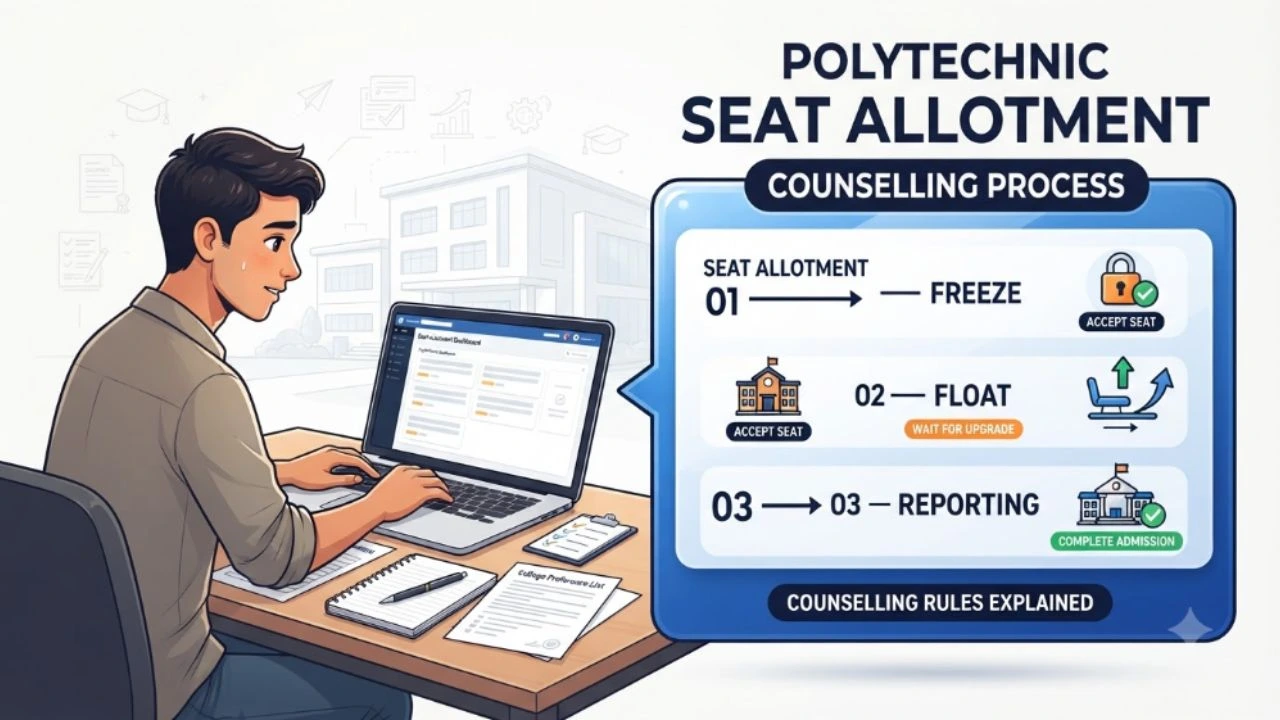
After the entrance exam or merit list, getting a good rank is only the first part of polytechnic admission. The next important stage is counselling, where candidates select colleges and branches, receive seat allotments, and complete the admission process. For many students, terms such as Freeze, Float, Float/Upgrade, Seat Acceptance, Document Verification and Reporting can be confusing. The exact options vary between states and counselling authorities, but the basic process remains similar.
This guide explains how polytechnic counselling generally works, what happens after seat allotment, and what you should check before accepting a seat.
Table of Contents
What Is Polytechnic Counselling?
Polytechnic counselling is the process through which eligible candidates are allotted seats in diploma programmes based on their entrance exam rank, merit, category, preferences and available seats. After the result is announced, the counselling authority opens registration and choice filling. Candidates select their preferred colleges and branches from the available list.
The system then processes these choices according to the applicable admission rules. For instance, a candidate with a strong rank may receive the first choice if a seat is available. Another candidate may receive the second or third preference if seats in the preferred branch have already been filled. Counselling is usually conducted online, although physical reporting and document verification may be required later.
Polytechnic Counselling Process: Step-by-Step
The exact procedure depends on the state and admission authority. In most cases, the process follows these stages.
1. Check the Counselling Notification
After the entrance exam result, visit the official counselling website and check the latest notification.
Look for details about:
- Counselling registration dates
- Eligibility requirements
- Choice filling schedule
- Seat allotment dates
- Counselling fees
- Seat acceptance rules
- Document verification
- Reporting deadlines
Do not rely only on social media posts or coaching websites for deadlines. Admission schedules can change, and missing a deadline can affect your seat.
2. Register for Counselling
Candidates who qualify for counselling usually need to register separately, even if they already completed the entrance exam application.
The registration process may require details such as:
- Application or roll number
- Date of birth
- Entrance exam rank
- Mobile number
- Email address
- Category details
- Domicile information
Some counselling authorities charge a registration or processing fee.
Enter your details carefully because incorrect information can create problems during verification.
3. Fill College and Branch Choices
Choice filling is one of the most important parts of counselling.
You may have several options, such as:
- Government polytechnic colleges
- Government-aided institutes
- Private polytechnic colleges
- Computer-related branches
- Civil Engineering
- Mechanical Engineering
- Electrical Engineering
- Electronics Engineering
- Automobile Engineering
Do not select choices randomly.
Think about the branch first, then consider college location, fees, hostel facilities, previous admission trends, infrastructure and placement opportunities.
A student interested in programming may place Computer Engineering higher, while someone interested in machines and manufacturing may prefer Mechanical Engineering.
4. Lock Your Choices
After arranging your preferences, check the complete list before the choice-locking deadline. Some counselling systems automatically lock choices after the deadline, while others require candidates to confirm them manually. Once the choices are locked, changing the order may not be possible. Keep a copy or screenshot of the final choice list for future reference.
How Does Polytechnic Seat Allotment Work?
Seat allotment is generally based on a combination of factors rather than rank alone.
These can include:
- Entrance exam rank or merit position
- Category
- Domicile rules
- College preference
- Branch preference
- Seat availability
- Reservation rules
- Counselling round
Suppose a candidate selects Government Polytechnic A with Computer Engineering as the first preference. If the candidate’s rank is suitable and a seat is available, the system may allot that choice. If the branch is already full, the system may move to the next available preference. This is why filling several realistic choices can be useful.
What Is Freeze in Polytechnic Counselling?
Freeze generally means that the candidate accepts the allotted seat and does not want to participate in further upgrades. For example, suppose you receive a Mechanical Engineering seat at your preferred government polytechnic. You are satisfied with the allotment and do not want another college or branch.
You can choose the Freeze option if it is available in that counselling system. After freezing the seat, the candidate normally proceeds with the required fee payment, document verification and college admission formalities. The exact meaning and consequences of Freeze can vary between counselling authorities, so always read the instructions for your particular admission process.
What Is Float or Upgrade?
The Float option generally allows a candidate to keep the currently allotted seat while remaining eligible for an upgrade in a later counselling round. Suppose you receive your third-choice college with Civil Engineering, but your first preference is a government college offering the same branch.
You may accept the current seat and choose Float if the counselling authority provides that option. If a better preference becomes available in the next round, the seat can be upgraded according to the applicable rules. If no upgrade occurs, the previously allotted seat generally remains available under the counselling authority’s rules.
Freeze vs Float
| Feature | Freeze | Float/Upgrade |
| Current seat | Accepted | Generally retained |
| Further upgrade | Usually not considered | Usually allowed |
| Suitable for | Candidates satisfied with allotment | Candidates wanting a better preference |
| Next round participation | Usually ends | May continue |
| Final decision | Seat is retained | Seat may change after upgrade |
The terminology is not identical across all states. Some authorities use different names for similar options.
What Happens After Seat Allotment?
Receiving a seat allotment does not always mean the admission is completely finished. Candidates generally need to complete several formalities within the specified deadline.
Pay the Seat Acceptance or Admission Fee
If the counselling authority requires an acceptance fee, pay it before the deadline. Save the payment receipt. Failure to make the required payment can result in cancellation of the allotted seat.
Download the Allotment Letter
After accepting the seat, download the provisional allotment letter or admission confirmation document if provided.
It may contain important information about:
- College name
- Branch
- Reporting date
- Verification centre
- Fee details
- Admission instructions
Keep both digital and printed copies where possible.
Document Verification for Polytechnic Admission
Document verification is another important stage.
The exact list varies by state and institution, but candidates may be asked for:
- Class 10 marksheet and certificate
- Class 12 certificate, where applicable
- Entrance exam rank card
- Admit card
- Allotment letter
- Aadhaar or another valid identity document
- Domicile certificate
- Category certificate
- Income certificate, if applicable
- Transfer certificate
- Character certificate
- Passport-size photographs
Candidates claiming reservation or other benefits should make sure their certificates meet the required format and validity conditions.
A mismatch between the application details and original documents can delay admission.
Reporting at the Allotted Polytechnic College
After online allotment and verification, the final step may involve reporting to the allotted institution. The reporting instructions normally mention the date, time and documents required.
At the college, candidates may need to:
- Submit or verify original documents.
- Provide photocopies of certificates.
- Complete admission forms.
- Pay the remaining institutional fees.
- Confirm the allotted branch.
- Complete hostel formalities, if required.
- Collect the admission confirmation or fee receipt.
Do not wait until the final day if physical reporting is required. Technical issues, missing documents or payment problems can create unnecessary pressure.
What If You Do Not Like Your Allotted College?
Not getting the preferred college or branch in the first round does not always mean the counselling process is over. If the counselling authority permits another round, candidates may participate through an upgrade or Float option. However, the rules differ. Before choosing an upgrade option, check whether your current seat will remain protected and what happens if no higher preference becomes available. This is especially important when the existing seat is already a reasonable option.
What Happens in the Next Counselling Round?
After the first round, vacant seats may become available because some candidates do not accept their allotments, fail to complete admission formalities or move to another institution. The counselling authority may then conduct another allotment round. Candidates who are eligible for further rounds can receive a higher preference depending on their rank, choices and available seats. Not every candidate receives an upgrade. The result depends on the number of vacant seats and the competition for each branch.
Important Mistakes to Avoid During Polytechnic Counselling
A few simple mistakes can cause major problems during admission.
Do not ignore deadlines. Registration, choice filling, fee payment and reporting each have separate deadlines in many counselling systems.
Do not fill choices without research. A college may look attractive because of its name, but fees, location, branch quality and facilities also matter.
Do not enter incorrect information. Details should match your official documents.
Do not forget payment receipts. Keep records of every counselling and admission payment.
Do not assume Freeze and Float mean the same thing everywhere. Read the official counselling instructions before selecting an option.
Do not rely on old cutoff data alone. Previous-year closing ranks can help estimate competition, but they do not guarantee the same allotment in the current year.
How to Choose Between Freeze and Float?
The decision depends mainly on how satisfied you are with your current allotment. If the allotted college and branch are already among your preferred choices and you do not want to risk changing the seat, Freeze may be appropriate where that option is available.
If you are reasonably satisfied but still want a chance at a higher preference, Float or Upgrade may be more suitable. Before making the choice, read the counselling authority’s specific rules. The terms and consequences are not completely uniform across India.
Final Words
Polytechnic counselling is not difficult once the process is understood. The key stages are registration, choice filling, seat allotment, seat acceptance, document verification and college reporting.
The most important decision often comes after the first allotment. If the seat is satisfactory, Freeze may be the logical choice. If you want to compete for a higher preference while retaining your current seat, Float or an upgrade option may be available.
Since counselling rules differ between states and admission authorities, always check the latest official notification before making a final decision. A careful choice at this stage can help you secure the right branch and college without unnecessary complications.